P49935
Gene name |
Ctsh |
Protein name |
Pro-cathepsin H |
Names |
Cathepsin B3, Cathepsin BA |
Species |
Mus musculus (Mouse) |
KEGG Pathway |
mmu:13036 |
EC number |
3.4.22.16: Cysteine endopeptidases |
Protein Class |
|
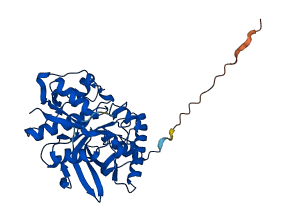
Descriptions
The autoinhibited protein was predicted that may have potential autoinhibitory elements via cis-regPred.
Autoinhibitory domains (AIDs)
Target domain |
|
Relief mechanism |
|
Assay |
cis-regPred |
Accessory elements
No accessory elements
Autoinhibited structure

Activated structure
1 structures for P49935
| Entry ID | Method | Resolution | Chain | Position | Source |
|---|---|---|---|---|---|
| AF-P49935-F1 | Predicted | AlphaFoldDB |
18 variants for P49935
| Variant ID(s) | Position | Change | Description | Diseaes Association | Provenance |
|---|---|---|---|---|---|
| rs3389029768 | 74 | K>* | No | EVA | |
| rs3389067028 | 92 | F>Y | No | EVA | |
| rs387884775 | 131 | K>I | No | EVA | |
| rs3389064556 | 167 | L>R | No | EVA | |
| rs3389063338 | 170 | C>S | No | EVA | |
| rs3389042952 | 173 | A>V | No | EVA | |
| rs3389063337 | 202 | S>R | No | EVA | |
| rs3389067004 | 204 | P>H | No | EVA | |
| rs246490440 | 206 | I>V | No | EVA | |
| rs235010083 | 210 | S>R | No | EVA | |
| rs223579089 | 211 | S>L | No | EVA | |
| rs262113750 | 211 | S>P | No | EVA | |
| rs256316848 | 213 | R>K | No | EVA | |
| rs3389050877 | 225 | N>S | No | EVA | |
| rs3389009115 | 235 | A>T | No | EVA | |
| rs3389063401 | 263 | G>C | No | EVA | |
| rs3389009145 | 300 | S>Y | No | EVA | |
| rs223648876 | 304 | Q>H | No | EVA |
No associated diseases with P49935
6 regional properties for P49935
| Type | Name | Position | InterPro Accession |
|---|---|---|---|
| active_site | Cysteine peptidase, cysteine active site | 133 - 144 | IPR000169 |
| domain | Peptidase C1A, papain C-terminal | 114 - 330 | IPR000668 |
| domain | Cathepsin propeptide inhibitor domain (I29) | 33 - 88 | IPR013201 |
| active_site | Cysteine peptidase, histidine active site | 277 - 287 | IPR025660 |
| active_site | Cysteine peptidase, asparagine active site | 294 - 313 | IPR025661 |
| domain | Papain-like cysteine endopeptidase | 115 - 329 | IPR039417 |
Functions
| Description | ||
|---|---|---|
| EC Number | 3.4.22.16 | Cysteine endopeptidases |
| Subcellular Localization |
|
|
| PANTHER Family | ||
| PANTHER Subfamily | ||
| PANTHER Protein Class | ||
| PANTHER Pathway Category | No pathway information available | |
9 GO annotations of cellular component
| Name | Definition |
|---|---|
| acrosomal vesicle | A structure in the head of a spermatozoon that contains acid hydrolases, and is concerned with the breakdown of the outer membrane of the ovum during fertilization. It lies just beneath the plasma membrane and is derived from the lysosome. |
| alveolar lamellar body | A specialized secretory organelle found in type II pneumocytes and involved in the synthesis, secretion, and reutilization of pulmonary surfactant. |
| axoneme | The bundle of microtubules and associated proteins that forms the core of cilia (also called flagella) in eukaryotic cells and is responsible for their movements. |
| cytoplasmic ribonucleoprotein granule | A ribonucleoprotein granule located in the cytoplasm. |
| cytosol | The part of the cytoplasm that does not contain organelles but which does contain other particulate matter, such as protein complexes. |
| extracellular space | That part of a multicellular organism outside the cells proper, usually taken to be outside the plasma membranes, and occupied by fluid. |
| intracellular membrane-bounded organelle | Organized structure of distinctive morphology and function, bounded by a single or double lipid bilayer membrane and occurring within the cell. Includes the nucleus, mitochondria, plastids, vacuoles, and vesicles. Excludes the plasma membrane. |
| lysosome | A small lytic vacuole that has cell cycle-independent morphology found in most animal cells and that contains a variety of hydrolases, most of which have their maximal activities in the pH range 5-6. The contained enzymes display latency if properly isolated. About 40 different lysosomal hydrolases are known and lysosomes have a great variety of morphologies and functions. |
| outer dense fiber | A supramolecular fiber found in the flagella of mammalian sperm that surrounds the nine microtubule doublets. These dense fibers are stiff and noncontractile. In human, they consist of about 10 major and at least 15 minor proteins, where all major proteins are ODF1, ODF2 or ODF2-related proteins. |
13 GO annotations of molecular function
| Name | Definition |
|---|---|
| aminopeptidase activity | Catalysis of the hydrolysis of a single N-terminal amino acid residue from a polypeptide chain. |
| cysteine-type endopeptidase activator activity involved in apoptotic process | Binds to and increases the rate of proteolysis catalyzed by a cysteine-type endopeptidase involved in the apoptotic process. |
| cysteine-type endopeptidase activity | Catalysis of the hydrolysis of internal, alpha-peptide bonds in a polypeptide chain by a mechanism in which the sulfhydryl group of a cysteine residue at the active center acts as a nucleophile. |
| cysteine-type peptidase activity | Catalysis of the hydrolysis of peptide bonds in a polypeptide chain by a mechanism in which the sulfhydryl group of a cysteine residue at the active center acts as a nucleophile. |
| endopeptidase activity | Catalysis of the hydrolysis of internal, alpha-peptide bonds in a polypeptide chain. |
| HLA-A specific activating MHC class I receptor activity | Combining with a MHC class I molecule of the HLA-A subclass to mediate signaling that activates a lymphocyte. |
| kininogen binding | Binding to a kininogen, a kinin precursor. |
| peptidase activator activity involved in apoptotic process | Binds to and increases the activity of a peptidase that is involved in the apoptotic process. |
| peptidase activity | Catalysis of the hydrolysis of a peptide bond. A peptide bond is a covalent bond formed when the carbon atom from the carboxyl group of one amino acid shares electrons with the nitrogen atom from the amino group of a second amino acid. |
| protein self-association | Binding to a domain within the same polypeptide. |
| protein-containing complex binding | Binding to a macromolecular complex. |
| serine-type endopeptidase activity | Catalysis of the hydrolysis of internal, alpha-peptide bonds in a polypeptide chain by a catalytic mechanism that involves a catalytic triad consisting of a serine nucleophile that is activated by a proton relay involving an acidic residue (e.g. aspartate or glutamate) and a basic residue (usually histidine). |
| thyroid hormone binding | Binding to thyroxine (T4) or triiodothyronine (T3), tyrosine-based hormones produced by the thyroid gland. |
23 GO annotations of biological process
| Name | Definition |
|---|---|
| bradykinin catabolic process | The chemical reactions and pathways resulting in the breakdown of the peptide bradykinin. |
| cellular response to thyroid hormone stimulus | A change in state or activity of a cell (in terms of movement, secretion, enzyme production, gene expression, etc.) as a result of a thyroid hormone stimulus. |
| dichotomous subdivision of terminal units involved in lung branching | The process in which a lung bud bifurcates. |
| ERK1 and ERK2 cascade | An intracellular protein kinase cascade containing at least ERK1 or ERK2 (MAPKs), a MEK (a MAPKK) and a MAP3K. The cascade may involve 4 different kinases, as it can also contain an additional tier: the upstream MAP4K. The kinases in each tier phosphorylate and activate the kinase in the downstream tier to transmit a signal within a cell. |
| immune response-regulating signaling pathway | The cascade of processes by which a signal interacts with a receptor, causing a change in the level or activity of a second messenger or other downstream target, and ultimately leading to the activation, perpetuation, or inhibition of an immune response. |
| membrane protein proteolysis | The proteolytic cleavage of a transmembrane protein leading to the release of its intracellular or ecto-domains. |
| metanephros development | The process whose specific outcome is the progression of the metanephros over time, from its formation to the mature structure. In mammals, the metanephros is the excretory organ of the fetus, which develops into the mature kidney and is formed from the rear portion of the nephrogenic cord. The metanephros is an endocrine and metabolic organ that filters the blood and excretes the end products of body metabolism in the form of urine. |
| negative regulation of apoptotic process | Any process that stops, prevents, or reduces the frequency, rate or extent of cell death by apoptotic process. |
| neuropeptide catabolic process | The chemical reactions and pathways resulting in the breakdown of neuropeptides. Neuropeptides are signaling peptides that travel across a synaptic junction. |
| positive regulation of angiogenesis | Any process that activates or increases angiogenesis. |
| positive regulation of apoptotic signaling pathway | Any process that activates or increases the frequency, rate or extent of apoptotic signaling pathway. |
| positive regulation of cell migration | Any process that activates or increases the frequency, rate or extent of cell migration. |
| positive regulation of cell population proliferation | Any process that activates or increases the rate or extent of cell proliferation. |
| positive regulation of epithelial cell migration | Any process that activates or increases the frequency, rate or extent of epithelial cell migration. |
| positive regulation of gene expression | Any process that increases the frequency, rate or extent of gene expression. Gene expression is the process in which a gene's coding sequence is converted into a mature gene product (protein or RNA). |
| positive regulation of peptidase activity | Any process that increases the frequency, rate or extent of peptidase activity, the hydrolysis of peptide bonds within proteins. |
| protein destabilization | Any process that decreases the stability of a protein, making it more vulnerable to degradative processes or aggregation. |
| proteolysis | The hydrolysis of proteins into smaller polypeptides and/or amino acids by cleavage of their peptide bonds. |
| proteolysis involved in protein catabolic process | The hydrolysis of a peptide bond or bonds within a protein as part of the chemical reactions and pathways resulting in the breakdown of a protein by individual cells. |
| response to retinoic acid | Any process that results in a change in state or activity of a cell or an organism (in terms of movement, secretion, enzyme production, gene expression, etc.) as a result of a retinoic acid stimulus. |
| surfactant homeostasis | Any process involved in the maintenance of a steady-state level of the surface-active lipoprotein mixture which coats the alveoli. |
| T cell mediated cytotoxicity | The directed killing of a target cell by a T cell through the release of granules containing cytotoxic mediators or through the engagement of death receptors. |
| zymogen activation | The proteolytic processing of an inactive enzyme to an active form. |
9 homologous proteins in AiPD
| UniProt AC | Gene Name | Protein Name | Species | Evidence Code |
|---|---|---|---|---|
| P09668 | CTSH | Pro-cathepsin H | Homo sapiens (Human) | PR |
| O70370 | Ctss | Cathepsin S | Mus musculus (Mouse) | PR |
| P56203 | Ctsw | Cathepsin W | Mus musculus (Mouse) | PR |
| Q8BM88 | Ctso | Cathepsin O | Mus musculus (Mouse) | PR |
| P00786 | Ctsh | Pro-cathepsin H | Rattus norvegicus (Rat) | PR |
| P22895 | P34 probable thiol protease | Glycine max (Soybean) (Glycine hispida) | PR | |
| O65493 | XCP1 | Cysteine protease XCP1 | Arabidopsis thaliana (Mouse-ear cress) | PR |
| Q94B08 | GCP1 | Germination-specific cysteine protease 1 | Arabidopsis thaliana (Mouse-ear cress) | PR |
| Q9LT77 | RDL2 | Probable cysteine protease RDL2 | Arabidopsis thaliana (Mouse-ear cress) | PR |
| 10 | 20 | 30 | 40 | 50 | 60 |
| MWAALPLLCA | GAWLLSTGAT | AELTVNAIEK | FHFKSWMKQH | QKTYSSVEYN | HRLQMFANNW |
| 70 | 80 | 90 | 100 | 110 | 120 |
| RKIQAHNQRN | HTFKMALNQF | SDMSFAEIKH | KFLWSEPQNC | SATKSNYLRG | TGPYPSSMDW |
| 130 | 140 | 150 | 160 | 170 | 180 |
| RKKGNVVSPV | KNQGACGSCW | TFSTTGALES | AVAIASGKML | SLAEQQLVDC | AQAFNNHGCK |
| 190 | 200 | 210 | 220 | 230 | 240 |
| GGLPSQAFEY | ILYNKGIMEE | DSYPYIGKDS | SCRFNPQKAV | AFVKNVVNIT | LNDEAAMVEA |
| 250 | 260 | 270 | 280 | 290 | 300 |
| VALYNPVSFA | FEVTEDFLMY | KSGVYSSKSC | HKTPDKVNHA | VLAVGYGEQN | GLLYWIVKNS |
| 310 | 320 | 330 | |||
| WGSQWGENGY | FLIERGKNMC | GLAACASYPI | PQV |