P22895
Gene name |
|
Protein name |
P34 probable thiol protease |
Names |
|
Species |
Glycine max (Soybean) (Glycine hispida) |
KEGG Pathway |
gmx:548062 |
EC number |
|
Protein Class |
|
Descriptions
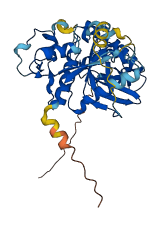
The autoinhibited protein was predicted that may have potential autoinhibitory elements via cis-regPred.
Autoinhibitory domains (AIDs)
Target domain |
|
Relief mechanism |
|
Assay |
cis-regPred |
Accessory elements
No accessory elements
Autoinhibited structure

Activated structure
1 structures for P22895
| Entry ID | Method | Resolution | Chain | Position | Source |
|---|---|---|---|---|---|
| AF-P22895-F1 | Predicted | AlphaFoldDB |
No variants for P22895
| Variant ID(s) | Position | Change | Description | Diseaes Association | Provenance |
|---|---|---|---|---|---|
| No variants for P22895 | |||||
No associated diseases with P22895
4 regional properties for P22895
| Type | Name | Position | InterPro Accession |
|---|---|---|---|
| domain | Peptidase C1A, papain C-terminal | 135 - 356 | IPR000668 |
| domain | Cathepsin propeptide inhibitor domain (I29) | 44 - 103 | IPR013201 |
| active_site | Cysteine peptidase, asparagine active site | 316 - 335 | IPR025661 |
| domain | Papain-like cysteine endopeptidase | 136 - 355 | IPR039417 |
2 GO annotations of cellular component
| Name | Definition |
|---|---|
| extracellular space | That part of a multicellular organism outside the cells proper, usually taken to be outside the plasma membranes, and occupied by fluid. |
| lysosome | A small lytic vacuole that has cell cycle-independent morphology found in most animal cells and that contains a variety of hydrolases, most of which have their maximal activities in the pH range 5-6. The contained enzymes display latency if properly isolated. About 40 different lysosomal hydrolases are known and lysosomes have a great variety of morphologies and functions. |
1 GO annotations of molecular function
| Name | Definition |
|---|---|
| cysteine-type endopeptidase activity | Catalysis of the hydrolysis of internal, alpha-peptide bonds in a polypeptide chain by a mechanism in which the sulfhydryl group of a cysteine residue at the active center acts as a nucleophile. |
1 GO annotations of biological process
| Name | Definition |
|---|---|
| proteolysis involved in protein catabolic process | The hydrolysis of a peptide bond or bonds within a protein as part of the chemical reactions and pathways resulting in the breakdown of a protein by individual cells. |
7 homologous proteins in AiPD
| UniProt AC | Gene Name | Protein Name | Species | Evidence Code |
|---|---|---|---|---|
| P09668 | CTSH | Pro-cathepsin H | Homo sapiens (Human) | PR |
| O70370 | Ctss | Cathepsin S | Mus musculus (Mouse) | PR |
| P49935 | Ctsh | Pro-cathepsin H | Mus musculus (Mouse) | PR |
| P00786 | Ctsh | Pro-cathepsin H | Rattus norvegicus (Rat) | PR |
| Q9LT77 | RDL2 | Probable cysteine protease RDL2 | Arabidopsis thaliana (Mouse-ear cress) | PR |
| O65493 | XCP1 | Cysteine protease XCP1 | Arabidopsis thaliana (Mouse-ear cress) | PR |
| Q94B08 | GCP1 | Germination-specific cysteine protease 1 | Arabidopsis thaliana (Mouse-ear cress) | PR |
| 10 | 20 | 30 | 40 | 50 | 60 |
| MGFLVLLLFS | LLGLSSSSSI | STHRSILDLD | LTKFTTQKQV | SSLFQLWKSE | HGRVYHNHEE |
| 70 | 80 | 90 | 100 | 110 | 120 |
| EAKRLEIFKN | NSNYIRDMNA | NRKSPHSHRL | GLNKFADITP | QEFSKKYLQA | PKDVSQQIKM |
| 130 | 140 | 150 | 160 | 170 | 180 |
| ANKKMKKEQY | SCDHPPASWD | WRKKGVITQV | KYQGGCGRGW | AFSATGAIEA | AHAIATGDLV |
| 190 | 200 | 210 | 220 | 230 | 240 |
| SLSEQELVDC | VEESEGSYNG | WQYQSFEWVL | EHGGIATDDD | YPYRAKEGRC | KANKIQDKVT |
| 250 | 260 | 270 | 280 | 290 | 300 |
| IDGYETLIMS | DESTESETEQ | AFLSAILEQP | ISVSIDAKDF | HLYTGGIYDG | ENCTSPYGIN |
| 310 | 320 | 330 | 340 | 350 | 360 |
| HFVLLVGYGS | ADGVDYWIAK | NSWGFDWGED | GYIWIQRNTG | NLLGVCGMNY | FASYPTKEES |
| 370 | |||||
| ETLVSARVKG | HRRVDHSPL |