Descriptions
The autoinhibited protein was predicted that may have potential autoinhibitory elements via cis-regPred.
Autoinhibitory domains (AIDs)
Target domain |
|
Relief mechanism |
|
Assay |
cis-regPred |
Accessory elements
No accessory elements
Autoinhibited structure

Activated structure
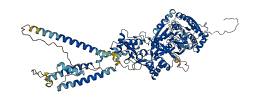
4 structures for P23819
| Entry ID | Method | Resolution | Chain | Position | Source |
|---|---|---|---|---|---|
| 7LDD | EM | 340 A | B/D | 1-883 | PDB |
| 7LDE | EM | 390 A | B/D | 1-883 | PDB |
| 7LEP | EM | 325 A | B/D | 417-840 | PDB |
| AF-P23819-F1 | Predicted | AlphaFoldDB |
1 variants for P23819
| Variant ID(s) | Position | Change | Description | Diseaes Association | Provenance |
|---|---|---|---|---|---|
| 607 | Q>R | RNA edited version [UniProt] | No |
No associated diseases with P23819
Functions
34 GO annotations of cellular component
| Name | Definition |
|---|---|
| AMPA glutamate receptor complex | An assembly of four or five subunits which form a structure with an extracellular N-terminus and a large loop that together form the ligand binding domain. The C-terminus is intracellular. The ionotropic glutamate receptor complex itself acts as a ligand gated ion channel; on binding glutamate, charged ions pass through a channel in the center of the receptor complex. The AMPA receptors mediate fast synaptic transmission in the CNS and are composed of subunits GluR1-4, products from separate genes. These subunits have an extracellular N-terminus and an intracellular C-terminus. |
| anchoring junction | A cell junction that mechanically attaches a cell (and its cytoskeleton) to neighboring cells or to the extracellular matrix. |
| asymmetric synapse | A type of synapse occurring between an axon and a dendritic spine or dendritic shaft. Asymmetric synapses, the most abundant synapse type in the central nervous system, involve axons that contain predominantly spherical vesicles and contain a thickened postsynaptic density. Most or all synapses of this type are excitatory. |
| cell surface | The external part of the cell wall and/or plasma membrane. |
| dendrite | A neuron projection that has a short, tapering, morphology. Dendrites receive and integrate signals from other neurons or from sensory stimuli, and conduct nerve impulses towards the axon or the cell body. In most neurons, the impulse is conveyed from dendrites to axon via the cell body, but in some types of unipolar neuron, the impulse does not travel via the cell body. |
| dendrite cytoplasm | All of the contents of a dendrite, excluding the surrounding plasma membrane. |
| dendritic shaft | Cylindric portion of the dendrite, directly stemming from the perikaryon, and carrying the dendritic spines. |
| dendritic spine | A small, membranous protrusion from a dendrite that forms a postsynaptic compartment, typically receiving input from a single presynapse. They function as partially isolated biochemical and an electrical compartments. Spine morphology is variable:they can be thin, stubby, mushroom, or branched, with a continuum of intermediate morphologies. They typically terminate in a bulb shape, linked to the dendritic shaft by a restriction. Spine remodeling is though to be involved in synaptic plasticity. |
| endoplasmic reticulum | The irregular network of unit membranes, visible only by electron microscopy, that occurs in the cytoplasm of many eukaryotic cells. The membranes form a complex meshwork of tubular channels, which are often expanded into slitlike cavities called cisternae. The ER takes two forms, rough (or granular), with ribosomes adhering to the outer surface, and smooth (with no ribosomes attached). |
| endoplasmic reticulum membrane | The lipid bilayer surrounding the endoplasmic reticulum. |
| glutamatergic synapse | A synapse that uses glutamate as a neurotransmitter. |
| growth cone | The migrating motile tip of a growing neuron projection, where actin accumulates, and the actin cytoskeleton is the most dynamic. |
| integral component of plasma membrane | The component of the plasma membrane consisting of the gene products and protein complexes having at least some part of their peptide sequence embedded in the hydrophobic region of the membrane. |
| integral component of postsynaptic density membrane | The component of the postsynaptic density membrane consisting of the gene products and protein complexes having at least some part of their peptide sequence embedded in the hydrophobic region of the membrane. |
| integral component of postsynaptic membrane | The component of the postsynaptic membrane consisting of the gene products and protein complexes having at least some part of their peptide sequence embedded in the hydrophobic region of the membrane. |
| integral component of presynaptic membrane | The component of the presynaptic membrane consisting of the gene products and protein complexes having at least some part of their peptide sequence embedded in the hydrophobic region of the membrane. |
| membrane | A lipid bilayer along with all the proteins and protein complexes embedded in it an attached to it. |
| neuron projection | A prolongation or process extending from a nerve cell, e.g. an axon or dendrite. |
| neuronal cell body | The portion of a neuron that includes the nucleus, but excludes cell projections such as axons and dendrites. |
| perikaryon | The portion of the cell soma (neuronal cell body) that excludes the nucleus. |
| perisynaptic space | The extracellular region immediately adjacent to to a synapse. |
| plasma membrane | The membrane surrounding a cell that separates the cell from its external environment. It consists of a phospholipid bilayer and associated proteins. |
| postsynaptic density | An electron dense network of proteins within and adjacent to the postsynaptic membrane of an asymmetric, neuron-neuron synapse. Its major components include neurotransmitter receptors and the proteins that spatially and functionally organize them such as anchoring and scaffolding molecules, signaling enzymes and cytoskeletal components. |
| postsynaptic density membrane | The membrane component of the postsynaptic density. This is the region of the postsynaptic membrane in which the population of neurotransmitter receptors involved in synaptic transmission are concentrated. |
| postsynaptic membrane | A specialized area of membrane facing the presynaptic membrane on the tip of the nerve ending and separated from it by a minute cleft (the synaptic cleft). Neurotransmitters cross the synaptic cleft and transmit the signal to the postsynaptic membrane. |
| presynaptic membrane | A specialized area of membrane of the axon terminal that faces the plasma membrane of the neuron or muscle fiber with which the axon terminal establishes a synaptic junction; many synaptic junctions exhibit structural presynaptic characteristics, such as conical, electron-dense internal protrusions, that distinguish it from the remainder of the axon plasma membrane. |
| protein-containing complex | A stable assembly of two or more macromolecules, i.e. proteins, nucleic acids, carbohydrates or lipids, in which at least one component is a protein and the constituent parts function together. |
| Schaffer collateral - CA1 synapse | A synapse between the Schaffer collateral axon of a CA3 pyramidal cell and a CA1 pyramidal cell. |
| somatodendritic compartment | The region of a neuron that includes the cell body (cell soma) and dendrite(s), but excludes the axon. |
| synapse | The junction between an axon of one neuron and a dendrite of another neuron, a muscle fiber or a glial cell. As the axon approaches the synapse it enlarges into a specialized structure, the presynaptic terminal bouton, which contains mitochondria and synaptic vesicles. At the tip of the terminal bouton is the presynaptic membrane; facing it, and separated from it by a minute cleft (the synaptic cleft) is a specialized area of membrane on the receiving cell, known as the postsynaptic membrane. In response to the arrival of nerve impulses, the presynaptic terminal bouton secretes molecules of neurotransmitters into the synaptic cleft. These diffuse across the cleft and transmit the signal to the postsynaptic membrane. |
| synaptic membrane | A specialized area of membrane on either the presynaptic or the postsynaptic side of a synapse, the junction between a nerve fiber of one neuron and another neuron or muscle fiber or glial cell. |
| synaptic vesicle | A secretory organelle, typically 50 nm in diameter, of presynaptic nerve terminals; accumulates in high concentrations of neurotransmitters and secretes these into the synaptic cleft by fusion with the 'active zone' of the presynaptic plasma membrane. |
| synaptic vesicle membrane | The lipid bilayer surrounding a synaptic vesicle. |
| terminal bouton | Terminal inflated portion of the axon, containing the specialized apparatus necessary to release neurotransmitters. The axon terminus is considered to be the whole region of thickening and the terminal bouton is a specialized region of it. |
16 GO annotations of molecular function
| Name | Definition |
|---|---|
| AMPA glutamate receptor activity | An ionotropic glutamate receptor activity that exhibits fast gating by glutamate and acts by opening a cation channel permeable to sodium, potassium, and, in the absence of a GluR2 subunit, calcium. |
| amyloid-beta binding | Binding to an amyloid-beta peptide/protein. |
| ATPase binding | Binding to an ATPase, any enzyme that catalyzes the hydrolysis of ATP. |
| cytoskeletal protein binding | Binding to a protein component of a cytoskeleton (actin, microtubule, or intermediate filament cytoskeleton). |
| extracellularly glutamate-gated ion channel activity | Enables the transmembrane transfer of an ion by a channel that opens when glutamate is bound by the channel complex or one of its constituent parts on the extracellular side of the plasma membrane. |
| glutamate receptor binding | Binding to a glutamate receptor. |
| identical protein binding | Binding to an identical protein or proteins. |
| immunoglobulin binding | Binding to an immunoglobulin. |
| ionotropic glutamate receptor activity | Catalysis of the transmembrane transfer of an ion by a channel that opens when glutamate has been bound by the channel complex or one of its constituent parts. |
| kainate selective glutamate receptor activity | An ionotropic glutamate receptor activity that exhibits fast gating by glutamate, acts by opening a cation channel permeable to sodium and potassium, and for which kainate is an agonist. |
| ligand-gated ion channel activity | Enables the transmembrane transfer of an ion by a channel that opens when a specific ligand has been bound by the channel complex or one of its constituent parts. |
| PDZ domain binding | Binding to a PDZ domain of a protein, a domain found in diverse signaling proteins. |
| protein kinase binding | Binding to a protein kinase, any enzyme that catalyzes the transfer of a phosphate group, usually from ATP, to a protein substrate. |
| signaling receptor activity | Receiving a signal and transmitting it in the cell to initiate a change in cell activity. A signal is a physical entity or change in state that is used to transfer information in order to trigger a response. |
| SNARE binding | Binding to a SNARE (soluble N-ethylmaleimide-sensitive factor attached protein receptor) protein. |
| transmitter-gated ion channel activity involved in regulation of postsynaptic membrane potential | Any transmitter-gated ion channel activity that is involved in regulation of postsynaptic membrane potential. |
8 GO annotations of biological process
| Name | Definition |
|---|---|
| chemical synaptic transmission | The vesicular release of classical neurotransmitter molecules from a presynapse, across a chemical synapse, the subsequent activation of neurotransmitter receptors at the postsynapse of a target cell (neuron, muscle, or secretory cell) and the effects of this activation on the postsynaptic membrane potential and ionic composition of the postsynaptic cytosol. This process encompasses both spontaneous and evoked release of neurotransmitter and all parts of synaptic vesicle exocytosis. Evoked transmission starts with the arrival of an action potential at the presynapse. |
| establishment of protein localization | The directed movement of a protein to a specific location. |
| ionotropic glutamate receptor signaling pathway | The series of molecular signals initiated by glutamate binding to a glutamate receptor on the surface of the target cell, followed by the movement of ions through a channel in the receptor complex, and ending with the regulation of a downstream cellular process, e.g. transcription. |
| positive regulation of synaptic transmission | Any process that activates or increases the frequency, rate or extent of synaptic transmission, the process of communication from a neuron to a target (neuron, muscle, or secretory cell) across a synapse. |
| protein tetramerization | The formation of a protein tetramer, a macromolecular structure consisting of four noncovalently associated identical or nonidentical subunits. |
| receptor internalization | A receptor-mediated endocytosis process that results in the movement of receptors from the plasma membrane to the inside of the cell. The process begins when cell surface receptors are monoubiquitinated following ligand-induced activation. Receptors are subsequently taken up into endocytic vesicles from where they are either targeted to the lysosome or vacuole for degradation or recycled back to the plasma membrane. |
| regulation of receptor recycling | Any process that modulates the frequency, rate, or extent of receptor recycling. |
| regulation of synaptic transmission, glutamatergic | Any process that modulates the frequency, rate or extent of glutamatergic synaptic transmission, the process of communication from a neuron to another neuron across a synapse using the neurotransmitter glutamate. |
10 homologous proteins in AiPD
| UniProt AC | Gene Name | Protein Name | Species | Evidence Code |
|---|---|---|---|---|
| Q91ZU9 | Grin3b | Glutamate receptor ionotropic, NMDA 3B | Mus musculus (Mouse) | PR |
| P19491 | Gria2 | Glutamate receptor 2 | Rattus norvegicus (Rat) | PR |
| Q9SHV1 | GLR2.2 | Glutamate receptor 2.2 | Arabidopsis thaliana (Mouse-ear cress) | PR |
| Q9SHV2 | GLR2.3 | Glutamate receptor 2.3 | Arabidopsis thaliana (Mouse-ear cress) | PR |
| O81776 | GLR2.4 | Glutamate receptor 2.4 | Arabidopsis thaliana (Mouse-ear cress) | PR |
| O04660 | GLR2.1 | Glutamate receptor 2.1 | Arabidopsis thaliana (Mouse-ear cress) | PR |
| O81078 | GLR2.9 | Glutamate receptor 2.9 | Arabidopsis thaliana (Mouse-ear cress) | PR |
| Q9SDQ4 | GLR3.7 | Glutamate receptor 3.7 | Arabidopsis thaliana (Mouse-ear cress) | PR |
| Q84W41 | GLR3.6 | Glutamate receptor 3.6 | Arabidopsis thaliana (Mouse-ear cress) | PR |
| Q9C8E7 | GLR3.3 | Glutamate receptor 3.3 | Arabidopsis thaliana (Mouse-ear cress) | PR |
| 10 | 20 | 30 | 40 | 50 | 60 |
| MQKIMHISVL | LSPVLWGLIF | GVSSNSIQIG | GLFPRGADQE | YSAFRVGMVQ | FSTSEFRLTP |
| 70 | 80 | 90 | 100 | 110 | 120 |
| HIDNLEVANS | FAVTNAFCSQ | FSRGVYAIFG | FYDKKSVNTI | TSFCGTLHVS | FITPSFPTDG |
| 130 | 140 | 150 | 160 | 170 | 180 |
| THPFVIQMRP | DLKGALLSLI | EYYQWDKFAY | LYDSDRGLST | LQAVLDSAAE | KKWQVTAINV |
| 190 | 200 | 210 | 220 | 230 | 240 |
| GNINNDKKDE | TYRSLFQDLE | LKKERRVILD | CERDKVNDIV | DQVITIGKHV | KGYHYIIANL |
| 250 | 260 | 270 | 280 | 290 | 300 |
| GFTDGDLLKI | QFGGANVSGF | QIVDYDDSLV | SKFIERWSTL | EEKEYPGAHT | ATIKYTSALT |
| 310 | 320 | 330 | 340 | 350 | 360 |
| YDAVQVMTEA | FRNLRKQRIE | ISRRGNAGDC | LANPAVPWGQ | GVEIERALKQ | VQVEGLSGNI |
| 370 | 380 | 390 | 400 | 410 | 420 |
| KFDQNGKRIN | YTINIMELKT | NGPRKIGYWS | EVDKMVVTLT | ELPSGNDTSG | LENKTVVVTT |
| 430 | 440 | 450 | 460 | 470 | 480 |
| ILESPYVMMK | KNHEMLEGNE | RYEGYCVDLA | AEIAKHCGFK | YKLTIVGDGK | YGARDADTKI |
| 490 | 500 | 510 | 520 | 530 | 540 |
| WNGMVGELVY | GKADIAIAPL | TITLVREEVI | DFSKPFMSLG | ISIMIKKPQK | SKPGVFSFLD |
| 550 | 560 | 570 | 580 | 590 | 600 |
| PLAYEIWMCI | VFAYIGVSVV | LFLVSRFSPY | EWHTEEFEDG | RETQSSESTN | EFGIFNSLWF |
| 610 | 620 | 630 | 640 | 650 | 660 |
| SLGAFMQQGC | DISPRSLSGR | IVGGVWWFFT | LIIISSYTAN | LAAFLTVERM | VSPIESAEDL |
| 670 | 680 | 690 | 700 | 710 | 720 |
| SKQTEIAYGT | LDSGSTKEFF | RRSKIAVFDK | MWTYMRSAEP | SVFVRTTAEG | VARVRKSKGK |
| 730 | 740 | 750 | 760 | 770 | 780 |
| YAYLLESTMN | EYIEQRKPCD | TMKVGGNLDS | KGYGIATPKG | SSLGNAVNLA | VLKLNEQGLL |
| 790 | 800 | 810 | 820 | 830 | 840 |
| DKLKNKWWYD | KGECGSGGGD | SKEKTSALSL | SNVAGVFYIL | VGGLGLAMLV | ALIEFCYKSR |
| 850 | 860 | 870 | 880 | ||
| AEAKRMKVAK | NAQNINPSSS | QNSQNFATYK | EGYNVYGIES | VKI |