P21447
Gene name |
Abcb1a |
Protein name |
ATP-dependent translocase ABCB1 |
Names |
ATP-binding cassette sub-family B member 1A, MDR1A, Multidrug resistance protein 1A, Multidrug resistance protein 3, P-glycoprotein 3, Phospholipid transporter ABCB1 |
Species |
Mus musculus (Mouse) |
KEGG Pathway |
mmu:18671 |
EC number |
7.6.2.1: Linked to the hydrolysis of a nucleoside triphosphate |
Protein Class |
|
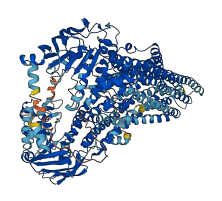
Descriptions
The autoinhibited protein was predicted that may have potential autoinhibitory elements via cis-regPred.
Autoinhibitory domains (AIDs)
Target domain |
|
Relief mechanism |
|
Assay |
cis-regPred |
Accessory elements
No accessory elements
Autoinhibited structure

Activated structure
41 structures for P21447
| Entry ID | Method | Resolution | Chain | Position | Source |
|---|---|---|---|---|---|
| 3G5U | X-ray | 380 A | A/B | 1-1276 | PDB |
| 3G60 | X-ray | 440 A | A/B | 1-1276 | PDB |
| 3G61 | X-ray | 435 A | A/B | 1-1276 | PDB |
| 4KSB | X-ray | 380 A | A | 1-1276 | PDB |
| 4KSC | X-ray | 400 A | A | 1-1276 | PDB |
| 4KSD | X-ray | 410 A | A | 1-1276 | PDB |
| 4LSG | X-ray | 380 A | A/B | 1-1276 | PDB |
| 4M1M | X-ray | 380 A | A/B | 1-1276 | PDB |
| 4M2S | X-ray | 440 A | A/B | 1-1276 | PDB |
| 4M2T | X-ray | 435 A | A/B | 1-1276 | PDB |
| 4Q9H | X-ray | 340 A | A | 1-1276 | PDB |
| 4Q9I | X-ray | 378 A | A | 1-1276 | PDB |
| 4Q9J | X-ray | 360 A | A | 1-1276 | PDB |
| 4Q9K | X-ray | 380 A | A | 1-1276 | PDB |
| 4Q9L | X-ray | 380 A | A | 1-1276 | PDB |
| 4XWK | X-ray | 350 A | A | 1-1276 | PDB |
| 5KO2 | X-ray | 330 A | A/B | 1-1276 | PDB |
| 5KOY | X-ray | 385 A | A/B | 1-1276 | PDB |
| 5KPD | X-ray | 335 A | A/B | 1-1276 | PDB |
| 5KPI | X-ray | 401 A | A/B | 1-1276 | PDB |
| 5KPJ | X-ray | 350 A | A | 1-1276 | PDB |
| 6GDI | EM | 790 A | A | 1-1276 | PDB |
| 6Q81 | EM | 790 A | A | 1-1276 | PDB |
| 6UJN | X-ray | 398 A | A | 1-1276 | PDB |
| 6UJP | X-ray | 398 A | A | 1-1276 | PDB |
| 6UJR | X-ray | 410 A | A | 1-1276 | PDB |
| 6UJS | X-ray | 417 A | A | 1-1276 | PDB |
| 6UJT | X-ray | 417 A | A | 1-1276 | PDB |
| 6UJW | X-ray | 415 A | A | 1-1276 | PDB |
| 7OTG | EM | 540 A | A | 1-1276 | PDB |
| 7OTI | EM | 420 A | A | 1-1276 | PDB |
| 7ZK4 | EM | 260 A | A | 1-1276 | PDB |
| 7ZK5 | EM | 260 A | A | 1-1276 | PDB |
| 7ZK6 | EM | 310 A | A | 1-1276 | PDB |
| 7ZK7 | EM | 320 A | A | 1-1276 | PDB |
| 7ZK8 | EM | 300 A | A | 1-1271 | PDB |
| 7ZK9 | EM | 430 A | A | 1-1260 | PDB |
| 7ZKA | EM | 290 A | A | 1-1276 | PDB |
| 7ZKB | EM | 470 A | A | 1-1276 | PDB |
| 8AVY | EM | 290 A | A | 1-1276 | PDB |
| AF-P21447-F1 | Predicted | AlphaFoldDB |
51 variants for P21447
| Variant ID(s) | Position | Change | Description | Diseaes Association | Provenance |
|---|---|---|---|---|---|
| rs3411747078 | 16 | S>P | No | EVA | |
| rs3388728908 | 58 | I>L | No | EVA | |
| rs3388736122 | 73 | D>V | No | EVA | |
| rs3388748966 | 88 | S>G | No | EVA | |
| rs31417886 | 88 | S>N | No | EVA | |
| rs244105348 | 91 | M>I | No | EVA | |
| rs217202515 | 95 | D>N | No | EVA | |
| rs31419904 | 131 | F>L | No | EVA | |
| rs3388743361 | 155 | E>V | No | EVA | |
| rs3388746714 | 165 | G>R | No | EVA | |
| rs3388743009 | 177 | K>I | No | EVA | |
| rs3388743367 | 195 | T>A | No | EVA | |
| rs3388739351 | 226 | G>D | No | EVA | |
| rs240310159 | 363 | K>N | No | EVA | |
| rs254265652 | 444 | D>E | No | EVA | |
| rs265821827 | 446 | M>V | No | EVA | |
| rs864273043 | 505 | A>P | No | EVA | |
| rs864303343 | 529 | G>R | No | EVA | |
| rs3388743414 | 561 | S>R | No | EVA | |
| rs3388740913 | 604 | E>* | No | EVA | |
| rs228638731 | 609 | D>E | No | EVA | |
| rs3388728920 | 614 | E>D | No | EVA | |
| rs3388749022 | 739 | G>D | No | EVA | |
| rs262661371 | 740 | P>S | No | EVA | |
| rs1134323936 | 754 | L>V | No | EVA | |
| rs1134894857 | 755 | F>Y | No | EVA | |
| rs229978426 | 757 | I>V | No | EVA | |
| rs222494891 | 789 | F>L | No | EVA | |
| rs3395246473 | 791 | S>T | No | EVA | |
| rs3388743420 | 827 | S>Y | No | EVA | |
| rs3388746786 | 832 | I>F | No | EVA | |
| rs3388746750 | 882 | D>E | No | EVA | |
| rs3388746739 | 895 | E>G | No | EVA | |
| rs3388743387 | 912 | F>L | No | EVA | |
| rs238566954 | 927 | A>S | No | EVA | |
| rs256545593 | 961 | T>A | No | EVA | |
| rs230481900 | 998 | T>K | No | EVA | |
| rs3388736152 | 1007 | I>T | No | EVA | |
| rs260713322 | 1011 | T>I | No | EVA | |
| rs3388739355 | 1018 | S>R | No | EVA | |
| rs3388739365 | 1021 | G>A | No | EVA | |
| rs3388733055 | 1036 | V>D | No | EVA | |
| rs232731033 | 1037 | V>M | No | EVA | |
| rs251200996 | 1045 | S>N | No | EVA | |
| rs3388735770 | 1092 | L>P | No | EVA | |
| rs31418766 | 1108 | Q>H | No | EVA | |
| rs3388743371 | 1133 | S>R | No | EVA | |
| rs3388733036 | 1143 | R>G | No | EVA | |
| rs3388739466 | 1230 | L>M | No | EVA | |
| rs3388740932 | 1247 | V>I | No | EVA | |
| rs215635890 | 1271 | A>T | No | EVA |
No associated diseases with P21447
8 regional properties for P21447
| Type | Name | Position | InterPro Accession |
|---|---|---|---|
| domain | ABC transporter-like, ATP-binding domain | 388 - 624 | IPR003439-1 |
| domain | ABC transporter-like, ATP-binding domain | 1031 - 1269 | IPR003439-2 |
| domain | AAA+ ATPase domain | 415 - 607 | IPR003593-1 |
| domain | AAA+ ATPase domain | 1058 - 1246 | IPR003593-2 |
| domain | ABC transporter type 1, transmembrane domain | 50 - 353 | IPR011527-1 |
| domain | ABC transporter type 1, transmembrane domain | 708 - 996 | IPR011527-2 |
| conserved_site | ABC transporter-like, conserved site | 527 - 541 | IPR017871-1 |
| conserved_site | ABC transporter-like, conserved site | 1172 - 1186 | IPR017871-2 |
Functions
| Description | ||
|---|---|---|
| EC Number | 7.6.2.1 | Linked to the hydrolysis of a nucleoside triphosphate |
| Subcellular Localization |
|
|
| PANTHER Family | ||
| PANTHER Subfamily | ||
| PANTHER Protein Class | ||
| PANTHER Pathway Category | No pathway information available | |
8 GO annotations of cellular component
| Name | Definition |
|---|---|
| apical plasma membrane | The region of the plasma membrane located at the apical end of the cell. |
| brush border membrane | The portion of the plasma membrane surrounding the brush border. |
| cell surface | The external part of the cell wall and/or plasma membrane. |
| integral component of membrane | The component of a membrane consisting of the gene products and protein complexes having at least some part of their peptide sequence embedded in the hydrophobic region of the membrane. |
| intercellular canaliculus | An extremely narrow tubular channel located between adjacent cells. An instance of this is the secretory canaliculi occurring between adjacent parietal cells in the gastric mucosa of vertebrates. |
| membrane | A lipid bilayer along with all the proteins and protein complexes embedded in it an attached to it. |
| nucleoplasm | That part of the nuclear content other than the chromosomes or the nucleolus. |
| plasma membrane | The membrane surrounding a cell that separates the cell from its external environment. It consists of a phospholipid bilayer and associated proteins. |
13 GO annotations of molecular function
| Name | Definition |
|---|---|
| ABC-type xenobiotic transporter activity | Catalysis of the reaction: ATP + H2O + xenobiotic(in) = ADP + phosphate + xenobiotic(out). |
| ATP binding | Binding to ATP, adenosine 5'-triphosphate, a universally important coenzyme and enzyme regulator. |
| ATP hydrolysis activity | Catalysis of the reaction: ATP + H2O = ADP + H+ phosphate. ATP hydrolysis is used in some reactions as an energy source, for example to catalyze a reaction or drive transport against a concentration gradient. |
| ATPase-coupled transmembrane transporter activity | Primary active transporter of a solute across a membrane, via the reaction: ATP + H2O = ADP + phosphate, to directly drive the transport of a substance across a membrane. The transport protein may be transiently phosphorylated (P-type transporters), or not (ABC-type transporters and other families of transporters). Primary active transport occurs up the solute's concentration gradient and is driven by a primary energy source. |
| carboxylic acid transmembrane transporter activity | Enables the transfer of carboxylic acids from one side of a membrane to the other. Carboxylic acids are organic acids containing one or more carboxyl (COOH) groups or anions (COO-). |
| ceramide floppase activity | Catalysis of the movement of ceramide from the cytosolic to the exoplasmic leaftlet of a membrane, using energy from the hydrolysis of ATP. |
| efflux transmembrane transporter activity | Enables the transfer of a specific substance or related group of substances from the inside of the cell to the outside of the cell across a membrane. |
| floppase activity | Catalysis of the movement of a lipid from the cytosolic to the exoplasmic leaftlet of a membrane, using energy from the hydrolysis of ATP. |
| phosphatidylcholine floppase activity | Catalysis of the movement of phosphatidylcholine from the cytosolic to the exoplasmic leaftlet of a membrane, using energy from the hydrolysis of ATP. |
| phosphatidylethanolamine flippase activity | Catalysis of the movement of phosphatidylethanolamine from the exoplasmic to the cytosolic leaftlet of a membrane, using energy from the hydrolysis of ATP. |
| transmembrane transporter activity | Enables the transfer of a substance, usually a specific substance or a group of related substances, from one side of a membrane to the other. |
| ubiquitin protein ligase binding | Binding to a ubiquitin protein ligase enzyme, any of the E3 proteins. |
| xenobiotic transmembrane transporter activity | Enables the directed movement of a xenobiotic from one side of a membrane to the other. A xenobiotic is a compound foreign to the organim exposed to it. It may be synthesized by another organism (like ampicilin) or it can be a synthetic chemical. |
52 GO annotations of biological process
| Name | Definition |
|---|---|
| brain development | The process whose specific outcome is the progression of the brain over time, from its formation to the mature structure. Brain development begins with patterning events in the neural tube and ends with the mature structure that is the center of thought and emotion. The brain is responsible for the coordination and control of bodily activities and the interpretation of information from the senses (sight, hearing, smell, etc.). |
| carboxylic acid transmembrane transport | The process in which carboxylic acid is transported across a membrane. |
| cellular hyperosmotic salinity response | Any process that results in a change in state or activity of a cell (in terms of movement, secretion, enzyme production, gene expression, etc.) as a result of detection of, or exposure to, an increase in the concentration of salt (particularly but not exclusively sodium and chloride ions) in the environment. |
| cellular response to alkaloid | Any process that results in a change in state or activity of a cell (in terms of movement, secretion, enzyme production, gene expression, etc.) as a result of an alkaloid stimulus. Alkaloids are a large group of nitrogenous substances found in naturally in plants, many of which have extracts that are pharmacologically active. |
| cellular response to antibiotic | Any process that results in a change in state or activity of a cell (in terms of movement, secretion, enzyme production, gene expression, etc.) as a result of an antibiotic stimulus. An antibiotic is a chemical substance produced by a microorganism which has the capacity to inhibit the growth of or to kill other microorganisms. |
| cellular response to borneol | Any process that results in a change in state or activity of a cell (in terms of movement, secretion, enzyme production, gene expression, etc.) as a result of a borneol stimulus. |
| cellular response to dexamethasone stimulus | Any process that results in a change in state or activity of a cell (in terms of movement, secretion, enzyme production, gene expression, etc.) as a result of a dexamethasone stimulus. |
| cellular response to estradiol stimulus | Any process that results in a change in state or activity of a cell (in terms of movement, secretion, enzyme production, gene expression, etc.) as a result of stimulus by estradiol, a C18 steroid hormone hydroxylated at C3 and C17 that acts as a potent estrogen. |
| cellular response to external biotic stimulus | Any process that results in a change in state or activity of a cell (in terms of movement, secretion, enzyme production, gene expression, etc.) as a result of an external biotic stimulus, an external stimulus caused by, or produced by living things. |
| cellular response to L-glutamate | Any process that results in a change in state or activity of a cell (in terms of movement, secretion, enzyme production, gene expression, etc.) as a result of a L-glutamate(1-) stimulus. |
| cellular response to lipopolysaccharide | Any process that results in a change in state or activity of a cell (in terms of movement, secretion, enzyme production, gene expression, etc.) as a result of a lipopolysaccharide stimulus; lipopolysaccharide is a major component of the cell wall of gram-negative bacteria. |
| cellular response to mycotoxin | Any process that results in a change in state or activity of a cell (in terms of movement, secretion, enzyme production, gene expression, etc.) as a result of a mycotoxin stimulus. A mycotoxin is a toxic chemical substance produced by fungi. |
| cellular response to tumor necrosis factor | Any process that results in a change in state or activity of a cell (in terms of movement, secretion, enzyme production, gene expression, etc.) as a result of a tumor necrosis factor stimulus. |
| ceramide translocation | The movement of a ceramide molecule from one leaflet of a membrane bilayer to the opposite leaflet. |
| circadian rhythm | Any biological process in an organism that recurs with a regularity of approximately 24 hours. |
| daunorubicin transport | The directed movement of daunorubicin, an anthracycline antibiotic produced by Streptomyces coeruleorubidus or S. peucetius and used as an antineoplastic into, out of or within a cell, or between cells, by means of some agent such as a transporter or pore. |
| establishment of blood-brain barrier | Establishment of the barrier between the blood and the brain. The cells in the brain are packed tightly together preventing the passage of most molecules from the blood into the brain. Only lipid soluble molecules or those that are actively transported can pass through the blood-brain barrier. |
| establishment of blood-retinal barrier | Establishment of the barrier between the blood and the retina. The blood-retinal barrier is located at two levels, forming an outer barrier in the retinal pigment epithelium and an inner barrier in the endothelial membrane of the retinal vessels. Both these membranes have tight junctions of the 'nonleaky' type. |
| export across plasma membrane | The directed movement of some substance from inside of a cell, across the plasma membrane and into the extracellular region. |
| G2/M transition of mitotic cell cycle | The mitotic cell cycle transition by which a cell in G2 commits to M phase. The process begins when the kinase activity of M cyclin/CDK complex reaches a threshold high enough for the cell cycle to proceed. This is accomplished by activating a positive feedback loop that results in the accumulation of unphosphorylated and active M cyclin/CDK complex. |
| hormone transport | The directed movement of hormones into, out of or within a cell, or between cells, by means of some agent such as a transporter or pore. |
| intestinal absorption | Any process in which nutrients are taken up from the contents of the intestine. |
| lactation | The regulated release of milk from the mammary glands and the period of time that a mother lactates to feed her young. |
| maintenance of blood-brain barrier | Maintaining the structure and function of the blood-brain barrier, thus ensuring specific regulated transport of substances (e.g. macromolecules, small molecules, ions) into the brain, and out of the brain into the blood circulation. |
| negative regulation of cell death | Any process that decreases the rate or frequency of cell death. Cell death is the specific activation or halting of processes within a cell so that its vital functions markedly cease, rather than simply deteriorating gradually over time, which culminates in cell death. |
| phospholipid translocation | The movement of a phospholipid molecule from one leaflet of a membrane bilayer to the opposite leaflet. |
| placenta development | The process whose specific outcome is the progression of the placenta over time, from its formation to the mature structure. The placenta is an organ of metabolic interchange between fetus and mother, partly of embryonic origin and partly of maternal origin. |
| positive regulation of anion channel activity | Any process that activates or increases the frequency, rate or extent of anion channel activity. |
| positive regulation of establishment of Sertoli cell barrier | Any process that activates or increases the frequency, rate or extent of establishment of Sertoli cell barrier. |
| positive regulation of response to drug | Any process that activates or increases the frequency, rate or extent of response to drug. |
| protein localization to bicellular tight junction | A process in which a protein is transported to, or maintained in, a location within a bicellular tight junction. |
| regulation of chloride transport | Any process that modulates the frequency, rate or extent of chloride transport. |
| regulation of intestinal absorption | Any process that modulates the frequency, rate or extent of intestinal absorption. |
| regulation of response to osmotic stress | Any process that modulates the rate or extent of the response to osmotic stress. |
| response to antineoplastic agent | Any process that results in a change in state or activity of a cell or an organism (in terms of movement, secretion, enzyme production, gene expression, etc.) as a result of an antineoplastic agent stimulus. An antineoplastic agent is a substance that inhibits or prevents the proliferation of neoplasms. |
| response to cadmium ion | Any process that results in a change in state or activity of a cell or an organism (in terms of movement, secretion, enzyme production, gene expression, etc.) as a result of a cadmium (Cd) ion stimulus. |
| response to codeine | Any process that results in a change in state or activity of a cell or an organism (in terms of movement, secretion, enzyme production, gene expression, etc.) as a result of a codeine stimulus. |
| response to cyclosporin A | Any process that results in a change in state or activity of a cell or an organism (in terms of movement, secretion, enzyme production, gene expression, etc.) as a result of a cyclosporin A stimulus. |
| response to glucagon | Any process that results in a change in state or activity of a cell or an organism (in terms of movement, secretion, enzyme production, gene expression, etc.) as a result of a glucagon stimulus. |
| response to glycoside | Any process that results in a change in state or activity of a cell or an organism (in terms of movement, secretion, enzyme production, gene expression, etc.) as a result of a glycoside stimulus. |
| response to hypoxia | Any process that results in a change in state or activity of a cell or an organism (in terms of movement, secretion, enzyme production, gene expression, etc.) as a result of a stimulus indicating lowered oxygen tension. Hypoxia, defined as a decline in O2 levels below normoxic levels of 20.8 - 20.95%, results in metabolic adaptation at both the cellular and organismal level. |
| response to morphine | Any process that results in a change in state or activity of a cell or an organism (in terms of movement, secretion, enzyme production, gene expression, etc.) as a result of a morphine stimulus. Morphine is an opioid alkaloid, isolated from opium, with a complex ring structure. |
| response to quercetin | Any process that results in a change in state or activity of a cell or an organism (in terms of movement, secretion, enzyme production, gene expression, etc.) as a result of a quercetin stimulus. |
| response to thyroxine | A change in state or activity of a cell or an organism (in terms of movement, secretion, enzyme production, gene expression, etc.) as a result of a thyroxine stimulus. |
| response to vitamin A | Any process that results in a change in state or activity of a cell or an organism (in terms of movement, secretion, enzyme production, gene expression, etc.) as a result of a vitamin A stimulus. |
| response to vitamin D | Any process that results in a change in state or activity of a cell or an organism (in terms of movement, secretion, enzyme production, gene expression, etc.) as a result of a vitamin D stimulus. |
| response to xenobiotic stimulus | Any process that results in a change in state or activity of a cell or an organism (in terms of movement, secretion, enzyme production, gene expression, etc.) as a result of a stimulus from a xenobiotic, a compound foreign to the organim exposed to it. It may be synthesized by another organism (like ampicilin) or it can be a synthetic chemical. |
| stem cell proliferation | The multiplication or reproduction of stem cells, resulting in the expansion of a stem cell population. A stem cell is a cell that retains the ability to divide and proliferate throughout life to provide progenitor cells that can differentiate into specialized cells. |
| terpenoid transport | The directed movement of terpenoids into, out of or within a cell, or between cells, by means of some agent such as a transporter or pore. Terpenoids are a class of compounds characterized by an isoprenoid chemical structure and include derivatives with various functional groups. |
| transepithelial transport | The directed movement of a substance from one side of an epithelium to the other. |
| xenobiotic detoxification by transmembrane export across the plasma membrane | A process that reduces or removes the toxicity of a xenobiotic by exporting it outside the cell. |
| xenobiotic transport across blood-brain barrier | The directed movement of a xenobiotic through the blood-brain barrier. |
10 homologous proteins in AiPD
| UniProt AC | Gene Name | Protein Name | Species | Evidence Code |
|---|---|---|---|---|
| O95342 | ABCB11 | Bile salt export pump | Homo sapiens (Human) | PR |
| P08183 | ABCB1 | ATP-dependent translocase ABCB1 | Homo sapiens (Human) | PR |
| P06795 | Abcb1b | ATP-dependent translocase ABCB1 | Mus musculus (Mouse) | PR |
| P21440 | Abcb4 | Phosphatidylcholine translocator ABCB4 | Mus musculus (Mouse) | PR |
| Q9QY30 | Abcb11 | Bile salt export pump | Mus musculus (Mouse) | PR |
| Q9DC29 | Abcb6 | ATP-binding cassette sub-family B member 6 | Mus musculus (Mouse) | PR |
| O70127 | Abcb11 | Bile salt export pump | Rattus norvegicus (Rat) | PR |
| Q8H1R4 | ABCI10 | ABC transporter I family member 10 | Arabidopsis thaliana (Mouse-ear cress) | PR |
| Q9LJX0 | ABCB19 | ABC transporter B family member 19 | Arabidopsis thaliana (Mouse-ear cress) | PR |
| Q9ZR72 | ABCB1 | ABC transporter B family member 1 | Arabidopsis thaliana (Mouse-ear cress) | PR |
| 10 | 20 | 30 | 40 | 50 | 60 |
| MELEEDLKGR | ADKNFSKMGK | KSKKEKKEKK | PAVSVLTMFR | YAGWLDRLYM | LVGTLAAIIH |
| 70 | 80 | 90 | 100 | 110 | 120 |
| GVALPLMMLI | FGDMTDSFAS | VGNVSKNSTN | MSEADKRAMF | AKLEEEMTTY | AYYYTGIGAG |
| 130 | 140 | 150 | 160 | 170 | 180 |
| VLIVAYIQVS | FWCLAAGRQI | HKIRQKFFHA | IMNQEIGWFD | VHDVGELNTR | LTDDVSKINE |
| 190 | 200 | 210 | 220 | 230 | 240 |
| GIGDKIGMFF | QAMATFFGGF | IIGFTRGWKL | TLVILAISPV | LGLSAGIWAK | ILSSFTDKEL |
| 250 | 260 | 270 | 280 | 290 | 300 |
| HAYAKAGAVA | EEVLAAIRTV | IAFGGQKKEL | ERYNNNLEEA | KRLGIKKAIT | ANISMGAAFL |
| 310 | 320 | 330 | 340 | 350 | 360 |
| LIYASYALAF | WYGTSLVISK | EYSIGQVLTV | FFSVLIGAFS | VGQASPNIEA | FANARGAAYE |
| 370 | 380 | 390 | 400 | 410 | 420 |
| VFKIIDNKPS | IDSFSKSGHK | PDNIQGNLEF | KNIHFSYPSR | KEVQILKGLN | LKVKSGQTVA |
| 430 | 440 | 450 | 460 | 470 | 480 |
| LVGNSGCGKS | TTVQLMQRLY | DPLDGMVSID | GQDIRTINVR | YLREIIGVVS | QEPVLFATTI |
| 490 | 500 | 510 | 520 | 530 | 540 |
| AENIRYGRED | VTMDEIEKAV | KEANAYDFIM | KLPHQFDTLV | GERGAQLSGG | QKQRIAIARA |
| 550 | 560 | 570 | 580 | 590 | 600 |
| LVRNPKILLL | DEATSALDTE | SEAVVQAALD | KAREGRTTIV | IAHRLSTVRN | ADVIAGFDGG |
| 610 | 620 | 630 | 640 | 650 | 660 |
| VIVEQGNHDE | LMREKGIYFK | LVMTQTAGNE | IELGNEACKS | KDEIDNLDMS | SKDSGSSLIR |
| 670 | 680 | 690 | 700 | 710 | 720 |
| RRSTRKSICG | PHDQDRKLST | KEALDEDVPP | ASFWRILKLN | STEWPYFVVG | IFCAIINGGL |
| 730 | 740 | 750 | 760 | 770 | 780 |
| QPAFSVIFSK | VVGVFTNGGP | PETQRQNSNL | FSLLFLILGI | ISFITFFLQG | FTFGKAGEIL |
| 790 | 800 | 810 | 820 | 830 | 840 |
| TKRLRYMVFK | SMLRQDVSWF | DDPKNTTGAL | TTRLANDAAQ | VKGATGSRLA | VIFQNIANLG |
| 850 | 860 | 870 | 880 | 890 | 900 |
| TGIIISLIYG | WQLTLLLLAI | VPIIAIAGVV | EMKMLSGQAL | KDKKELEGSG | KIATEAIENF |
| 910 | 920 | 930 | 940 | 950 | 960 |
| RTVVSLTREQ | KFETMYAQSL | QIPYRNAMKK | AHVFGITFSF | TQAMMYFSYA | ACFRFGAYLV |
| 970 | 980 | 990 | 1000 | 1010 | 1020 |
| TQQLMTFENV | LLVFSAIVFG | AMAVGQVSSF | APDYAKATVS | ASHIIRIIEK | TPEIDSYSTQ |
| 1030 | 1040 | 1050 | 1060 | 1070 | 1080 |
| GLKPNMLEGN | VQFSGVVFNY | PTRPSIPVLQ | GLSLEVKKGQ | TLALVGSSGC | GKSTVVQLLE |
| 1090 | 1100 | 1110 | 1120 | 1130 | 1140 |
| RFYDPMAGSV | FLDGKEIKQL | NVQWLRAQLG | IVSQEPILFD | CSIAENIAYG | DNSRVVSYEE |
| 1150 | 1160 | 1170 | 1180 | 1190 | 1200 |
| IVRAAKEANI | HQFIDSLPDK | YNTRVGDKGT | QLSGGQKQRI | AIARALVRQP | HILLLDEATS |
| 1210 | 1220 | 1230 | 1240 | 1250 | 1260 |
| ALDTESEKVV | QEALDKAREG | RTCIVIAHRL | STIQNADLIV | VIQNGKVKEH | GTHQQLLAQK |
| 1270 | |||||
| GIYFSMVSVQ | AGAKRS |