Q9DC29
Gene name |
Abcb6 |
Protein name |
ATP-binding cassette sub-family B member 6 |
Names |
ABC-type heme transporter ABCB6 |
Species |
Mus musculus (Mouse) |
KEGG Pathway |
mmu:74104 |
EC number |
7.6.2.5: Linked to the hydrolysis of a nucleoside triphosphate |
Protein Class |
|
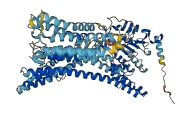
Descriptions
The autoinhibited protein was predicted that may have potential autoinhibitory elements via cis-regPred.
Autoinhibitory domains (AIDs)
Target domain |
|
Relief mechanism |
|
Assay |
cis-regPred |
Accessory elements
No accessory elements
Autoinhibited structure

Activated structure
1 structures for Q9DC29
| Entry ID | Method | Resolution | Chain | Position | Source |
|---|---|---|---|---|---|
| AF-Q9DC29-F1 | Predicted | AlphaFoldDB |
49 variants for Q9DC29
| Variant ID(s) | Position | Change | Description | Diseaes Association | Provenance |
|---|---|---|---|---|---|
| rs3388480338 | 3 | T>P | No | EVA | |
| rs3388479512 | 25 | P>L | No | EVA | |
| rs3388481617 | 113 | L>M | No | EVA | |
| rs3413122884 | 113 | L>RDG* | No | EVA | |
| rs3388480841 | 117 | A>G | No | EVA | |
| rs3388478878 | 118 | S>G | No | EVA | |
| rs243450501 | 119 | V>A | No | EVA | |
| rs3388478897 | 135 | S>I | No | EVA | |
| rs3388479288 | 163 | L>* | No | EVA | |
| rs3388481672 | 175 | W>* | No | EVA | |
| rs3388480499 | 194 | V>M | No | EVA | |
| rs3388479637 | 200 | F>L | No | EVA | |
| rs51736521 | 227 | G>R | No | EVA | |
| rs3388478556 | 234 | D>Y | No | EVA | |
| rs212651980 | 236 | R>Q | No | EVA | |
| rs3388478917 | 241 | D>V | No | EVA | |
| rs3388479649 | 287 | R>M | No | EVA | |
| rs3388481641 | 291 | N>K | No | EVA | |
| rs50543979 | 295 | A>S | No | EVA | |
| rs3388481692 | 308 | T>I | No | EVA | |
| rs3388481610 | 363 | G>S | No | EVA | |
| rs3388479104 | 383 | L>V | No | EVA | |
| rs3388480791 | 463 | V>G | No | EVA | |
| rs3413013155 | 466 | Y>F | No | EVA | |
| rs50778184 | 474 | D>E | No | EVA | |
| rs3388479141 | 504 | V>M | No | EVA | |
| rs3388480559 | 534 | G>D | No | EVA | |
| rs3388481618 | 569 | K>* | No | EVA | |
| rs3388479095 | 571 | E>D | No | EVA | |
| rs13468017 | 573 | E>Q | No | EVA | |
| rs3388478379 | 591 | E>* | No | EVA | |
| rs3390211073 | 596 | H>P | No | EVA | |
| rs3390143771 | 597 | F>I | No | EVA | |
| rs230639220 | 601 | D>E | No | EVA | |
| rs3388478252 | 637 | F>I | No | EVA | |
| rs242030588 | 641 | D>E | No | EVA | |
| rs247565226 | 642 | I>V | No | EVA | |
| rs3388480535 | 667 | G>R | No | EVA | |
| rs3388479396 | 669 | V>L | No | EVA | |
| rs3388480827 | 672 | D>N | No | EVA | |
| rs3388480875 | 693 | D>N | No | EVA | |
| rs3388478437 | 697 | E>G | No | EVA | |
| rs3388479651 | 746 | D>N | No | EVA | |
| rs3388479287 | 759 | T>I | No | EVA | |
| rs3388481657 | 808 | H>Y | No | EVA | |
| rs3388479416 | 811 | L>R | No | EVA | |
| rs3388478777 | 813 | S>P | No | EVA | |
| rs3388480349 | 816 | G>E | No | EVA | |
| rs3388478376 | 840 | D>G | No | EVA |
No associated diseases with Q9DC29
11 regional properties for Q9DC29
| Type | Name | Position | InterPro Accession |
|---|---|---|---|
| domain | Biotin/lipoyl attachment | 745 - 819 | IPR000089 |
| binding_site | Biotin-binding site | 776 - 793 | IPR001882 |
| domain | Carbamoyl-phosphate synthetase large subunit-like, ATP-binding domain | 288 - 471 | IPR005479 |
| domain | Biotin carboxylase-like, N-terminal domain | 118 - 237 | IPR005481 |
| domain | Biotin carboxylase, C-terminal | 507 - 614 | IPR005482 |
| domain | ATP-grasp fold | 275 - 466 | IPR011761 |
| domain | Acetyl-coenzyme A carboxyltransferase, N-terminal | 1576 - 1914 | IPR011762 |
| domain | Acetyl-coenzyme A carboxyltransferase, C-terminal | 1918 - 2234 | IPR011763 |
| domain | Biotin carboxylation domain | 117 - 618 | IPR011764 |
| domain | Acetyl-CoA carboxylase, central domain | 819 - 1569 | IPR013537 |
| domain | Acetyl-CoA carboxylase | 1669 - 2222 | IPR034733 |
Functions
| Description | ||
|---|---|---|
| EC Number | 7.6.2.5 | Linked to the hydrolysis of a nucleoside triphosphate |
| Subcellular Localization |
|
|
| PANTHER Family | ||
| PANTHER Subfamily | ||
| PANTHER Protein Class | ||
| PANTHER Pathway Category | No pathway information available | |
21 GO annotations of cellular component
| Name | Definition |
|---|---|
| cytosol | The part of the cytoplasm that does not contain organelles but which does contain other particulate matter, such as protein complexes. |
| early endosome membrane | The lipid bilayer surrounding an early endosome. |
| endolysosome membrane | The lipid bilayer surrounding an endolysosome. An endolysosome is a transient hybrid organelle formed by fusion of a late endosome with a lysosome. |
| endoplasmic reticulum | The irregular network of unit membranes, visible only by electron microscopy, that occurs in the cytoplasm of many eukaryotic cells. The membranes form a complex meshwork of tubular channels, which are often expanded into slitlike cavities called cisternae. The ER takes two forms, rough (or granular), with ribosomes adhering to the outer surface, and smooth (with no ribosomes attached). |
| endoplasmic reticulum membrane | The lipid bilayer surrounding the endoplasmic reticulum. |
| endosome | A vacuole to which materials ingested by endocytosis are delivered. |
| extracellular exosome | A vesicle that is released into the extracellular region by fusion of the limiting endosomal membrane of a multivesicular body with the plasma membrane. Extracellular exosomes, also simply called exosomes, have a diameter of about 40-100 nm. |
| Golgi apparatus | A membrane-bound cytoplasmic organelle of the endomembrane system that further processes the core oligosaccharides (e.g. N-glycans) added to proteins in the endoplasmic reticulum and packages them into membrane-bound vesicles. The Golgi apparatus operates at the intersection of the secretory, lysosomal, and endocytic pathways. |
| Golgi membrane | The lipid bilayer surrounding any of the compartments of the Golgi apparatus. |
| integral component of membrane | The component of a membrane consisting of the gene products and protein complexes having at least some part of their peptide sequence embedded in the hydrophobic region of the membrane. |
| integral component of mitochondrial outer membrane | The component of the mitochondrial outer membrane consisting of the gene products having at least some part of their peptide sequence embedded in the hydrophobic region of the membrane. |
| late endosome membrane | The lipid bilayer surrounding a late endosome. |
| lysosomal membrane | The lipid bilayer surrounding the lysosome and separating its contents from the cell cytoplasm. |
| melanosome membrane | The lipid bilayer surrounding a melanosome. |
| mitochondrial envelope | The double lipid bilayer enclosing the mitochondrion and separating its contents from the cell cytoplasm; includes the intermembrane space. |
| mitochondrial outer membrane | The outer, i.e. cytoplasm-facing, lipid bilayer of the mitochondrial envelope. |
| mitochondrion | A semiautonomous, self replicating organelle that occurs in varying numbers, shapes, and sizes in the cytoplasm of virtually all eukaryotic cells. It is notably the site of tissue respiration. |
| multivesicular body membrane | The lipid bilayer surrounding a multivesicular body. |
| nucleoplasm | That part of the nuclear content other than the chromosomes or the nucleolus. |
| plasma membrane | The membrane surrounding a cell that separates the cell from its external environment. It consists of a phospholipid bilayer and associated proteins. |
| vacuolar membrane | The lipid bilayer surrounding the vacuole and separating its contents from the cytoplasm of the cell. |
8 GO annotations of molecular function
| Name | Definition |
|---|---|
| ABC-type heme transporter activity | Catalysis of the reaction: ATP + H2O + heme(in) = ADP + phosphate + heme(out). |
| ABC-type transporter activity | Primary active transporter characterized by two nucleotide-binding domains and two transmembrane domains. Uses the energy generated from ATP hydrolysis to drive the transport of a substance across a membrane. |
| ATP binding | Binding to ATP, adenosine 5'-triphosphate, a universally important coenzyme and enzyme regulator. |
| ATP hydrolysis activity | Catalysis of the reaction: ATP + H2O = ADP + H+ phosphate. ATP hydrolysis is used in some reactions as an energy source, for example to catalyze a reaction or drive transport against a concentration gradient. |
| ATPase-coupled transmembrane transporter activity | Primary active transporter of a solute across a membrane, via the reaction: ATP + H2O = ADP + phosphate, to directly drive the transport of a substance across a membrane. The transport protein may be transiently phosphorylated (P-type transporters), or not (ABC-type transporters and other families of transporters). Primary active transport occurs up the solute's concentration gradient and is driven by a primary energy source. |
| efflux transmembrane transporter activity | Enables the transfer of a specific substance or related group of substances from the inside of the cell to the outside of the cell across a membrane. |
| heme binding | Binding to a heme, a compound composed of iron complexed in a porphyrin (tetrapyrrole) ring. |
| tetrapyrrole binding | Binding to a tetrapyrrole, a compound containing four pyrrole nuclei variously substituted and linked to each other through carbons at the alpha position. |
12 GO annotations of biological process
| Name | Definition |
|---|---|
| brain development | The process whose specific outcome is the progression of the brain over time, from its formation to the mature structure. Brain development begins with patterning events in the neural tube and ends with the mature structure that is the center of thought and emotion. The brain is responsible for the coordination and control of bodily activities and the interpretation of information from the senses (sight, hearing, smell, etc.). |
| cellular copper ion homeostasis | Any process involved in the maintenance of an internal steady state of copper ions at the level of a cell. |
| cellular detoxification of cadmium ion | Any process that reduces or removes the toxicity of cadmium cations in a cell. These include transport of cadmium cations away from sensitive areas and to compartments or complexes whose purpose is sequestration. |
| heme metabolic process | The chemical reactions and pathways involving heme, any compound of iron complexed in a porphyrin (tetrapyrrole) ring. |
| heme transmembrane transport | The process in which heme, any compound of iron complexed in a porphyrin (tetrapyrrole) ring, is transported from one side of a membrane to the other by means of some agent such as a transporter or pore. |
| heme transport | The directed movement of heme, any compound of iron complexed in a porphyrin (tetrapyrrole) ring, into, out of or within a cell, or between cells, by means of some agent such as a transporter or pore. |
| melanosome assembly | The aggregation, arrangement and bonding together of a set of components to form a melanosome, a tissue-specific, membrane-bounded cytoplasmic organelle within which melanin pigments are synthesized and stored. |
| porphyrin-containing compound biosynthetic process | The chemical reactions and pathways resulting in the formation of any member of a large group of derivatives or analogs of porphyrin. Porphyrin consists of a ring of four pyrrole nuclei linked each to the next at their alpha positions through a methine group. |
| porphyrin-containing compound metabolic process | The chemical reactions and pathways involving any member of a large group of derivatives or analogs of porphyrin. Porphyrins consists of a ring of four pyrrole nuclei linked each to the next at their alpha positions through a methine group. |
| skin development | The process whose specific outcome is the progression of the skin over time, from its formation to the mature structure. The skin is the external membranous integument of an animal. In vertebrates the skin generally consists of two layers, an outer nonsensitive and nonvascular epidermis (cuticle or skarfskin) composed of cells which are constantly growing and multiplying in the deeper, and being thrown off in the superficial layers, as well as an inner vascular dermis (cutis, corium or true skin) composed mostly of connective tissue. |
| tetrapyrrole metabolic process | The chemical reactions and pathways involving tetrapyrroles, natural pigments containing four pyrrole rings joined by one-carbon units linking position 2 of one pyrrole ring to position 5 of the next. |
| transmembrane transport | The process in which a solute is transported across a lipid bilayer, from one side of a membrane to the other. |
10 homologous proteins in AiPD
| UniProt AC | Gene Name | Protein Name | Species | Evidence Code |
|---|---|---|---|---|
| P40416 | ATM1 | Iron-sulfur clusters transporter ATM1, mitochondrial | Saccharomyces cerevisiae (strain ATCC 204508 / S288c) (Baker's yeast) | PR |
| Q9NP58 | ABCB6 | ATP-binding cassette sub-family B member 6 | Homo sapiens (Human) | PR |
| Q9QY30 | Abcb11 | Bile salt export pump | Mus musculus (Mouse) | PR |
| P21440 | Abcb4 | Phosphatidylcholine translocator ABCB4 | Mus musculus (Mouse) | PR |
| P06795 | Abcb1b | ATP-dependent translocase ABCB1 | Mus musculus (Mouse) | PR |
| P21447 | Abcb1a | ATP-dependent translocase ABCB1 | Mus musculus (Mouse) | PR |
| O70595 | Abcb6 | ATP-binding cassette sub-family B member 6 | Rattus norvegicus (Rat) | PR |
| Q9M0G9 | ABCB24 | ABC transporter B family member 24, mitochondrial | Arabidopsis thaliana (Mouse-ear cress) | PR |
| Q9FUT3 | ABCB23 | ABC transporter B family member 23, mitochondrial | Arabidopsis thaliana (Mouse-ear cress) | PR |
| Q9LVM1 | ABCB25 | ABC transporter B family member 25, mitochondrial | Arabidopsis thaliana (Mouse-ear cress) | PR |
| 10 | 20 | 30 | 40 | 50 | 60 |
| MVTVGNYCET | EGPAGPAWTQ | NGLSPCFFFT | LVPSTLLTLG | VLALVLVLPR | RRREVPAGPE |
| 70 | 80 | 90 | 100 | 110 | 120 |
| ELSWAAGPRV | APYVLQLFLA | TLQMALPLAG | LAGRVGTARG | VRLPGYLLLA | SVLESLASVC |
| 130 | 140 | 150 | 160 | 170 | 180 |
| GLWLLVVERS | QARQSLAMGV | WMKFRHSLGL | LLLWTVTFAA | ENLALVSWNS | PQWWWARADL |
| 190 | 200 | 210 | 220 | 230 | 240 |
| GQQVQFGLWV | LRYVTSGGLF | ILGLWAPGLR | PQSYTLHVHE | EDQDVGGNQG | RSTDRRSTWR |
| 250 | 260 | 270 | 280 | 290 | 300 |
| DLGRKLRLLS | SYLWPRGSPS | LQLIVLICLG | LMGLERALNV | LVPIFYRDIV | NLLTAKAPWS |
| 310 | 320 | 330 | 340 | 350 | 360 |
| SLAWTVTTYV | FLKFLQGGGT | GSTGFVSNLR | TFLWIRVQQF | TSRGVELRLF | SHLHELSLRW |
| 370 | 380 | 390 | 400 | 410 | 420 |
| HLGRRTGEVL | RIVDRGTSSV | TGLLSYLVFS | IIPTLADIII | GIIYFSMFFN | AWFGLIVFLC |
| 430 | 440 | 450 | 460 | 470 | 480 |
| MSLYLILTIV | VTEWRAKFRR | DMNTQENATR | ARAVDSLLNF | ETVKYYGAEG | YEVDRYREAI |
| 490 | 500 | 510 | 520 | 530 | 540 |
| LKFQGLEWKS | TASLVVLNQT | QNLVIGLGLL | AGSLLCAYFV | SEQKLQVGDF | VLFGTYITQL |
| 550 | 560 | 570 | 580 | 590 | 600 |
| YMPLNWFGTY | YRMIQTNFID | MENMFDLLKE | ETEVKDVPGA | GPLRFHKGRI | EFENVHFSYA |
| 610 | 620 | 630 | 640 | 650 | 660 |
| DGQETLQDVS | FTVMPGQTVA | LVGPSGAGKS | TILRLLFRFY | DISSGCIRID | GQDISQVTQI |
| 670 | 680 | 690 | 700 | 710 | 720 |
| SLRSHIGVVP | QDTVLFNDTI | ANNIRYGRVT | AGDSEVEAAA | QAAGIHDAIL | SFPEGYETQV |
| 730 | 740 | 750 | 760 | 770 | 780 |
| GERGLKLSGG | EKQRVAIART | ILKAPDIILL | DEATSALDTS | NERAIQASLA | KVCTNRTTIV |
| 790 | 800 | 810 | 820 | 830 | 840 |
| IAHRLSTVVN | ADQILVIKDG | CIIERGRHEA | LLSRGGVYAE | MWQLQQQGQE | TVPEESKPQD |
| TA |