Q9LVM1
Gene name |
ABCB25 (ATM3, STA1, At5g58270, MCK7.14) |
Protein name |
ABC transporter B family member 25, mitochondrial |
Names |
ABC transporter ABCB.25, AtABCB25, ABC transporter of the mitochondrion 3, AtATM3, Iron-sulfur clusters transporter ATM3, Protein STARIK 1 |
Species |
Arabidopsis thaliana (Mouse-ear cress) |
KEGG Pathway |
ath:AT5G58270 |
EC number |
|
Protein Class |
|
Descriptions
The autoinhibited protein was predicted that may have potential autoinhibitory elements via cis-regPred.
Autoinhibitory domains (AIDs)
Target domain |
|
Relief mechanism |
|
Assay |
cis-regPred |
Accessory elements
No accessory elements
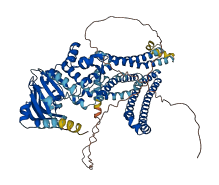
Autoinhibited structure

Activated structure
5 structures for Q9LVM1
| Entry ID | Method | Resolution | Chain | Position | Source |
|---|---|---|---|---|---|
| 7N58 | EM | 340 A | A/B | 1-728 | PDB |
| 7N59 | EM | 360 A | A/B | 1-728 | PDB |
| 7N5A | EM | 395 A | A/B | 1-728 | PDB |
| 7N5B | EM | 380 A | A/B | 1-728 | PDB |
| AF-Q9LVM1-F1 | Predicted | AlphaFoldDB |
23 variants for Q9LVM1
| Variant ID(s) | Position | Change | Description | Diseaes Association | Provenance |
|---|---|---|---|---|---|
| tmp_5_23562216_C_T | 17 | R>C | No | 1000Genomes | |
| tmp_5_23562288_A_T | 41 | N>Y | No | 1000Genomes | |
| ENSVATH07444636 | 80 | Q>P | No | 1000Genomes | |
| tmp_5_23562478_C_G | 104 | T>S | No | 1000Genomes | |
| tmp_5_23562483_G_A | 106 | E>K | No | 1000Genomes | |
| ENSVATH12839892 | 119 | A>G | No | 1000Genomes | |
| tmp_5_23562570_G_C | 135 | D>H | No | 1000Genomes | |
| ENSVATH07444637 | 172 | A>P | No | 1000Genomes | |
| ENSVATH07444638 | 176 | G>V | No | 1000Genomes | |
| ENSVATH07444639 | 184 | F>L | No | 1000Genomes | |
| ENSVATH14639071 | 229 | R>Q | No | 1000Genomes | |
| tmp_5_23563218_G_A | 266 | S>N | No | 1000Genomes | |
| ENSVATH03447798 | 374 | D>N | No | 1000Genomes | |
| ENSVATH12839928 | 376 | A>V | No | 1000Genomes | |
| ENSVATH00740681 | 410 | M>V | No | 1000Genomes | |
| ENSVATH07444655 | 490 | P>R | No | 1000Genomes | |
| tmp_5_23565265_T_G | 495 | L>V | No | 1000Genomes | |
| ENSVATH14639078 | 497 | G>R | No | 1000Genomes | |
| tmp_5_23565304_G_A | 508 | V>M | No | 1000Genomes | |
| tmp_5_23565688_G_A | 557 | V>I | No | 1000Genomes | |
| tmp_5_23566017_G_A | 584 | E>K | No | 1000Genomes | |
| tmp_5_23566565_A_G | 629 | T>A | No | 1000Genomes | |
| tmp_5_23566924_G_T | 691 | V>L | No | 1000Genomes |
No associated diseases with Q9LVM1
4 regional properties for Q9LVM1
6 GO annotations of cellular component
| Name | Definition |
|---|---|
| chloroplast | A chlorophyll-containing plastid with thylakoids organized into grana and frets, or stroma thylakoids, and embedded in a stroma. |
| chloroplast envelope | The double lipid bilayer enclosing the chloroplast and separating its contents from the rest of the cytoplasm; includes the intermembrane space. |
| integral component of membrane | The component of a membrane consisting of the gene products and protein complexes having at least some part of their peptide sequence embedded in the hydrophobic region of the membrane. |
| mitochondrial inner membrane | The inner, i.e. lumen-facing, lipid bilayer of the mitochondrial envelope. It is highly folded to form cristae. |
| mitochondrion | A semiautonomous, self replicating organelle that occurs in varying numbers, shapes, and sizes in the cytoplasm of virtually all eukaryotic cells. It is notably the site of tissue respiration. |
| plastid | Any member of a family of organelles found in the cytoplasm of plants and some protists, which are membrane-bounded and contain DNA. Plant plastids develop from a common type, the proplastid. |
3 GO annotations of molecular function
| Name | Definition |
|---|---|
| ABC-type transporter activity | Primary active transporter characterized by two nucleotide-binding domains and two transmembrane domains. Uses the energy generated from ATP hydrolysis to drive the transport of a substance across a membrane. |
| ATP binding | Binding to ATP, adenosine 5'-triphosphate, a universally important coenzyme and enzyme regulator. |
| ATPase-coupled transmembrane transporter activity | Primary active transporter of a solute across a membrane, via the reaction: ATP + H2O = ADP + phosphate, to directly drive the transport of a substance across a membrane. The transport protein may be transiently phosphorylated (P-type transporters), or not (ABC-type transporters and other families of transporters). Primary active transport occurs up the solute's concentration gradient and is driven by a primary energy source. |
12 GO annotations of biological process
| Name | Definition |
|---|---|
| cellular iron ion homeostasis | Any process involved in the maintenance of an internal steady state of iron ions at the level of a cell. |
| chloroplast organization | A process that is carried out at the cellular level which results in the assembly, arrangement of constituent parts, or disassembly of the chloroplast. |
| chromosome organization | A process that is carried out at the cellular level that results in the assembly, arrangement of constituent parts, or disassembly of chromosomes, structures composed of a very long molecule of DNA and associated proteins that carries hereditary information. This term covers covalent modifications at the molecular level as well as spatial relationships among the major components of a chromosome. |
| ion transport | The directed movement of charged atoms or small charged molecules into, out of or within a cell, or between cells, by means of some agent such as a transporter or pore. |
| Mo-molybdopterin cofactor biosynthetic process | The chemical reactions and pathways resulting in the formation of the Mo-molybdopterin cofactor, essential for the catalytic activity of some enzymes. The cofactor consists of a mononuclear molybdenum (Mo) ion coordinated by one or two molybdopterin ligands. |
| pollen development | The process whose specific outcome is the progression of the pollen grain over time, from its formation to the mature structure. The process begins with the meiosis of the microsporocyte to form four haploid microspores. The nucleus of each microspore then divides by mitosis to form a two-celled organism, the pollen grain, that contains a tube cell as well as a smaller generative cell. The pollen grain is surrounded by an elaborate cell wall. In some species, the generative cell immediately divides again to give a pair of sperm cells. In most flowering plants, however this division takes place later, in the tube that develops when a pollen grain germinates. |
| regulation of catalytic activity | Any process that modulates the activity of an enzyme. |
| regulation of chlorophyll biosynthetic process | Any process that modulates the frequency, rate or extent of the chemical reactions and pathways resulting in the formation of chlorophyll, any compound of magnesium complexed in a porphyrin (tetrapyrrole) ring and which functions as a photosynthetic pigment, from less complex precursors. |
| response to cadmium ion | Any process that results in a change in state or activity of a cell or an organism (in terms of movement, secretion, enzyme production, gene expression, etc.) as a result of a cadmium (Cd) ion stimulus. |
| response to lead ion | Any process that results in a change in state or activity of a cell or an organism (in terms of movement, secretion, enzyme production, gene expression, etc.) as a result of a lead ion stimulus. |
| root development | The process whose specific outcome is the progression of the root over time, from its formation to the mature structure. The root is the water- and mineral-absorbing part of a plant which is usually underground, does not bear leaves, tends to grow downwards and is typically derived from the radicle of the embryo. |
| transmembrane transport | The process in which a solute is transported across a lipid bilayer, from one side of a membrane to the other. |
8 homologous proteins in AiPD
| UniProt AC | Gene Name | Protein Name | Species | Evidence Code |
|---|---|---|---|---|
| P40416 | ATM1 | Iron-sulfur clusters transporter ATM1, mitochondrial | Saccharomyces cerevisiae (strain ATCC 204508 / S288c) (Baker's yeast) | PR |
| Q9NP58 | ABCB6 | ATP-binding cassette sub-family B member 6 | Homo sapiens (Human) | PR |
| Q9DC29 | Abcb6 | ATP-binding cassette sub-family B member 6 | Mus musculus (Mouse) | PR |
| O70595 | Abcb6 | ATP-binding cassette sub-family B member 6 | Rattus norvegicus (Rat) | PR |
| Q9FUT3 | ABCB23 | ABC transporter B family member 23, mitochondrial | Arabidopsis thaliana (Mouse-ear cress) | PR |
| Q9M0G9 | ABCB24 | ABC transporter B family member 24, mitochondrial | Arabidopsis thaliana (Mouse-ear cress) | PR |
| Q9LJX0 | ABCB19 | ABC transporter B family member 19 | Arabidopsis thaliana (Mouse-ear cress) | PR |
| Q9ZR72 | ABCB1 | ABC transporter B family member 1 | Arabidopsis thaliana (Mouse-ear cress) | PR |
| 10 | 20 | 30 | 40 | 50 | 60 |
| MSRGSRFVRA | PGLLLCRVNL | QPQPKIPSFS | YSLRSDYRLH | NGFSNYIRRN | SIRTSPVINA |
| 70 | 80 | 90 | 100 | 110 | 120 |
| FLSDNSPSPS | PSPSPIRFVQ | RSSMLNGRLF | STSTPNPDQT | TTKTKEIKTT | SSDSDSAMAD |
| 130 | 140 | 150 | 160 | 170 | 180 |
| MKILRTLAGY | LWMRDNPEFR | FRVIAALGFL | VGAKVLNVQV | PFLFKLAVDW | LASATGTGAS |
| 190 | 200 | 210 | 220 | 230 | 240 |
| LTTFAATNPT | LLTVFATPAA | VLIGYGIART | GSSAFNELRT | AVFSKVALRT | IRSVSRKVFS |
| 250 | 260 | 270 | 280 | 290 | 300 |
| HLHDLDLRYH | LSRETGGLNR | IIDRGSRAIN | FILSAMVFNV | VPTILEISMV | SGILAYKFGA |
| 310 | 320 | 330 | 340 | 350 | 360 |
| AFAWITSLSV | GSYIVFTLAV | TQWRTKFRKA | MNKADNDAST | RAIDSLINYE | TVKYFNNEGY |
| 370 | 380 | 390 | 400 | 410 | 420 |
| EAEKYDQFLK | KYEDAALQTQ | RSLAFLNFGQ | SIIFSTALST | AMVLCSQGIM | NGQMTVGDLV |
| 430 | 440 | 450 | 460 | 470 | 480 |
| MVNGLLFQLS | LPLNFLGSVY | RETIQSLVDM | KSMFQLLEEK | SDITNTSDAK | PLVLKGGNIE |
| 490 | 500 | 510 | 520 | 530 | 540 |
| FENVHFSYLP | ERKILDGISF | VVPAGKSVAI | VGTSGSGKST | ILRMLFRFFD | TDSGNIRIDG |
| 550 | 560 | 570 | 580 | 590 | 600 |
| QDIKEVRLDS | LRSSIGVVPQ | DTVLFNDTIF | HNIHYGRLSA | TEEEVYEAAR | RAAIHETISN |
| 610 | 620 | 630 | 640 | 650 | 660 |
| FPDKYSTIVG | ERGLKLSGGE | KQRVALARTF | LKSPAILLCD | EATSALDSTT | EAEILNALKA |
| 670 | 680 | 690 | 700 | 710 | 720 |
| LASNRTSIFI | AHRLTTAMQC | DEIVVLENGK | VVEQGPHDEL | LGKSGRYAQL | WTQQNSSVDM |
| LDAAIKLE |