O70127
Gene name |
Abcb11 |
Protein name |
Bile salt export pump |
Names |
ATP-binding cassette sub-family B member 11, Sister of P-glycoprotein |
Species |
Rattus norvegicus (Rat) |
KEGG Pathway |
rno:83569 |
EC number |
|
Protein Class |
|
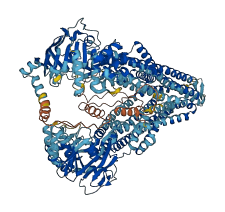
Descriptions
The autoinhibited protein was predicted that may have potential autoinhibitory elements via cis-regPred.
Autoinhibitory domains (AIDs)
Target domain |
|
Relief mechanism |
|
Assay |
cis-regPred |
Accessory elements
No accessory elements
Autoinhibited structure

Activated structure
1 structures for O70127
| Entry ID | Method | Resolution | Chain | Position | Source |
|---|---|---|---|---|---|
| AF-O70127-F1 | Predicted | AlphaFoldDB |
No variants for O70127
| Variant ID(s) | Position | Change | Description | Diseaes Association | Provenance |
|---|---|---|---|---|---|
| No variants for O70127 | |||||
No associated diseases with O70127
7 regional properties for O70127
| Type | Name | Position | InterPro Accession |
|---|---|---|---|
| domain | ABC transporter-like, ATP-binding domain | 420 - 656 | IPR003439-1 |
| domain | ABC transporter-like, ATP-binding domain | 1078 - 1316 | IPR003439-2 |
| domain | AAA+ ATPase domain | 447 - 639 | IPR003593-1 |
| domain | AAA+ ATPase domain | 1105 - 1299 | IPR003593-2 |
| domain | ABC transporter type 1, transmembrane domain | 62 - 385 | IPR011527-1 |
| domain | ABC transporter type 1, transmembrane domain | 756 - 1043 | IPR011527-2 |
| conserved_site | ABC transporter-like, conserved site | 559 - 573 | IPR017871 |
Functions
13 GO annotations of cellular component
| Name | Definition |
|---|---|
| apical part of cell | The region of a polarized cell that forms a tip or is distal to a base. For example, in a polarized epithelial cell, the apical region has an exposed surface and lies opposite to the basal lamina that separates the epithelium from other tissue. |
| apical plasma membrane | The region of the plasma membrane located at the apical end of the cell. |
| cell surface | The external part of the cell wall and/or plasma membrane. |
| endosome | A vacuole to which materials ingested by endocytosis are delivered. |
| Golgi apparatus | A membrane-bound cytoplasmic organelle of the endomembrane system that further processes the core oligosaccharides (e.g. N-glycans) added to proteins in the endoplasmic reticulum and packages them into membrane-bound vesicles. The Golgi apparatus operates at the intersection of the secretory, lysosomal, and endocytic pathways. |
| Golgi membrane | The lipid bilayer surrounding any of the compartments of the Golgi apparatus. |
| integral component of membrane | The component of a membrane consisting of the gene products and protein complexes having at least some part of their peptide sequence embedded in the hydrophobic region of the membrane. |
| intercellular canaliculus | An extremely narrow tubular channel located between adjacent cells. An instance of this is the secretory canaliculi occurring between adjacent parietal cells in the gastric mucosa of vertebrates. |
| intracellular canaliculus | An apical plasma membrane part that forms a narrow enfolded luminal membrane channel, lined with numerous microvilli, that appears to extend into the cytoplasm of the cell. A specialized network of intracellular canaliculi is a characteristic feature of parietal cells of the gastric mucosa in vertebrates. |
| membrane | A lipid bilayer along with all the proteins and protein complexes embedded in it an attached to it. |
| plasma membrane | The membrane surrounding a cell that separates the cell from its external environment. It consists of a phospholipid bilayer and associated proteins. |
| recycling endosome | An organelle consisting of a network of tubules that functions in targeting molecules, such as receptors transporters and lipids, to the plasma membrane. |
| recycling endosome membrane | The lipid bilayer surrounding a recycling endosome. |
7 GO annotations of molecular function
| Name | Definition |
|---|---|
| ABC-type bile acid transporter activity | Enables the transfer of a solute or solutes from one side of a membrane to the other according to the reaction: bile acid(in) + ATP + H2O -> bile acid(out) + ADP + phosphate. |
| ABC-type xenobiotic transporter activity | Catalysis of the reaction: ATP + H2O + xenobiotic(in) = ADP + phosphate + xenobiotic(out). |
| ATP binding | Binding to ATP, adenosine 5'-triphosphate, a universally important coenzyme and enzyme regulator. |
| ATPase-coupled transmembrane transporter activity | Primary active transporter of a solute across a membrane, via the reaction: ATP + H2O = ADP + phosphate, to directly drive the transport of a substance across a membrane. The transport protein may be transiently phosphorylated (P-type transporters), or not (ABC-type transporters and other families of transporters). Primary active transport occurs up the solute's concentration gradient and is driven by a primary energy source. |
| bile acid transmembrane transporter activity | Enables the transfer of bile acid from one side of a membrane to the other. Bile acids are any of a group of steroid carboxylic acids occurring in bile, where they are present as the sodium salts of their amides with glycine or taurine. |
| canalicular bile acid transmembrane transporter activity | The directed movement of bile acid and bile salts out of a hepatocyte and into the bile canaliculus by means of an agent such as a transporter or pore. Bile canaliculi are the thin tubes formed by hepatocyte membranes. Bile acids are any of a group of steroid carboxylic acids occurring in bile, where they are present as the sodium salts of their amides with glycine or taurine. |
| carbohydrate transmembrane transporter activity | Enables the transfer of carbohydrate from one side of a membrane to the other. |
25 GO annotations of biological process
| Name | Definition |
|---|---|
| bile acid and bile salt transport | The directed movement of bile acid and bile salts into, out of or within a cell, or between cells, by means of some agent such as a transporter or pore. |
| bile acid metabolic process | The chemical reactions and pathways involving bile acids, a group of steroid carboxylic acids occurring in bile, where they are present as the sodium salts of their amides with glycine or taurine. |
| bile acid signaling pathway | The series of molecular signals initiated by bile acid binding to its receptor, and ending with the regulation of a downstream cellular process, e.g. transcription. |
| canalicular bile acid transport | Enables the transfer of bile acid from one side of a hepatocyte plasma membrane into a bile canaliculus. Bile canaliculi are the thin tubes formed by hepatocyte membranes. Bile acids are any of a group of steroid carboxylic acids occurring in bile, where they are present as the sodium salts of their amides with glycine or taurine. |
| cellular response to xenobiotic stimulus | Any process that results in a change in state or activity of a cell (in terms of movement, secretion, enzyme production, gene expression, etc.) as a result of a stimulus from a xenobiotic, a compound foreign to the organism exposed to it. It may be synthesized by another organism (like ampicilin) or it can be a synthetic chemical. |
| cholesterol homeostasis | Any process involved in the maintenance of an internal steady state of cholesterol within an organism or cell. |
| fatty acid metabolic process | The chemical reactions and pathways involving fatty acids, aliphatic monocarboxylic acids liberated from naturally occurring fats and oils by hydrolysis. |
| lipid homeostasis | Any process involved in the maintenance of an internal steady state of lipid within an organism or cell. |
| phospholipid homeostasis | Any process involved in the maintenance of an internal steady state of phospholipid within an organism or cell. |
| positive regulation of bile acid secretion | Any process that activates or increases the frequency, rate or extent of the controlled release of bile acid from a cell or a tissue. |
| protein ubiquitination | The process in which one or more ubiquitin groups are added to a protein. |
| regulation of bile acid metabolic process | Any process that modulates the frequency, rate or extent of bile acid metabolic process. |
| regulation of bile acid secretion | Any process that modulates the frequency, rate or extent of the controlled release of bile acid from a cell or a tissue. |
| regulation of fatty acid beta-oxidation | Any process that modulates the frequency, rate or extent of fatty acid bbeta-oxidation. |
| regulation of gene expression | Any process that modulates the frequency, rate or extent of gene expression. Gene expression is the process in which a gene's coding sequence is converted into a mature gene product (protein or RNA). |
| response to 17alpha-ethynylestradiol | Any process that results in a change in state or activity of a cell or an organism (in terms of movement, secretion, enzyme production, gene expression, etc.) as a result of a 17alpha-ethynylestradiol stimulus. |
| response to estrogen | Any process that results in a change in state or activity of a cell or an organism (in terms of movement, secretion, enzyme production, gene expression, etc.) as a result of stimulus by an estrogen, C18 steroid hormones that can stimulate the development of female sexual characteristics. |
| response to ethanol | Any process that results in a change in state or activity of a cell or an organism (in terms of movement, secretion, enzyme production, gene expression, etc.) as a result of an ethanol stimulus. |
| response to organic cyclic compound | Any process that results in a change in state or activity of a cell or an organism (in terms of movement, secretion, enzyme production, gene expression, etc.) as a result of an organic cyclic compound stimulus. |
| response to oxidative stress | Any process that results in a change in state or activity of a cell or an organism (in terms of movement, secretion, enzyme production, gene expression, etc.) as a result of oxidative stress, a state often resulting from exposure to high levels of reactive oxygen species, e.g. superoxide anions, hydrogen peroxide (H2O2), and hydroxyl radicals. |
| response to xenobiotic stimulus | Any process that results in a change in state or activity of a cell or an organism (in terms of movement, secretion, enzyme production, gene expression, etc.) as a result of a stimulus from a xenobiotic, a compound foreign to the organim exposed to it. It may be synthesized by another organism (like ampicilin) or it can be a synthetic chemical. |
| transmembrane transport | The process in which a solute is transported across a lipid bilayer, from one side of a membrane to the other. |
| xenobiotic export from cell | The directed movement of a xenobiotic from a cell, into the extracellular region. A xenobiotic is a compound foreign to the organim exposed to it. It may be synthesized by another organism (like ampicilin) or it can be a synthetic chemical. |
| xenobiotic metabolic process | The chemical reactions and pathways involving a xenobiotic compound, a compound foreign to the organim exposed to it. It may be synthesized by another organism (like ampicilin) or it can be a synthetic chemical. |
| xenobiotic transmembrane transport | The process in which a xenobiotic, a compound foreign to the organim exposed to it, is transported across a membrane. It may be synthesized by another organism (like ampicilin) or it can be a synthetic chemical. |
11 homologous proteins in AiPD
| UniProt AC | Gene Name | Protein Name | Species | Evidence Code |
|---|---|---|---|---|
| P08183 | ABCB1 | ATP-dependent translocase ABCB1 | Homo sapiens (Human) | PR |
| O95342 | ABCB11 | Bile salt export pump | Homo sapiens (Human) | PR |
| P21440 | Abcb4 | Phosphatidylcholine translocator ABCB4 | Mus musculus (Mouse) | PR |
| P06795 | Abcb1b | ATP-dependent translocase ABCB1 | Mus musculus (Mouse) | PR |
| P21447 | Abcb1a | ATP-dependent translocase ABCB1 | Mus musculus (Mouse) | PR |
| Q9QY30 | Abcb11 | Bile salt export pump | Mus musculus (Mouse) | PR |
| O70595 | Abcb6 | ATP-binding cassette sub-family B member 6 | Rattus norvegicus (Rat) | PR |
| Q5RKI8 | Abcb8 | Mitochondrial potassium channel ATP-binding subunit | Rattus norvegicus (Rat) | PR |
| Q8H1R4 | ABCI10 | ABC transporter I family member 10 | Arabidopsis thaliana (Mouse-ear cress) | PR |
| Q9ZR72 | ABCB1 | ABC transporter B family member 1 | Arabidopsis thaliana (Mouse-ear cress) | PR |
| Q9LJX0 | ABCB19 | ABC transporter B family member 19 | Arabidopsis thaliana (Mouse-ear cress) | PR |
| 10 | 20 | 30 | 40 | 50 | 60 |
| MSDSVILRSV | KKFGEENHAF | ESDGSHNNDK | KSRLQDKMKE | GDIRVGFFEL | FRFSSSKDIW |
| 70 | 80 | 90 | 100 | 110 | 120 |
| LMLMGGVCAL | LHGMAQPGIL | IIFGIMTDIF | IKYDIERQEL | EIPGKACVNN | TIVWINSSFH |
| 130 | 140 | 150 | 160 | 170 | 180 |
| QNMTNGTVCG | LVDIESEMIK | FSGIYAGVGM | TVLILGYFQI | RLWVITGARQ | IRRMRKIYFR |
| 190 | 200 | 210 | 220 | 230 | 240 |
| RIMRMEIGWF | DCTSVGELNS | RFADDIEKIN | DAIADQLAHF | LQRMSTAMCG | LLLGFYRGWK |
| 250 | 260 | 270 | 280 | 290 | 300 |
| LTLVILAVSP | LIGIGAAVIG | LSIAKFTELE | LKAYAKAGSI | ADEVLSSIRT | VAAFGGENKE |
| 310 | 320 | 330 | 340 | 350 | 360 |
| VERYEKNLVF | AQRWGIWKGM | VMGFFTGYMW | CLIFFCYALA | FWYGSTLVLD | EEEYTPGTLV |
| 370 | 380 | 390 | 400 | 410 | 420 |
| QIFLCVILAA | MNIGHASSCL | EIFSTGCSAA | TNIFQTIDRQ | PVIDCMSGDG | YKLDRIKGEI |
| 430 | 440 | 450 | 460 | 470 | 480 |
| EFHNVTFHYP | SRPDVKILDN | LSMVIKPGET | TALVGSSGAG | KSTALQLIQR | FYDPCEGMVT |
| 490 | 500 | 510 | 520 | 530 | 540 |
| LDGHDIRSLN | IRWLRDQIGI | VEQEPVLFST | TIAENIRFGR | EDATMEDIVQ | AAKDANAYNF |
| 550 | 560 | 570 | 580 | 590 | 600 |
| IMALPQQFDT | LVGEGGGQMS | GGQKQRVAIA | RALIRNPKIL | LLDMATSALD | NESEARVQEA |
| 610 | 620 | 630 | 640 | 650 | 660 |
| LNKIQHGHTI | ISVAHRLSTV | RAADVIIGFE | HGVAVERGTH | EELLERKGVY | FMLVTLQSQG |
| 670 | 680 | 690 | 700 | 710 | 720 |
| DNAHKETSIM | GKDATEGGTL | ERTFSRGSYR | DSLRASIRQR | SKSQLSLLTH | DPPLAVADHK |
| 730 | 740 | 750 | 760 | 770 | 780 |
| SSYKDSKDND | VLVEEVEPAP | VRRILKYNIP | EWHYILVGSL | SAAINGAVTP | IYSLLFSQLL |
| 790 | 800 | 810 | 820 | 830 | 840 |
| GTFSLLDKEQ | QRSEIHSMCL | FFVILGCVSI | FTQFLQGYTF | AKSGELLTKR | LRKFGFKAML |
| 850 | 860 | 870 | 880 | 890 | 900 |
| GQDIGWFDDL | RNNPGVLTTR | LATDASQVQG | ATGSQVGMMV | NSFTNIIAAL | LIAFFFSWKL |
| 910 | 920 | 930 | 940 | 950 | 960 |
| SLIITIFFPF | LALSGAVQTK | MLTGFASQDK | QALEKAGQIT | SEALSNIRTV | AGIGVEGRFI |
| 970 | 980 | 990 | 1000 | 1010 | 1020 |
| KAFEVELQTS | YKTAVRKANI | YGLCFAFSQG | IAFLANSAAY | RYGGYLIAYE | GLGFSHVFRV |
| 1030 | 1040 | 1050 | 1060 | 1070 | 1080 |
| VSSVALSATA | VGRTFSYTPS | YAKAKISAAR | FFQLLDRKPP | INVYSEAGEK | WDNFQGKIDF |
| 1090 | 1100 | 1110 | 1120 | 1130 | 1140 |
| IDCKFTYPSR | PDIQVLNGLS | VSVNPGQTLA | FVGSSGCGKS | TSIQLLERFY | DPDQGTVMID |
| 1150 | 1160 | 1170 | 1180 | 1190 | 1200 |
| GHDSKKVNIQ | FLRSNIGIVS | QEPVLFDCSI | MDNIKYGDNT | KEISVERAIA | AAKQAQLHDF |
| 1210 | 1220 | 1230 | 1240 | 1250 | 1260 |
| VMSLPEKYET | NVGIQGSQLS | RGEKQRIAIA | RAIVRDPKIL | LLDEATSALD | TESEKTVQTA |
| 1270 | 1280 | 1290 | 1300 | 1310 | 1320 |
| LDKAREGRTC | IVIAHRLSTI | QNSDIIAVVS | QGVVIEKGTH | EKLMAQKGAY | YKLVITGAPI |
| S |