Q5RKI8
Gene name |
Abcb8 |
Protein name |
Mitochondrial potassium channel ATP-binding subunit |
Names |
ATP-binding cassette sub-family B member 8, mitochondrial, ABCB8, Mitochondrial sulfonylurea-receptor, MITOSUR |
Species |
Rattus norvegicus (Rat) |
KEGG Pathway |
rno:362302 |
EC number |
|
Protein Class |
|
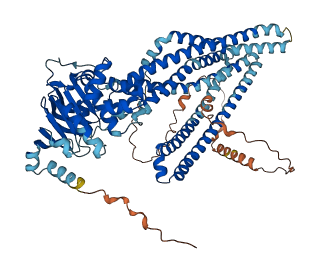
Descriptions
The autoinhibited protein was predicted that may have potential autoinhibitory elements via cis-regPred.
Autoinhibitory domains (AIDs)
Target domain |
|
Relief mechanism |
|
Assay |
cis-regPred |
Accessory elements
No accessory elements
Autoinhibited structure

Activated structure
1 structures for Q5RKI8
| Entry ID | Method | Resolution | Chain | Position | Source |
|---|---|---|---|---|---|
| AF-Q5RKI8-F1 | Predicted | AlphaFoldDB |
No variants for Q5RKI8
| Variant ID(s) | Position | Change | Description | Diseaes Association | Provenance |
|---|---|---|---|---|---|
| No variants for Q5RKI8 | |||||
No associated diseases with Q5RKI8
4 regional properties for Q5RKI8
7 GO annotations of cellular component
| Name | Definition |
|---|---|
| integral component of membrane | The component of a membrane consisting of the gene products and protein complexes having at least some part of their peptide sequence embedded in the hydrophobic region of the membrane. |
| mitochondrial ATP-gated potassium channel complex | A protein-containing complex that is capable of the ATP-dependent diffusion of a potassium ion across the mitochondrial inner membrane. |
| mitochondrial inner membrane | The inner, i.e. lumen-facing, lipid bilayer of the mitochondrial envelope. It is highly folded to form cristae. |
| mitochondrial membrane | Either of the lipid bilayers that surround the mitochondrion and form the mitochondrial envelope. |
| mitochondrion | A semiautonomous, self replicating organelle that occurs in varying numbers, shapes, and sizes in the cytoplasm of virtually all eukaryotic cells. It is notably the site of tissue respiration. |
| nucleolus | A small, dense body one or more of which are present in the nucleus of eukaryotic cells. It is rich in RNA and protein, is not bounded by a limiting membrane, and is not seen during mitosis. Its prime function is the transcription of the nucleolar DNA into 45S ribosomal-precursor RNA, the processing of this RNA into 5.8S, 18S, and 28S components of ribosomal RNA, and the association of these components with 5S RNA and proteins synthesized outside the nucleolus. This association results in the formation of ribonucleoprotein precursors; these pass into the cytoplasm and mature into the 40S and 60S subunits of the ribosome. |
| nucleoplasm | That part of the nuclear content other than the chromosomes or the nucleolus. |
3 GO annotations of molecular function
| Name | Definition |
|---|---|
| ABC-type transporter activity | Primary active transporter characterized by two nucleotide-binding domains and two transmembrane domains. Uses the energy generated from ATP hydrolysis to drive the transport of a substance across a membrane. |
| ATP binding | Binding to ATP, adenosine 5'-triphosphate, a universally important coenzyme and enzyme regulator. |
| ATPase-coupled transmembrane transporter activity | Primary active transporter of a solute across a membrane, via the reaction: ATP + H2O = ADP + phosphate, to directly drive the transport of a substance across a membrane. The transport protein may be transiently phosphorylated (P-type transporters), or not (ABC-type transporters and other families of transporters). Primary active transport occurs up the solute's concentration gradient and is driven by a primary energy source. |
4 GO annotations of biological process
| Name | Definition |
|---|---|
| cell volume homeostasis | Any process involved in maintaining the steady state of a cell's volume. The cell's volume refers to the three-dimensional space occupied by a cell. |
| mitochondrial potassium ion transmembrane transport | The process in which a potassium ion is transported across a mitochondrial membrane, into or out of the mitochondrion. |
| potassium ion transmembrane transport | A process in which a potassium ion is transported from one side of a membrane to the other. |
| transmembrane transport | The process in which a solute is transported across a lipid bilayer, from one side of a membrane to the other. |
3 homologous proteins in AiPD
| UniProt AC | Gene Name | Protein Name | Species | Evidence Code |
|---|---|---|---|---|
| O70595 | Abcb6 | ATP-binding cassette sub-family B member 6 | Rattus norvegicus (Rat) | PR |
| O70127 | Abcb11 | Bile salt export pump | Rattus norvegicus (Rat) | PR |
| B2GUP8 | abcb8 | Mitochondrial potassium channel ATP-binding subunit | Xenopus tropicalis (Western clawed frog) (Silurana tropicalis) | PR |
| 10 | 20 | 30 | 40 | 50 | 60 |
| MLVHLFRVGI | RGGPVPRWSL | QSLRFQTFSA | ARSSDDQFSS | CLLRAVAQLR | SQLRAHLPRS |
| 70 | 80 | 90 | 100 | 110 | 120 |
| PPASHRSTSA | WCWVGGTLVV | PAVLWQHPRF | CLIALCEAKG | SPPAQPTRAR | ELRFKWKLFW |
| 130 | 140 | 150 | 160 | 170 | 180 |
| HFLHPHLLAL | GLAIVLALGA | ALVNVQIPLL | LGQLVEIVAK | YTREHVGSFV | SESRRLSIQL |
| 190 | 200 | 210 | 220 | 230 | 240 |
| LLLYGVQGLL | TFGYLVLLSH | MGERMAMDMR | KALFSSLLRQ | DIAFFDAKKT | GQLVSRLTTD |
| 250 | 260 | 270 | 280 | 290 | 300 |
| VQEFKSSFKL | VISQGLRSST | QVIGSLMTLS | ILSPRLTLML | AVVTPALMGV | GTLMGSGLRK |
| 310 | 320 | 330 | 340 | 350 | 360 |
| LSRQCQEQIA | RATGVADEAL | GSVRTVRAFA | MEKREEERYQ | AELESCCCKA | EELGRGIALF |
| 370 | 380 | 390 | 400 | 410 | 420 |
| QGLSNIAFNC | MVLGTLFIGG | SLVAGQQLKG | GDLMSFLVAS | QTVQRSMASL | SVLFGQVVRG |
| 430 | 440 | 450 | 460 | 470 | 480 |
| LSAGARVFEY | MSLSPVIPLT | GGYSIPSKDL | RGSITFQNVS | FSYPCRPGFN | VLKNFTLKLP |
| 490 | 500 | 510 | 520 | 530 | 540 |
| PGKIVALVGQ | SGGGKTTVAS | LLERFYDPTA | GVVTLDGHDL | RTLDPSWLRG | QVIGFISQEP |
| 550 | 560 | 570 | 580 | 590 | 600 |
| VLFATTIMEN | IRFGKLDASD | EEVYTAARKA | NAHEFISSFP | DGYSTVVGER | GTTLSGGQKQ |
| 610 | 620 | 630 | 640 | 650 | 660 |
| RLAIARALIK | RPTVLILDEA | TSALDAESER | IVQEALDRAS | AGRTVLVIAH | RLSTVRAAHS |
| 670 | 680 | 690 | 700 | 710 | |
| IIVMANGQVC | EAGTHEELLQ | KGGLYAELIR | RQALDASLPS | APPAEKPEDH | RSCQ |