P13721
Gene name |
St6gal1 (Siat1) |
Protein name |
Beta-galactoside alpha-2,6-sialyltransferase 1 |
Names |
Alpha 2,6-ST 1, CMP-N-acetylneuraminate-beta-galactosamide-alpha-2,6-sialyltransferase 1, ST6Gal I, ST6GalI, Sialyltransferase 1 |
Species |
Rattus norvegicus (Rat) |
KEGG Pathway |
rno:25197 |
EC number |
2.4.3.1: Sialyltransferases |
Protein Class |
|
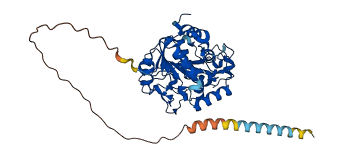
Descriptions
The autoinhibited protein was predicted that may have potential autoinhibitory elements via cis-regPred.
Autoinhibitory domains (AIDs)
Target domain |
|
Relief mechanism |
|
Assay |
cis-regPred |
Accessory elements
No accessory elements
Autoinhibited structure

Activated structure
2 structures for P13721
| Entry ID | Method | Resolution | Chain | Position | Source |
|---|---|---|---|---|---|
| 4MPS | X-ray | 240 A | A/B | 95-403 | PDB |
| AF-P13721-F1 | Predicted | AlphaFoldDB |
No variants for P13721
| Variant ID(s) | Position | Change | Description | Diseaes Association | Provenance |
|---|---|---|---|---|---|
| No variants for P13721 | |||||
No associated diseases with P13721
No regional properties for P13721
| Type | Name | Position | InterPro Accession |
|---|---|---|---|
| No domain, repeats, and functional sites for P13721 | |||
Functions
| Description | ||
|---|---|---|
| EC Number | 2.4.3.1 | Sialyltransferases |
| Subcellular Localization |
|
|
| PANTHER Family | ||
| PANTHER Subfamily | ||
| PANTHER Protein Class | ||
| PANTHER Pathway Category | No pathway information available | |
8 GO annotations of cellular component
| Name | Definition |
|---|---|
| endoplasmic reticulum | The irregular network of unit membranes, visible only by electron microscopy, that occurs in the cytoplasm of many eukaryotic cells. The membranes form a complex meshwork of tubular channels, which are often expanded into slitlike cavities called cisternae. The ER takes two forms, rough (or granular), with ribosomes adhering to the outer surface, and smooth (with no ribosomes attached). |
| extracellular region | The space external to the outermost structure of a cell. For cells without external protective or external encapsulating structures this refers to space outside of the plasma membrane. This term covers the host cell environment outside an intracellular parasite. |
| Golgi apparatus | A membrane-bound cytoplasmic organelle of the endomembrane system that further processes the core oligosaccharides (e.g. N-glycans) added to proteins in the endoplasmic reticulum and packages them into membrane-bound vesicles. The Golgi apparatus operates at the intersection of the secretory, lysosomal, and endocytic pathways. |
| Golgi cisterna membrane | The lipid bilayer surrounding any of the thin, flattened compartments that form the central portion of the Golgi complex. |
| Golgi medial cisterna | The middle Golgi cisterna (or cisternae). |
| Golgi membrane | The lipid bilayer surrounding any of the compartments of the Golgi apparatus. |
| Golgi trans cisterna | The Golgi cisterna farthest from the endoplasmic reticulum; the final processing compartment through which proteins pass before exiting the Golgi apparatus; the compartment in which N-linked protein glycosylation is completed. |
| integral component of membrane | The component of a membrane consisting of the gene products and protein complexes having at least some part of their peptide sequence embedded in the hydrophobic region of the membrane. |
3 GO annotations of molecular function
| Name | Definition |
|---|---|
| beta-galactoside alpha-2,6-sialyltransferase activity | Catalysis of the reaction: CMP-N-acetylneuraminate + beta-D-galactosyl-(1->4)-acetyl-beta-D-glucosamine = CMP + alpha-N-acetylneuraminyl-(2->6)-beta-D-galactosyl-(1->4)-N-acetyl-beta-D-glucosamine. |
| protein homodimerization activity | Binding to an identical protein to form a homodimer. |
| sialyltransferase activity | Catalysis of the transfer of sialic acid to an acceptor molecule, typically the terminal portions of the sialylated glycolipids (gangliosides) or to the N- or O-linked sugar chains of glycoproteins. |
10 GO annotations of biological process
| Name | Definition |
|---|---|
| N-acetylneuraminate metabolic process | The chemical reactions and pathways involving N-acetylneuraminate, the anion of 5-(acetylamino)-3,5-dideoxy-D-glycero-D-galacto-non-3-ulosonic acid. |
| negative regulation of chemotaxis | Any process that stops, prevents, or reduces the frequency, rate or extent of the directed movement of a motile cell or organism in response to a specific chemical concentration gradient. |
| negative regulation of macrophage apoptotic process | Any process that stops, prevents, or reduces the frequency, rate or extent of macrophage apoptotic process. |
| positive regulation of mononuclear cell proliferation | Any process that activates or increases the frequency, rate or extent of mononuclear cell proliferation. |
| protein glycosylation | A protein modification process that results in the addition of a carbohydrate or carbohydrate derivative unit to a protein amino acid, e.g. the addition of glycan chains to proteins. |
| protein N-linked glycosylation via asparagine | The glycosylation of protein via the N4 atom of peptidyl-asparagine forming N4-glycosyl-L-asparagine; the most common form is N-acetylglucosaminyl asparagine; N-acetylgalactosaminyl asparagine and N4 glucosyl asparagine also occur. This modification typically occurs in extracellular peptides with an N-X-(ST) motif. Partial modification has been observed to occur with cysteine, rather than serine or threonine, in the third position; secondary structure features are important, and proline in the second or fourth positions inhibits modification. |
| protein sialylation | A protein modification process that results in the addition of a sialic acid unit to the end of an oligosaccharide chain in a glycoprotein. |
| regulation of substrate adhesion-dependent cell spreading | Any process that modulates the frequency, rate or extent of substrate adhesion-dependent cell spreading. |
| response to ethanol | Any process that results in a change in state or activity of a cell or an organism (in terms of movement, secretion, enzyme production, gene expression, etc.) as a result of an ethanol stimulus. |
| sialylation | The covalent attachment of sialic acid to a substrate molecule. |
11 homologous proteins in AiPD
| UniProt AC | Gene Name | Protein Name | Species | Evidence Code |
|---|---|---|---|---|
| Q92184 | ST6GALNAC2 | Alpha-N-acetylgalactosaminide alpha-2,6-sialyltransferase 2 | Gallus gallus (Chicken) | PR |
| Q701R0 | ST6GAL2 | Beta-galactoside alpha-2,6-sialyltransferase 2 | Gallus gallus (Chicken) | PR |
| Q92182 | ST6GAL1 | Beta-galactoside alpha-2,6-sialyltransferase 1 | Gallus gallus (Chicken) | PR |
| Q9UJ37 | ST6GALNAC2 | Alpha-N-acetylgalactosaminide alpha-2,6-sialyltransferase 2 | Homo sapiens (Human) | PR |
| Q96JF0 | ST6GAL2 | Beta-galactoside alpha-2,6-sialyltransferase 2 | Homo sapiens (Human) | PR |
| Q9BVH7 | ST6GALNAC5 | Alpha-N-acetylgalactosaminide alpha-2,6-sialyltransferase 5 | Homo sapiens (Human) | PR |
| P15907 | ST6GAL1 | Beta-galactoside alpha-2,6-sialyltransferase 1 | Homo sapiens (Human) | PR |
| Q9QYJ1 | St6galnac5 | Alpha-N-acetylgalactosaminide alpha-2,6-sialyltransferase 5 | Mus musculus (Mouse) | PR |
| P70277 | St6galnac2 | Alpha-N-acetylgalactosaminide alpha-2,6-sialyltransferase 2 | Mus musculus (Mouse) | PR |
| Q64685 | St6gal1 | Beta-galactoside alpha-2,6-sialyltransferase 1 | Mus musculus (Mouse) | PR |
| Q9SGD2 | GALT29A | Beta-1,6-galactosyltransferase GALT29A | Arabidopsis thaliana (Mouse-ear cress) | PR |
| 10 | 20 | 30 | 40 | 50 | 60 |
| MIHTNLKKKF | SLFILVFLLF | AVICVWKKGS | DYEALTLQAK | EFQMPKSQEK | VAMGSASQVV |
| 70 | 80 | 90 | 100 | 110 | 120 |
| FSNSKQDPKE | DIPILSYHRV | TAKVKPQPSF | QVWDKDSTYS | KLNPRLLKIW | RNYLNMNKYK |
| 130 | 140 | 150 | 160 | 170 | 180 |
| VSYKGPGPGV | KFSVEALRCH | LRDHVNVSMI | EATDFPFNTT | EWEGYLPKEN | FRTKVGPWQR |
| 190 | 200 | 210 | 220 | 230 | 240 |
| CAVVSSAGSL | KNSQLGREID | NHDAVLRFNG | APTDNFQQDV | GSKTTIRLMN | SQLVTTEKRF |
| 250 | 260 | 270 | 280 | 290 | 300 |
| LKDSLYTEGI | LIVWDPSVYH | ADIPKWYQKP | DYNFFETYKS | YRRLNPSQPF | YILKPQMPWE |
| 310 | 320 | 330 | 340 | 350 | 360 |
| LWDIIQEISA | DLIQPNPPSS | GMLGIIIMMT | LCDQVDIYEF | LPSKRKTDVC | YYHQKFFDSA |
| 370 | 380 | 390 | 400 | ||
| CTMGAYHPLL | FEKNMVKHLN | EGTDEDIYLF | GKATLSGFRN | IRC |