P09812
Gene name |
Pygm |
Protein name |
Glycogen phosphorylase, muscle form |
Names |
Myophosphorylase |
Species |
Rattus norvegicus (Rat) |
KEGG Pathway |
|
EC number |
2.4.1.1: Hexosyltransferases |
Protein Class |
|
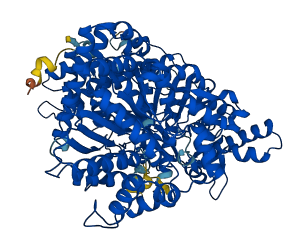
Descriptions
The autoinhibited protein was predicted that may have potential autoinhibitory elements via cis-regPred.
Autoinhibitory domains (AIDs)
Target domain |
|
Relief mechanism |
|
Assay |
cis-regPred |
Accessory elements
No accessory elements
Autoinhibited structure

Activated structure
1 structures for P09812
| Entry ID | Method | Resolution | Chain | Position | Source |
|---|---|---|---|---|---|
| AF-P09812-F1 | Predicted | AlphaFoldDB |
No variants for P09812
| Variant ID(s) | Position | Change | Description | Diseaes Association | Provenance |
|---|---|---|---|---|---|
| No variants for P09812 | |||||
No associated diseases with P09812
1 regional properties for P09812
| Type | Name | Position | InterPro Accession |
|---|---|---|---|
| conserved_site | Phosphorylase pyridoxal-phosphate attachment site | 673 - 685 | IPR035090 |
Functions
| Description | ||
|---|---|---|
| EC Number | 2.4.1.1 | Hexosyltransferases |
| Subcellular Localization |
|
|
| PANTHER Family | ||
| PANTHER Subfamily | ||
| PANTHER Protein Class | ||
| PANTHER Pathway Category | No pathway information available | |
2 GO annotations of cellular component
| Name | Definition |
|---|---|
| cytoplasm | The contents of a cell excluding the plasma membrane and nucleus, but including other subcellular structures. |
| sarcoplasmic reticulum | A fine reticular network of membrane-limited elements that pervades the sarcoplasm of a muscle cell; continuous over large portions of the cell and with the nuclear envelope; that part of the endoplasmic reticulum specialized for calcium release, uptake and storage. |
7 GO annotations of molecular function
| Name | Definition |
|---|---|
| AMP binding | Binding to AMP, adenosine monophosphate. |
| carbohydrate binding | Binding to a carbohydrate, which includes monosaccharides, oligosaccharides and polysaccharides as well as substances derived from monosaccharides by reduction of the carbonyl group (alditols), by oxidation of one or more hydroxy groups to afford the corresponding aldehydes, ketones, or carboxylic acids, or by replacement of one or more hydroxy group(s) by a hydrogen atom. Cyclitols are generally not regarded as carbohydrates. |
| glycogen phosphorylase activity | Catalysis of the reaction: glycogen + phosphate = maltodextrin + alpha-D-glucose 1-phosphate. |
| linear malto-oligosaccharide phosphorylase activity | Catalysis of the reaction: hydrogenphosphate + a linear malto-oligosaccharide = alpha-D-glucose 1-phosphate + a linear malto-oligosaccharide. |
| organic cyclic compound binding | Binding to an organic cyclic compound, any molecular entity that contains carbon arranged in a cyclic molecular structure. |
| pyridoxal phosphate binding | Binding to pyridoxal 5' phosphate, 3-hydroxy-5-(hydroxymethyl)-2-methyl4-pyridine carboxaldehyde 5' phosphate, the biologically active form of vitamin B6. |
| SHG alpha-glucan phosphorylase activity | Catalysis of the reaction: hydrogenphosphate + a plant soluble heteroglycan = alpha-D-glucose 1-phosphate + a plant soluble heteroglycan. |
6 GO annotations of biological process
| Name | Definition |
|---|---|
| cellular calcium ion homeostasis | Any process involved in the maintenance of an internal steady state of calcium ions at the level of a cell. |
| glycogen catabolic process | The chemical reactions and pathways resulting in the breakdown of glycogen, a polydisperse, highly branched glucan composed of chains of D-glucose residues. |
| glycogen metabolic process | The chemical reactions and pathways involving glycogen, a polydisperse, highly branched glucan composed of chains of D-glucose residues in alpha-(1->4) glycosidic linkage, joined together by alpha-(1->6) glycosidic linkages. |
| response to cAMP | Any process that results in a change in state or activity of a cell or an organism (in terms of movement, secretion, enzyme production, gene expression, etc.) as a result of a cAMP (cyclic AMP, adenosine 3',5'-cyclophosphate) stimulus. |
| response to hypoxia | Any process that results in a change in state or activity of a cell or an organism (in terms of movement, secretion, enzyme production, gene expression, etc.) as a result of a stimulus indicating lowered oxygen tension. Hypoxia, defined as a decline in O2 levels below normoxic levels of 20.8 - 20.95%, results in metabolic adaptation at both the cellular and organismal level. |
| response to organic substance | Any process that results in a change in state or activity of a cell or an organism (in terms of movement, secretion, enzyme production, gene expression, etc.) as a result of an organic substance stimulus. |
14 homologous proteins in AiPD
| UniProt AC | Gene Name | Protein Name | Species | Evidence Code |
|---|---|---|---|---|
| P06738 | GPH1 | Glycogen phosphorylase | Saccharomyces cerevisiae (strain ATCC 204508 / S288c) (Baker's yeast) | PR |
| Q0VCM4 | PYGL | Glycogen phosphorylase, liver form | Bos taurus (Bovine) | PR |
| P06737 | PYGL | Glycogen phosphorylase, liver form | Homo sapiens (Human) | PR |
| P11216 | PYGB | Glycogen phosphorylase, brain form | Homo sapiens (Human) | PR |
| P11217 | PYGM | Glycogen phosphorylase, muscle form | Homo sapiens (Human) | PR |
| Q8CI94 | Pygb | Glycogen phosphorylase, brain form | Mus musculus (Mouse) | PR |
| Q9ET01 | Pygl | Glycogen phosphorylase, liver form | Mus musculus (Mouse) | PR |
| Q9WUB3 | Pygm | Glycogen phosphorylase, muscle form | Mus musculus (Mouse) | PR |
| P04045 | Alpha-1,4 glucan phosphorylase L-1 isozyme, chloroplastic/amyloplastic | Solanum tuberosum (Potato) | PR | |
| P53535 | STP-1 | Alpha-1,4 glucan phosphorylase L-2 isozyme, chloroplastic/amyloplastic | Solanum tuberosum (Potato) | PR |
| P32811 | Alpha-glucan phosphorylase, H isozyme | Solanum tuberosum (Potato) | PR | |
| P09811 | Pygl | Glycogen phosphorylase, liver form | Rattus norvegicus (Rat) | PR |
| Q9LIB2 | PHS1 | Alpha-glucan phosphorylase 1 | Arabidopsis thaliana (Mouse-ear cress) | PR |
| Q9SD76 | PHS2 | Alpha-glucan phosphorylase 2, cytosolic | Arabidopsis thaliana (Mouse-ear cress) | PR |
| 10 | 20 | 30 | 40 | 50 | 60 |
| MSRPLSDQDK | RKQISVRGLA | GVENVSDLKK | NFNRHLHFTL | VKDRNVATPR | DYYFALAHTV |
| 70 | 80 | 90 | 100 | 110 | 120 |
| RDHLVDRWIR | TQQHYYAKDP | KRIYYLSLEL | YMGRTLQNTM | VNLALENACD | EATYQLGLDM |
| 130 | 140 | 150 | 160 | 170 | 180 |
| EELEEIEEDA | GLGNGGLGRL | AACFLDSMAT | LGLAAYGYGI | RYEFGIFNQK | ICGGWQMEEA |
| 190 | 200 | 210 | 220 | 230 | 240 |
| DDWLRYGNPW | EKARPEFTLP | VHFYGRVEHT | SQGAKWVDTQ | VVLAMPYDTP | VPGYRNNVVN |
| 250 | 260 | 270 | 280 | 290 | 300 |
| TMRLWSAKAP | PYFNLKDFNV | GGYIQAVLDR | NLAENISRVL | YPNDKFFEGK | ELRLKQEYFV |
| 310 | 320 | 330 | 340 | 350 | 360 |
| VAATLQDIIR | RFKSSKFGCR | DPVRTNFDAF | PDKVAIQLND | THPSLAIPEL | IRILVDLERL |
| 370 | 380 | 390 | 400 | 410 | 420 |
| DWDKAWDVTV | KTCAYTNHTV | LPEALERWPV | HLMETLLPRH | LQIIYEINQR | FLNRVAAAFP |
| 430 | 440 | 450 | 460 | 470 | 480 |
| GDVDRLRRMS | LVEEGAVKRI | NMAHLCIAGS | HAVNGVARIH | SEILKKTIFK | DFYELEPHKF |
| 490 | 500 | 510 | 520 | 530 | 540 |
| QNKTNGITPR | RWLVLCNPGL | AEVIAERIGE | EYISDLDQLR | KLLSYLDDQA | FIRDVAKVKQ |
| 550 | 560 | 570 | 580 | 590 | 600 |
| ENKLKFSAYL | ETEYKVHINP | NSLFDVQVKR | IHEYKRQLLN | CLHIITLYNR | IKREPNRFMV |
| 610 | 620 | 630 | 640 | 650 | 660 |
| PRTIMIGGKA | APGYHMAKMI | IKLITAIGDV | VNHDPAVGDR | FRVIFLENYR | VSLAEKVIPA |
| 670 | 680 | 690 | 700 | 710 | 720 |
| ADLSEQISTA | GTEASGTGNM | KFMLNGALTI | GTMDGANVEM | AEEAGEDNFF | IFGMRVEDVE |
| 730 | 740 | 750 | 760 | 770 | 780 |
| RLDQRGYNAQ | EYYDRIPELR | QIIEQLSSGF | FSPKQPDLFK | DIVNMVMHHD | RFKVFADYEE |
| 790 | 800 | 810 | 820 | 830 | 840 |
| YIKCQDKVSE | LYKNPREWTR | MVIRNIATSG | KFSSDRTIAQ | YAREIWGLEP | SRQRLPAPDE |
| KI |