P04642
Gene name |
Ldha (Ldh-1, Ldh1) |
Protein name |
L-lactate dehydrogenase A chain |
Names |
LDH-A, LDH muscle subunit, LDH-M |
Species |
Rattus norvegicus (Rat) |
KEGG Pathway |
rno:24533 |
EC number |
1.1.1.27: With NAD(+) or NADP(+) as acceptor |
Protein Class |
|
Descriptions
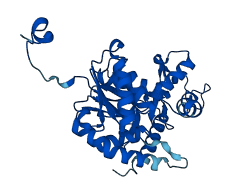
The autoinhibited protein was predicted that may have potential autoinhibitory elements via cis-regPred.
Autoinhibitory domains (AIDs)
Target domain |
|
Relief mechanism |
|
Assay |
cis-regPred |
Accessory elements
No accessory elements
Autoinhibited structure

Activated structure
14 structures for P04642
| Entry ID | Method | Resolution | Chain | Position | Source |
|---|---|---|---|---|---|
| 4AJ1 | X-ray | 187 A | A/B/C/D | 2-332 | PDB |
| 4AJ2 | X-ray | 175 A | A/B/C/D | 2-332 | PDB |
| 4AJ4 | X-ray | 190 A | A/B/C/D | 1-332 | PDB |
| 4AJE | X-ray | 235 A | A/B/C/D | 2-332 | PDB |
| 4AJH | X-ray | 193 A | A/B/C/D | 2-332 | PDB |
| 4AJI | X-ray | 193 A | A/B/C/D | 2-332 | PDB |
| 4AJJ | X-ray | 175 A | A/B/C/D | 2-332 | PDB |
| 4AJK | X-ray | 203 A | A/B/C/D | 2-332 | PDB |
| 4AJL | X-ray | 177 A | A/B/C/D | 2-332 | PDB |
| 4AJN | X-ray | 210 A | A/B/C/D | 2-332 | PDB |
| 4AJO | X-ray | 196 A | A/B/C/D | 2-332 | PDB |
| 4AL4 | X-ray | 178 A | A/B/C/D | 2-332 | PDB |
| 5ES3 | X-ray | 229 A | A/B/C/D/E/F/G/H | 2-332 | PDB |
| AF-P04642-F1 | Predicted | AlphaFoldDB |
No variants for P04642
| Variant ID(s) | Position | Change | Description | Diseaes Association | Provenance |
|---|---|---|---|---|---|
| No variants for P04642 | |||||
No associated diseases with P04642
No regional properties for P04642
| Type | Name | Position | InterPro Accession |
|---|---|---|---|
| No domain, repeats, and functional sites for P04642 | |||
Functions
| Description | ||
|---|---|---|
| EC Number | 1.1.1.27 | With NAD(+) or NADP(+) as acceptor |
| Subcellular Localization |
|
|
| PANTHER Family | ||
| PANTHER Subfamily | ||
| PANTHER Protein Class | ||
| PANTHER Pathway Category | No pathway information available | |
3 GO annotations of cellular component
| Name | Definition |
|---|---|
| cytosol | The part of the cytoplasm that does not contain organelles but which does contain other particulate matter, such as protein complexes. |
| oxidoreductase complex | Any protein complex that possesses oxidoreductase activity. |
| sperm fibrous sheath | A cytoskeletal structure surrounding the axoneme and outer dense fibers of the sperm flagellum. Consists of two longitudinal columns connected by closely arrayed semicircular ribs that assemble from distal to proximal throughout spermiogenesis. The fibrous sheath probably influences the degree of flexibility, plane of flagellar motion, and the shape of the flagellar beat. |
5 GO annotations of molecular function
| Name | Definition |
|---|---|
| identical protein binding | Binding to an identical protein or proteins. |
| kinase binding | Binding to a kinase, any enzyme that catalyzes the transfer of a phosphate group. |
| L-lactate dehydrogenase activity | Catalysis of the reaction: (S)-lactate + NAD+ = pyruvate + NADH + H+. |
| lactate dehydrogenase activity | Catalysis of the reaction: lactate + NAD+ = H+ + NADH + pyruvate. |
| NAD binding | Binding to nicotinamide adenine dinucleotide, a coenzyme involved in many redox and biosynthetic reactions; binding may be to either the oxidized form, NAD+, or the reduced form, NADH. |
15 GO annotations of biological process
| Name | Definition |
|---|---|
| cellular response to extracellular stimulus | Any process that results in a change in state or activity of a cell (in terms of movement, secretion, enzyme production, gene expression, etc.) as a result of an extracellular stimulus. |
| glucose catabolic process to lactate via pyruvate | The anaerobic enzymatic chemical reactions and pathways resulting in the breakdown of glucose to lactate, via canonical glycolysis, yielding energy in the form of adenosine triphosphate (ATP). |
| lactate metabolic process | The chemical reactions and pathways involving lactate, the anion of lactic acid. |
| NAD metabolic process | The chemical reactions and pathways involving nicotinamide adenine dinucleotide (NAD), a coenzyme present in most living cells and derived from the B vitamin nicotinic acid. |
| positive regulation of apoptotic process | Any process that activates or increases the frequency, rate or extent of cell death by apoptotic process. |
| post-embryonic animal organ development | Development, taking place during the post-embryonic phase of an animal tissue or tissues that work together to perform a specific function or functions. Development pertains to the process whose specific outcome is the progression of a structure over time, from its formation to the mature structure. Organs are commonly observed as visibly distinct structures, but may also exist as loosely associated clusters of cells that work together to perform a specific function or functions. |
| pyruvate metabolic process | The chemical reactions and pathways involving pyruvate, 2-oxopropanoate. |
| response to cAMP | Any process that results in a change in state or activity of a cell or an organism (in terms of movement, secretion, enzyme production, gene expression, etc.) as a result of a cAMP (cyclic AMP, adenosine 3',5'-cyclophosphate) stimulus. |
| response to estrogen | Any process that results in a change in state or activity of a cell or an organism (in terms of movement, secretion, enzyme production, gene expression, etc.) as a result of stimulus by an estrogen, C18 steroid hormones that can stimulate the development of female sexual characteristics. |
| response to glucose | Any process that results in a change in state or activity of a cell or an organism (in terms of movement, secretion, enzyme production, gene expression, etc.) as a result of a glucose stimulus. |
| response to hydrogen peroxide | Any process that results in a change in state or activity of a cell or an organism (in terms of movement, secretion, enzyme production, gene expression, etc.) as a result of a hydrogen peroxide (H2O2) stimulus. |
| response to hypoxia | Any process that results in a change in state or activity of a cell or an organism (in terms of movement, secretion, enzyme production, gene expression, etc.) as a result of a stimulus indicating lowered oxygen tension. Hypoxia, defined as a decline in O2 levels below normoxic levels of 20.8 - 20.95%, results in metabolic adaptation at both the cellular and organismal level. |
| response to nutrient | Any process that results in a change in state or activity of a cell or an organism (in terms of movement, secretion, enzyme production, gene expression, etc.) as a result of a nutrient stimulus. |
| response to organic cyclic compound | Any process that results in a change in state or activity of a cell or an organism (in terms of movement, secretion, enzyme production, gene expression, etc.) as a result of an organic cyclic compound stimulus. |
| response to xenobiotic stimulus | Any process that results in a change in state or activity of a cell or an organism (in terms of movement, secretion, enzyme production, gene expression, etc.) as a result of a stimulus from a xenobiotic, a compound foreign to the organim exposed to it. It may be synthesized by another organism (like ampicilin) or it can be a synthetic chemical. |
11 homologous proteins in AiPD
| UniProt AC | Gene Name | Protein Name | Species | Evidence Code |
|---|---|---|---|---|
| P19858 | LDHA | L-lactate dehydrogenase A chain | Bos taurus (Bovine) | PR |
| Q5E9B1 | LDHB | L-lactate dehydrogenase B chain | Bos taurus (Bovine) | PR |
| Q5R1W9 | LDHA | L-lactate dehydrogenase A chain | Pan troglodytes (Chimpanzee) | PR |
| P07195 | LDHB | L-lactate dehydrogenase B chain | Homo sapiens (Human) | PR |
| P07864 | LDHC | L-lactate dehydrogenase C chain | Homo sapiens (Human) | PR |
| P00338 | LDHA | L-lactate dehydrogenase A chain | Homo sapiens (Human) | PR |
| P16125 | Ldhb | L-lactate dehydrogenase B chain | Mus musculus (Mouse) | PR |
| P06151 | Ldha | L-lactate dehydrogenase A chain | Mus musculus (Mouse) | PR |
| P00339 | LDHA | L-lactate dehydrogenase A chain | Sus scrofa (Pig) | PR |
| Q66KB7 | uevld | Ubiquitin-conjugating enzyme E2 variant 3 | Xenopus tropicalis (Western clawed frog) (Silurana tropicalis) | PR |
| Q6DBY5 | uevld | Ubiquitin-conjugating enzyme E2 variant 3 | Danio rerio (Zebrafish) (Brachydanio rerio) | PR |
| 10 | 20 | 30 | 40 | 50 | 60 |
| MAALKDQLIV | NLLKEEQVPQ | NKITVVGVGA | VGMACAISIL | MKDLADELAL | VDVIEDKLKG |
| 70 | 80 | 90 | 100 | 110 | 120 |
| EMMDLQHGSL | FLKTPKIVSS | KDYSVTANSK | LVIITAGARQ | QEGESRLNLV | QRNVNIFKFI |
| 130 | 140 | 150 | 160 | 170 | 180 |
| IPNVVKYSPQ | CKLLIVSNPV | DILTYVAWKI | SGFPKNRVIG | SGCNLDSARF | RYLMGERLGV |
| 190 | 200 | 210 | 220 | 230 | 240 |
| HPLSCHGWVL | GEHGDSSVPV | WSGVNVAGVS | LKSLNPQLGT | DADKEQWKDV | HKQVVDSAYE |
| 250 | 260 | 270 | 280 | 290 | 300 |
| VIKLKGYTSW | AIGLSVADLA | ESIMKNLRRV | HPISTMIKGL | YGIKEDVFLS | VPCILGQNGI |
| 310 | 320 | 330 | |||
| SDVVKVTLTP | DEEARLKKSA | DTLWGIQKEL | QF |