O09032
Gene name |
Elavl4 (Hud) |
Protein name |
ELAV-like protein 4 |
Names |
IL-13 receptor subunit alpha-1, IL-13R subunit alpha-1, IL-13R-alpha-1, IL-13RA1, Interleukin-13-binding protein, Novel cytokine receptor 4, NR4, Hu-antigen D, HuD, Paraneoplastic encephalomyelitis antigen HuD |
Species |
Rattus norvegicus (Rat) |
KEGG Pathway |
rno:432358 |
EC number |
|
Protein Class |
|
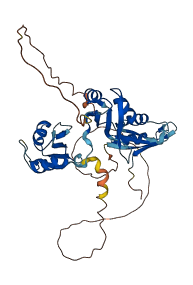
Descriptions
The autoinhibited protein was predicted that may have potential autoinhibitory elements via cis-regPred.
Autoinhibitory domains (AIDs)
Target domain |
|
Relief mechanism |
|
Assay |
cis-regPred |
Accessory elements
No accessory elements
Autoinhibited structure

Activated structure
1 structures for O09032
| Entry ID | Method | Resolution | Chain | Position | Source |
|---|---|---|---|---|---|
| AF-O09032-F1 | Predicted | AlphaFoldDB |
No variants for O09032
| Variant ID(s) | Position | Change | Description | Diseaes Association | Provenance |
|---|---|---|---|---|---|
| No variants for O09032 | |||||
No associated diseases with O09032
1 regional properties for O09032
| Type | Name | Position | InterPro Accession |
|---|---|---|---|
| domain | AP2/ERF domain | 106 - 170 | IPR001471 |
Functions
13 GO annotations of cellular component
| Name | Definition |
|---|---|
| axon | The long process of a neuron that conducts nerve impulses, usually away from the cell body to the terminals and varicosities, which are sites of storage and release of neurotransmitter. |
| cytoplasm | The contents of a cell excluding the plasma membrane and nucleus, but including other subcellular structures. |
| cytoskeleton | A cellular structure that forms the internal framework of eukaryotic and prokaryotic cells. The cytoskeleton includes intermediate filaments, microfilaments, microtubules, the microtrabecular lattice, and other structures characterized by a polymeric filamentous nature and long-range order within the cell. The various elements of the cytoskeleton not only serve in the maintenance of cellular shape but also have roles in other cellular functions, including cellular movement, cell division, endocytosis, and movement of organelles. |
| cytosol | The part of the cytoplasm that does not contain organelles but which does contain other particulate matter, such as protein complexes. |
| dendrite | A neuron projection that has a short, tapering, morphology. Dendrites receive and integrate signals from other neurons or from sensory stimuli, and conduct nerve impulses towards the axon or the cell body. In most neurons, the impulse is conveyed from dendrites to axon via the cell body, but in some types of unipolar neuron, the impulse does not travel via the cell body. |
| glutamatergic synapse | A synapse that uses glutamate as a neurotransmitter. |
| growth cone | The migrating motile tip of a growing neuron projection, where actin accumulates, and the actin cytoskeleton is the most dynamic. |
| membrane | A lipid bilayer along with all the proteins and protein complexes embedded in it an attached to it. |
| neuronal cell body | The portion of a neuron that includes the nucleus, but excludes cell projections such as axons and dendrites. |
| nuclear envelope | The double lipid bilayer enclosing the nucleus and separating its contents from the rest of the cytoplasm; includes the intermembrane space, a gap of width 20-40 nm (also called the perinuclear space). |
| nucleus | A membrane-bounded organelle of eukaryotic cells in which chromosomes are housed and replicated. In most cells, the nucleus contains all of the cell's chromosomes except the organellar chromosomes, and is the site of RNA synthesis and processing. In some species, or in specialized cell types, RNA metabolism or DNA replication may be absent. |
| perikaryon | The portion of the cell soma (neuronal cell body) that excludes the nucleus. |
| polysomal ribosome | A ribosome bound to mRNA that forms part of a polysome. |
6 GO annotations of molecular function
| Name | Definition |
|---|---|
| mRNA 3'-UTR AU-rich region binding | Binding to a region containing frequent adenine and uridine bases within the 3' untranslated region of a mRNA molecule or in pre-mRNA intron. The ARE-binding element consensus is UUAUUUAUU. ARE-binding proteins control the stability and/or translation of mRNAs. |
| mRNA 3'-UTR binding | Binding to a 3' untranslated region of an mRNA molecule. |
| mRNA binding | Binding to messenger RNA (mRNA), an intermediate molecule between DNA and protein. mRNA includes UTR and coding sequences, but does not contain introns. |
| poly(A) binding | Binding to a sequence of adenylyl residues in an RNA molecule, such as the poly(A) tail, a sequence of adenylyl residues at the 3' end of eukaryotic mRNA. |
| pre-mRNA intronic pyrimidine-rich binding | Binding to a pyrimidine-rich (CU-rich) intronic sequence of a pre-messenger RNA (pre-mRNA). |
| translation regulator activity | Any molecular function involved in the initiation, activation, perpetuation, repression or termination of polypeptide synthesis at the ribosome. |
20 GO annotations of biological process
| Name | Definition |
|---|---|
| 3'-UTR-mediated mRNA stabilization | An mRNA stabilization process in which one or more RNA-binding proteins associate with the 3'-untranslated region (UTR) of an mRNA. |
| aging | A developmental process that is a deterioration and loss of function over time. Aging includes loss of functions such as resistance to disease, homeostasis, and fertility, as well as wear and tear. Aging includes cellular senescence, but is more inclusive. May precede death and may succeed developmental maturation (GO:0021700). |
| associative learning | Learning by associating a stimulus (the cause) with a particular outcome (the effect). |
| cellular response to nerve growth factor stimulus | A process that results in a change in state or activity of a cell (in terms of movement, secretion, enzyme production, gene expression, etc.) as a result of a nerve growth factor stimulus. |
| cerebral cortex neuron differentiation | The process in which a relatively unspecialized cell acquires specialized features of a neuron residing in the cerebral cortex. |
| dendrite morphogenesis | The process in which the anatomical structures of a dendrite are generated and organized. |
| learning | Any process in an organism in which a relatively long-lasting adaptive behavioral change occurs as the result of experience. |
| locomotory behavior | The specific movement from place to place of an organism in response to external or internal stimuli. Locomotion of a whole organism in a manner dependent upon some combination of that organism's internal state and external conditions. |
| mRNA processing | Any process involved in the conversion of a primary mRNA transcript into one or more mature mRNA(s) prior to translation into polypeptide. |
| nervous system development | The process whose specific outcome is the progression of nervous tissue over time, from its formation to its mature state. |
| neuron differentiation | The process in which a relatively unspecialized cell acquires specialized features of a neuron. |
| positive regulation of 3'-UTR-mediated mRNA stabilization | Any process that activates or increases the frequency, rate or extent of 3'-UTR-mediated mRNA stabilization. |
| positive regulation of dendrite development | Any process that activates or increases the frequency, rate or extent of dendrite development. |
| regeneration | The regrowth of a lost or destroyed body part, such as an organ or tissue. This process may occur via renewal, repair, and/or growth alone (i.e. increase in size or mass). |
| regulation of mRNA stability | Any process that modulates the propensity of mRNA molecules to degradation. Includes processes that both stabilize and destabilize mRNAs. |
| regulation of translation at synapse, modulating synaptic transmission | Any process that modulates synaptic transmission by regulating translation occurring at the synapse. |
| response to cocaine | Any process that results in a change in state or activity of a cell or an organism (in terms of movement, secretion, enzyme production, gene expression, etc.) as a result of a cocaine stimulus. Cocaine is a crystalline alkaloid obtained from the leaves of the coca plant. |
| response to endoplasmic reticulum stress | Any process that results in a change in state or activity of a cell (in terms of movement, secretion, enzyme production, gene expression, etc.) as a result of a stress acting at the endoplasmic reticulum. ER stress usually results from the accumulation of unfolded or misfolded proteins in the ER lumen. |
| RNA processing | Any process involved in the conversion of one or more primary RNA transcripts into one or more mature RNA molecules. |
| RNA splicing | The process of removing sections of the primary RNA transcript to remove sequences not present in the mature form of the RNA and joining the remaining sections to form the mature form of the RNA. |
12 homologous proteins in AiPD
| UniProt AC | Gene Name | Protein Name | Species | Evidence Code |
|---|---|---|---|---|
| Q14576 | ELAVL3 | ELAV-like protein 3 | Homo sapiens (Human) | PR |
| Q12926 | ELAVL2 | ELAV-like protein 2 | Homo sapiens (Human) | PR |
| P26378 | ELAVL4 | ELAV-like protein 4 | Homo sapiens (Human) | PR |
| Q60900 | Elavl3 | ELAV-like protein 3 | Mus musculus (Mouse) | PR |
| Q7TPD6 | Raver2 | Ribonucleoprotein PTB-binding 2 | Mus musculus (Mouse) | PR |
| Q60899 | Elavl2 | ELAV-like protein 2 | Mus musculus (Mouse) | PR |
| Q61701 | Elavl4 | ELAV-like protein 4 | Mus musculus (Mouse) | PR |
| Q8CH84 | Elavl2 | ELAV-like protein 2 | Rattus norvegicus (Rat) | PR |
| Q5RK09 | Eif3g | Eukaryotic translation initiation factor 3 subunit G | Rattus norvegicus (Rat) | PR |
| Q28FX0 | elavl3 | ELAV-like protein 3 | Xenopus tropicalis (Western clawed frog) (Silurana tropicalis) | PR |
| Q28GD4 | elavl2 | ELAV-like protein 2 | Xenopus tropicalis (Western clawed frog) (Silurana tropicalis) | PR |
| A4QNI8 | elavl4 | ELAV-like protein 4 | Xenopus tropicalis (Western clawed frog) (Silurana tropicalis) | PR |
| 10 | 20 | 30 | 40 | 50 | 60 |
| MEWNGLKMII | STMEPQVSNG | PTSNTSNGPS | SNNRNCPSPM | QTGAATDDSK | TNLIVNYLPQ |
| 70 | 80 | 90 | 100 | 110 | 120 |
| NMTQEEFRSL | FGSIGEIESC | KLVRDKITGQ | SLGYGFVNYI | DPKDAEKAIN | TLNGLRLQTK |
| 130 | 140 | 150 | 160 | 170 | 180 |
| TIKVSYARPS | SASIRDANLY | VSGLPKTMTQ | KELEQLFSQY | GRIITSRILV | DQVTGVSRGV |
| 190 | 200 | 210 | 220 | 230 | 240 |
| GFIRFDKRIE | AEEAIKGLNG | QKPSGATEPI | TVKFANNPSQ | KSSQALLSQL | YQSPNRRYPG |
| 250 | 260 | 270 | 280 | 290 | 300 |
| PLHHQAQRFR | LDNLLNMAYG | VKRLMSGPVP | PSACPPRFSP | ITIDGMTSLV | GMNIPGHTGT |
| 310 | 320 | 330 | 340 | 350 | 360 |
| GWCIFVYNLS | PDSDESVLWQ | LFGPFGAVNN | VKVIRDFNTN | KCKGFGFVTM | TNYDEAAMAI |
| 370 | 380 | ||||
| ASLNGYRLGD | RVLQVSFKTN | KAHKS |