Q9VSE7
Gene name |
mthl7 (CG7476) |
Protein name |
Probable G-protein coupled receptor Mth-like 7 |
Names |
Protein methuselah-like 7 |
Species |
Drosophila melanogaster (Fruit fly) |
KEGG Pathway |
dme:Dmel_CG7476 |
EC number |
|
Protein Class |
|
Descriptions
The autoinhibited protein was predicted that may have potential autoinhibitory elements via cis-regPred.
Autoinhibitory domains (AIDs)
Target domain |
|
Relief mechanism |
|
Assay |
cis-regPred |
Accessory elements
No accessory elements
Autoinhibited structure

Activated structure
1 structures for Q9VSE7
| Entry ID | Method | Resolution | Chain | Position | Source |
|---|---|---|---|---|---|
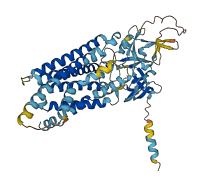
| AF-Q9VSE7-F1 | Predicted | AlphaFoldDB |
No variants for Q9VSE7
| Variant ID(s) | Position | Change | Description | Diseaes Association | Provenance |
|---|---|---|---|---|---|
| No variants for Q9VSE7 | |||||
No associated diseases with Q9VSE7
10 regional properties for Q9VSE7
| Type | Name | Position | InterPro Accession |
|---|---|---|---|
| domain | GPS motif | 815 - 868 | IPR000203 |
| repeat | Thrombospondin type-1 (TSP1) repeat | 291 - 343 | IPR000884-1 |
| repeat | Thrombospondin type-1 (TSP1) repeat | 345 - 398 | IPR000884-2 |
| repeat | Thrombospondin type-1 (TSP1) repeat | 400 - 453 | IPR000884-3 |
| repeat | Thrombospondin type-1 (TSP1) repeat | 455 - 508 | IPR000884-4 |
| domain | GPCR, family 2, extracellular hormone receptor domain | 491 - 576 | IPR001879 |
| domain | GPCR, family 2-like, transmembrane domain | 877 - 1151 | IPR017981 |
| conserved_site | GPCR, family 2, secretin-like, conserved site | 1139 - 1154 | IPR017983 |
| domain | GAIN domain, N-terminal | 595 - 793 | IPR032471 |
| domain | Adhesion G protein-coupled receptor B, N-terminal domain | 30 - 201 | IPR043838 |
2 GO annotations of cellular component
| Name | Definition |
|---|---|
| integral component of membrane | The component of a membrane consisting of the gene products and protein complexes having at least some part of their peptide sequence embedded in the hydrophobic region of the membrane. |
| plasma membrane | The membrane surrounding a cell that separates the cell from its external environment. It consists of a phospholipid bilayer and associated proteins. |
1 GO annotations of molecular function
| Name | Definition |
|---|---|
| G protein-coupled receptor activity | Combining with an extracellular signal and transmitting the signal across the membrane by activating an associated G-protein; promotes the exchange of GDP for GTP on the alpha subunit of a heterotrimeric G-protein complex. |
4 GO annotations of biological process
| Name | Definition |
|---|---|
| cell surface receptor signaling pathway | The series of molecular signals initiated by activation of a receptor on the surface of a cell. The pathway begins with binding of an extracellular ligand to a cell surface receptor, or for receptors that signal in the absence of a ligand, by ligand-withdrawal or the activity of a constitutively active receptor. The pathway ends with regulation of a downstream cellular process, e.g. transcription. |
| determination of adult lifespan | The pathways that regulate the duration of the adult phase of the life-cycle of an animal. |
| G protein-coupled receptor signaling pathway | The series of molecular signals initiated by a ligand binding to its receptor, in which the activated receptor promotes the exchange of GDP for GTP on the alpha-subunit of an associated heterotrimeric G-protein complex. The GTP-bound activated alpha-G-protein then dissociates from the beta- and gamma-subunits to further transmit the signal within the cell. The pathway begins with receptor-ligand interaction, and ends with regulation of a downstream cellular process. The pathway can start from the plasma membrane, Golgi or nuclear membrane. |
| response to starvation | Any process that results in a change in state or activity of a cell or an organism (in terms of movement, secretion, enzyme production, gene expression, etc.) as a result of a starvation stimulus, deprivation of nourishment. |
9 homologous proteins in AiPD
| UniProt AC | Gene Name | Protein Name | Species | Evidence Code |
|---|---|---|---|---|
| Q9W0R6 | mthl9 | Probable G-protein coupled receptor Mth-like 9 | Drosophila melanogaster (Fruit fly) | PR |
| Q9W0R5 | mthl10 | Probable G-protein coupled receptor Mth-like 10 | Drosophila melanogaster (Fruit fly) | PR |
| O97148 | mth | G-protein coupled receptor Mth | Drosophila melanogaster (Fruit fly) | PR |
| P83119 | mthl12 | Probable G-protein coupled receptor Mth-like 12 | Drosophila melanogaster (Fruit fly) | PR |
| Q8IZF3 | ADGRF4 | Adhesion G protein-coupled receptor F4 | Homo sapiens (Human) | PR |
| Q9UHX3 | ADGRE2 | Adhesion G protein-coupled receptor E2 | Homo sapiens (Human) | PR |
| Q86SQ4 | ADGRG6 | Adhesion G-protein coupled receptor G6 | Homo sapiens (Human) | PR |
| Q80TR1 | Adgrl1 | Adhesion G protein-coupled receptor L1 | Mus musculus (Mouse) | PR |
| Q2Q426 | ADGRE2 | Adhesion G protein-coupled receptor E2 | Macaca mulatta (Rhesus macaque) | PR |
| 10 | 20 | 30 | 40 | 50 | 60 |
| MRLPWVIFCT | VLLLIFTNNS | NADIPGCNYY | DTVDISYIER | QNDSYLYDDI | EIPASLTGYY |
| 70 | 80 | 90 | 100 | 110 | 120 |
| EFRQFGDGSI | TPIEKHLRAC | VCSVRPCIRI | CCPAKNFLAN | GKCDDGLKEE | LARFKPYIYF |
| 130 | 140 | 150 | 160 | 170 | 180 |
| TYMDLQARVP | LTDMAIIRDE | FFDCDEMIYI | SDFNYFLEEV | SIQIFNKCGL | IVWFQDGKFW |
| 190 | 200 | 210 | 220 | 230 | 240 |
| VTVDLFMEKQ | DYCLYRHNFD | SDFPKSMWII | RHRCTSHISP | GSLEILIITM | ICFVLTIAVY |
| 250 | 260 | 270 | 280 | 290 | 300 |
| LYIKKLRNVT | GKCIVCCIVS | RFIQCLIMIL | DHLNLLNGIC | SPAGYSSHFF | RMASNLWLSV |
| 310 | 320 | 330 | 340 | 350 | 360 |
| ISYHTWKVLT | SLNRVDPNYR | FLRYNAFVWS | TAAIMTGSIY | IVNQIWENDP | SKWNWLPLVG |
| 370 | 380 | 390 | 400 | 410 | 420 |
| FIRCSVKDWH | PSVWIYISGP | SLALSTFNVA | MFALTAIYIR | KVKGGINKFT | NEEEGRINCI |
| 430 | 440 | 450 | 460 | 470 | 480 |
| NFDSQTYLQF | LRLSIVMGLT | WIFNVIPYSA | RLHIFWEWVG | IISEYFHSAF | GIVLFVLLVL |
| 490 | |||||
| KRSTWTLMMD | S |