P83119
Gene name |
mthl12 |
Protein name |
Probable G-protein coupled receptor Mth-like 12 |
Names |
Protein methuselah-like 12 |
Species |
Drosophila melanogaster (Fruit fly) |
KEGG Pathway |
dme:Dmel_CG32853 |
EC number |
|
Protein Class |
|
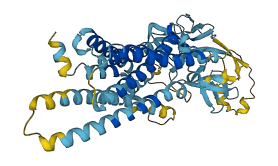
Descriptions
The autoinhibited protein was predicted that may have potential autoinhibitory elements via cis-regPred.
Autoinhibitory domains (AIDs)
Target domain |
|
Relief mechanism |
|
Assay |
cis-regPred |
Accessory elements
No accessory elements
Autoinhibited structure

Activated structure
1 structures for P83119
| Entry ID | Method | Resolution | Chain | Position | Source |
|---|---|---|---|---|---|
| AF-P83119-F1 | Predicted | AlphaFoldDB |
No variants for P83119
| Variant ID(s) | Position | Change | Description | Diseaes Association | Provenance |
|---|---|---|---|---|---|
| No variants for P83119 | |||||
No associated diseases with P83119
2 GO annotations of cellular component
| Name | Definition |
|---|---|
| integral component of membrane | The component of a membrane consisting of the gene products and protein complexes having at least some part of their peptide sequence embedded in the hydrophobic region of the membrane. |
| plasma membrane | The membrane surrounding a cell that separates the cell from its external environment. It consists of a phospholipid bilayer and associated proteins. |
1 GO annotations of molecular function
| Name | Definition |
|---|---|
| G protein-coupled receptor activity | Combining with an extracellular signal and transmitting the signal across the membrane by activating an associated G-protein; promotes the exchange of GDP for GTP on the alpha subunit of a heterotrimeric G-protein complex. |
5 GO annotations of biological process
| Name | Definition |
|---|---|
| anatomical structure development | The biological process whose specific outcome is the progression of an anatomical structure from an initial condition to its mature state. This process begins with the formation of the structure and ends with the mature structure, whatever form that may be including its natural destruction. An anatomical structure is any biological entity that occupies space and is distinguished from its surroundings. Anatomical structures can be macroscopic such as a carpel, or microscopic such as an acrosome. |
| cell surface receptor signaling pathway | The series of molecular signals initiated by activation of a receptor on the surface of a cell. The pathway begins with binding of an extracellular ligand to a cell surface receptor, or for receptors that signal in the absence of a ligand, by ligand-withdrawal or the activity of a constitutively active receptor. The pathway ends with regulation of a downstream cellular process, e.g. transcription. |
| determination of adult lifespan | The pathways that regulate the duration of the adult phase of the life-cycle of an animal. |
| G protein-coupled receptor signaling pathway | The series of molecular signals initiated by a ligand binding to its receptor, in which the activated receptor promotes the exchange of GDP for GTP on the alpha-subunit of an associated heterotrimeric G-protein complex. The GTP-bound activated alpha-G-protein then dissociates from the beta- and gamma-subunits to further transmit the signal within the cell. The pathway begins with receptor-ligand interaction, and ends with regulation of a downstream cellular process. The pathway can start from the plasma membrane, Golgi or nuclear membrane. |
| response to starvation | Any process that results in a change in state or activity of a cell or an organism (in terms of movement, secretion, enzyme production, gene expression, etc.) as a result of a starvation stimulus, deprivation of nourishment. |
9 homologous proteins in AiPD
| UniProt AC | Gene Name | Protein Name | Species | Evidence Code |
|---|---|---|---|---|
| Q9W0R6 | mthl9 | Probable G-protein coupled receptor Mth-like 9 | Drosophila melanogaster (Fruit fly) | PR |
| Q9W0R5 | mthl10 | Probable G-protein coupled receptor Mth-like 10 | Drosophila melanogaster (Fruit fly) | PR |
| Q9VSE7 | mthl7 | Probable G-protein coupled receptor Mth-like 7 | Drosophila melanogaster (Fruit fly) | PR |
| O97148 | mth | G-protein coupled receptor Mth | Drosophila melanogaster (Fruit fly) | PR |
| Q8IZF3 | ADGRF4 | Adhesion G protein-coupled receptor F4 | Homo sapiens (Human) | PR |
| Q9UHX3 | ADGRE2 | Adhesion G protein-coupled receptor E2 | Homo sapiens (Human) | PR |
| Q86SQ4 | ADGRG6 | Adhesion G-protein coupled receptor G6 | Homo sapiens (Human) | PR |
| Q80TR1 | Adgrl1 | Adhesion G protein-coupled receptor L1 | Mus musculus (Mouse) | PR |
| Q2Q426 | ADGRE2 | Adhesion G protein-coupled receptor E2 | Macaca mulatta (Rhesus macaque) | PR |
| 10 | 20 | 30 | 40 | 50 | 60 |
| MFLWLKCFCT | LIIVTIAKNS | SAKIPHCKYD | ETINISHFKR | LNDAYIYEHF | EIPANLTGEF |
| 70 | 80 | 90 | 100 | 110 | 120 |
| DYKELMDGSK | VPTEFPNLRG | CICKVRPCIR | ICCARKNILS | NGECSDGVKN | EIKLTMLDLT |
| 130 | 140 | 150 | 160 | 170 | 180 |
| MQDILLTDPT | LAELNMIPQY | NSTELLILRE | QFQPCDEIVS | LKRDEYTILK | DGSILLHTSA |
| 190 | 200 | 210 | 220 | 230 | 240 |
| EILSNDQYCL | YPEIYSDFPE | TIRIINRRCY | RNVMPGIAQL | SVISVVGFIL | TLAVYLSVEK |
| 250 | 260 | 270 | 280 | 290 | 300 |
| LRNLLGKCLI | CSLFSMFMEY | FIWTMDYFRL | LQSICSAAGY | MKYFFSMSSY | LWFSVVSFHL |
| 310 | 320 | 330 | 340 | 350 | 360 |
| WELFTSLNRH | EPQYRFLIYN | TFVWCTAAIP | TVVIFSMNQM | WENDPGKSEW | LPLVGYFGCS |
| 370 | 380 | 390 | 400 | 410 | 420 |
| VKDWNSSSWF | YSHIPIVILN | SFNVIMFVLT | AIYIWKVKKG | VKSFAQHDER | NTTCLEFNVQ |
| 430 | 440 | 450 | 460 | 470 | 480 |
| TYIQFVRLFL | IMGASWLLDQ | LTRLAEDSHL | LLDTIVLNLT | VYLNAAFGIL | IFVLLILKGS |
| TFKMIMER |