Q9FMP3
Gene name |
PYD2 |
Protein name |
Dihydropyrimidinase |
Names |
Dihydropyrimidine amidohydrolase, Protein PYRIMIDINE 2 |
Species |
Arabidopsis thaliana (Mouse-ear cress) |
KEGG Pathway |
ath:AT5G12200 |
EC number |
3.5.2.2: In cyclic amides |
Protein Class |
|
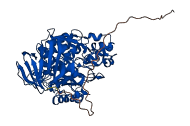
Descriptions
The autoinhibited protein was predicted that may have potential autoinhibitory elements via cis-regPred.
Autoinhibitory domains (AIDs)
Target domain |
|
Relief mechanism |
|
Assay |
cis-regPred |
Accessory elements
No accessory elements
Autoinhibited structure

Activated structure
1 structures for Q9FMP3
| Entry ID | Method | Resolution | Chain | Position | Source |
|---|---|---|---|---|---|
| AF-Q9FMP3-F1 | Predicted | AlphaFoldDB |
28 variants for Q9FMP3
| Variant ID(s) | Position | Change | Description | Diseaes Association | Provenance |
|---|---|---|---|---|---|
| ENSVATH00618850 | 4 | D>N | No | 1000Genomes | |
| ENSVATH06958481 | 11 | S>F | No | 1000Genomes | |
| ENSVATH06958482 | 11 | S>P | No | 1000Genomes | |
| ENSVATH14005704 | 45 | T>M | No | 1000Genomes | |
| tmp_5_3944332_C_T | 57 | A>T | No | 1000Genomes | |
| tmp_5_3944175_C_T | 81 | V>I | No | 1000Genomes | |
| ENSVATH03049955 | 151 | A>S | No | 1000Genomes | |
| ENSVATH03049954 | 154 | N>K | No | 1000Genomes | |
| ENSVATH14005701 | 161 | M>I | No | 1000Genomes | |
| ENSVATH03049950 | 182 | M>I | No | 1000Genomes | |
| tmp_5_3943745_T_C | 182 | M>V | No | 1000Genomes | |
| tmp_5_3943570_C_T | 204 | V>I | No | 1000Genomes | |
| ENSVATH14005700 | 223 | A>T | No | 1000Genomes | |
| tmp_5_3943423_G_A | 253 | L>F | No | 1000Genomes | |
| ENSVATH06958461 | 263 | A>S | No | 1000Genomes | |
| tmp_5_3943223_T_A | 276 | T>S | No | 1000Genomes | |
| tmp_5_3943179_G_T | 290 | D>E | No | 1000Genomes | |
| tmp_5_3942940_C_T | 307 | V>I | No | 1000Genomes | |
| tmp_5_3942767_C_T | 338 | V>I | No | 1000Genomes | |
| tmp_5_3942599_T_C | 358 | T>A | No | 1000Genomes | |
| tmp_5_3942544_C_A | 376 | R>L | No | 1000Genomes | |
| ENSVATH00618843 | 377 | R>K | No | 1000Genomes | |
| ENSVATH03049942 | 402 | L>I | No | 1000Genomes | |
| tmp_5_3942283_C_T | 409 | R>Q | No | 1000Genomes | |
| ENSVATH03049939 | 458 | T>I | No | 1000Genomes | |
| ENSVATH06958445 | 494 | K>N | No | 1000Genomes | |
| tmp_5_3941801_G_A | 499 | P>S | No | 1000Genomes | |
| ENSVATH14005697 | 514 | N>T | No | 1000Genomes |
No associated diseases with Q9FMP3
1 regional properties for Q9FMP3
| Type | Name | Position | InterPro Accession |
|---|---|---|---|
| domain | Amidohydrolase-related | 94 - 480 | IPR006680 |
Functions
| Description | ||
|---|---|---|
| EC Number | 3.5.2.2 | In cyclic amides |
| Subcellular Localization |
|
|
| PANTHER Family | ||
| PANTHER Subfamily | ||
| PANTHER Protein Class | ||
| PANTHER Pathway Category | No pathway information available | |
4 GO annotations of cellular component
| Name | Definition |
|---|---|
| endomembrane system | A collection of membranous structures involved in transport within the cell. The main components of the endomembrane system are endoplasmic reticulum, Golgi bodies, vesicles, cell membrane and nuclear envelope. Members of the endomembrane system pass materials through each other or though the use of vesicles. |
| endoplasmic reticulum | The irregular network of unit membranes, visible only by electron microscopy, that occurs in the cytoplasm of many eukaryotic cells. The membranes form a complex meshwork of tubular channels, which are often expanded into slitlike cavities called cisternae. The ER takes two forms, rough (or granular), with ribosomes adhering to the outer surface, and smooth (with no ribosomes attached). |
| Golgi apparatus | A membrane-bound cytoplasmic organelle of the endomembrane system that further processes the core oligosaccharides (e.g. N-glycans) added to proteins in the endoplasmic reticulum and packages them into membrane-bound vesicles. The Golgi apparatus operates at the intersection of the secretory, lysosomal, and endocytic pathways. |
| plastid | Any member of a family of organelles found in the cytoplasm of plants and some protists, which are membrane-bounded and contain DNA. Plant plastids develop from a common type, the proplastid. |
2 GO annotations of molecular function
| Name | Definition |
|---|---|
| dihydropyrimidinase activity | Catalysis of the reaction: 5,6-dihydrouracil + H2O = 3-ureidopropionate. |
| metal ion binding | Binding to a metal ion. |
4 GO annotations of biological process
| Name | Definition |
|---|---|
| beta-alanine biosynthetic process | The chemical reactions and pathways resulting in the formation of beta-alanine (3-aminopropanoic acid), an achiral amino acid and an isomer of alanine. It occurs free (e.g. in brain) and in combination (e.g. in pantothenate) but it is not a constituent of proteins. |
| cellular response to nitrogen levels | Any process that results in a change in state or activity of a cell (in terms of movement, secretion, enzyme production, gene expression, etc.) as a result of a stimulus reflecting the presence, absence, or concentration of inorganic nitrogen. |
| pyrimidine nucleobase catabolic process | The chemical reactions and pathways resulting in the breakdown of pyrimidine nucleobases, 1,3-diazine, organic nitrogenous bases. |
| uracil catabolic process | The chemical reactions and pathways resulting in the breakdown of uracil, 2,4-dioxopyrimidine, one of the pyrimidine bases occurring in RNA, but not in DNA. |
10 homologous proteins in AiPD
| UniProt AC | Gene Name | Protein Name | Species | Evidence Code |
|---|---|---|---|---|
| Q90635 | DPYSL2 | Dihydropyrimidinase-related protein 2 | Gallus gallus (Chicken) | PR |
| Q14194 | CRMP1 | Dihydropyrimidinase-related protein 1 | Homo sapiens (Human) | PR |
| Q16555 | DPYSL2 | Dihydropyrimidinase-related protein 2 | Homo sapiens (Human) | PR |
| Q14195 | DPYSL3 | Dihydropyrimidinase-related protein 3 | Homo sapiens (Human) | PR |
| O08553 | Dpysl2 | Dihydropyrimidinase-related protein 2 | Mus musculus (Mouse) | PR |
| P97427 | Crmp1 | Dihydropyrimidinase-related protein 1 | Mus musculus (Mouse) | PR |
| Q62188 | Dpysl3 | Dihydropyrimidinase-related protein 3 | Mus musculus (Mouse) | PR |
| P47942 | Dpysl2 | Dihydropyrimidinase-related protein 2 | Rattus norvegicus (Rat) | PR |
| Q62952 | Dpysl3 | Dihydropyrimidinase-related protein 3 | Rattus norvegicus (Rat) | PR |
| Q6GL72 | dpysl3 | Dihydropyrimidinase-related protein 3 | Xenopus tropicalis (Western clawed frog) (Silurana tropicalis) | PR |
| 10 | 20 | 30 | 40 | 50 | 60 |
| MALDAFFFIV | SLFLLFPSPS | ASESTTQFCS | AGRENGVGSC | GVSSTRILIK | GGTVVNAHHQ |
| 70 | 80 | 90 | 100 | 110 | 120 |
| ELADVYVENG | IIVAVQPNIK | VGDEVTVLDA | TGKFVMPGGI | DPHTHLAMEF | MGTETIDDFF |
| 130 | 140 | 150 | 160 | 170 | 180 |
| SGQAAALAGG | TTMHIDFVIP | VNGNLVAGFE | AYENKSRESC | MDYGFHMAIT | KWDEGVSRDM |
| 190 | 200 | 210 | 220 | 230 | 240 |
| EMLVKEKGIN | SFKFFLAYKG | SLMVTDDLLL | EGLKRCKSLG | ALAMVHAENG | DAVFEGQKRM |
| 250 | 260 | 270 | 280 | 290 | 300 |
| IELGITGPEG | HALSRPPVLE | GEATARAIRL | ARFINTPLYV | VHVMSVDAMD | EIAKARKSGQ |
| 310 | 320 | 330 | 340 | 350 | 360 |
| KVIGEPVVSG | LILDDHWLWD | PDFTIASKYV | MSPPIRPVGH | GKALQDALST | GILQLVGTDH |
| 370 | 380 | 390 | 400 | 410 | 420 |
| CTFNSTQKAL | GLDDFRRIPN | GVNGLEERMH | LIWDTMVESG | QLSATDYVRI | TSTECARIFN |
| 430 | 440 | 450 | 460 | 470 | 480 |
| IYPRKGAILA | GSDADIIILN | PNSSYEISSK | SHHSRSDTNV | YEGRRGKGKV | EVTIAGGRIV |
| 490 | 500 | 510 | 520 | 530 | |
| WENEELKVVP | RSGKYIEMPP | FSYLFDGIEK | SDANYLSSLR | APVKRVRTEA | T |