Q62952
Gene name |
Dpysl3 (Crmp4) |
Protein name |
Dihydropyrimidinase-related protein 3 |
Names |
DRP-3, Collapsin response mediator protein 4, CRMP-4, TOAD-64/Ulip/CRMP, TUC-4b |
Species |
Rattus norvegicus (Rat) |
KEGG Pathway |
rno:25418 |
EC number |
|
Protein Class |
|
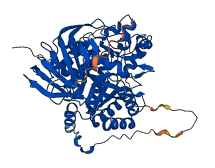
Descriptions
The autoinhibited protein was predicted that may have potential autoinhibitory elements via cis-regPred.
Autoinhibitory domains (AIDs)
Target domain |
|
Relief mechanism |
|
Assay |
cis-regPred |
Accessory elements
No accessory elements
Autoinhibited structure

Activated structure
1 structures for Q62952
| Entry ID | Method | Resolution | Chain | Position | Source |
|---|---|---|---|---|---|
| AF-Q62952-F1 | Predicted | AlphaFoldDB |
1 variants for Q62952
| Variant ID(s) | Position | Change | Description | Diseaes Association | Provenance |
|---|---|---|---|---|---|
| rs8171757 | 466 | G>V | No | EVA |
No associated diseases with Q62952
1 regional properties for Q62952
| Type | Name | Position | InterPro Accession |
|---|---|---|---|
| domain | Amidohydrolase-related | 64 - 453 | IPR006680 |
7 GO annotations of cellular component
| Name | Definition |
|---|---|
| cell body | The portion of a cell bearing surface projections such as axons, dendrites, cilia, or flagella that includes the nucleus, but excludes all cell projections. |
| cytosol | The part of the cytoplasm that does not contain organelles but which does contain other particulate matter, such as protein complexes. |
| extracellular space | That part of a multicellular organism outside the cells proper, usually taken to be outside the plasma membranes, and occupied by fluid. |
| filamentous actin | A two-stranded helical polymer of the protein actin. |
| growth cone | The migrating motile tip of a growing neuron projection, where actin accumulates, and the actin cytoskeleton is the most dynamic. |
| lamellipodium | A thin sheetlike process extended by the leading edge of a migrating cell or extending cell process; contains a dense meshwork of actin filaments. |
| synapse | The junction between an axon of one neuron and a dendrite of another neuron, a muscle fiber or a glial cell. As the axon approaches the synapse it enlarges into a specialized structure, the presynaptic terminal bouton, which contains mitochondria and synaptic vesicles. At the tip of the terminal bouton is the presynaptic membrane; facing it, and separated from it by a minute cleft (the synaptic cleft) is a specialized area of membrane on the receiving cell, known as the postsynaptic membrane. In response to the arrival of nerve impulses, the presynaptic terminal bouton secretes molecules of neurotransmitters into the synaptic cleft. These diffuse across the cleft and transmit the signal to the postsynaptic membrane. |
6 GO annotations of molecular function
| Name | Definition |
|---|---|
| chondroitin sulfate binding | Binding to chondroitin sulfate, a glycosaminoglycan made up of two alternating monosaccharides: D-glucuronic acid (GlcA) and N-acetyl-D-galactosamine (GalNAc). |
| filamin binding | Binding to a filamin, any member of a family of high molecular mass cytoskeletal proteins that crosslink actin filaments to form networks and stress fibers. Filamins contain an amino-terminal alpha-actinin-like actin binding domain, which is followed by a rod-domain composed of 4 to 24 100-residue repetitive segments including a carboxy-terminal dimerization domain. |
| hydrolase activity, acting on carbon-nitrogen (but not peptide) bonds | Catalysis of the hydrolysis of any carbon-nitrogen bond, C-N, with the exception of peptide bonds. |
| identical protein binding | Binding to an identical protein or proteins. |
| phosphoprotein binding | Binding to a phosphorylated protein. |
| SH3 domain binding | Binding to a SH3 domain (Src homology 3) of a protein, small protein modules containing approximately 50 amino acid residues found in a great variety of intracellular or membrane-associated proteins. |
10 GO annotations of biological process
| Name | Definition |
|---|---|
| actin crosslink formation | The process in which two or more actin filaments are connected together by proteins that act as crosslinks between the filaments. The crosslinked filaments may be on the same or differing axes. |
| actin filament bundle assembly | The assembly of actin filament bundles; actin filaments are on the same axis but may be oriented with the same or opposite polarities and may be packed with different levels of tightness. |
| cellular response to cytokine stimulus | Any process that results in a change in state or activity of a cell (in terms of movement, secretion, enzyme production, gene expression, etc.) as a result of a cytokine stimulus. |
| negative regulation of cell migration | Any process that stops, prevents, or reduces the frequency, rate or extent of cell migration. |
| negative regulation of neuron projection development | Any process that decreases the rate, frequency or extent of neuron projection development. Neuron projection development is the process whose specific outcome is the progression of a neuron projection over time, from its formation to the mature structure. A neuron projection is any process extending from a neural cell, such as axons or dendrites (collectively called neurites). |
| nervous system development | The process whose specific outcome is the progression of nervous tissue over time, from its formation to its mature state. |
| neuron development | The process whose specific outcome is the progression of a neuron over time, from initial commitment of the cell to a specific fate, to the fully functional differentiated cell. |
| positive regulation of filopodium assembly | Any process that activates or increases the frequency, rate or extent of the assembly of a filopodium, a thin, stiff protrusion extended by the leading edge of a motile cell such as a crawling fibroblast or amoeba, or an axonal growth cone. |
| positive regulation of neuron projection development | Any process that increases the rate, frequency or extent of neuron projection development. Neuron projection development is the process whose specific outcome is the progression of a neuron projection over time, from its formation to the mature structure. A neuron projection is any process extending from a neural cell, such as axons or dendrites (collectively called neurites). |
| response to axon injury | Any process that results in a change in state or activity of a cell or an organism (in terms of movement, secretion, enzyme production, gene expression, etc.) as a result of an axon injury stimulus. |
10 homologous proteins in AiPD
| UniProt AC | Gene Name | Protein Name | Species | Evidence Code |
|---|---|---|---|---|
| Q90635 | DPYSL2 | Dihydropyrimidinase-related protein 2 | Gallus gallus (Chicken) | PR |
| Q16555 | DPYSL2 | Dihydropyrimidinase-related protein 2 | Homo sapiens (Human) | PR |
| Q14194 | CRMP1 | Dihydropyrimidinase-related protein 1 | Homo sapiens (Human) | PR |
| Q14195 | DPYSL3 | Dihydropyrimidinase-related protein 3 | Homo sapiens (Human) | PR |
| O08553 | Dpysl2 | Dihydropyrimidinase-related protein 2 | Mus musculus (Mouse) | PR |
| P97427 | Crmp1 | Dihydropyrimidinase-related protein 1 | Mus musculus (Mouse) | PR |
| Q62188 | Dpysl3 | Dihydropyrimidinase-related protein 3 | Mus musculus (Mouse) | PR |
| P47942 | Dpysl2 | Dihydropyrimidinase-related protein 2 | Rattus norvegicus (Rat) | PR |
| Q9FMP3 | PYD2 | Dihydropyrimidinase | Arabidopsis thaliana (Mouse-ear cress) | PR |
| Q6GL72 | dpysl3 | Dihydropyrimidinase-related protein 3 | Xenopus tropicalis (Western clawed frog) (Silurana tropicalis) | PR |
| 10 | 20 | 30 | 40 | 50 | 60 |
| MSYQGKKNIP | RITSDRLLIK | GGRIVNDDQS | FYADIYMEDG | LIKQIGDNLI | VPGGVKTIEA |
| 70 | 80 | 90 | 100 | 110 | 120 |
| NGKMVMPGGI | DVHTHFQMPY | KGMTTVDDFF | QGTKAALAGG | TTMIIDHVVP | EPESSLTEAY |
| 130 | 140 | 150 | 160 | 170 | 180 |
| EKWREWADGK | SCCDYALHVD | ITHWNDSVKQ | EVQNLSKEKG | VNSFMVYMAY | KDLYQVSNTE |
| 190 | 200 | 210 | 220 | 230 | 240 |
| LYEIFTCLGE | LGAIAQVHAE | NGDIIAQEQA | RMLEMGITGP | EGHVLSRPEE | LEAEAVFRAI |
| 250 | 260 | 270 | 280 | 290 | 300 |
| TVASQTNCPL | YVTKVMSKSA | ADLISQARKK | GNVVFGEPIT | ASLGIDGTHY | WSKNWAKAAA |
| 310 | 320 | 330 | 340 | 350 | 360 |
| FVTSPPLSPD | PTTPDYINSL | LASGDLQLSG | SAHCTFSTAQ | KAIGKDNFTA | IPEGTNGVEE |
| 370 | 380 | 390 | 400 | 410 | 420 |
| RMSVIWDKAV | ATGKMDENQF | VAVTSTNAAK | IFNLYPRKGR | IAVGSDSDLV | IWDPDAVKIV |
| 430 | 440 | 450 | 460 | 470 | 480 |
| SAKNHQSVAE | YNIFEGMELR | GAPLVVICQG | KIMLEDGNLH | VTQGAGRFIP | CSPFSDYVYK |
| 490 | 500 | 510 | 520 | 530 | 540 |
| RIKARRKMAD | LHAVPRGMYD | GPVFDLTTTP | KGGTPAGSTR | GSPTRPNPPV | RNLHQSGFSL |
| 550 | 560 | ||||
| SGTQVDEGVR | SASKRIVAPP | GGRSNITSLS |