O08553
Gene name |
Dpysl2 (Crmp2, Ulip2) |
Protein name |
Dihydropyrimidinase-related protein 2 |
Names |
DRP-2, Unc-33-like phosphoprotein 2, ULIP-2 |
Species |
Mus musculus (Mouse) |
KEGG Pathway |
mmu:12934 |
EC number |
|
Protein Class |
|
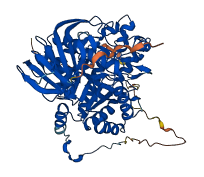
Descriptions
The autoinhibited protein was predicted that may have potential autoinhibitory elements via cis-regPred.
Autoinhibitory domains (AIDs)
Target domain |
|
Relief mechanism |
|
Assay |
cis-regPred |
Accessory elements
No accessory elements
Autoinhibited structure

Activated structure
2 structures for O08553
| Entry ID | Method | Resolution | Chain | Position | Source |
|---|---|---|---|---|---|
| 5UQC | X-ray | 178 A | A/B | 15-496 | PDB |
| AF-O08553-F1 | Predicted | AlphaFoldDB |
26 variants for O08553
| Variant ID(s) | Position | Change | Description | Diseaes Association | Provenance |
|---|---|---|---|---|---|
| rs3389355519 | 69 | G>E | No | EVA | |
| rs3389344472 | 118 | A>T | No | EVA | |
| rs3389322334 | 122 | Q>* | No | EVA | |
| rs3389328716 | 125 | E>G | No | EVA | |
| rs3404521475 | 157 | K>E | No | EVA | |
| rs3389328723 | 237 | N>I | No | EVA | |
| rs3389335354 | 268 | R>L | No | EVA | |
| rs3389340605 | 271 | G>R | No | EVA | |
| rs3389322331 | 286 | D>N | No | EVA | |
| rs3389341964 | 294 | N>K | No | EVA | |
| rs3389328686 | 298 | A>T | No | EVA | |
| rs3389339405 | 314 | P>S | No | EVA | |
| rs3389335317 | 326 | L>I | No | EVA | |
| rs3389342013 | 333 | H>P | No | EVA | |
| rs3389337017 | 347 | N>S | No | EVA | |
| rs3389344480 | 357 | G>D | No | EVA | |
| rs3389311368 | 372 | T>S | No | EVA | |
| rs3389342041 | 373 | G>D | No | EVA | |
| rs3405190926 | 381 | V>A | No | EVA | |
| rs3389334227 | 431 | Y>F | No | EVA | |
| rs3389341977 | 449 | Q>H | No | EVA | |
| rs3389262069 | 518 | S>T | No | EVA | |
| rs3412972314 | 519 | A>T | No | EVA | |
| rs3389262073 | 531 | V>G | No | EVA | |
| rs3389340681 | 534 | L>V | No | EVA | |
| rs3389262077 | 559 | V>E | No | EVA |
No associated diseases with O08553
1 regional properties for O08553
| Type | Name | Position | InterPro Accession |
|---|---|---|---|
| domain | Amidohydrolase-related | 64 - 453 | IPR006680 |
14 GO annotations of cellular component
| Name | Definition |
|---|---|
| axon | The long process of a neuron that conducts nerve impulses, usually away from the cell body to the terminals and varicosities, which are sites of storage and release of neurotransmitter. |
| cytosol | The part of the cytoplasm that does not contain organelles but which does contain other particulate matter, such as protein complexes. |
| dendrite | A neuron projection that has a short, tapering, morphology. Dendrites receive and integrate signals from other neurons or from sensory stimuli, and conduct nerve impulses towards the axon or the cell body. In most neurons, the impulse is conveyed from dendrites to axon via the cell body, but in some types of unipolar neuron, the impulse does not travel via the cell body. |
| growth cone | The migrating motile tip of a growing neuron projection, where actin accumulates, and the actin cytoskeleton is the most dynamic. |
| membrane | A lipid bilayer along with all the proteins and protein complexes embedded in it an attached to it. |
| microtubule | Any of the long, generally straight, hollow tubes of internal diameter 12-15 nm and external diameter 24 nm found in a wide variety of eukaryotic cells; each consists (usually) of 13 protofilaments of polymeric tubulin, staggered in such a manner that the tubulin monomers are arranged in a helical pattern on the microtubular surface, and with the alpha/beta axes of the tubulin subunits parallel to the long axis of the tubule; exist in equilibrium with pool of tubulin monomers and can be rapidly assembled or disassembled in response to physiological stimuli; concerned with force generation, e.g. in the spindle. |
| mitochondrion | A semiautonomous, self replicating organelle that occurs in varying numbers, shapes, and sizes in the cytoplasm of virtually all eukaryotic cells. It is notably the site of tissue respiration. |
| myelin sheath | An electrically insulating fatty layer that surrounds the axons of many neurons. It is an outgrowth of glial cells: Schwann cells supply the myelin for peripheral neurons while oligodendrocytes supply it to those of the central nervous system. |
| neuron projection | A prolongation or process extending from a nerve cell, e.g. an axon or dendrite. |
| neuronal cell body | The portion of a neuron that includes the nucleus, but excludes cell projections such as axons and dendrites. |
| plasma membrane | The membrane surrounding a cell that separates the cell from its external environment. It consists of a phospholipid bilayer and associated proteins. |
| presynapse | The part of a synapse that is part of the presynaptic cell. |
| protein-containing complex | A stable assembly of two or more macromolecules, i.e. proteins, nucleic acids, carbohydrates or lipids, in which at least one component is a protein and the constituent parts function together. |
| terminal bouton | Terminal inflated portion of the axon, containing the specialized apparatus necessary to release neurotransmitters. The axon terminus is considered to be the whole region of thickening and the terminal bouton is a specialized region of it. |
4 GO annotations of molecular function
| Name | Definition |
|---|---|
| hydrolase activity, acting on carbon-nitrogen (but not peptide) bonds | Catalysis of the hydrolysis of any carbon-nitrogen bond, C-N, with the exception of peptide bonds. |
| identical protein binding | Binding to an identical protein or proteins. |
| microtubule binding | Binding to a microtubule, a filament composed of tubulin monomers. |
| protein kinase binding | Binding to a protein kinase, any enzyme that catalyzes the transfer of a phosphate group, usually from ATP, to a protein substrate. |
9 GO annotations of biological process
| Name | Definition |
|---|---|
| axon guidance | The chemotaxis process that directs the migration of an axon growth cone to a specific target site in response to a combination of attractive and repulsive cues. |
| brain development | The process whose specific outcome is the progression of the brain over time, from its formation to the mature structure. Brain development begins with patterning events in the neural tube and ends with the mature structure that is the center of thought and emotion. The brain is responsible for the coordination and control of bodily activities and the interpretation of information from the senses (sight, hearing, smell, etc.). |
| cytoskeleton organization | A process that is carried out at the cellular level which results in the assembly, arrangement of constituent parts, or disassembly of cytoskeletal structures. |
| endocytosis | A vesicle-mediated transport process in which cells take up external materials or membrane constituents by the invagination of a small region of the plasma membrane to form a new membrane-bounded vesicle. |
| positive regulation of glutamate secretion | Any process that activates or increases the frequency, rate or extent of the controlled release of glutamate. |
| regulation of axon extension | Any process that modulates the rate, direction or extent of axon extension. |
| regulation of neuron differentiation | Any process that modulates the frequency, rate or extent of neuron differentiation. |
| regulation of neuron projection development | Any process that modulates the rate, frequency or extent of neuron projection development. Neuron projection development is the process whose specific outcome is the progression of a neuron projection over time, from its formation to the mature structure. A neuron projection is any process extending from a neural cell, such as axons or dendrites (collectively called neurites). |
| synaptic vesicle transport | The directed movement of synaptic vesicles. |
10 homologous proteins in AiPD
| UniProt AC | Gene Name | Protein Name | Species | Evidence Code |
|---|---|---|---|---|
| Q90635 | DPYSL2 | Dihydropyrimidinase-related protein 2 | Gallus gallus (Chicken) | PR |
| Q14194 | CRMP1 | Dihydropyrimidinase-related protein 1 | Homo sapiens (Human) | PR |
| Q14195 | DPYSL3 | Dihydropyrimidinase-related protein 3 | Homo sapiens (Human) | PR |
| Q16555 | DPYSL2 | Dihydropyrimidinase-related protein 2 | Homo sapiens (Human) | PR |
| P97427 | Crmp1 | Dihydropyrimidinase-related protein 1 | Mus musculus (Mouse) | PR |
| Q62188 | Dpysl3 | Dihydropyrimidinase-related protein 3 | Mus musculus (Mouse) | PR |
| Q62952 | Dpysl3 | Dihydropyrimidinase-related protein 3 | Rattus norvegicus (Rat) | PR |
| P47942 | Dpysl2 | Dihydropyrimidinase-related protein 2 | Rattus norvegicus (Rat) | PR |
| Q9FMP3 | PYD2 | Dihydropyrimidinase | Arabidopsis thaliana (Mouse-ear cress) | PR |
| Q6GL72 | dpysl3 | Dihydropyrimidinase-related protein 3 | Xenopus tropicalis (Western clawed frog) (Silurana tropicalis) | PR |
| 10 | 20 | 30 | 40 | 50 | 60 |
| MSYQGKKNIP | RITSDRLLIK | GGKIVNDDQS | FYADIYMEDG | LIKQIGENLI | VPGGVKTIEA |
| 70 | 80 | 90 | 100 | 110 | 120 |
| HSRMVIPGGI | DVHTRFQMPD | QGMTSADDFF | QGTKAALAGG | TTMIIDHVVP | EPGTSLLAAF |
| 130 | 140 | 150 | 160 | 170 | 180 |
| DQWREWADSK | SCCDYSLHVD | ITEWHKGIQE | EMEALVKDHG | VNSFLVYMAF | KDRFQLTDSQ |
| 190 | 200 | 210 | 220 | 230 | 240 |
| IYEVLSVIRD | IGAIAQVHAE | NGDIIAEEQQ | RILDLGITGP | EGHVLSRPEE | VEAEAVNRSI |
| 250 | 260 | 270 | 280 | 290 | 300 |
| TIANQTNCPL | YVTKVMSKSA | AEVIAQARKK | GTVVYGEPIT | ASLGTDGSHY | WSKNWAKAAA |
| 310 | 320 | 330 | 340 | 350 | 360 |
| FVTSPPLSPD | PTTPDFLNSL | LSCGDLQVTG | SAHCTFNTAQ | KAVGKDNFTL | IPEGTNGTEE |
| 370 | 380 | 390 | 400 | 410 | 420 |
| RMSVIWDKAV | VTGKMDENQF | VAVTSTNAAK | VFNLYPRKGR | ISVGSDADLV | IWDPDSVKTI |
| 430 | 440 | 450 | 460 | 470 | 480 |
| SAKTHNSALE | YNIFEGMECR | GSPLVVISQG | KIVLEDGTLH | VTEGSGRYIP | RKPFPDFVYK |
| 490 | 500 | 510 | 520 | 530 | 540 |
| RIKARSRLAE | LRGVPRGLYD | GPVCEVSVTP | KTVTPASSAK | TSPAKQQAPP | VRNLHQSGFS |
| 550 | 560 | 570 | |||
| LSGAQIDDNI | PRRTTQRIVA | PPGGRANITS | LG |