Q96CW1
Gene name |
AP2M1 |
Protein name |
AP-2 complex subunit mu |
Names |
AP-2 mu chain, Adaptin-mu2, Adaptor protein complex AP-2 subunit mu, Adaptor-related protein complex 2 subunit mu, Clathrin assembly protein complex 2 mu medium chain, Clathrin coat assembly protein AP50, Clathrin coat-associated protein AP50, HA2 50 kDa subunit, Plasma membrane adaptor AP-2 50 kDa protein |
Species |
Homo sapiens (Human) |
KEGG Pathway |
hsa:1173 |
EC number |
|
Protein Class |
|
Descriptions
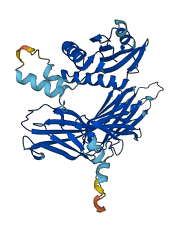
The autoinhibited protein was predicted that may have potential autoinhibitory elements via cis-regPred.
Autoinhibitory domains (AIDs)
Target domain |
|
Relief mechanism |
|
Assay |
cis-regPred |
Accessory elements
No accessory elements
Autoinhibited structure

Activated structure
4 structures for Q96CW1
| Entry ID | Method | Resolution | Chain | Position | Source |
|---|---|---|---|---|---|
| 1H6E | X-ray | 360 A | A | 164-435 | PDB |
| 6BNT | X-ray | 320 A | A | 160-435 | PDB |
| 6URI | X-ray | 300 A | M | 1-135 | PDB |
| AF-Q96CW1-F1 | Predicted | AlphaFoldDB |
105 variants for Q96CW1
| Variant ID(s) | Position | Change | Description | Diseaes Association | Provenance |
|---|---|---|---|---|---|
|
CA355424353 RCV000850490 rs1577059692 VAR_082954 RCV001263339 RCV001869288 |
170 | R>W | Autism Intellectual developmental disorder 60 with seizures MRD60; reduced clathrin-mediated endocytosis; no effect on clathrin-coated pit location; no effect on protein stability and membrane recruitment [ClinVar, UniProt] | Yes |
ClinGen ClinVar UniProt Ensembl dbSNP |
|
CA355419042 rs1288870682 |
7 | I>V | No |
ClinGen gnomAD |
|
|
CA355419556 rs1577057376 |
14 | V>G | No |
ClinGen Ensembl |
|
|
CA2727615 rs757550426 |
19 | V>I | No |
ClinGen ExAC TOPMed gnomAD |
|
|
rs1474004926 CA355419669 |
25 | G>A | No |
ClinGen gnomAD |
|
|
rs1010505410 CA88860279 |
28 | A>T | No |
ClinGen TOPMed gnomAD |
|
| TCGA novel | 31 | A>V | Variant assessed as Somatic; impact. [NCI-TCGA] | No | NCI-TCGA |
|
CA355420068 rs1159187719 |
35 | N>S | No |
ClinGen TOPMed |
|
|
rs1447584022 CA355420107 COSM3392243 |
39 | A>G | pancreas [Cosmic] | No |
ClinGen cosmic curated gnomAD |
|
rs1167948297 CA355420110 |
40 | R>W | Variant assessed as Somatic; 0.0 impact. [NCI-TCGA] | No |
ClinGen NCI-TCGA gnomAD |
| TCGA novel | 41 | Q>H | Variant assessed as Somatic; impact. [NCI-TCGA] | No | NCI-TCGA |
| TCGA novel | 43 | V>L | Variant assessed as Somatic; impact. [NCI-TCGA] | No | NCI-TCGA |
|
rs1431035134 CA355420160 COSM1733690 |
44 | R>C | Variant assessed as Somatic; 0.0 impact. pancreas [NCI-TCGA, Cosmic] | No |
ClinGen cosmic curated NCI-TCGA gnomAD |
|
rs777567779 COSM1421283 CA2727662 |
47 | V>I | Variant assessed as Somatic; 0.0 impact. large_intestine [NCI-TCGA, Cosmic] | No |
ClinGen cosmic curated ExAC NCI-TCGA TOPMed gnomAD |
|
rs1363532872 CA355420272 |
50 | I>F | No |
ClinGen gnomAD |
|
|
CA355420305 rs1299055414 |
52 | R>H | No |
ClinGen Ensembl |
|
| TCGA novel | 54 | S>N | Variant assessed as Somatic; impact. [NCI-TCGA] | No | NCI-TCGA |
|
rs1560125973 CA355420405 |
56 | F>L | No |
ClinGen Ensembl |
|
|
rs774293277 CA2727665 |
58 | V>I | No |
ClinGen ExAC gnomAD |
|
|
rs1244718251 CA355420461 |
60 | R>W | No |
ClinGen TOPMed |
|
| TCGA novel | 62 | N>K | Variant assessed as Somatic; impact. [NCI-TCGA] | No | NCI-TCGA |
|
rs1179952536 CA355420510 |
63 | I>V | No |
ClinGen TOPMed |
|
|
CA355420563 rs1344972426 |
67 | A>T | No |
ClinGen gnomAD |
|
|
rs938377626 CA88860290 |
69 | T>I | No |
ClinGen TOPMed |
|
|
CA355420609 rs1366273789 |
70 | K>R | No |
ClinGen gnomAD |
|
|
CA2727669 rs761946127 |
75 | A>T | No |
ClinGen ExAC TOPMed gnomAD |
|
|
rs11539599 CA88860295 |
79 | F>S | No |
ClinGen Ensembl |
|
|
CA355420859 rs1577058498 |
85 | M>I | No |
ClinGen Ensembl |
|
|
CA88860298 rs995446453 |
88 | V>M | No |
ClinGen gnomAD |
|
| TCGA novel | 89 | M>D | Variant assessed as Somatic; impact. [NCI-TCGA] | No | NCI-TCGA |
|
rs1451306432 CA355420954 |
90 | A>T | No |
ClinGen gnomAD |
|
|
CA355422028 rs1466219319 |
102 | K>R | No |
ClinGen gnomAD |
|
|
CA355422346 rs1577058537 |
113 | D>E | No |
ClinGen Ensembl |
|
|
rs1054219693 CA88860558 |
116 | L>V | No |
ClinGen Ensembl |
|
| TCGA novel | 119 | G>D | Variant assessed as Somatic; impact. [NCI-TCGA] | No | NCI-TCGA |
| TCGA novel | 122 | Q>H | Variant assessed as Somatic; impact. [NCI-TCGA] | No | NCI-TCGA |
|
CA355422893 rs1268508290 |
124 | S>Y | Variant assessed as Somatic; 0.0 impact. [NCI-TCGA] | No |
ClinGen NCI-TCGA gnomAD |
| TCGA novel | 125 | E>K | Variant assessed as Somatic; impact. [NCI-TCGA] | No | NCI-TCGA |
|
COSM1041941 CA88860565 rs1041547140 |
128 | A>T | Variant assessed as Somatic; 0.0 impact. endometrium [NCI-TCGA, Cosmic] | No |
ClinGen cosmic curated NCI-TCGA TOPMed gnomAD |
|
CA355422979 rs1488778255 |
128 | A>V | Variant assessed as Somatic; 4.638e-05 impact. [NCI-TCGA] | No |
ClinGen NCI-TCGA gnomAD |
|
COSM1041942 CA2727698 rs756877807 |
134 | T>M | Variant assessed as Somatic; 0.0 impact. endometrium [NCI-TCGA, Cosmic] | No |
ClinGen cosmic curated ExAC NCI-TCGA TOPMed gnomAD |
| TCGA novel | 146 | E>* | Variant assessed as Somatic; impact. [NCI-TCGA] | No | NCI-TCGA |
|
rs1577059635 CA355424002 |
152 | T>P | No |
ClinGen Ensembl |
|
|
rs760568336 CA2727761 |
153 | S>N | No |
ClinGen ExAC gnomAD |
|
|
CA355424032 rs1407472608 |
153 | S>R | No |
ClinGen gnomAD |
|
|
CA355424088 rs1350761218 |
157 | G>R | No |
ClinGen gnomAD |
|
|
rs1347499734 CA355424125 |
159 | I>V | No |
ClinGen TOPMed |
|
|
rs75115208 CA2727763 |
162 | R>G | No |
ClinGen ExAC gnomAD |
|
|
rs1174158560 CA355424186 |
162 | R>Q | Variant assessed as Somatic; impact. [NCI-TCGA] | No |
ClinGen NCI-TCGA gnomAD |
|
CA2727764 rs758349806 |
163 | R>G | No |
ClinGen ExAC gnomAD |
|
|
CA355424274 rs1365734309 |
167 | K>Q | No |
ClinGen gnomAD |
|
|
CA355424294 rs1204561603 |
167 | K>R | No |
ClinGen gnomAD |
|
|
rs190763860 CA88860726 |
179 | E>D | No |
ClinGen 1000Genomes |
|
|
CA355424995 rs1401089204 |
198 | G>A | No |
ClinGen gnomAD |
|
| TCGA novel | 198 | G>S | Variant assessed as Somatic; impact. [NCI-TCGA] | No | NCI-TCGA |
|
CA88860758 rs764425106 |
199 | R>Q | No |
ClinGen Ensembl |
|
| TCGA novel | 208 | G>C | Variant assessed as Somatic; impact. [NCI-TCGA] | No | NCI-TCGA |
|
rs745352586 CA2727792 |
209 | M>I | No |
ClinGen ExAC gnomAD |
|
|
CA2727794 rs775111647 |
216 | M>I | No |
ClinGen ExAC TOPMed gnomAD |
|
|
CA355426383 rs1296367856 |
217 | N>H | No |
ClinGen gnomAD |
|
|
rs868202860 CA88862481 |
222 | I>F | No |
ClinGen Ensembl |
|
|
CA355426479 rs1309270364 |
222 | I>T | No |
ClinGen gnomAD |
|
|
CA88862482 rs4359840 |
224 | K>N | No |
ClinGen Ensembl |
|
| TCGA novel | 225 | Q>A | Variant assessed as Somatic; impact. [NCI-TCGA] | No | NCI-TCGA |
|
CA2727795 rs760378136 |
226 | G>S | No |
ClinGen ExAC TOPMed gnomAD |
|
| TCGA novel | 227 | K>T | Variant assessed as Somatic; impact. [NCI-TCGA] | No | NCI-TCGA |
|
CA355426592 rs1255589027 |
228 | G>D | No |
ClinGen TOPMed gnomAD |
|
|
rs1343191302 CA355426608 |
229 | T>R | No |
ClinGen TOPMed |
|
|
rs768293750 CA2727796 |
230 | A>D | No |
ClinGen ExAC gnomAD |
|
|
rs1225655503 CA355426804 |
237 | G>R | No |
ClinGen TOPMed gnomAD |
|
|
rs1486833836 CA355427037 |
249 | H>N | No |
ClinGen gnomAD |
|
|
rs1189215920 CA355427061 |
249 | H>Q | No |
ClinGen gnomAD |
|
|
rs1207518781 CA355427119 |
253 | R>Q | No |
ClinGen TOPMed gnomAD |
|
|
rs1560127156 CA355427392 |
267 | P>L | No |
ClinGen Ensembl |
|
|
rs1560127249 CA355427649 |
278 | R>G | No |
ClinGen Ensembl |
|
|
CA2727824 rs764346596 |
279 | T>S | No |
ClinGen ExAC gnomAD |
|
|
rs1306308611 CA355427693 |
280 | T>I | No |
ClinGen gnomAD |
|
|
CA88862755 rs11539600 |
283 | I>T | No |
ClinGen Ensembl |
|
|
rs1375179511 CA355427898 |
287 | F>L | No |
ClinGen gnomAD |
|
|
rs757608518 CA2727826 |
289 | V>A | No |
ClinGen ExAC gnomAD |
|
| TCGA novel | 294 | R>* | Variant assessed as Somatic; impact. [NCI-TCGA] | No | NCI-TCGA |
|
CA355428005 rs1409982122 |
294 | R>Q | No |
ClinGen gnomAD |
|
|
rs374946932 CA2727829 |
297 | G>E | No |
ClinGen ESP ExAC gnomAD |
|
|
CA355428085 rs1313715106 |
298 | R>C | Variant assessed as Somatic; impact. [NCI-TCGA] | No |
ClinGen Ensembl NCI-TCGA |
|
CA2727830 rs780471771 |
299 | T>S | No |
ClinGen ExAC gnomAD |
|
|
CA88862805 rs369968833 |
307 | I>M | No |
ClinGen ESP TOPMed gnomAD |
|
|
rs1360424786 CA355428398 |
313 | P>A | No |
ClinGen Ensembl |
|
|
rs1476339200 CA355428739 |
323 | R>S | No |
ClinGen gnomAD |
|
|
CA355428789 rs1325820757 |
326 | T>S | No |
ClinGen gnomAD |
|
| TCGA novel | 330 | T>K | Variant assessed as Somatic; impact. [NCI-TCGA] | No | NCI-TCGA |
|
rs1560127376 CA355428912 |
333 | V>M | No |
ClinGen Ensembl |
|
|
CA88862885 rs367833738 |
349 | N>D | No |
ClinGen Ensembl |
|
|
CA355429319 rs1182493513 |
349 | N>I | No |
ClinGen gnomAD |
|
|
CA88862890 rs1006265324 |
352 | V>M | No |
ClinGen TOPMed gnomAD |
|
|
rs778579769 CA2727881 |
363 | E>A | No |
ClinGen ExAC gnomAD |
|
|
CA355429684 rs1359577138 |
367 | S>N | No |
ClinGen TOPMed |
|
|
CA88863189 rs902011278 |
368 | A>T | No |
ClinGen Ensembl |
|
|
rs1803438 CA88863192 |
370 | I>F | No |
ClinGen Ensembl |
|
|
rs748219382 CA2727885 |
370 | I>T | No |
ClinGen ExAC gnomAD |
|
|
CA2727886 rs769916005 |
375 | T>A | No |
ClinGen ExAC gnomAD |
|
|
rs1340280100 CA355429910 |
380 | K>Q | No |
ClinGen TOPMed gnomAD |
|
| TCGA novel | 386 | I>H | Variant assessed as Somatic; impact. [NCI-TCGA] | No | NCI-TCGA |
|
CA355430420 rs1282982213 |
395 | A>T | No |
ClinGen TOPMed |
|
|
CA2727924 rs757427503 |
402 | R>C | No |
ClinGen ExAC gnomAD |
|
| TCGA novel | 409 | P>L | Variant assessed as Somatic; impact. [NCI-TCGA] | No | NCI-TCGA |
1 associated diseases with Q96CW1
[MIM: 618587]: Intellectual developmental disorder, autosomal dominant 60, with seizures (MRD60)
An autosomal dominant disorder characterized by global developmental delay apparent in the first six months of life, followed by onset of seizures between 21 months and 4 years. Disease features include moderate-to-severe intellectual disability, poor speech, delayed walking, and ataxia. {ECO:0000269|PubMed:31104773}. Note=The disease is caused by variants affecting the gene represented in this entry.
Without disease ID
- An autosomal dominant disorder characterized by global developmental delay apparent in the first six months of life, followed by onset of seizures between 21 months and 4 years. Disease features include moderate-to-severe intellectual disability, poor speech, delayed walking, and ataxia. {ECO:0000269|PubMed:31104773}. Note=The disease is caused by variants affecting the gene represented in this entry.
Functions
15 GO annotations of cellular component
| Name | Definition |
|---|---|
| AP-2 adaptor complex | A heterotetrameric AP-type membrane coat adaptor complex that consists of alpha, beta2, mu2 and sigma2 subunits, and links clathrin to the membrane surface of a vesicle, and the cargo receptors during receptor/clathrin mediated endocytosis. Vesicles with AP-2-containing coats are normally found primarily near the plasma membrane, on endocytic vesicles. In at least humans, the AP-2 complex can be heterogeneric due to the existence of multiple subunit isoforms encoded by different alpha genes (alphaA and alphaC). |
| clathrin-coated endocytic vesicle | A clathrin-coated, membrane-bounded intracellular vesicle formed by invagination of the plasma membrane around an extracellular substance. |
| clathrin-coated endocytic vesicle membrane | The lipid bilayer surrounding a clathrin-coated endocytic vesicle. |
| clathrin-coated pit | A part of the endomembrane system in the form of an invagination of a membrane upon which a clathrin coat forms, and that can be converted by vesicle budding into a clathrin-coated vesicle. Coated pits form on the plasma membrane, where they are involved in receptor-mediated selective transport of many proteins and other macromolecules across the cell membrane, in the trans-Golgi network, and on some endosomes. |
| cytoplasmic side of plasma membrane | The leaflet the plasma membrane that faces the cytoplasm and any proteins embedded or anchored in it or attached to its surface. |
| cytoplasmic vesicle | A vesicle found in the cytoplasm of a cell. |
| cytosol | The part of the cytoplasm that does not contain organelles but which does contain other particulate matter, such as protein complexes. |
| endocytic vesicle membrane | The lipid bilayer surrounding an endocytic vesicle. |
| endolysosome membrane | The lipid bilayer surrounding an endolysosome. An endolysosome is a transient hybrid organelle formed by fusion of a late endosome with a lysosome. |
| extracellular exosome | A vesicle that is released into the extracellular region by fusion of the limiting endosomal membrane of a multivesicular body with the plasma membrane. Extracellular exosomes, also simply called exosomes, have a diameter of about 40-100 nm. |
| glutamatergic synapse | A synapse that uses glutamate as a neurotransmitter. |
| lysosomal membrane | The lipid bilayer surrounding the lysosome and separating its contents from the cell cytoplasm. |
| plasma membrane | The membrane surrounding a cell that separates the cell from its external environment. It consists of a phospholipid bilayer and associated proteins. |
| postsynapse | The part of a synapse that is part of the post-synaptic cell. |
| presynapse | The part of a synapse that is part of the presynaptic cell. |
6 GO annotations of molecular function
| Name | Definition |
|---|---|
| clathrin adaptor activity | Bringing together a cargo protein with clathrin, responsible for the formation of endocytic vesicles. |
| disordered domain specific binding | Binding to a disordered domain of a protein. |
| lipid binding | Binding to a lipid. |
| low-density lipoprotein particle receptor binding | Binding to a low-density lipoprotein receptor. |
| signal sequence binding | Binding to a signal sequence, a specific peptide sequence found on protein precursors or mature proteins that dictates where the mature protein is localized. |
| transmembrane transporter binding | Binding to a transmembrane transporter, a protein or protein complex that enables the transfer of a substance, usually a specific substance or a group of related substances, from one side of a membrane to the other. |
13 GO annotations of biological process
| Name | Definition |
|---|---|
| clathrin-dependent endocytosis | An endocytosis process that begins when material is taken up into clathrin-coated pits, which then pinch off to form clathrin-coated endocytic vesicles. |
| endocytosis | A vesicle-mediated transport process in which cells take up external materials or membrane constituents by the invagination of a small region of the plasma membrane to form a new membrane-bounded vesicle. |
| intracellular protein transport | The directed movement of proteins in a cell, including the movement of proteins between specific compartments or structures within a cell, such as organelles of a eukaryotic cell. |
| negative regulation of protein localization to plasma membrane | Any process that stops, prevents or reduces the frequency, rate or extent of protein localization to plasma membrane. |
| positive regulation of receptor internalization | Any process that activates or increases the frequency, rate or extent of receptor internalization. |
| positive regulation of synaptic vesicle endocytosis | Any process that activates or increases the frequency, rate or extent of synaptic vesicle endocytosis. |
| postsynaptic neurotransmitter receptor internalization | A receptor-mediated endocytosis process that results in the internalization of a neurotransmitter receptor from the postsynaptic membrane endocytic zone into an endocytic vesicle. |
| protein-containing complex assembly | The aggregation, arrangement and bonding together of a set of macromolecules to form a protein-containing complex. |
| receptor internalization | A receptor-mediated endocytosis process that results in the movement of receptors from the plasma membrane to the inside of the cell. The process begins when cell surface receptors are monoubiquitinated following ligand-induced activation. Receptors are subsequently taken up into endocytic vesicles from where they are either targeted to the lysosome or vacuole for degradation or recycled back to the plasma membrane. |
| regulation of vesicle size | Any process that modulates the size of a vesicle. |
| synaptic vesicle endocytosis | A vesicle-mediated transport process, in which the synaptic vesicle membrane constituents are retrieved from the presynaptic membrane on the axon terminal after neurotransmitter secretion by exocytosis. Synaptic vesicle endocytosis can occur via clathrin-dependent and clathrin-independent mechanisms. |
| vesicle budding from membrane | The evagination of a membrane, resulting in formation of a vesicle. |
| vesicle-mediated transport | A cellular transport process in which transported substances are moved in membrane-bounded vesicles; transported substances are enclosed in the vesicle lumen or located in the vesicle membrane. The process begins with a step that directs a substance to the forming vesicle, and includes vesicle budding and coating. Vesicles are then targeted to, and fuse with, an acceptor membrane. |
7 homologous proteins in AiPD
| UniProt AC | Gene Name | Protein Name | Species | Evidence Code |
|---|---|---|---|---|
| P38700 | APM2 | Adaptin medium chain homolog APM2 | Saccharomyces cerevisiae (strain ATCC 204508 / S288c) (Baker's yeast) | PR |
| Q99186 | APM4 | AP-2 complex subunit mu | Saccharomyces cerevisiae (strain ATCC 204508 / S288c) (Baker's yeast) | PR |
| Q9Y6Q5 | AP1M2 | AP-1 complex subunit mu-2 | Homo sapiens (Human) | PR |
| Q9BXS5 | AP1M1 | AP-1 complex subunit mu-1 | Homo sapiens (Human) | PR |
| P84091 | Ap2m1 | AP-2 complex subunit mu | Mus musculus (Mouse) | PR |
| P35603 | dpy-23 | AP-2 complex subunit mu | Caenorhabditis elegans | PR |
| O23140 | AP2M | AP-2 complex subunit mu | Arabidopsis thaliana (Mouse-ear cress) | PR |
| 10 | 20 | 30 | 40 | 50 | 60 |
| MIGGLFIYNH | KGEVLISRVY | RDDIGRNAVD | AFRVNVIHAR | QQVRSPVTNI | ARTSFFHVKR |
| 70 | 80 | 90 | 100 | 110 | 120 |
| SNIWLAAVTK | QNVNAAMVFE | FLYKMCDVMA | AYFGKISEEN | IKNNFVLIYE | LLDEILDFGY |
| 130 | 140 | 150 | 160 | 170 | 180 |
| PQNSETGALK | TFITQQGIKS | QHQTKEEQSQ | ITSQVTGQIG | WRREGIKYRR | NELFLDVLES |
| 190 | 200 | 210 | 220 | 230 | 240 |
| VNLLMSPQGQ | VLSAHVSGRV | VMKSYLSGMP | ECKFGMNDKI | VIEKQGKGTA | DETSKSGKQS |
| 250 | 260 | 270 | 280 | 290 | 300 |
| IAIDDCTFHQ | CVRLSKFDSE | RSISFIPPDG | EFELMRYRTT | KDIILPFRVI | PLVREVGRTK |
| 310 | 320 | 330 | 340 | 350 | 360 |
| LEVKVVIKSN | FKPSLLAQKI | EVRIPTPLNT | SGVQVICMKG | KAKYKASENA | IVWKIKRMAG |
| 370 | 380 | 390 | 400 | 410 | 420 |
| MKESQISAEI | ELLPTNDKKK | WARPPISMNF | EVPFAPSGLK | VRYLKVFEPK | LNYSDHDVIK |
| 430 | |||||
| WVRYIGRSGI | YETRC |