P35603
Gene name |
dpy-23 (ap50, R160.1) |
Protein name |
AP-2 complex subunit mu |
Names |
Clathrin assembly protein complex 2 mu medium chain, Clathrin coat assembly protein AP50, Clathrin coat-associated protein AP50, Mu2-adaptin, Plasma membrane adaptor AP-2 50 kDa protein, Protein dumpy-23 |
Species |
Caenorhabditis elegans |
KEGG Pathway |
cel:CELE_R160.1 |
EC number |
|
Protein Class |
|
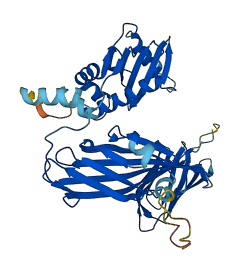
Descriptions
The autoinhibited protein was predicted that may have potential autoinhibitory elements via cis-regPred.
Autoinhibitory domains (AIDs)
Target domain |
|
Relief mechanism |
|
Assay |
cis-regPred |
Accessory elements
No accessory elements
Autoinhibited structure

Activated structure
1 structures for P35603
| Entry ID | Method | Resolution | Chain | Position | Source |
|---|---|---|---|---|---|
| AF-P35603-F1 | Predicted | AlphaFoldDB |
No variants for P35603
| Variant ID(s) | Position | Change | Description | Diseaes Association | Provenance |
|---|---|---|---|---|---|
| No variants for P35603 | |||||
No associated diseases with P35603
6 regional properties for P35603
| Type | Name | Position | InterPro Accession |
|---|---|---|---|
| conserved_site | Clathrin adaptor, mu subunit, conserved site | 163 - 183 | IPR018240-1 |
| conserved_site | Clathrin adaptor, mu subunit, conserved site | 267 - 281 | IPR018240-2 |
| domain | AP complex, mu/sigma subunit | 2 - 126 | IPR022775 |
| domain | Mu homology domain | 164 - 441 | IPR028565 |
| domain | Mu2, C-terminal domain | 172 - 440 | IPR043512 |
| domain | AP-2 complex subunit mu, N-terminal | 1 - 140 | IPR043532 |
Functions
5 GO annotations of cellular component
| Name | Definition |
|---|---|
| AP-2 adaptor complex | A heterotetrameric AP-type membrane coat adaptor complex that consists of alpha, beta2, mu2 and sigma2 subunits, and links clathrin to the membrane surface of a vesicle, and the cargo receptors during receptor/clathrin mediated endocytosis. Vesicles with AP-2-containing coats are normally found primarily near the plasma membrane, on endocytic vesicles. In at least humans, the AP-2 complex can be heterogeneric due to the existence of multiple subunit isoforms encoded by different alpha genes (alphaA and alphaC). |
| cytoplasmic vesicle | A vesicle found in the cytoplasm of a cell. |
| periciliary membrane compartment | A plasma membrane region adjacent to the base of eukaryotic cilia and flagella that is enriched in endocytosis-associated proteins and vesicles and that appears to regulate ciliary membrane homeostasis. |
| synapse | The junction between an axon of one neuron and a dendrite of another neuron, a muscle fiber or a glial cell. As the axon approaches the synapse it enlarges into a specialized structure, the presynaptic terminal bouton, which contains mitochondria and synaptic vesicles. At the tip of the terminal bouton is the presynaptic membrane; facing it, and separated from it by a minute cleft (the synaptic cleft) is a specialized area of membrane on the receiving cell, known as the postsynaptic membrane. In response to the arrival of nerve impulses, the presynaptic terminal bouton secretes molecules of neurotransmitters into the synaptic cleft. These diffuse across the cleft and transmit the signal to the postsynaptic membrane. |
| synaptic vesicle | A secretory organelle, typically 50 nm in diameter, of presynaptic nerve terminals; accumulates in high concentrations of neurotransmitters and secretes these into the synaptic cleft by fusion with the 'active zone' of the presynaptic plasma membrane. |
1 GO annotations of molecular function
| Name | Definition |
|---|---|
| clathrin adaptor activity | Bringing together a cargo protein with clathrin, responsible for the formation of endocytic vesicles. |
9 GO annotations of biological process
| Name | Definition |
|---|---|
| body morphogenesis | The process in which the anatomical structures of the soma are generated and organized. |
| clathrin-dependent endocytosis | An endocytosis process that begins when material is taken up into clathrin-coated pits, which then pinch off to form clathrin-coated endocytic vesicles. |
| endocytosis | A vesicle-mediated transport process in which cells take up external materials or membrane constituents by the invagination of a small region of the plasma membrane to form a new membrane-bounded vesicle. |
| intracellular protein transport | The directed movement of proteins in a cell, including the movement of proteins between specific compartments or structures within a cell, such as organelles of a eukaryotic cell. |
| positive regulation of necrotic cell death | Any process that increases the rate, frequency or extent of necrotic cell death. Necrotic cell death is a cell death process that is morphologically characterized by a gain in cell volume (oncosis), swelling of organelles, plasma membrane rupture and subsequent loss of intracellular contents. |
| positive regulation of Wnt protein secretion | Any process that activates or increases the frequency, rate or extent of the controlled release of a Wnt protein from a cell. |
| protein localization to non-motile cilium | A process in which a protein is transported to, or maintained in, a location within a non-motile cilium. |
| receptor-mediated endocytosis | An endocytosis process in which cell surface receptors ensure specificity of transport. A specific receptor on the cell surface binds tightly to the extracellular macromolecule (the ligand) that it recognizes; the plasma-membrane region containing the receptor-ligand complex then undergoes endocytosis, forming a transport vesicle containing the receptor-ligand complex and excluding most other plasma-membrane proteins. Receptor-mediated endocytosis generally occurs via clathrin-coated pits and vesicles. |
| vesicle-mediated transport | A cellular transport process in which transported substances are moved in membrane-bounded vesicles; transported substances are enclosed in the vesicle lumen or located in the vesicle membrane. The process begins with a step that directs a substance to the forming vesicle, and includes vesicle budding and coating. Vesicles are then targeted to, and fuse with, an acceptor membrane. |
5 homologous proteins in AiPD
| UniProt AC | Gene Name | Protein Name | Species | Evidence Code |
|---|---|---|---|---|
| P38700 | APM2 | Adaptin medium chain homolog APM2 | Saccharomyces cerevisiae (strain ATCC 204508 / S288c) (Baker's yeast) | PR |
| Q99186 | APM4 | AP-2 complex subunit mu | Saccharomyces cerevisiae (strain ATCC 204508 / S288c) (Baker's yeast) | PR |
| Q96CW1 | AP2M1 | AP-2 complex subunit mu | Homo sapiens (Human) | PR |
| P84091 | Ap2m1 | AP-2 complex subunit mu | Mus musculus (Mouse) | PR |
| O23140 | AP2M | AP-2 complex subunit mu | Arabidopsis thaliana (Mouse-ear cress) | PR |
| 10 | 20 | 30 | 40 | 50 | 60 |
| MIGGLFVYNH | KGEVLISRIY | RDDVTRNAVD | AFRVNVIHAR | QQVRSPVTNM | ARTSFFHVKR |
| 70 | 80 | 90 | 100 | 110 | 120 |
| GNVWICAVTR | QNVNAAMVFE | FLKRFADTMQ | SYFGKLNEEN | VKNNFVLIYE | LLDEILDFGY |
| 130 | 140 | 150 | 160 | 170 | 180 |
| PQNTDPGVLK | TFITQQGVRT | ADAPVPVTKE | EQSQITSQVT | GQIGWRREGI | KYRRNELFLD |
| 190 | 200 | 210 | 220 | 230 | 240 |
| VIEYVNLLMN | QQGQVLSAHV | AGKVAMKSYL | SGMPECKFGI | NDKITIEGKS | KPGSDDPNKA |
| 250 | 260 | 270 | 280 | 290 | 300 |
| SRAAVAIDDC | QFHQCVKLTK | FETEHAISFI | PPDGEYELMR | YRTTKDIQLP | FRVIPLVREV |
| 310 | 320 | 330 | 340 | 350 | 360 |
| SRNKMEVKVV | VKSNFKPSLL | AQKLEVRIPT | PPNTSGVQLI | CMKGKAKYKA | GENAIVWKIK |
| 370 | 380 | 390 | 400 | 410 | 420 |
| RMAGMKESQI | SAEIDLLSTG | NVEKKKWNRP | PVSMNFEVPF | APSGLKVRYL | KVFEPKLNYS |
| 430 | 440 | ||||
| DHDVIKWVRY | IGRSGLYETR | C |