Q96330
Gene name |
FLS1 (FLS, At5g08640, MAH20.20) |
Protein name |
Flavonol synthase/flavanone 3-hydroxylase |
Names |
FLS 1 |
Species |
Arabidopsis thaliana (Mouse-ear cress) |
KEGG Pathway |
ath:AT5G08640 |
EC number |
1.14.11.9: With 2-oxoglutarate as one donor, and incorporation of one atom each of oxygen into both donors |
Protein Class |
|
Descriptions
The autoinhibited protein was predicted that may have potential autoinhibitory elements via cis-regPred.
Autoinhibitory domains (AIDs)
Target domain |
|
Relief mechanism |
|
Assay |
cis-regPred |
Accessory elements
No accessory elements
Autoinhibited structure

Activated structure
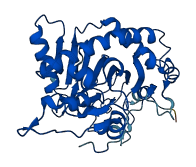
1 structures for Q96330
| Entry ID | Method | Resolution | Chain | Position | Source |
|---|---|---|---|---|---|
| AF-Q96330-F1 | Predicted | AlphaFoldDB |
14 variants for Q96330
| Variant ID(s) | Position | Change | Description | Diseaes Association | Provenance |
|---|---|---|---|---|---|
| tmp_5_2804074_G_T | 22 | E>D | No | 1000Genomes | |
| ENSVATH06942291 | 52 | D>N | No | 1000Genomes | |
| ENSVATH13963754 | 79 | T>R | No | 1000Genomes | |
| ENSVATH10657275 | 82 | I>M | No | 1000Genomes | |
| ENSVATH06942294 | 83 | R>Q | No | 1000Genomes | |
| ENSVATH13963805 | 84 | R>L | No | 1000Genomes | |
| tmp_5_2804281_A_T | 91 | K>N | No | 1000Genomes | |
| ENSVATH06942295 | 108 | D>G | No | 1000Genomes | |
| tmp_5_2804333_T_A | 109 | S>T | No | 1000Genomes | |
| ENSVATH06942297 | 167 | K>N | No | 1000Genomes | |
| ENSVATH00612587 | 179 | D>E | No | 1000Genomes | |
| tmp_5_2805081_C_A,G | 306 | P>Q | No | 1000Genomes | |
| tmp_5_2805081_C_A,G | 306 | P>R | No | 1000Genomes | |
| ENSVATH06942304 | 317 | F>Y | No | 1000Genomes |
2 associated diseases with Q96330
[MIM: 162100]: Hereditary neuralgic amyotrophy (HNA)
Autosomal dominant form of recurrent focal neuropathy characterized clinically by acute, recurrent episodes of brachial plexus neuropathy with muscle weakness and atrophy preceded by severe pain in the affected arm. HNA is triggered by environmental factors such as infection or parturition. {ECO:0000269|PubMed:16186812, ECO:0000269|PubMed:17546647, ECO:0000269|PubMed:18492087, ECO:0000269|PubMed:19451530}. Note=The disease is caused by variants affecting the gene represented in this entry.
Without disease ID
- Autosomal dominant form of recurrent focal neuropathy characterized clinically by acute, recurrent episodes of brachial plexus neuropathy with muscle weakness and atrophy preceded by severe pain in the affected arm. HNA is triggered by environmental factors such as infection or parturition. {ECO:0000269|PubMed:16186812, ECO:0000269|PubMed:17546647, ECO:0000269|PubMed:18492087, ECO:0000269|PubMed:19451530}. Note=The disease is caused by variants affecting the gene represented in this entry.
1 regional properties for Q96330
| Type | Name | Position | InterPro Accession |
|---|---|---|---|
| domain | Septin-type guanine nucleotide-binding (G) domain | 295 - 571 | IPR030379 |
Functions
| Description | ||
|---|---|---|
| EC Number | 1.14.11.9 | With 2-oxoglutarate as one donor, and incorporation of one atom each of oxygen into both donors |
| Subcellular Localization |
|
|
| PANTHER Family | ||
| PANTHER Subfamily | ||
| PANTHER Protein Class | ||
| PANTHER Pathway Category | No pathway information available | |
2 GO annotations of cellular component
| Name | Definition |
|---|---|
| cytoplasm | The contents of a cell excluding the plasma membrane and nucleus, but including other subcellular structures. |
| nucleus | A membrane-bounded organelle of eukaryotic cells in which chromosomes are housed and replicated. In most cells, the nucleus contains all of the cell's chromosomes except the organellar chromosomes, and is the site of RNA synthesis and processing. In some species, or in specialized cell types, RNA metabolism or DNA replication may be absent. |
5 GO annotations of molecular function
| Name | Definition |
|---|---|
| dioxygenase activity | Catalysis of an oxidation-reduction (redox) reaction in which both atoms of oxygen from one molecule of O2 are incorporated into the (reduced) product(s) of the reaction. The two atoms of oxygen may be distributed between two different products. [DOI:10.1016/S0040-4020(03)00944-X, GOC:bf] |
| flavonol synthase activity | Catalysis of the reaction: a dihydroflavonol + 2-oxoglurate + O2 = a flavonol + succinate + CO2 + H2O. |
| L-ascorbic acid binding | Binding to L-ascorbic acid, (2R)-2-[(1S)-1,2-dihydroxyethyl]-4-hydroxy-5-oxo-2,5-dihydrofuran-3-olate; L-ascorbic acid is vitamin C and has co-factor and anti-oxidant activities in many species. |
| metal ion binding | Binding to a metal ion. |
| naringenin 3-dioxygenase activity | Catalysis of the reaction: naringenin + 2-oxoglutarate + O2 = dihydrokaempferol + succinate + CO2. |
3 GO annotations of biological process
| Name | Definition |
|---|---|
| flavonoid biosynthetic process | The chemical reactions and pathways resulting in the formation of flavonoids, a group of phenolic derivatives containing a flavan skeleton. |
| response to auxin | Any process that results in a change in state or activity of a cell or an organism (in terms of movement, secretion, enzyme production, gene expression, etc.) as a result of an auxin stimulus. |
| response to light stimulus | Any process that results in a change in state or activity of a cell or an organism (in terms of movement, secretion, enzyme production, gene expression, etc.) as a result of a light stimulus, electromagnetic radiation of wavelengths classified as infrared, visible or ultraviolet light. |
9 homologous proteins in AiPD
| UniProt AC | Gene Name | Protein Name | Species | Evidence Code |
|---|---|---|---|---|
| P41213 | A2 | Leucoanthocyanidin dioxygenase | Zea mays (Maize) | PR |
| Q8H1S4 | At1g06650 | 1-aminocyclopropane-1-carboxylate oxidase homolog 3 | Arabidopsis thaliana (Mouse-ear cress) | PR |
| Q9C899 | F6'H2 | Feruloyl CoA ortho-hydroxylase 2 | Arabidopsis thaliana (Mouse-ear cress) | PR |
| Q9ZUN4 | ACO1 | 1-aminocyclopropane-1-carboxylate oxidase 1 | Arabidopsis thaliana (Mouse-ear cress) | PR |
| F4KAS1 | FLS4 | Probable flavonol synthase 4 | Arabidopsis thaliana (Mouse-ear cress) | PR |
| Q0WPW4 | At1g77330 | 1-aminocyclopropane-1-carboxylate oxidase 5 | Arabidopsis thaliana (Mouse-ear cress) | PR |
| Q9FFQ5 | FLS3 | Flavonol synthase 3 | Arabidopsis thaliana (Mouse-ear cress) | PR |
| Q9FZ21 | GA2OX6 | Gibberellin 2-beta-dioxygenase 6 | Arabidopsis thaliana (Mouse-ear cress) | PR |
| Q9ZTA3 | AOP1 | Probable 2-oxoglutarate-dependent dioxygenase AOP1 | Arabidopsis thaliana (Mouse-ear cress) | PR |
| 10 | 20 | 30 | 40 | 50 | 60 |
| MEVERVQDIS | SSSLLTEAIP | LEFIRSEKEQ | PAITTFRGPT | PAIPVVDLSD | PDEESVRRAV |
| 70 | 80 | 90 | 100 | 110 | 120 |
| VKASEEWGLF | QVVNHGIPTE | LIRRLQDVGR | KFFELPSSEK | ESVAKPEDSK | DIEGYGTKLQ |
| 130 | 140 | 150 | 160 | 170 | 180 |
| KDPEGKKAWV | DHLFHRIWPP | SCVNYRFWPK | NPPEYREVNE | EYAVHVKKLS | ETLLGILSDG |
| 190 | 200 | 210 | 220 | 230 | 240 |
| LGLKRDALKE | GLGGEMAEYM | MKINYYPPCP | RPDLALGVPA | HTDLSGITLL | VPNEVPGLQV |
| 250 | 260 | 270 | 280 | 290 | 300 |
| FKDDHWFDAE | YIPSAVIVHI | GDQILRLSNG | RYKNVLHRTT | VDKEKTRMSW | PVFLEPPREK |
| 310 | 320 | 330 | |||
| IVGPLPELTG | DDNPPKFKPF | AFKDYSYRKL | NKLPLD |