Q922R8
Gene name |
Pdia6 (Txndc7) |
Protein name |
Protein disulfide-isomerase A6 |
Names |
Thioredoxin domain-containing protein 7 |
Species |
Mus musculus (Mouse) |
KEGG Pathway |
mmu:71853 |
EC number |
5.3.4.1: Transposing S-S bonds |
Protein Class |
|
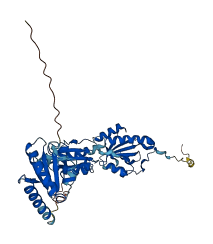
Descriptions
The autoinhibited protein was predicted that may have potential autoinhibitory elements via cis-regPred.
Autoinhibitory domains (AIDs)
Target domain |
|
Relief mechanism |
|
Assay |
cis-regPred |
Accessory elements
No accessory elements
Autoinhibited structure

Activated structure
2 structures for Q922R8
| Entry ID | Method | Resolution | Chain | Position | Source |
|---|---|---|---|---|---|
| 2DML | NMR | - | A | 16-132 | PDB |
| AF-Q922R8-F1 | Predicted | AlphaFoldDB |
No variants for Q922R8
| Variant ID(s) | Position | Change | Description | Diseaes Association | Provenance |
|---|---|---|---|---|---|
| No variants for Q922R8 | |||||
No associated diseases with Q922R8
6 regional properties for Q922R8
| Type | Name | Position | InterPro Accession |
|---|---|---|---|
| domain | Protein disulfide-isomerase, thioredoxin-like domain | 30 - 125 | IPR005788-1 |
| domain | Protein disulfide-isomerase, thioredoxin-like domain | 165 - 263 | IPR005788-2 |
| domain | Thioredoxin domain | 19 - 133 | IPR013766-1 |
| domain | Thioredoxin domain | 151 - 287 | IPR013766-2 |
| conserved_site | Thioredoxin, conserved site | 47 - 65 | IPR017937-1 |
| conserved_site | Thioredoxin, conserved site | 182 - 200 | IPR017937-2 |
Functions
| Description | ||
|---|---|---|
| EC Number | 5.3.4.1 | Transposing S-S bonds |
| Subcellular Localization |
|
|
| PANTHER Family | ||
| PANTHER Subfamily | ||
| PANTHER Protein Class | ||
| PANTHER Pathway Category | No pathway information available | |
9 GO annotations of cellular component
| Name | Definition |
|---|---|
| cytosol | The part of the cytoplasm that does not contain organelles but which does contain other particulate matter, such as protein complexes. |
| endoplasmic reticulum | The irregular network of unit membranes, visible only by electron microscopy, that occurs in the cytoplasm of many eukaryotic cells. The membranes form a complex meshwork of tubular channels, which are often expanded into slitlike cavities called cisternae. The ER takes two forms, rough (or granular), with ribosomes adhering to the outer surface, and smooth (with no ribosomes attached). |
| endoplasmic reticulum chaperone complex | A protein complex that is located in the endoplasmic reticulum and is composed of chaperone proteins, including BiP, GRP94; CaBP1, protein disulfide isomerase (PDI), ERdj3, cyclophilin B, ERp72, GRP170, UDP-glucosyltransferase, and SDF2-L1. |
| endoplasmic reticulum lumen | The volume enclosed by the membranes of the endoplasmic reticulum. |
| endoplasmic reticulum-Golgi intermediate compartment | A complex system of membrane-bounded compartments located between endoplasmic reticulum (ER) and the Golgi complex, with a distinctive membrane protein composition; involved in ER-to-Golgi and Golgi-to-ER transport. |
| extracellular space | That part of a multicellular organism outside the cells proper, usually taken to be outside the plasma membranes, and occupied by fluid. |
| melanosome | A tissue-specific, membrane-bounded cytoplasmic organelle within which melanin pigments are synthesized and stored. Melanosomes are synthesized in melanocyte cells. |
| plasma membrane | The membrane surrounding a cell that separates the cell from its external environment. It consists of a phospholipid bilayer and associated proteins. |
| smooth endoplasmic reticulum | The smooth endoplasmic reticulum (smooth ER or SER) has no ribosomes attached to it. The smooth ER is the recipient of the proteins synthesized in the rough ER. Those proteins to be exported are passed to the Golgi complex, the resident proteins are returned to the rough ER and the lysosomal proteins after phosphorylation of their mannose residues are passed to the lysosomes. Glycosylation of the glycoproteins also continues. The smooth ER is the site of synthesis of lipids, including the phospholipids. The membranes of the smooth ER also contain enzymes that catalyze a series of reactions to detoxify both lipid-soluble drugs and harmful products of metabolism. Large quantities of certain compounds such as phenobarbital cause an increase in the amount of the smooth ER. |
2 GO annotations of molecular function
| Name | Definition |
|---|---|
| protein disulfide isomerase activity | Catalysis of the rearrangement of both intrachain and interchain disulfide bonds in proteins. |
| protein-disulfide reductase activity | Catalysis of the reaction: a protein with reduced sulfide groups = a protein with oxidized disulfide bonds. |
3 GO annotations of biological process
| Name | Definition |
|---|---|
| platelet activation | A series of progressive, overlapping events triggered by exposure of the platelets to subendothelial tissue. These events include shape change, adhesiveness, aggregation, and release reactions. When carried through to completion, these events lead to the formation of a stable hemostatic plug. |
| platelet aggregation | The adhesion of one platelet to one or more other platelets via adhesion molecules. |
| response to endoplasmic reticulum stress | Any process that results in a change in state or activity of a cell (in terms of movement, secretion, enzyme production, gene expression, etc.) as a result of a stress acting at the endoplasmic reticulum. ER stress usually results from the accumulation of unfolded or misfolded proteins in the ER lumen. |
12 homologous proteins in AiPD
| UniProt AC | Gene Name | Protein Name | Species | Evidence Code |
|---|---|---|---|---|
| Q12404 | MPD1 | Protein disulfide-isomerase MPD1 | Saccharomyces cerevisiae (strain ATCC 204508 / S288c) (Baker's yeast) | PR |
| Q2KIL5 | PDIA5 | Protein disulfide-isomerase A5 | Bos taurus (Bovine) | PR |
| Q8N807 | PDILT | Protein disulfide-isomerase-like protein of the testis | Homo sapiens (Human) | PR |
| Q15084 | PDIA6 | Protein disulfide-isomerase A6 | Homo sapiens (Human) | PR |
| Q921X9 | Pdia5 | Protein disulfide-isomerase A5 | Mus musculus (Mouse) | PR |
| Q5I0H9 | Pdia5 | Protein disulfide-isomerase A5 | Rattus norvegicus (Rat) | PR |
| Q63081 | Pdia6 | Protein disulfide-isomerase A6 | Rattus norvegicus (Rat) | PR |
| Q10N04 | PDIL5-1 | Protein disulfide isomerase-like 5-1 | Oryza sativa subsp japonica (Rice) | PR |
| Q67UF5 | PDIL2-3 | Protein disulfide isomerase-like 2-3 | Oryza sativa subsp japonica (Rice) | PR |
| Q8GYD1 | PDIL5-1 | Protein disulfide-isomerase 5-1 | Arabidopsis thaliana (Mouse-ear cress) | PR |
| O48773 | PDIL2-3 | Protein disulfide-isomerase 2-3 | Arabidopsis thaliana (Mouse-ear cress) | PR |
| Q9MAU6 | PDIL2-2 | Protein disulfide-isomerase like 2-2 | Arabidopsis thaliana (Mouse-ear cress) | PR |
| 10 | 20 | 30 | 40 | 50 | 60 |
| MARLVLGLVS | CTFFLAVSGL | YSSSDDVIEL | TPSNFNREVI | QSDGLWLVEF | YAPWCGHCQR |
| 70 | 80 | 90 | 100 | 110 | 120 |
| LTPEWKKAAT | ALKDVVKVGA | VNADKHQSLG | GQYGVQGFPT | IKIFGANKNK | PEDYQGGRTG |
| 130 | 140 | 150 | 160 | 170 | 180 |
| EAIVDAALSA | LRQLVKDRLG | GRSGGYSSGK | QGRGDSSSKK | DVVELTDDTF | DKNVLDSEDV |
| 190 | 200 | 210 | 220 | 230 | 240 |
| WMVEFYAPWC | GHCKNLEPEW | AAAATEVKEQ | TKGKVKLAAV | DATVNQVLAS | RYGIKGFPTI |
| 250 | 260 | 270 | 280 | 290 | 300 |
| KIFQKGESPV | DYDGGRTRSD | IVSRALDLFS | DNAPPPELLE | IINEDIAKKT | CEEHQLCVVA |
| 310 | 320 | 330 | 340 | 350 | 360 |
| VLPHILDTGA | AGRNSYLEVL | LKLADKYKKK | MWGWLWTEAG | AQYELENALG | IGGFGYPAMA |
| 370 | 380 | 390 | 400 | 410 | 420 |
| AINARKMKFA | LLKGSFSEQG | INEFLRELSF | GRGSTAPVGG | GSFPTITPRE | PWDGKDGELP |
| 430 | |||||
| VEDDIDLSDV | ELDDLEKDEL |