Q8RXL8
Gene name |
UXT3 |
Protein name |
UDP-xylose transporter 3 |
Names |
|
Species |
Arabidopsis thaliana (Mouse-ear cress) |
KEGG Pathway |
ath:AT1G06890 |
EC number |
|
Protein Class |
|
Descriptions
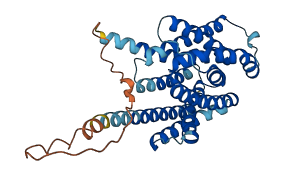
The autoinhibited protein was predicted that may have potential autoinhibitory elements via cis-regPred.
Autoinhibitory domains (AIDs)
Target domain |
|
Relief mechanism |
|
Assay |
cis-regPred |
Accessory elements
No accessory elements
Autoinhibited structure

Activated structure
1 structures for Q8RXL8
| Entry ID | Method | Resolution | Chain | Position | Source |
|---|---|---|---|---|---|
| AF-Q8RXL8-F1 | Predicted | AlphaFoldDB |
4 variants for Q8RXL8
| Variant ID(s) | Position | Change | Description | Diseaes Association | Provenance |
|---|---|---|---|---|---|
| tmp_1_2113992_C_A | 16 | S>I | No | 1000Genomes | |
| tmp_1_2113134_G_C | 104 | T>S | No | 1000Genomes | |
| tmp_1_2112780_T_A | 145 | T>S | No | 1000Genomes | |
| tmp_1_2111736_G_T | 356 | Q>K | No | 1000Genomes |
No associated diseases with Q8RXL8
1 regional properties for Q8RXL8
| Type | Name | Position | InterPro Accession |
|---|---|---|---|
| domain | Sugar phosphate transporter domain | 21 - 294 | IPR004853 |
5 GO annotations of cellular component
| Name | Definition |
|---|---|
| endosome | A vacuole to which materials ingested by endocytosis are delivered. |
| Golgi apparatus | A membrane-bound cytoplasmic organelle of the endomembrane system that further processes the core oligosaccharides (e.g. N-glycans) added to proteins in the endoplasmic reticulum and packages them into membrane-bound vesicles. The Golgi apparatus operates at the intersection of the secretory, lysosomal, and endocytic pathways. |
| Golgi membrane | The lipid bilayer surrounding any of the compartments of the Golgi apparatus. |
| integral component of membrane | The component of a membrane consisting of the gene products and protein complexes having at least some part of their peptide sequence embedded in the hydrophobic region of the membrane. |
| trans-Golgi network | The network of interconnected tubular and cisternal structures located within the Golgi apparatus on the side distal to the endoplasmic reticulum, from which secretory vesicles emerge. The trans-Golgi network is important in the later stages of protein secretion where it is thought to play a key role in the sorting and targeting of secreted proteins to the correct destination. |
3 GO annotations of molecular function
| Name | Definition |
|---|---|
| antiporter activity | Enables the active transport of a solute across a membrane by a mechanism whereby two or more species are transported in opposite directions in a tightly coupled process not directly linked to a form of energy other than chemiosmotic energy. The reaction is: solute A(out) + solute B(in) = solute A(in) + solute B(out). |
| nucleotide-sugar transmembrane transporter activity | Enables the transfer of a nucleotide-sugar from one side of a membrane to the other. A nucleotide-sugar is any nucleotide in which the distal phosphoric residue of a nucleoside 5'-diphosphate is in glycosidic linkage with a monosaccharide or monosaccharide derivative. |
| UDP-xylose transmembrane transporter activity | Enables the transfer of UDP-xylose from one side of a membrane to the other. UDP-xylose is a substance composed of xylose in glycosidic linkage with uridine diphosphate. |
2 GO annotations of biological process
| Name | Definition |
|---|---|
| carbohydrate transport | The directed movement of carbohydrate into, out of or within a cell, or between cells, by means of some agent such as a transporter or pore. Carbohydrates are a group of organic compounds based of the general formula Cx(H2O)y. |
| UDP-xylose transmembrane transport | The directed movement of UDP-xylose into, out of or within a cell, or between cells, by means of some agent such as a transporter or pore. UDP-xylose is a substance composed of xylose in glycosidic linkage with uridine diphosphate. |
8 homologous proteins in AiPD
| UniProt AC | Gene Name | Protein Name | Species | Evidence Code |
|---|---|---|---|---|
| P0CK97 | SLC35E2A | Solute carrier family 35 member E2A | Homo sapiens (Human) | PR |
| Q96K37 | SLC35E1 | Solute carrier family 35 member E1 | Homo sapiens (Human) | PR |
| P0CK96 | SLC35E2B | Solute carrier family 35 member E2B | Homo sapiens (Human) | PR |
| Q8C811 | Slc35e2a | Solute carrier family 35 member E2A | Mus musculus (Mouse) | PR |
| Q8CD26 | Slc35e1 | Solute carrier family 35 member E1 | Mus musculus (Mouse) | PR |
| Q8H0T6 | PPT2 | Phosphoenolpyruvate/phosphate translocator 2, chloroplastic | Arabidopsis thaliana (Mouse-ear cress) | PR |
| Q9SS40 | At3g10290 | Probable sugar phosphate/phosphate translocator At3g10290 | Arabidopsis thaliana (Mouse-ear cress) | PR |
| Q9SRE4 | URGT1 | UDP-rhamnose/UDP-galactose transporter 1 | Arabidopsis thaliana (Mouse-ear cress) | PR |
| 10 | 20 | 30 | 40 | 50 | 60 |
| MSEGQKFQLG | TIGALSLSVV | SSVSIVICNK | ALISTLGFTF | ATTLTSWHLL | VTFCSLHVAL |
| 70 | 80 | 90 | 100 | 110 | 120 |
| WMKMFEHKPF | DPRAVMGFGI | LNGISIGLLN | LSLGFNSVGF | YQMTKLAIIP | CTVLLETLFF |
| 130 | 140 | 150 | 160 | 170 | 180 |
| RKKFSRKIQF | SLTILLLGVG | IATVTDLQLN | MLGSVLSLLA | VVTTCVAQIM | TNTIQKKFKV |
| 190 | 200 | 210 | 220 | 230 | 240 |
| SSTQLLYQSC | PYQAITLFVT | GPFLDGLLTN | QNVFAFKYTS | QVVFFIVLSC | LISVSVNFST |
| 250 | 260 | 270 | 280 | 290 | 300 |
| FLVIGKTSPV | TYQVLGHLKT | CLVLAFGYVL | LRDPFDWRNI | LGILVAVIGM | VVYSYYCSIE |
| 310 | 320 | 330 | 340 | 350 | |
| TQQKASETST | QLPQMKESEK | DPLIAAENGS | GVLSDGGGGV | QQKTVAPVWN | SNKDFQA |