Q8RWR1
Gene name |
JMJ30 |
Protein name |
Lysine-specific demethylase JMJ30 |
Names |
AtJMJ30, JmjC domain-containing protein 30, Jumonji domain-containing protein 5, AtJMJD5, [histone H3]-trimethyl-L-lysine(36) monodemethylase JMJ30 |
Species |
Arabidopsis thaliana (Mouse-ear cress) |
KEGG Pathway |
ath:AT3G20810 |
EC number |
1.14.11.27: With 2-oxoglutarate as one donor, and incorporation of one atom each of oxygen into both donors |
Protein Class |
|
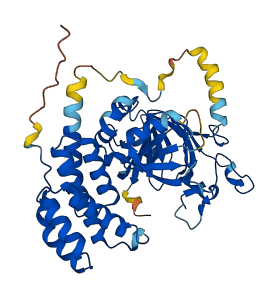
Descriptions
The autoinhibited protein was predicted that may have potential autoinhibitory elements via cis-regPred.
Autoinhibitory domains (AIDs)
Target domain |
|
Relief mechanism |
|
Assay |
cis-regPred |
Accessory elements
No accessory elements
Autoinhibited structure

Activated structure
1 structures for Q8RWR1
| Entry ID | Method | Resolution | Chain | Position | Source |
|---|---|---|---|---|---|
| AF-Q8RWR1-F1 | Predicted | AlphaFoldDB |
33 variants for Q8RWR1
| Variant ID(s) | Position | Change | Description | Diseaes Association | Provenance |
|---|---|---|---|---|---|
| ENSVATH05872087 | 5 | T>P | No | 1000Genomes | |
| tmp_3_7275835_T_A | 8 | S>T | No | 1000Genomes | |
| tmp_3_7275848_A_T | 12 | H>L | No | 1000Genomes | |
| ENSVATH13955138 | 13 | N>I | No | 1000Genomes | |
| tmp_3_7275959_T_C | 49 | V>A | No | 1000Genomes | |
| ENSVATH00336768 | 54 | S>N | No | 1000Genomes | |
| tmp_3_7275988_G_A | 59 | A>T | No | 1000Genomes | |
| tmp_3_7276111_T_G | 100 | F>V | No | 1000Genomes | |
| tmp_3_7276126_G_A | 105 | G>S | No | 1000Genomes | |
| tmp_3_7276160_T_G | 116 | M>R | No | 1000Genomes | |
| ENSVATH10811352 | 120 | K>Q | No | 1000Genomes | |
| tmp_3_7276181_A_T | 123 | H>L | No | 1000Genomes | |
| ENSVATH05872090 | 136 | M>I | No | 1000Genomes | |
| tmp_3_7276291_G_A | 160 | V>I | No | 1000Genomes | |
| ENSVATH10811366 | 181 | R>K | No | 1000Genomes | |
| ENSVATH10811367 | 184 | T>A | No | 1000Genomes | |
| tmp_3_7276501_G_T | 187 | R>I | No | 1000Genomes | |
| ENSVATH10811368 | 192 | S>C | No | 1000Genomes | |
| tmp_3_7276534_G_A | 198 | G>E | No | 1000Genomes | |
| ENSVATH05872093 | 216 | M>I | No | 1000Genomes | |
| tmp_3_7276614_T_G | 225 | W>G | No | 1000Genomes | |
| ENSVATH00336769 | 229 | D>E | No | 1000Genomes | |
| ENSVATH00336770 | 233 | A>T | No | 1000Genomes | |
| tmp_3_7277102_G_A | 252 | D>N | No | 1000Genomes | |
| tmp_3_7277171_A_G | 275 | M>V | No | 1000Genomes | |
| tmp_3_7277174_G_A | 276 | E>K | No | 1000Genomes | |
| tmp_3_7277206_T_A | 286 | F>L | No | 1000Genomes | |
| tmp_3_7277353_G_C | 304 | V>L | No | 1000Genomes | |
| ENSVATH05872102 | 327 | H>Y | No | 1000Genomes | |
| ENSVATH10811401 | 352 | D>Y | No | 1000Genomes | |
| tmp_3_7277967_C_A | 371 | D>E | No | 1000Genomes | |
| ENSVATH10811403 | 377 | E>K | No | 1000Genomes | |
| tmp_3_7278103_A_G | 417 | S>G | No | 1000Genomes |
No associated diseases with Q8RWR1
Functions
| Description | ||
|---|---|---|
| EC Number | 1.14.11.27 | With 2-oxoglutarate as one donor, and incorporation of one atom each of oxygen into both donors |
| Subcellular Localization |
|
|
| PANTHER Family | ||
| PANTHER Subfamily | ||
| PANTHER Protein Class | ||
| PANTHER Pathway Category | No pathway information available | |
4 GO annotations of cellular component
| Name | Definition |
|---|---|
| cytoplasm | The contents of a cell excluding the plasma membrane and nucleus, but including other subcellular structures. |
| endoplasmic reticulum | The irregular network of unit membranes, visible only by electron microscopy, that occurs in the cytoplasm of many eukaryotic cells. The membranes form a complex meshwork of tubular channels, which are often expanded into slitlike cavities called cisternae. The ER takes two forms, rough (or granular), with ribosomes adhering to the outer surface, and smooth (with no ribosomes attached). |
| euchromatin | A dispersed and relatively uncompacted form of chromatin that is in a transcription-competent conformation. |
| nucleus | A membrane-bounded organelle of eukaryotic cells in which chromosomes are housed and replicated. In most cells, the nucleus contains all of the cell's chromosomes except the organellar chromosomes, and is the site of RNA synthesis and processing. In some species, or in specialized cell types, RNA metabolism or DNA replication may be absent. |
9 GO annotations of molecular function
| Name | Definition |
|---|---|
| 2-oxoglutarate-dependent dioxygenase activity | Catalysis of the reaction: A + 2-oxoglutarate + O2 = B + succinate + CO2. This is an oxidation-reduction (redox) reaction in which hydrogen or electrons are transferred from 2-oxoglutarate and one other donor, and one atom of oxygen is incorporated into each donor. |
| DNA-binding transcription factor activity | A transcription regulator activity that modulates transcription of gene sets via selective and non-covalent binding to a specific double-stranded genomic DNA sequence (sometimes referred to as a motif) within a cis-regulatory region. Regulatory regions include promoters (proximal and distal) and enhancers. Genes are transcriptional units, and include bacterial operons. |
| H3K27me3 modified histone binding | Binding to a histone H3 in which the lysine residue at position 27 has been modified by trimethylation. |
| histone H3-tri/di-methyl-lysine-27 demethylase activity | Catalysis of the removal of a methyl group from a tri- or a dimethyl-lysine residue at position 27 of the histone H3 protein. This is a dioxygenase reaction that is dependent on Fe(II) and 2-oxoglutarate. |
| histone H3-tri/dimethyl-lysine-36 demethylase activity | Catalysis of the removal of a methyl group from a tri- or a dimethyl-lysine residue at position 36 of the histone H3 protein. This is a dioxygenase reaction that is dependent on Fe(II) and 2-oxoglutarate. |
| histone H3-tri/dimethyl-lysine-9 demethylase activity | Catalysis of the removal of a methyl group from a tri or a dimethyl-lysine residue at position 9 of the histone H3 protein. This is a dioxygenase reaction that is dependent on Fe(II) and 2-oxoglutarate. |
| histone methyltransferase activity (H3-K36 specific) | Catalysis of the reaction: S-adenosyl-L-methionine + histone H3 L-lysine (position 36) = S-adenosyl-L-homocysteine + histone H3 N6-methyl-L-lysine (position 36). This reaction is the addition of a methyl group onto lysine at position 36 of the histone H3 protein. |
| metal ion binding | Binding to a metal ion. |
| sequence-specific DNA binding | Binding to DNA of a specific nucleotide composition, e.g. GC-rich DNA binding, or with a specific sequence motif or type of DNA e.g. promotor binding or rDNA binding. |
19 GO annotations of biological process
| Name | Definition |
|---|---|
| callus formation | The process by which a callus is formed at a wound site. A plant callus is a portion of plant tissue that consists of mass of undifferentiated plant cells. It consists primarily of parenchyma cells but possibly contains other cell types as the callus begins to differentiate. |
| circadian rhythm | Any biological process in an organism that recurs with a regularity of approximately 24 hours. |
| flower development | The process whose specific outcome is the progression of the flower over time, from its formation to the mature structure. The flower is the reproductive structure in a plant, and its development begins with the transition of the vegetative or inflorescence meristem into a floral meristem. |
| histone H3-K27 demethylation | The modification of histone H3 by the removal of a methyl group from lysine at position 27 of the histone. |
| histone H3-K36 demethylation | The modification of histone H3 by the removal of a methyl group from lysine at position 36 of the histone. |
| histone H3-K9 demethylation | The modification of histone H3 by the removal of a methyl group from lysine at position 9 of the histone. |
| histone H3-K9 trimethylation | The modification of histone H3 by addition of three methyl groups to lysine at position 9 of the histone. |
| primary root development | The process whose specific outcome is the progression of the primary root over time, from its formation to the mature structure. The primary root develops directly from the embryonic radicle. |
| regulation of abscisic acid-activated signaling pathway | Any process that modulates the frequency, rate or extent of abscisic acid (ABA) signaling. |
| regulation of brassinosteroid mediated signaling pathway | Any process that modulates the frequency, rate or extent of brassinosteroid mediated signaling pathway. |
| regulation of circadian rhythm | Any process that modulates the frequency, rate or extent of a circadian rhythm. A circadian rhythm is a biological process in an organism that recurs with a regularity of approximately 24 hours. |
| regulation of gene expression | Any process that modulates the frequency, rate or extent of gene expression. Gene expression is the process in which a gene's coding sequence is converted into a mature gene product (protein or RNA). |
| regulation of gene expression, epigenetic | A process that modulates the frequency, rate or extent of gene expression through chromatin remodelling either by modifying higher order chromatin fiber structure, nucleosomal histones, or the DNA. Once established, this regulation may be maintained over many cell divisions. It can also be heritable in the absence of the instigating signal. |
| regulation of photoperiodism, flowering | Any process that modulates the frequency, rate or extent of photoperiodism, flowering. |
| regulation of seedling development | Any process that modulates the frequency, rate or extent of seedling development. |
| response to abscisic acid | Any process that results in a change in state or activity of a cell or an organism (in terms of movement, secretion, enzyme production, gene expression, etc.) as a result of an abscisic acid stimulus. |
| response to brassinosteroid | Any process that results in a change in state or activity of a cell or an organism (in terms of movement, secretion, enzyme production, gene expression, etc.) as a result of a brassinosteroid stimulus. |
| response to temperature stimulus | Any process that results in a change in state or activity of a cell or an organism (in terms of movement, secretion, enzyme production, gene expression, etc.) as a result of a temperature stimulus. |
| temperature compensation of the circadian clock | The process in which the circadian clock maintains robust and accurate timing over a broad range of physiological temperatures. The circadian clock is an endogenous 24-h timer found in most eukaryotes and in photosynthetic bacteria. The clock drives rhythms in the physiology, biochemistry, and metabolism of the organisms. |
9 homologous proteins in AiPD
| UniProt AC | Gene Name | Protein Name | Species | Evidence Code |
|---|---|---|---|---|
| Q58CU3 | HSPBAP1 | HSPB1-associated protein 1 | Bos taurus (Bovine) | PR |
| E1C7T6 | TYW5 | tRNA wybutosine-synthesizing protein 5 | Gallus gallus (Chicken) | PR |
| Q96EW2 | HSPBAP1 | HSPB1-associated protein 1 | Homo sapiens (Human) | PR |
| Q8BK58 | Hspbap1 | HSPB1-associated protein 1 | Mus musculus (Mouse) | PR |
| Q5BKC6 | Hspbap1 | HSPB1-associated protein 1 | Rattus norvegicus (Rat) | PR |
| B2GUS6 | kdm8 | Lysine-specific demethylase 8 | Xenopus tropicalis (Western clawed frog) (Silurana tropicalis) | PR |
| Q08BV2 | tyw5 | tRNA wybutosine-synthesizing protein 5 | Danio rerio (Zebrafish) (Brachydanio rerio) | PR |
| A8E534 | kdm8 | Lysine-specific demethylase 8 | Danio rerio (Zebrafish) (Brachydanio rerio) | PR |
| Q6AXL5 | hspbap1 | HSPB1-associated protein 1 homolog | Danio rerio (Zebrafish) (Brachydanio rerio) | PR |
| 10 | 20 | 30 | 40 | 50 | 60 |
| MSGATTASSG | DHNNLRLPTP | TLDAESQTLL | QSISAEGGYA | YARMAVLAVA | GDQSAAEAAR |
| 70 | 80 | 90 | 100 | 110 | 120 |
| DMAWEQLHSG | PWHSVLPVWR | DAYSMACLHV | AKIHFAAGEF | GEALGALDMG | LIMGGMLLRK |
| 130 | 140 | 150 | 160 | 170 | 180 |
| DLHDSVLLVS | SEARKMTKSL | EEASGDFKGE | RLVPEVPVDV | NEVRHVLANL | QLLVLKILPC |
| 190 | 200 | 210 | 220 | 230 | 240 |
| RSLTCKRVEK | RSGLSLEGFL | RDYYLPGTPV | VITNSMAHWP | ARTKWNHLDY | LNAVAGNRTV |
| 250 | 260 | 270 | 280 | 290 | 300 |
| PVEVGKNYLC | SDWKQELVTF | SKFLERMRTN | KSSPMEPTYL | AQHPLFDQIN | ELRDDICIPD |
| 310 | 320 | 330 | 340 | 350 | 360 |
| YCFVGGGELQ | SLNAWFGPAG | TVTPLHHDPH | HNILAQVVGK | KYIRLYPSFL | QDELYPYSET |
| 370 | 380 | 390 | 400 | 410 | 420 |
| MLCNSSQVDL | DNIDETEFPK | AMELEFMDCI | LEEGEMLYIP | PKWWHYVRSL | TMSLSVSFWW |
| SNEAESSSS |