Q8K4F8
Gene name |
Ccnf |
Protein name |
Cyclin-F |
Names |
|
Species |
Rattus norvegicus (Rat) |
KEGG Pathway |
rno:117524 |
EC number |
|
Protein Class |
|
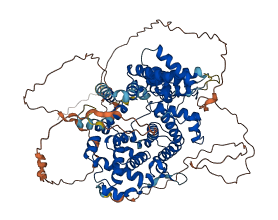
Descriptions
The autoinhibited protein was predicted that may have potential autoinhibitory elements via cis-regPred.
Autoinhibitory domains (AIDs)
Target domain |
|
Relief mechanism |
|
Assay |
cis-regPred |
Accessory elements
No accessory elements
Autoinhibited structure

Activated structure
1 structures for Q8K4F8
| Entry ID | Method | Resolution | Chain | Position | Source |
|---|---|---|---|---|---|
| AF-Q8K4F8-F1 | Predicted | AlphaFoldDB |
No variants for Q8K4F8
| Variant ID(s) | Position | Change | Description | Diseaes Association | Provenance |
|---|---|---|---|---|---|
| No variants for Q8K4F8 | |||||
No associated diseases with Q8K4F8
16 regional properties for Q8K4F8
| Type | Name | Position | InterPro Accession |
|---|---|---|---|
| ptm | EGF-type aspartate/asparagine hydroxylation site | 595 - 606 | IPR000152-1 |
| ptm | EGF-type aspartate/asparagine hydroxylation site | 750 - 761 | IPR000152-2 |
| domain | EGF-like domain | 579 - 620 | IPR000742-1 |
| domain | EGF-like domain | 738 - 775 | IPR000742-2 |
| domain | CUB domain | 354 - 466 | IPR000859-1 |
| domain | CUB domain | 467 - 579 | IPR000859-2 |
| domain | CUB domain | 623 - 735 | IPR000859-3 |
| domain | CUB domain | 779 - 891 | IPR000859-4 |
| domain | CUB domain | 892 - 1008 | IPR000859-5 |
| domain | Peptidase M12A | 153 - 352 | IPR001506 |
| domain | EGF-like calcium-binding domain | 579 - 620 | IPR001881-1 |
| domain | EGF-like calcium-binding domain | 735 - 775 | IPR001881-2 |
| domain | Peptidase, metallopeptidase | 158 - 300 | IPR006026 |
| conserved_site | EGF-like calcium-binding, conserved site | 579 - 604 | IPR018097-1 |
| conserved_site | EGF-like calcium-binding, conserved site | 735 - 759 | IPR018097-2 |
| domain | Tolloid/BMP1 peptidase domain | 153 - 352 | IPR034036 |
Functions
8 GO annotations of cellular component
| Name | Definition |
|---|---|
| cell junction | A cellular component that forms a specialized region of connection between two or more cells, or between a cell and the extracellular matrix, or between two membrane-bound components of a cell, such as flagella. |
| centriole | A cellular organelle, found close to the nucleus in many eukaryotic cells, consisting of a small cylinder with microtubular walls, 300-500 nm long and 150-250 nm in diameter. It contains nine short, parallel, peripheral microtubular fibrils, each fibril consisting of one complete microtubule fused to two incomplete microtubules. Cells usually have two centrioles, lying at right angles to each other. At division, each pair of centrioles generates another pair and the twin pairs form the pole of the mitotic spindle. |
| centrosome | A structure comprised of a core structure (in most organisms, a pair of centrioles) and peripheral material from which a microtubule-based structure, such as a spindle apparatus, is organized. Centrosomes occur close to the nucleus during interphase in many eukaryotic cells, though in animal cells it changes continually during the cell-division cycle. |
| cyclin-dependent protein kinase holoenzyme complex | Cyclin-dependent protein kinases (CDKs) are enzyme complexes that contain a kinase catalytic subunit associated with a regulatory cyclin partner. |
| cytoplasm | The contents of a cell excluding the plasma membrane and nucleus, but including other subcellular structures. |
| nucleus | A membrane-bounded organelle of eukaryotic cells in which chromosomes are housed and replicated. In most cells, the nucleus contains all of the cell's chromosomes except the organellar chromosomes, and is the site of RNA synthesis and processing. In some species, or in specialized cell types, RNA metabolism or DNA replication may be absent. |
| perinuclear region of cytoplasm | Cytoplasm situated near, or occurring around, the nucleus. |
| SCF ubiquitin ligase complex | A ubiquitin ligase complex in which a cullin from the Cul1 subfamily and a RING domain protein form the catalytic core; substrate specificity is conferred by a Skp1 adaptor and an F-box protein. SCF complexes are involved in targeting proteins for degradation by the proteasome. The best characterized complexes are those from yeast and mammals (with core subunits named Cdc53/Cul1, Rbx1/Hrt1/Roc1). |
3 GO annotations of molecular function
| Name | Definition |
|---|---|
| anaphase-promoting complex binding | Binding to an anaphase-promoting complex. A ubiquitin ligase complex that degrades mitotic cyclins and anaphase inhibitory protein, thereby triggering sister chromatid separation and exit from mitosis. |
| cyclin-dependent protein serine/threonine kinase regulator activity | Modulates the activity of a cyclin-dependent protein serine/threonine kinase, enzymes of the protein kinase family that are regulated through association with cyclins and other proteins. |
| protein kinase binding | Binding to a protein kinase, any enzyme that catalyzes the transfer of a phosphate group, usually from ATP, to a protein substrate. |
10 GO annotations of biological process
| Name | Definition |
|---|---|
| cell division | The process resulting in division and partitioning of components of a cell to form more cells; may or may not be accompanied by the physical separation of a cell into distinct, individually membrane-bounded daughter cells. |
| mitotic cell cycle phase transition | The cell cycle process by which a cell commits to entering the next mitotic cell cycle phase. |
| negative regulation of centrosome duplication | Any process that decreases the frequency, rate or extent of centrosome duplication. Centrosome duplication is the replication of a centrosome, a structure comprised of a pair of centrioles and peri-centriolar material from which a microtubule spindle apparatus is organized. |
| placenta development | The process whose specific outcome is the progression of the placenta over time, from its formation to the mature structure. The placenta is an organ of metabolic interchange between fetus and mother, partly of embryonic origin and partly of maternal origin. |
| protein ubiquitination | The process in which one or more ubiquitin groups are added to a protein. |
| re-entry into mitotic cell cycle | The resumption of the mitotic cell division cycle by cells that were in a quiescent or other non-dividing state. |
| regulation of cell cycle | Any process that modulates the rate or extent of progression through the cell cycle. |
| regulation of cyclin-dependent protein serine/threonine kinase activity | Any process that modulates the frequency, rate or extent of cyclin-dependent protein serine/threonine kinase activity. |
| response to organic substance | Any process that results in a change in state or activity of a cell or an organism (in terms of movement, secretion, enzyme production, gene expression, etc.) as a result of an organic substance stimulus. |
| SCF-dependent proteasomal ubiquitin-dependent protein catabolic process | The chemical reactions and pathways resulting in the breakdown of a protein or peptide by hydrolysis of its peptide bonds, initiated by the covalent attachment of ubiquitin, with ubiquitin-protein ligation catalyzed by an SCF (Skp1/Cul1/F-box protein) complex, and mediated by the proteasome. |
11 homologous proteins in AiPD
| UniProt AC | Gene Name | Protein Name | Species | Evidence Code |
|---|---|---|---|---|
| P20438 | CLN2 | G1/S-specific cyclin CLN2 | Saccharomyces cerevisiae (strain ATCC 204508 / S288c) (Baker's yeast) | PR |
| P24869 | CLB2 | G2/mitotic-specific cyclin-2 | Saccharomyces cerevisiae (strain ATCC 204508 / S288c) (Baker's yeast) | PR |
| P41002 | CCNF | Cyclin-F | Homo sapiens (Human) | PR |
| Q10PQ9 | SDS | Cyclin-SDS-like | Oryza sativa subsp japonica (Rice) | PR |
| Q10Q62 | CYCF3-2 | Putative cyclin-F3-2 | Oryza sativa subsp japonica (Rice) | PR |
| Q0JIF2 | CYCB1-1 | Cyclin-B1-1 | Oryza sativa subsp japonica (Rice) | PR |
| A0MEB5 | CYCA3-3 | Cyclin-A3-3 | Arabidopsis thaliana (Mouse-ear cress) | PR |
| Q9FMH5 | CYCA3-1 | Putative cyclin-A3-1 | Arabidopsis thaliana (Mouse-ear cress) | PR |
| O48790 | CYCB1-4 | Cyclin-B1-4 | Arabidopsis thaliana (Mouse-ear cress) | PR |
| Q9C6A9 | CYCA3-2 | Cyclin-A3-2 | Arabidopsis thaliana (Mouse-ear cress) | PR |
| Q1PFW3 | SDS | Cyclin-SDS | Arabidopsis thaliana (Mouse-ear cress) | PR |
| 10 | 20 | 30 | 40 | 50 | 60 |
| MGSGGVIHCR | CAKCFCYPTK | RRIKRRPRNL | TILSLPEDVL | FHILKWLSVG | DILAVRAVHS |
| 70 | 80 | 90 | 100 | 110 | 120 |
| HLKYLVDNHA | SVWASASFQE | LWPSPQNLKL | FERAAEKGNF | EAAVKLGIAY | LYNEGLSVSD |
| 130 | 140 | 150 | 160 | 170 | 180 |
| EACAEVNGLK | ASRFFSMAER | LNTGSDPFIW | LFIRPPWSVS | GSCCKAVVHD | SLRAECQLQR |
| 190 | 200 | 210 | 220 | 230 | 240 |
| SHKASILHCL | GRVLNLFEDE | EKRKQAHNLF | EESAHQGCLA | SSYLLWESDR | KVDMSDPGRC |
| 250 | 260 | 270 | 280 | 290 | 300 |
| LHSFRKLRDY | AAKGCWEAQL | ALAKACAGGS | QLGLEGKACS | ESVCQLFQAS | QAVNKQQIFS |
| 310 | 320 | 330 | 340 | 350 | 360 |
| VQKGLSDTMR | YILIDWLVEV | ATMKDFTSLC | LHLTVECVDR | YLRRRLVPRY | KLQLLGIACM |
| 370 | 380 | 390 | 400 | 410 | 420 |
| VICTRFISKE | ILTIREAVWL | TDNTYKYEDL | VRVMGEIISA | LEGKIRIPTV | VDYKEVLLTL |
| 430 | 440 | 450 | 460 | 470 | 480 |
| VPVAPRTQHL | CSFLCELTLL | HTSLSVYAPA | RLASAALLLA | RLMHGHTQPW | TTQLWDLTGF |
| 490 | 500 | 510 | 520 | 530 | 540 |
| SYSDLTPCVL | SLHKKCFHDD | APKDYRQVSL | TAVKQRFEDK | CYEEISQEEV | LSYAELCSAL |
| 550 | 560 | 570 | 580 | 590 | 600 |
| GVKQESPEPP | SFPSSGEIHT | FLSSPSGRRS | KRKRENSLQE | DRGSFVTTPT | AELSNQEETL |
| 610 | 620 | 630 | 640 | 650 | 660 |
| LGSLLDWSLD | CCSGYEGDQE | SEGEKEGDVT | APSGLLDVTV | VYLNPEEHCC | QESSDEEVWP |
| 670 | 680 | 690 | 700 | 710 | 720 |
| EDKSHPTPGT | QAPPASAPWP | LPCNRGDPGK | DVTTSGYSSV | SSSSPISSLD | GGMVGSPRST |
| 730 | 740 | 750 | 760 | 770 | |
| SVLSVGSHSS | TKPCYHQAKK | SCLQCRPPNP | PESGAHQQPV | KRQNLSVHSD | EDTNLGFLKL |