Q8CHH9
Gene name |
Septin8 |
Protein name |
Septin-8 |
Names |
|
Species |
Mus musculus (Mouse) |
KEGG Pathway |
mmu:20362 |
EC number |
|
Protein Class |
|
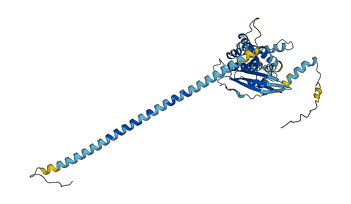
Descriptions
The autoinhibited protein was predicted that may have potential autoinhibitory elements via cis-regPred.
Autoinhibitory domains (AIDs)
Target domain |
|
Relief mechanism |
|
Assay |
cis-regPred |
Accessory elements
No accessory elements
Autoinhibited structure

Activated structure
1 structures for Q8CHH9
| Entry ID | Method | Resolution | Chain | Position | Source |
|---|---|---|---|---|---|
| AF-Q8CHH9-F1 | Predicted | AlphaFoldDB |
20 variants for Q8CHH9
| Variant ID(s) | Position | Change | Description | Diseaes Association | Provenance |
|---|---|---|---|---|---|
| rs3389151418 | 56 | G>D | No | EVA | |
| rs3401866786 | 69 | F>L | No | EVA | |
| rs3402329161 | 70 | E>V | No | EVA | |
| rs3389158898 | 92 | E>V | No | EVA | |
| rs3389155215 | 95 | V>A | No | EVA | |
| rs3389155437 | 129 | E>D | No | EVA | |
| rs3389094830 | 138 | I>F | No | EVA | |
| rs3389151449 | 151 | H>Y | No | EVA | |
| rs3389143210 | 173 | K>T | No | EVA | |
| rs3389094777 | 180 | N>S | No | EVA | |
| rs3389149484 | 194 | S>I | No | EVA | |
| rs3389164053 | 200 | K>Q | No | EVA | |
| rs3389149505 | 205 | G>C | No | EVA | |
| rs3389127192 | 209 | S>N | No | EVA | |
| rs3389158877 | 302 | R>H | No | EVA | |
| rs3389094812 | 305 | L>F | No | EVA | |
| rs3389143262 | 372 | H>R | No | EVA | |
| rs3389158854 | 390 | E>D | No | EVA | |
| rs3389131501 | 393 | E>* | No | EVA | |
| rs3389154145 | 407 | A>V | No | EVA |
No associated diseases with Q8CHH9
Functions
9 GO annotations of cellular component
| Name | Definition |
|---|---|
| anchoring junction | A cell junction that mechanically attaches a cell (and its cytoskeleton) to neighboring cells or to the extracellular matrix. |
| axon | The long process of a neuron that conducts nerve impulses, usually away from the cell body to the terminals and varicosities, which are sites of storage and release of neurotransmitter. |
| cell division site | The eventual plane of cell division (also known as cell cleavage or cytokinesis) in a dividing cell. In Eukaryotes, the cleavage apparatus, composed of septin structures and the actomyosin contractile ring, forms along this plane, and the mitotic, or meiotic, spindle is aligned perpendicular to the division plane. In bacteria, the cell division site is generally located at mid-cell and is the site at which the cytoskeletal structure, the Z-ring, assembles. |
| microtubule cytoskeleton | The part of the cytoskeleton (the internal framework of a cell) composed of microtubules and associated proteins. |
| myelin sheath | An electrically insulating fatty layer that surrounds the axons of many neurons. It is an outgrowth of glial cells: Schwann cells supply the myelin for peripheral neurons while oligodendrocytes supply it to those of the central nervous system. |
| presynapse | The part of a synapse that is part of the presynaptic cell. |
| septin complex | A protein complex containing septins. Typically, these complexes contain multiple septins and are oligomeric. |
| septin ring | A tight ring-shaped structure that forms in the division plane at the site of cytokinesis; composed of members of the conserved family of filament-forming proteins called septins as well as septin-associated proteins. This type of septin structure is observed at the bud neck of budding fungal cells, at the site of cell division in animal cells, at the junction between the mother cell and a pseudohyphal projection, and also within hyphae of filamentous fungi at sites where a septum will form. |
| synaptic vesicle membrane | The lipid bilayer surrounding a synaptic vesicle. |
4 GO annotations of molecular function
| Name | Definition |
|---|---|
| GTP binding | Binding to GTP, guanosine triphosphate. |
| GTPase activity | Catalysis of the reaction: GTP + H2O = GDP + H+ + phosphate. |
| molecular adaptor activity | The binding activity of a molecule that brings together two or more molecules through a selective, non-covalent, often stoichiometric interaction, permitting those molecules to function in a coordinated way. |
| SNARE binding | Binding to a SNARE (soluble N-ethylmaleimide-sensitive factor attached protein receptor) protein. |
5 GO annotations of biological process
| Name | Definition |
|---|---|
| cytoskeleton-dependent cytokinesis | A cytokinesis that involves the function of a set of proteins that are part of the microfilament or microtubule cytoskeleton. |
| protein localization | Any process in which a protein is transported to, or maintained in, a specific location. |
| regulation of intracellular protein transport | Any process that modulates the frequency, rate or extent of the directed movement of proteins within cells. |
| regulation of protein stability | Any process that affects the structure and integrity of a protein, altering the likelihood of its degradation or aggregation. |
| regulation of SNARE complex assembly | Any process that modulates the frequency, rate or extent of assembly of the SNARE complex. The SNARE complex is a protein complex involved in membrane fusion; a stable ternary complex consisting of a four-helix bundle, usually formed from one R-SNARE and three Q-SNAREs with an ionic layer sandwiched between hydrophobic layers. |
21 homologous proteins in AiPD
| UniProt AC | Gene Name | Protein Name | Species | Evidence Code |
|---|---|---|---|---|
| P32468 | CDC12 | Cell division control protein 12 | Saccharomyces cerevisiae (strain ATCC 204508 / S288c) (Baker's yeast) | PR |
| Q07657 | SHS1 | Seventh homolog of septin 1 | Saccharomyces cerevisiae (strain ATCC 204508 / S288c) (Baker's yeast) | PR |
| P32457 | CDC3 | Cell division control protein 3 | Saccharomyces cerevisiae (strain ATCC 204508 / S288c) (Baker's yeast) | PR |
| A2VE99 | SEPTIN11 | Septin-11 | Bos taurus (Bovine) | PR |
| A6QQL3 | SEPTIN14 | Septin-14 | Bos taurus (Bovine) | PR |
| Q3SZN0 | SEPTIN6 | Septin-6 | Bos taurus (Bovine) | PR |
| P54359 | 02-Sep | Septin-2 | Drosophila melanogaster (Fruit fly) | PR |
| Q14141 | SEPTIN6 | Septin-6 | Homo sapiens (Human) | PR |
| Q9NVA2 | SEPTIN11 | Septin-11 | Homo sapiens (Human) | PR |
| Q9P0V9 | SEPTIN10 | Septin-10 | Homo sapiens (Human) | PR |
| P28661 | Septin4 | Septin-4 | Mus musculus (Mouse) | PR |
| Q9R1T4 | Septin6 | Septin-6 | Mus musculus (Mouse) | PR |
| Q9DA97 | Septin14 | Septin-14 | Mus musculus (Mouse) | PR |
| Q8C1B7 | Septin11 | Septin-11 | Mus musculus (Mouse) | PR |
| Q9Z1S5 | Septin3 | Neuronal-specific septin-3 | Mus musculus (Mouse) | PR |
| Q80UG5 | Septin9 | Septin-9 | Mus musculus (Mouse) | PR |
| O55131 | Septin7 | Septin-7 | Mus musculus (Mouse) | PR |
| B3GNI6 | Septin11 | Septin-11 | Rattus norvegicus (Rat) | PR |
| B0BNF1 | Septin8 | Septin-8 | Rattus norvegicus (Rat) | PR |
| A4FUM1 | sept8b | Septin-8-B | Danio rerio (Zebrafish) (Brachydanio rerio) | PR |
| Q642H3 | sept8a | Septin-8-A | Danio rerio (Zebrafish) (Brachydanio rerio) | PR |
| 10 | 20 | 30 | 40 | 50 | 60 |
| MAATDLERVS | NAEPEPRSLS | LGGHVGFDSL | PDQLVSKSVT | QGFSFNILCV | GETGIGKSTL |
| 70 | 80 | 90 | 100 | 110 | 120 |
| MNTLFNTTFE | TEEASHHEEC | VRLRPQTYDL | QESNVHLKLT | IVDAVGFGDQ | INKDDSYRPI |
| 130 | 140 | 150 | 160 | 170 | 180 |
| VDYIDAQFEN | YLQEELKIRR | SLFDYHDTRI | HVCLYFITPT | GHSLKSLDLV | TMKKLDSKVN |
| 190 | 200 | 210 | 220 | 230 | 240 |
| IIPIIAKADT | ISKSELHKFK | IKIMGELVSN | GVQIYQFPTD | DEAVAEINAV | MNAHLPFAVV |
| 250 | 260 | 270 | 280 | 290 | 300 |
| GSTEEVKVGN | KLVRARQYPW | GVVQVENENH | CDFVKLREML | IRVNMEDLRE | QTHSRHYELY |
| 310 | 320 | 330 | 340 | 350 | 360 |
| RRCKLEEMGF | QDSDGDSQPF | SLQETYEAKR | KEFLSELQRK | EEEMRQMFVN | KVKETELELK |
| 370 | 380 | 390 | 400 | 410 | 420 |
| EKERELHEKF | EHLKRIHQEE | KRKVEEKRRE | LEEETNAFNC | RKAAMEALQS | QALHATSQQP |
| LRKDKDKKN |