P28661
Gene name |
Septin4 |
Protein name |
Septin-4 |
Names |
Bradeion beta, Brain protein H5, CE5B3 beta, Cell division control-related protein 2, hCDCREL-2, Peanut-like protein 2 |
Species |
Mus musculus (Mouse) |
KEGG Pathway |
mmu:18952 |
EC number |
|
Protein Class |
|
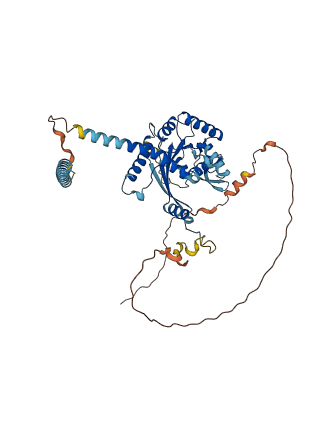
Descriptions
The autoinhibited protein was predicted that may have potential autoinhibitory elements via cis-regPred.
Autoinhibitory domains (AIDs)
Target domain |
|
Relief mechanism |
|
Assay |
cis-regPred |
Accessory elements
No accessory elements
Autoinhibited structure

Activated structure
1 structures for P28661
| Entry ID | Method | Resolution | Chain | Position | Source |
|---|---|---|---|---|---|
| AF-P28661-F1 | Predicted | AlphaFoldDB |
8 variants for P28661
| Variant ID(s) | Position | Change | Description | Diseaes Association | Provenance |
|---|---|---|---|---|---|
| rs3389127788 | 85 | Q>H | No | EVA | |
| rs3389154363 | 148 | M>V | No | EVA | |
| rs3389199395 | 162 | N>D | No | EVA | |
| rs3389160508 | 188 | I>F | No | EVA | |
| rs3389190209 | 286 | P>S | No | EVA | |
| rs3389165874 | 427 | K>T | No | EVA | |
| rs3389199424 | 449 | T>N | No | EVA | |
| rs3389194633 | 463 | M>I | No | EVA |
No associated diseases with P28661
1 regional properties for P28661
| Type | Name | Position | InterPro Accession |
|---|---|---|---|
| domain | Ubiquitin-conjugating enzyme E2 | 402 - 568 | IPR000608 |
Functions
19 GO annotations of cellular component
| Name | Definition |
|---|---|
| anchoring junction | A cell junction that mechanically attaches a cell (and its cytoskeleton) to neighboring cells or to the extracellular matrix. |
| axon | The long process of a neuron that conducts nerve impulses, usually away from the cell body to the terminals and varicosities, which are sites of storage and release of neurotransmitter. |
| axon terminus | Terminal inflated portion of the axon, containing the specialized apparatus necessary to release neurotransmitters. The axon terminus is considered to be the whole region of thickening and the terminal button is a specialized region of it. |
| cell division site | The eventual plane of cell division (also known as cell cleavage or cytokinesis) in a dividing cell. In Eukaryotes, the cleavage apparatus, composed of septin structures and the actomyosin contractile ring, forms along this plane, and the mitotic, or meiotic, spindle is aligned perpendicular to the division plane. In bacteria, the cell division site is generally located at mid-cell and is the site at which the cytoskeletal structure, the Z-ring, assembles. |
| cell projection | A prolongation or process extending from a cell, e.g. a flagellum or axon. |
| cytoplasm | The contents of a cell excluding the plasma membrane and nucleus, but including other subcellular structures. |
| cytosol | The part of the cytoplasm that does not contain organelles but which does contain other particulate matter, such as protein complexes. |
| dendrite | A neuron projection that has a short, tapering, morphology. Dendrites receive and integrate signals from other neurons or from sensory stimuli, and conduct nerve impulses towards the axon or the cell body. In most neurons, the impulse is conveyed from dendrites to axon via the cell body, but in some types of unipolar neuron, the impulse does not travel via the cell body. |
| microtubule cytoskeleton | The part of the cytoskeleton (the internal framework of a cell) composed of microtubules and associated proteins. |
| mitochondrion | A semiautonomous, self replicating organelle that occurs in varying numbers, shapes, and sizes in the cytoplasm of virtually all eukaryotic cells. It is notably the site of tissue respiration. |
| motile cilium | A cilium which may have a variable arrangement of axonemal microtubules and also contains molecular motors. It may beat with a whip-like pattern that promotes cell motility or transport of fluids and other cells across a cell surface, such as on epithelial cells that line the lumenal ducts of various tissues; or they may display a distinct twirling motion that directs fluid flow asymmetrically across the cellular surface to affect asymmetric body plan organization. Motile cilia can be found in single as well as multiple copies per cell. |
| myelin sheath | An electrically insulating fatty layer that surrounds the axons of many neurons. It is an outgrowth of glial cells: Schwann cells supply the myelin for peripheral neurons while oligodendrocytes supply it to those of the central nervous system. |
| nucleoplasm | That part of the nuclear content other than the chromosomes or the nucleolus. |
| perikaryon | The portion of the cell soma (neuronal cell body) that excludes the nucleus. |
| septin complex | A protein complex containing septins. Typically, these complexes contain multiple septins and are oligomeric. |
| septin ring | A tight ring-shaped structure that forms in the division plane at the site of cytokinesis; composed of members of the conserved family of filament-forming proteins called septins as well as septin-associated proteins. This type of septin structure is observed at the bud neck of budding fungal cells, at the site of cell division in animal cells, at the junction between the mother cell and a pseudohyphal projection, and also within hyphae of filamentous fungi at sites where a septum will form. |
| sperm annulus | The ring-like, filamentous structure located at the distal end of the midpiece of the sperm flagellum; the annulus is thought to form a diffusion barrier between the midpiece and the principal piece and serve as a stabilizing structure for tail rigidity. |
| sperm flagellum | A microtubule-based flagellum (or cilium) that is part of a sperm, a mature male germ cell that develops from a spermatid. |
| synaptic vesicle | A secretory organelle, typically 50 nm in diameter, of presynaptic nerve terminals; accumulates in high concentrations of neurotransmitters and secretes these into the synaptic cleft by fusion with the 'active zone' of the presynaptic plasma membrane. |
5 GO annotations of molecular function
| Name | Definition |
|---|---|
| GTP binding | Binding to GTP, guanosine triphosphate. |
| GTPase activity | Catalysis of the reaction: GTP + H2O = GDP + H+ + phosphate. |
| identical protein binding | Binding to an identical protein or proteins. |
| magnesium ion binding | Binding to a magnesium (Mg) ion. |
| molecular adaptor activity | The binding activity of a molecule that brings together two or more molecules through a selective, non-covalent, often stoichiometric interaction, permitting those molecules to function in a coordinated way. |
16 GO annotations of biological process
| Name | Definition |
|---|---|
| brain development | The process whose specific outcome is the progression of the brain over time, from its formation to the mature structure. Brain development begins with patterning events in the neural tube and ends with the mature structure that is the center of thought and emotion. The brain is responsible for the coordination and control of bodily activities and the interpretation of information from the senses (sight, hearing, smell, etc.). |
| cytoskeleton-dependent cytokinesis | A cytokinesis that involves the function of a set of proteins that are part of the microfilament or microtubule cytoskeleton. |
| flagellated sperm motility | The directed, self-propelled movement of a cilium (aka flagellum) that contributes to the movement of a flagellated sperm. |
| hematopoietic stem cell homeostasis | Any biological process involved in the maintenance of the steady-state number of hematopoietic stem cells within a population of cells. |
| negative regulation of stem cell proliferation | Any process that stops, prevents or reduces the frequency, rate or extent of stem cell proliferation. |
| neuron migration | The characteristic movement of an immature neuron from germinal zones to specific positions where they will reside as they mature. |
| positive regulation of apoptotic process | Any process that activates or increases the frequency, rate or extent of cell death by apoptotic process. |
| positive regulation of intrinsic apoptotic signaling pathway | Any process that activates or increases the frequency, rate or extent of intrinsic apoptotic signaling pathway. |
| positive regulation of protein ubiquitination | Any process that activates or increases the frequency, rate or extent of the addition of ubiquitin groups to a protein. |
| protein localization | Any process in which a protein is transported to, or maintained in, a specific location. |
| regulation of exocytosis | Any process that modulates the frequency, rate or extent of exocytosis. |
| sperm capacitation | A process required for sperm to reach fertilization competence. Sperm undergo an incompletely understood series of morphological and molecular maturational processes, termed capacitation, involving, among other processes, protein tyrosine phosphorylation and increased intracellular calcium. |
| sperm mitochondrion organization | A process that is carried out at the cellular level which results in the assembly, arrangement of constituent parts, or disassembly of sperm mitochondria; the process in which they take on their characteristic morphology; they are flattened, elongated, and arranged circumferentially into a tight helical coil around the tail-dense fibers of the mature sperm. |
| spermatid development | The process whose specific outcome is the progression of a spermatid over time, from its formation to the mature structure. |
| spermatid differentiation | The process whose specific outcome is the progression of a spermatid over time, from initial commitment of the cell to a specific fate, to the fully functional differentiated cell. |
| tissue morphogenesis | The process in which the anatomical structures of a tissue are generated and organized. |
14 homologous proteins in AiPD
| UniProt AC | Gene Name | Protein Name | Species | Evidence Code |
|---|---|---|---|---|
| P32468 | CDC12 | Cell division control protein 12 | Saccharomyces cerevisiae (strain ATCC 204508 / S288c) (Baker's yeast) | PR |
| Q07657 | SHS1 | Seventh homolog of septin 1 | Saccharomyces cerevisiae (strain ATCC 204508 / S288c) (Baker's yeast) | PR |
| P32457 | CDC3 | Cell division control protein 3 | Saccharomyces cerevisiae (strain ATCC 204508 / S288c) (Baker's yeast) | PR |
| Q6Q137 | SEPTIN7 | Septin-7 | Bos taurus (Bovine) | PR |
| Q5R1W1 | SEPTIN7 | Septin-7 | Pan troglodytes (Chimpanzee) | PR |
| Q16181 | SEPTIN7 | Septin-7 | Homo sapiens (Human) | PR |
| Q9R1T4 | Septin6 | Septin-6 | Mus musculus (Mouse) | PR |
| Q9DA97 | Septin14 | Septin-14 | Mus musculus (Mouse) | PR |
| Q8CHH9 | Septin8 | Septin-8 | Mus musculus (Mouse) | PR |
| Q8C1B7 | Septin11 | Septin-11 | Mus musculus (Mouse) | PR |
| Q9Z1S5 | Septin3 | Neuronal-specific septin-3 | Mus musculus (Mouse) | PR |
| Q80UG5 | Septin9 | Septin-9 | Mus musculus (Mouse) | PR |
| O55131 | Septin7 | Septin-7 | Mus musculus (Mouse) | PR |
| Q9WVC0 | Septin7 | Septin-7 | Rattus norvegicus (Rat) | PR |
| 10 | 20 | 30 | 40 | 50 | 60 |
| MDHSLGWQGN | SVPEDGTEAG | IKHFLEDSSD | DAELSKFVKD | FPGSEPYHSA | ESKTRVARPQ |
| 70 | 80 | 90 | 100 | 110 | 120 |
| ILEPRPQSPD | LCDDDVEFRG | SLWPQPSDSQ | QYFSAPAPLS | PSSRPRSPWG | KLDPYDSSED |
| 130 | 140 | 150 | 160 | 170 | 180 |
| DKEYVGFATL | PNQVHRKSVK | KGFDFTLMVA | GESGLGKSTL | VNSLFLTDLY | RDRKLLGAEE |
| 190 | 200 | 210 | 220 | 230 | 240 |
| RIMQTVEITK | HAVDIEEKGV | RLRLTIVDTP | GFGDAVNNTE | CWKPVAEYID | QQFEQYFRDE |
| 250 | 260 | 270 | 280 | 290 | 300 |
| SGLNRKNIQD | NRVHCCLYFI | SPFGHGLRPL | DVEFMKALHQ | RVNIVPILAK | ADTLTPPEVD |
| 310 | 320 | 330 | 340 | 350 | 360 |
| RKKCKIREEI | EHFGIKIYQF | PDCDSDEDED | FKLQDQALKE | SIPFAVIGSN | TVVEARGRRV |
| 370 | 380 | 390 | 400 | 410 | 420 |
| RGRLYPWGIV | EVENPGHCDF | VKLRTMLVRT | HMQDLKDVTR | ETHYENYRAQ | CIQSMTRLVV |
| 430 | 440 | 450 | 460 | 470 | |
| KERNRNKLTR | ESGTDFPIPA | VPPGTDPETE | KLIREKDEEL | RRMQEMLHKI | QRQMKETH |