Q9WVC0
Gene name |
Septin7 |
Protein name |
Septin-7 |
Names |
CDC10 protein homolog |
Species |
Rattus norvegicus (Rat) |
KEGG Pathway |
rno:64551 |
EC number |
|
Protein Class |
|
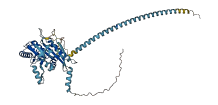
Descriptions
The autoinhibited protein was predicted that may have potential autoinhibitory elements via cis-regPred.
Autoinhibitory domains (AIDs)
Target domain |
|
Relief mechanism |
|
Assay |
cis-regPred |
Accessory elements
No accessory elements
Autoinhibited structure

Activated structure
1 structures for Q9WVC0
| Entry ID | Method | Resolution | Chain | Position | Source |
|---|---|---|---|---|---|
| AF-Q9WVC0-F1 | Predicted | AlphaFoldDB |
No variants for Q9WVC0
| Variant ID(s) | Position | Change | Description | Diseaes Association | Provenance |
|---|---|---|---|---|---|
| No variants for Q9WVC0 | |||||
No associated diseases with Q9WVC0
No regional properties for Q9WVC0
| Type | Name | Position | InterPro Accession |
|---|---|---|---|
| No domain, repeats, and functional sites for Q9WVC0 | |||
Functions
25 GO annotations of cellular component
| Name | Definition |
|---|---|
| axon terminus | Terminal inflated portion of the axon, containing the specialized apparatus necessary to release neurotransmitters. The axon terminus is considered to be the whole region of thickening and the terminal button is a specialized region of it. |
| axoneme | The bundle of microtubules and associated proteins that forms the core of cilia (also called flagella) in eukaryotic cells and is responsible for their movements. |
| cell body | The portion of a cell bearing surface projections such as axons, dendrites, cilia, or flagella that includes the nucleus, but excludes all cell projections. |
| cell cortex | The region of a cell that lies just beneath the plasma membrane and often, but not always, contains a network of actin filaments and associated proteins. |
| cell division site | The eventual plane of cell division (also known as cell cleavage or cytokinesis) in a dividing cell. In Eukaryotes, the cleavage apparatus, composed of septin structures and the actomyosin contractile ring, forms along this plane, and the mitotic, or meiotic, spindle is aligned perpendicular to the division plane. In bacteria, the cell division site is generally located at mid-cell and is the site at which the cytoskeletal structure, the Z-ring, assembles. |
| cleavage furrow | The cleavage furrow is a plasma membrane invagination at the cell division site. The cleavage furrow begins as a shallow groove and eventually deepens to divide the cytoplasm. |
| glutamatergic synapse | A synapse that uses glutamate as a neurotransmitter. |
| kinetochore | A multisubunit complex that is located at the centromeric region of DNA and provides an attachment point for the spindle microtubules. |
| membrane | A lipid bilayer along with all the proteins and protein complexes embedded in it an attached to it. |
| microtubule cytoskeleton | The part of the cytoskeleton (the internal framework of a cell) composed of microtubules and associated proteins. |
| midbody | A thin cytoplasmic bridge formed between daughter cells at the end of cytokinesis. The midbody forms where the contractile ring constricts, and may persist for some time before finally breaking to complete cytokinesis. |
| neuron projection | A prolongation or process extending from a nerve cell, e.g. an axon or dendrite. |
| neuronal cell body | The portion of a neuron that includes the nucleus, but excludes cell projections such as axons and dendrites. |
| non-motile cilium | A cilium which may have a variable array of axonemal microtubules but does not contain molecular motors. |
| nucleus | A membrane-bounded organelle of eukaryotic cells in which chromosomes are housed and replicated. In most cells, the nucleus contains all of the cell's chromosomes except the organellar chromosomes, and is the site of RNA synthesis and processing. In some species, or in specialized cell types, RNA metabolism or DNA replication may be absent. |
| presynaptic membrane | A specialized area of membrane of the axon terminal that faces the plasma membrane of the neuron or muscle fiber with which the axon terminal establishes a synaptic junction; many synaptic junctions exhibit structural presynaptic characteristics, such as conical, electron-dense internal protrusions, that distinguish it from the remainder of the axon plasma membrane. |
| protein-containing complex | A stable assembly of two or more macromolecules, i.e. proteins, nucleic acids, carbohydrates or lipids, in which at least one component is a protein and the constituent parts function together. |
| septin complex | A protein complex containing septins. Typically, these complexes contain multiple septins and are oligomeric. |
| septin cytoskeleton | The part of the cytoskeleton (the internal framework of a cell) composed of septins and associated proteins. Includes septin cytoskeleton-associated complexes. |
| septin filament array | Arrays of septin filaments, or bars, found in a series of filamentous structures. Such structures have been observed in the prospore membrane during spore formation in S. cerevisiae and in the chlamydospore membrane during chlamydospore formation in C. albicans. |
| septin ring | A tight ring-shaped structure that forms in the division plane at the site of cytokinesis; composed of members of the conserved family of filament-forming proteins called septins as well as septin-associated proteins. This type of septin structure is observed at the bud neck of budding fungal cells, at the site of cell division in animal cells, at the junction between the mother cell and a pseudohyphal projection, and also within hyphae of filamentous fungi at sites where a septum will form. |
| sperm annulus | The ring-like, filamentous structure located at the distal end of the midpiece of the sperm flagellum; the annulus is thought to form a diffusion barrier between the midpiece and the principal piece and serve as a stabilizing structure for tail rigidity. |
| spindle | The array of microtubules and associated molecules that forms between opposite poles of a eukaryotic cell during mitosis or meiosis and serves to move the duplicated chromosomes apart. |
| stress fiber | A contractile actin filament bundle that consists of short actin filaments with alternating polarity, cross-linked by alpha-actinin and possibly other actin bundling proteins, and with myosin present in a periodic distribution along the fiber. |
| synapse | The junction between an axon of one neuron and a dendrite of another neuron, a muscle fiber or a glial cell. As the axon approaches the synapse it enlarges into a specialized structure, the presynaptic terminal bouton, which contains mitochondria and synaptic vesicles. At the tip of the terminal bouton is the presynaptic membrane; facing it, and separated from it by a minute cleft (the synaptic cleft) is a specialized area of membrane on the receiving cell, known as the postsynaptic membrane. In response to the arrival of nerve impulses, the presynaptic terminal bouton secretes molecules of neurotransmitters into the synaptic cleft. These diffuse across the cleft and transmit the signal to the postsynaptic membrane. |
4 GO annotations of molecular function
| Name | Definition |
|---|---|
| GTP binding | Binding to GTP, guanosine triphosphate. |
| GTPase activity | Catalysis of the reaction: GTP + H2O = GDP + H+ + phosphate. |
| identical protein binding | Binding to an identical protein or proteins. |
| molecular adaptor activity | The binding activity of a molecule that brings together two or more molecules through a selective, non-covalent, often stoichiometric interaction, permitting those molecules to function in a coordinated way. |
12 GO annotations of biological process
| Name | Definition |
|---|---|
| cilium assembly | The assembly of a cilium, a specialized eukaryotic organelle that consists of a filiform extrusion of the cell surface. Each cilium is bounded by an extrusion of the cytoplasmic membrane, and contains a regular longitudinal array of microtubules, anchored basally in a centriole. |
| collateral sprouting | The process in which outgrowths develop from the shafts of existing axons. |
| cortical cytoskeleton organization | A process that is carried out at the cellular level which results in the assembly, arrangement of constituent parts, or disassembly of cytoskeletal structures in the cell cortex, i.e. just beneath the plasma membrane. |
| cytoskeleton-dependent cytokinesis | A cytokinesis that involves the function of a set of proteins that are part of the microfilament or microtubule cytoskeleton. |
| dendritic spine morphogenesis | The process in which the anatomical structures of a dendritic spine are generated and organized. A dendritic spine is a protrusion from a dendrite and a specialized subcellular compartment involved in synaptic transmission. |
| mitotic cytokinesis | A cell cycle process that results in the division of the cytoplasm of a cell after mitosis, resulting in the separation of the original cell into two daughter cells. |
| positive regulation of non-motile cilium assembly | Any process that activates or increases the frequency, rate or extent of non-motile cilium assembly. |
| postsynapse organization | A process that is carried out at the cellular level which results in the assembly, arrangement of constituent parts, or disassembly of a postsynapse. |
| protein localization | Any process in which a protein is transported to, or maintained in, a specific location. |
| pseudopodium retraction | The myosin-based contraction and retraction of a pseudopodium. |
| regulation of embryonic cell shape | Any process that modulates the surface configuration of an embryonic cell. |
| spermatogenesis | The developmental process by which male germ line stem cells self renew or give rise to successive cell types resulting in the development of a spermatozoa. |
12 homologous proteins in AiPD
| UniProt AC | Gene Name | Protein Name | Species | Evidence Code |
|---|---|---|---|---|
| P32468 | CDC12 | Cell division control protein 12 | Saccharomyces cerevisiae (strain ATCC 204508 / S288c) (Baker's yeast) | PR |
| Q07657 | SHS1 | Seventh homolog of septin 1 | Saccharomyces cerevisiae (strain ATCC 204508 / S288c) (Baker's yeast) | PR |
| P32457 | CDC3 | Cell division control protein 3 | Saccharomyces cerevisiae (strain ATCC 204508 / S288c) (Baker's yeast) | PR |
| Q6Q137 | SEPTIN7 | Septin-7 | Bos taurus (Bovine) | PR |
| Q5R1W1 | SEPTIN7 | Septin-7 | Pan troglodytes (Chimpanzee) | PR |
| Q16181 | SEPTIN7 | Septin-7 | Homo sapiens (Human) | PR |
| P28661 | Septin4 | Septin-4 | Mus musculus (Mouse) | PR |
| O55131 | Septin7 | Septin-7 | Mus musculus (Mouse) | PR |
| B3GNI6 | Septin11 | Septin-11 | Rattus norvegicus (Rat) | PR |
| Q9WU34 | Septin3 | Neuronal-specific septin-3 | Rattus norvegicus (Rat) | PR |
| B0BNF1 | Septin8 | Septin-8 | Rattus norvegicus (Rat) | PR |
| Q9QZR6 | Septin9 | Septin-9 | Rattus norvegicus (Rat) | PR |
| 10 | 20 | 30 | 40 | 50 | 60 |
| MSVSARSAAA | EERSVNCSTM | AQPKNLEGYV | GFANLPNQVY | RKSVKRGFEF | TLMVVGESGL |
| 70 | 80 | 90 | 100 | 110 | 120 |
| GKSTLINSLF | LTDLYSPEYP | GPSHRIKKTV | QVEQSKVLIK | EGGVQLLLTI | VDTPGFGDAV |
| 130 | 140 | 150 | 160 | 170 | 180 |
| DNSNCWQPVI | DYIDSKFEDY | LNAESRVNRR | QMPDNRVQCC | LYFIAPSGHG | LKPLDIEFMK |
| 190 | 200 | 210 | 220 | 230 | 240 |
| RLHEKVNIIP | LIAKADTLTP | EECQQFKKQI | MKEIQGHKIK | IYEFPETDDE | EENKLVKKIK |
| 250 | 260 | 270 | 280 | 290 | 300 |
| DRLPLAVVGS | NTIIEVNGKR | VRGRQYPWGV | AEVENGEHCD | FTILRNMLIR | THMQDLKDVT |
| 310 | 320 | 330 | 340 | 350 | 360 |
| NNVHYENYRS | RKLAAVTYNG | VDNNKNKGQL | TKSPLAQMEE | ERREHVAKMK | KMEMEMEQVF |
| 370 | 380 | 390 | 400 | 410 | 420 |
| EMKVKEKVQK | LKDSEAELQR | RHEQMKKNLE | AQHKELEEKR | RQFEEEKANW | EAQQRILEQQ |
| 430 | |||||
| NSSRTLEKNK | KKGKIF |