Q6P5E8
Gene name |
Dgkq |
Protein name |
Diacylglycerol kinase theta |
Names |
DAG kinase theta, Diglyceride kinase theta, DGK-theta |
Species |
Mus musculus (Mouse) |
KEGG Pathway |
mmu:110524 |
EC number |
2.7.1.93: Phosphotransferases with an alcohol group as acceptor |
Protein Class |
|
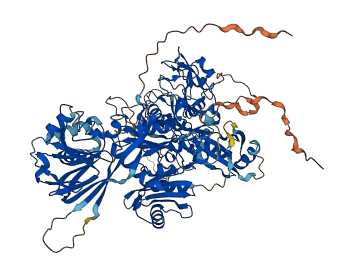
Descriptions
The autoinhibited protein was predicted that may have potential autoinhibitory elements via cis-regPred.
Autoinhibitory domains (AIDs)
Target domain |
|
Relief mechanism |
|
Assay |
cis-regPred |
Accessory elements
No accessory elements
Autoinhibited structure

Activated structure
1 structures for Q6P5E8
| Entry ID | Method | Resolution | Chain | Position | Source |
|---|---|---|---|---|---|
| AF-Q6P5E8-F1 | Predicted | AlphaFoldDB |
34 variants for Q6P5E8
| Variant ID(s) | Position | Change | Description | Diseaes Association | Provenance |
|---|---|---|---|---|---|
| rs864275001 | 42 | E>G | No | EVA | |
| rs48061479 | 49 | G>A | No | EVA | |
| rs3388775699 | 175 | T>R | No | EVA | |
| rs3388780410 | 183 | G>R | No | EVA | |
| rs3395942775 | 187 | S>P | No | EVA | |
| rs3388780477 | 203 | V>A | No | EVA | |
| rs3388758576 | 235 | S>F | No | EVA | |
| rs3388771783 | 243 | V>G | No | EVA | |
| rs3388778156 | 263 | V>A | No | EVA | |
| rs3388749151 | 273 | V>I | No | EVA | |
| rs3388778306 | 293 | K>I | No | EVA | |
| rs3388780400 | 319 | A>S | No | EVA | |
| rs3410573636 | 374 | S>P | No | EVA | |
| rs260475868 | 375 | V>M | No | EVA | |
| rs29549416 | 456 | E>D | No | EVA | |
| rs3388758541 | 475 | S>R | No | EVA | |
| rs222828972 | 487 | T>S | No | EVA | |
| rs3388761763 | 495 | V>M | No | EVA | |
| rs3388771780 | 533 | A>G | No | EVA | |
| rs3388771780 | 533 | A>V | No | EVA | |
| rs3388778073 | 541 | F>L | No | EVA | |
| rs3388777279 | 704 | M>V | No | EVA | |
| rs47147307 | 719 | T>P | No | EVA | |
| rs3388777253 | 753 | A>S | No | EVA | |
| rs3388749153 | 754 | R>C | No | EVA | |
| rs3388780423 | 764 | R>K | No | EVA | |
| rs3388778121 | 784 | S>T | No | EVA | |
| rs3395759926 | 802 | S>C | No | EVA | |
| rs3395315484 | 803 | I>N | No | EVA | |
| rs3388780441 | 881 | V>M | No | EVA | |
| rs3395969549 | 890 | P>* | No | EVA | |
| rs3388778322 | 891 | G>C | No | EVA | |
| rs3388769733 | 913 | R>G | No | EVA | |
| rs33203948 | 918 | N>I | No | EVA |
No associated diseases with Q6P5E8
4 regional properties for Q6P5E8
| Type | Name | Position | InterPro Accession |
|---|---|---|---|
| repeat | Leucine-rich repeat | 66 - 87 | IPR001611-1 |
| repeat | Leucine-rich repeat | 88 - 109 | IPR001611-2 |
| repeat | Leucine-rich repeat | 110 - 131 | IPR001611-3 |
| repeat | Leucine-rich repeat | 132 - 153 | IPR001611-4 |
Functions
| Description | ||
|---|---|---|
| EC Number | 2.7.1.93 | Phosphotransferases with an alcohol group as acceptor |
| Subcellular Localization |
|
|
| PANTHER Family | ||
| PANTHER Subfamily | ||
| PANTHER Protein Class | ||
| PANTHER Pathway Category | No pathway information available | |
13 GO annotations of cellular component
| Name | Definition |
|---|---|
| anchoring junction | A cell junction that mechanically attaches a cell (and its cytoskeleton) to neighboring cells or to the extracellular matrix. |
| cytoplasm | The contents of a cell excluding the plasma membrane and nucleus, but including other subcellular structures. |
| cytoskeleton | A cellular structure that forms the internal framework of eukaryotic and prokaryotic cells. The cytoskeleton includes intermediate filaments, microfilaments, microtubules, the microtrabecular lattice, and other structures characterized by a polymeric filamentous nature and long-range order within the cell. The various elements of the cytoskeleton not only serve in the maintenance of cellular shape but also have roles in other cellular functions, including cellular movement, cell division, endocytosis, and movement of organelles. |
| cytosol | The part of the cytoplasm that does not contain organelles but which does contain other particulate matter, such as protein complexes. |
| endosome | A vacuole to which materials ingested by endocytosis are delivered. |
| glutamatergic synapse | A synapse that uses glutamate as a neurotransmitter. |
| nuclear matrix | The dense fibrillar network lying on the inner side of the nuclear membrane. |
| nuclear speck | A discrete extra-nucleolar subnuclear domain, 20-50 in number, in which splicing factors are seen to be localized by immunofluorescence microscopy. |
| nucleus | A membrane-bounded organelle of eukaryotic cells in which chromosomes are housed and replicated. In most cells, the nucleus contains all of the cell's chromosomes except the organellar chromosomes, and is the site of RNA synthesis and processing. In some species, or in specialized cell types, RNA metabolism or DNA replication may be absent. |
| plasma membrane | The membrane surrounding a cell that separates the cell from its external environment. It consists of a phospholipid bilayer and associated proteins. |
| postsynapse | The part of a synapse that is part of the post-synaptic cell. |
| presynapse | The part of a synapse that is part of the presynaptic cell. |
| vesicle membrane | The lipid bilayer surrounding any membrane-bounded vesicle in the cell. |
7 GO annotations of molecular function
| Name | Definition |
|---|---|
| ATP binding | Binding to ATP, adenosine 5'-triphosphate, a universally important coenzyme and enzyme regulator. |
| diacylglycerol kinase activity | Catalysis of the reaction: NTP + 1,2-diacylglycerol = NDP + 1,2-diacylglycerol-3-phosphate. |
| DNA-binding transcription factor binding | Binding to a DNA-binding transcription factor, a protein that interacts with a specific DNA sequence (sometimes referred to as a motif) within the regulatory region of a gene to modulate transcription. |
| kinase binding | Binding to a kinase, any enzyme that catalyzes the transfer of a phosphate group. |
| metal ion binding | Binding to a metal ion. |
| phospholipase binding | Binding to a phospholipase. |
| transmembrane receptor protein tyrosine kinase activator activity | Binds to and increases the activity of a transmembrane receptor protein tyrosine kinase. |
25 GO annotations of biological process
| Name | Definition |
|---|---|
| cAMP-mediated signaling | Any intracellular signal transduction in which the signal is passed on within the cell via cyclic AMP (cAMP). Includes production of cAMP, and downstream effectors that further transmit the signal within the cell. |
| diacylglycerol metabolic process | The chemical reactions and pathways involving diacylglycerol, a glyceride in which any two of the R groups (positions not specified) are acyl groups while the remaining R group can be either H or an alkyl group. |
| G protein-coupled receptor signaling pathway | The series of molecular signals initiated by a ligand binding to its receptor, in which the activated receptor promotes the exchange of GDP for GTP on the alpha-subunit of an associated heterotrimeric G-protein complex. The GTP-bound activated alpha-G-protein then dissociates from the beta- and gamma-subunits to further transmit the signal within the cell. The pathway begins with receptor-ligand interaction, and ends with regulation of a downstream cellular process. The pathway can start from the plasma membrane, Golgi or nuclear membrane. |
| glycerolipid metabolic process | The chemical reactions and pathways involving glycerolipids, any lipid with a glycerol backbone. Diacylglycerol and phosphatidate are key lipid intermediates of glycerolipid biosynthesis. |
| intracellular signal transduction | The process in which a signal is passed on to downstream components within the cell, which become activated themselves to further propagate the signal and finally trigger a change in the function or state of the cell. |
| lipid phosphorylation | The process of introducing one or more phosphate groups into a lipid, any member of a group of substances soluble in lipid solvents but only sparingly soluble in aqueous solvents. |
| negative regulation of gene expression | Any process that decreases the frequency, rate or extent of gene expression. Gene expression is the process in which a gene's coding sequence is converted into a mature gene product (protein or RNA). |
| negative regulation of peptidyl-threonine phosphorylation | Any process that decreases the frequency, rate or extent of peptidyl-threonine phosphorylation. Peptidyl-threonine phosphorylation is the phosphorylation of peptidyl-threonine to form peptidyl-O-phospho-L-threonine. |
| peptidyl-serine phosphorylation | The phosphorylation of peptidyl-serine to form peptidyl-O-phospho-L-serine. |
| phosphatidic acid biosynthetic process | The chemical reactions and pathways resulting in the formation of phosphatidic acid, any derivative of glycerol phosphate in which both the remaining hydroxyl groups of the glycerol moiety are esterified with fatty acids. |
| positive regulation of gene expression | Any process that increases the frequency, rate or extent of gene expression. Gene expression is the process in which a gene's coding sequence is converted into a mature gene product (protein or RNA). |
| positive regulation of peptidyl-tyrosine phosphorylation | Any process that activates or increases the frequency, rate or extent of the phosphorylation of peptidyl-tyrosine. |
| protein kinase C signaling | A series of reactions, mediated by the intracellular serine/threonine kinase protein kinase C, which occurs as a result of a single trigger reaction or compound. |
| protein kinase C-activating G protein-coupled receptor signaling pathway | The series of molecular signals generated as a consequence of a G protein-coupled receptor binding to its physiological ligand, where the pathway proceeds with activation of protein kinase C (PKC). PKC is activated by second messengers including diacylglycerol (DAG). |
| regulation of cholesterol metabolic process | Any process that modulates the rate, frequency, or extent of cholesterol metabolism, the chemical reactions and pathways involving cholesterol, cholest-5-en-3 beta-ol, the principal sterol of vertebrates and the precursor of many steroids, including bile acids and steroid hormones. |
| regulation of cortisol biosynthetic process | Any process that modulates the frequency, rate or extent of cortisol biosynthetic process. |
| regulation of G protein-coupled receptor signaling pathway | Any process that modulates the frequency, rate or extent of G protein-coupled receptor signaling pathway. |
| regulation of gluconeogenesis | Any process that modulates the frequency, rate or extent of gluconeogenesis, the formation of glucose from noncarbohydrate precursors, such as pyruvate, amino acids and glycerol. |
| regulation of progesterone biosynthetic process | Any process that modulates the frequency, rate or extent of progesterone biosynthetic process. |
| regulation of synaptic vesicle endocytosis | Any process that modulates the frequency, rate or extent of synaptic vesicle endocytosis. |
| regulation of TORC1 signaling | Any process that modulates the frequency, rate or extent of TORC1 signaling. |
| regulation of transcription by RNA polymerase II | Any process that modulates the frequency, rate or extent of transcription mediated by RNA polymerase II. |
| response to ATP | Any process that results in a change in state or activity of a cell or an organism (in terms of movement, secretion, enzyme production, gene expression, etc.) as a result of an ATP (adenosine 5'-triphosphate) stimulus. |
| response to cAMP | Any process that results in a change in state or activity of a cell or an organism (in terms of movement, secretion, enzyme production, gene expression, etc.) as a result of a cAMP (cyclic AMP, adenosine 3',5'-cyclophosphate) stimulus. |
| thrombin-activated receptor signaling pathway | A G protein-coupled receptor signaling pathway initiated by thrombin binding to its receptor on the surface of a target cell, and ending with the regulation of a downstream cellular process. |
8 homologous proteins in AiPD
| UniProt AC | Gene Name | Protein Name | Species | Evidence Code |
|---|---|---|---|---|
| P52429 | DGKE | Diacylglycerol kinase epsilon | Homo sapiens (Human) | PR |
| O88673 | Dgka | Diacylglycerol kinase alpha | Mus musculus (Mouse) | PR |
| Q91WG7 | Dgkg | Diacylglycerol kinase gamma | Mus musculus (Mouse) | PR |
| P20192 | DGKA | Diacylglycerol kinase alpha | Sus scrofa (Pig) | PR |
| P49620 | Dgkg | Diacylglycerol kinase gamma | Rattus norvegicus (Rat) | PR |
| P51556 | Dgka | Diacylglycerol kinase alpha | Rattus norvegicus (Rat) | PR |
| Q8VZG1 | DGK3 | Diacylglycerol kinase 3 | Arabidopsis thaliana (Mouse-ear cress) | PR |
| Q9FFN7 | DGK2 | Diacylglycerol kinase 2 | Arabidopsis thaliana (Mouse-ear cress) | PR |
| 10 | 20 | 30 | 40 | 50 | 60 |
| MAAAAEPGAR | TWPGSGSPRL | GSPAGSPVLG | ISGRTRPGSG | PERTSRAIGS | AAPGHSFRKV |
| 70 | 80 | 90 | 100 | 110 | 120 |
| TLTKPTFCHL | CSDFIWGLAG | FLCDVCNFMS | HEKCLKQVKT | PCTSIAPSLV | RVPVAHCFGS |
| 130 | 140 | 150 | 160 | 170 | 180 |
| LGLYKRKFCV | VCRKSLEVPA | FRCEVCELHV | HPDCVPFACS | DCRQCHQDGQ | QDYDTYHHHW |
| 190 | 200 | 210 | 220 | 230 | 240 |
| REGNLPSGAR | CEVCRKTCGS | SDVLAGVRCE | WCGVQAHSVC | STALAPECTF | GRLRSMVLPP |
| 250 | 260 | 270 | 280 | 290 | 300 |
| SCVRLLSRNF | SKMHCFRIPE | TMVLELGDGD | DGVDGSAAIG | TGREVLTATE | STKQTLKIFD |
| 310 | 320 | 330 | 340 | 350 | 360 |
| GNDSMRKNQF | RLVTVSRLAR | NEEVMEAALR | AYYISEDPKD | FQLQALPLSG | NAQALGKAGT |
| 370 | 380 | 390 | 400 | 410 | 420 |
| TEEEASKGSC | PRDSVPEAWV | IRSLPRTQEI | LKIYPGWLKV | GVAYVSIRVN | SQSTARSVVQ |
| 430 | 440 | 450 | 460 | 470 | 480 |
| EVLPLFGQQV | EDKERFQLIE | VLMSSRQVQR | TVLADEEPLL | DRLWDIRQTS | VRQVSQTRFY |
| 490 | 500 | 510 | 520 | 530 | 540 |
| VAETRATAPR | VSLFVGGLPP | GLSPQDYSNL | LHEAMATKAA | VVSVSHVYSL | QGAVILDVTC |
| 550 | 560 | 570 | 580 | 590 | 600 |
| FAEAERLYML | ARDTAVHGRP | LTALVLPDVL | HTKLPPDCCP | LLVFVNPKSG | GLKGRELLCS |
| 610 | 620 | 630 | 640 | 650 | 660 |
| FRKLLNPHQV | FELTNGGPLP | GFHLFSQVPS | FRVLVCGGDG | TVGWVLAALE | ETRRHLACPE |
| 670 | 680 | 690 | 700 | 710 | 720 |
| PSVAILPLGT | GNDLGRVLRW | GAGYSGEDPF | SVLVSVDEAD | AVLMDRWTIL | LDAHEIDSTE |
| 730 | 740 | 750 | 760 | 770 | 780 |
| NNVVETEPPK | IVQMNNYCGI | GIDAELSLDF | HQAREEEPGK | FTSRFHNKGV | YVRVGLQKIS |
| 790 | 800 | 810 | 820 | 830 | 840 |
| HSRSLHKEIR | LQVEQQEVEL | PSIEGLIFIN | IPSWGSGADL | WGSDNDSRFE | KPRIDDGLLE |
| 850 | 860 | 870 | 880 | 890 | 900 |
| VVGVTGVVHM | GQVQGGLRSG | IRIAQGSYFR | VTLLKATPVQ | VDGEPWVQAP | GHMIISATAP |
| 910 | 920 | 930 | |||
| KVHMLRKAKQ | KPRKAGANRD | TRVDTLPAPE | GNPL |