P51556
Gene name |
Dgka (Dagk, Dagk1) |
Protein name |
Diacylglycerol kinase alpha |
Names |
DAG kinase alpha, 80 kDa diacylglycerol kinase, Diglyceride kinase alpha, DGK-alpha |
Species |
Rattus norvegicus (Rat) |
KEGG Pathway |
rno:140866 |
EC number |
|
Protein Class |
|
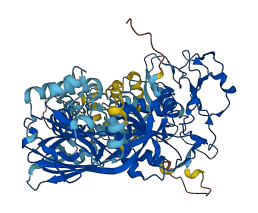
Descriptions
The autoinhibited protein was predicted that may have potential autoinhibitory elements via cis-regPred.
Autoinhibitory domains (AIDs)
Target domain |
|
Relief mechanism |
|
Assay |
cis-regPred |
Accessory elements
No accessory elements
Autoinhibited structure

Activated structure
1 structures for P51556
| Entry ID | Method | Resolution | Chain | Position | Source |
|---|---|---|---|---|---|
| AF-P51556-F1 | Predicted | AlphaFoldDB |
No variants for P51556
| Variant ID(s) | Position | Change | Description | Diseaes Association | Provenance |
|---|---|---|---|---|---|
| No variants for P51556 | |||||
No associated diseases with P51556
2 GO annotations of cellular component
| Name | Definition |
|---|---|
| cytosol | The part of the cytoplasm that does not contain organelles but which does contain other particulate matter, such as protein complexes. |
| plasma membrane | The membrane surrounding a cell that separates the cell from its external environment. It consists of a phospholipid bilayer and associated proteins. |
6 GO annotations of molecular function
| Name | Definition |
|---|---|
| ATP binding | Binding to ATP, adenosine 5'-triphosphate, a universally important coenzyme and enzyme regulator. |
| calcium ion binding | Binding to a calcium ion (Ca2+). |
| diacylglycerol kinase activity | Catalysis of the reaction: NTP + 1,2-diacylglycerol = NDP + 1,2-diacylglycerol-3-phosphate. |
| kinase activity | Catalysis of the transfer of a phosphate group, usually from ATP, to a substrate molecule. |
| lipid binding | Binding to a lipid. |
| phospholipid binding | Binding to a phospholipid, a class of lipids containing phosphoric acid as a mono- or diester. |
6 GO annotations of biological process
| Name | Definition |
|---|---|
| diacylglycerol metabolic process | The chemical reactions and pathways involving diacylglycerol, a glyceride in which any two of the R groups (positions not specified) are acyl groups while the remaining R group can be either H or an alkyl group. |
| glycerolipid metabolic process | The chemical reactions and pathways involving glycerolipids, any lipid with a glycerol backbone. Diacylglycerol and phosphatidate are key lipid intermediates of glycerolipid biosynthesis. |
| intracellular signal transduction | The process in which a signal is passed on to downstream components within the cell, which become activated themselves to further propagate the signal and finally trigger a change in the function or state of the cell. |
| lipid phosphorylation | The process of introducing one or more phosphate groups into a lipid, any member of a group of substances soluble in lipid solvents but only sparingly soluble in aqueous solvents. |
| phosphatidic acid biosynthetic process | The chemical reactions and pathways resulting in the formation of phosphatidic acid, any derivative of glycerol phosphate in which both the remaining hydroxyl groups of the glycerol moiety are esterified with fatty acids. |
| protein kinase C-activating G protein-coupled receptor signaling pathway | The series of molecular signals generated as a consequence of a G protein-coupled receptor binding to its physiological ligand, where the pathway proceeds with activation of protein kinase C (PKC). PKC is activated by second messengers including diacylglycerol (DAG). |
8 homologous proteins in AiPD
| UniProt AC | Gene Name | Protein Name | Species | Evidence Code |
|---|---|---|---|---|
| P52429 | DGKE | Diacylglycerol kinase epsilon | Homo sapiens (Human) | PR |
| Q6P5E8 | Dgkq | Diacylglycerol kinase theta | Mus musculus (Mouse) | PR |
| Q91WG7 | Dgkg | Diacylglycerol kinase gamma | Mus musculus (Mouse) | PR |
| O88673 | Dgka | Diacylglycerol kinase alpha | Mus musculus (Mouse) | PR |
| P20192 | DGKA | Diacylglycerol kinase alpha | Sus scrofa (Pig) | PR |
| P49620 | Dgkg | Diacylglycerol kinase gamma | Rattus norvegicus (Rat) | PR |
| Q8VZG1 | DGK3 | Diacylglycerol kinase 3 | Arabidopsis thaliana (Mouse-ear cress) | PR |
| Q9FFN7 | DGK2 | Diacylglycerol kinase 2 | Arabidopsis thaliana (Mouse-ear cress) | PR |
| 10 | 20 | 30 | 40 | 50 | 60 |
| MAKDKGLISP | EDFAQLQKYI | DYSTKSVSDV | LKVFEMNKYC | QGDEIGYLGF | EQFLKMYLEV |
| 70 | 80 | 90 | 100 | 110 | 120 |
| EEVPHHLCWT | LFWSFHSSQD | LDEETESKAN | VICLSDVYCY | FTLLEGGSPE | DKLEFTFKLY |
| 130 | 140 | 150 | 160 | 170 | 180 |
| DMDRNGILDS | TEVEKIILQM | MRVAEYLDWD | VSELRPILQE | MMKEMDRDGS | GCVSLAEWVR |
| 190 | 200 | 210 | 220 | 230 | 240 |
| AGATTVPLLV | LLGIDMTMKD | DGHHIWRPKR | FSRPVYCNLC | ELSIGLGKQG | LSCNLCKYIV |
| 250 | 260 | 270 | 280 | 290 | 300 |
| HDHCAMKAQP | CEVSTYAKSR | KDIGVQPHVW | VRGGCHSGRC | DRCQKKIRTY | HSLTGLHCVW |
| 310 | 320 | 330 | 340 | 350 | 360 |
| CHLEIHDDCL | QAVGPECDCG | LLRDHILPPC | SIYPRVLVSG | QECKQKTTDV | TSLCTPEAFR |
| 370 | 380 | 390 | 400 | 410 | 420 |
| IEPVSNTHPL | LVFINPKSGG | KQGQSVLWKF | QYILNPRQVF | NLKDGPEPGL | RFFKDVPQFR |
| 430 | 440 | 450 | 460 | 470 | 480 |
| VLVCGGDGTV | GWILETIDKA | NFPIVPPVAV | LPLGTGNDLA | RCLRWGRGYE | GENLRKILKD |
| 490 | 500 | 510 | 520 | 530 | 540 |
| IEISKVVYLD | RWLLEVIPQQ | NGEKSDPVPS | QIINNYFSIG | VDASIAHRFH | LMREKYPEKF |
| 550 | 560 | 570 | 580 | 590 | 600 |
| NSRMKNKLWY | LEFATSESIF | STCKKLEESV | TVEICGKLLD | LSDLSLEGIA | VLNIPSMHGG |
| 610 | 620 | 630 | 640 | 650 | 660 |
| SNLWGDTKRP | HGDTCGINQA | LGSVAKIITD | PDILKTCVPD | MSDKRLEVVG | IEGVIEMGQI |
| 670 | 680 | 690 | 700 | 710 | 720 |
| YTRLKSAGHR | LAKCSEITFQ | TTKTLPMQVD | GEPWMQAPCT | IKITHKNQMP | MLMGPAPSSS |
| NFFGFWS |