Q63664
Gene name |
Kcnj8 |
Protein name |
ATP-sensitive inward rectifier potassium channel 8 |
Names |
Inward rectifier K(+) channel Kir6.1, Potassium channel, inwardly rectifying subfamily J member 8, uKATP-1 |
Species |
Rattus norvegicus (Rat) |
KEGG Pathway |
rno:25472 |
EC number |
|
Protein Class |
|
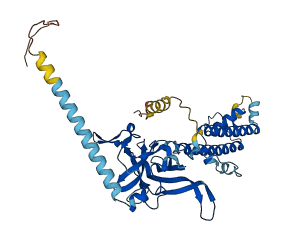
Descriptions
The autoinhibited protein was predicted that may have potential autoinhibitory elements via cis-regPred.
Autoinhibitory domains (AIDs)
Target domain |
|
Relief mechanism |
|
Assay |
cis-regPred |
Accessory elements
No accessory elements
Autoinhibited structure

Activated structure
5 structures for Q63664
| Entry ID | Method | Resolution | Chain | Position | Source |
|---|---|---|---|---|---|
| 7MIT | EM | 340 A | A/B/C/D | 1-424 | PDB |
| 7MJO | EM | 400 A | A/B/C/D | 1-424 | PDB |
| 7MJP | EM | 420 A | A/B/C/D | 1-424 | PDB |
| 7MJQ | EM | 420 A | A/B/C/D | 1-424 | PDB |
| AF-Q63664-F1 | Predicted | AlphaFoldDB |
6 variants for Q63664
| Variant ID(s) | Position | Change | Description | Diseaes Association | Provenance |
|---|---|---|---|---|---|
| rs8160291 | 23 | R>H | No | EVA | |
| rs8154646 | 48 | K>Q | No | EVA | |
| 150 | E>G | No | |||
| 170 | N>D | No | |||
| 241 | V>A | No | |||
| 379 | S>F | No |
No associated diseases with Q63664
7 GO annotations of cellular component
| Name | Definition |
|---|---|
| intracellular membrane-bounded organelle | Organized structure of distinctive morphology and function, bounded by a single or double lipid bilayer membrane and occurring within the cell. Includes the nucleus, mitochondria, plastids, vacuoles, and vesicles. Excludes the plasma membrane. |
| inward rectifying potassium channel | A protein complex that comprises four pore-forming (Kir6.x) and four regulatory sulphonylurea receptor (SURx) subunits and forms a transmembrane channel through which ions may pass. The opening and closing of the channel is regulated by ATP: binding of ATP to the Kir6.x subunit inhibits channel activity, whereas binding of Mg2+-complexed ATP or ADP to the SURx subunit stimulates channel activity. |
| membrane | A lipid bilayer along with all the proteins and protein complexes embedded in it an attached to it. |
| mitochondrion | A semiautonomous, self replicating organelle that occurs in varying numbers, shapes, and sizes in the cytoplasm of virtually all eukaryotic cells. It is notably the site of tissue respiration. |
| myofibril | The contractile element of skeletal and cardiac muscle; a long, highly organized bundle of actin, myosin, and other proteins that contracts by a sliding filament mechanism. |
| plasma membrane | The membrane surrounding a cell that separates the cell from its external environment. It consists of a phospholipid bilayer and associated proteins. |
| sarcolemma | The outer membrane of a muscle cell, consisting of the plasma membrane, a covering basement membrane (about 100 nm thick and sometimes common to more than one fiber), and the associated loose network of collagen fibers. |
6 GO annotations of molecular function
| Name | Definition |
|---|---|
| ATP binding | Binding to ATP, adenosine 5'-triphosphate, a universally important coenzyme and enzyme regulator. |
| ATP-activated inward rectifier potassium channel activity | Enables the transmembrane transfer of a potassium ion by an inwardly-rectifying voltage-gated channel, where the inward rectification is due to a voltage-dependent block of the channel pore by ATP. An inwardly rectifying current-voltage relation is one where at any given driving force the inward flow of K+ ions exceeds the outward flow for the opposite driving force. |
| ATPase-coupled cation transmembrane transporter activity | Enables the transfer of a solute or solutes from one side of a membrane to the other according to the reaction: ATP + H2O + cation(out) = ADP + phosphate + cation(in). |
| inward rectifier potassium channel activity | Enables the transmembrane transfer of a potassium ion by an inwardly-rectifying voltage-gated channel. An inwardly rectifying current-voltage relation is one where at any given driving force the inward flow of K+ ions exceeds the outward flow for the opposite driving force. The inward-rectification is due to a voltage-dependent block of the channel pore by a specific ligand or ligands, and as a result the macroscopic conductance depends on the difference between membrane voltage and the K+ equilibrium potential rather than on membrane voltage itself. |
| sulfonylurea receptor binding | Binding to a sulfonylurea receptor, a regulatory subunit of the ATP-sensitive potassium ion channel. |
| voltage-gated potassium channel activity involved in ventricular cardiac muscle cell action potential repolarization | Enables the transmembrane transfer of a potassium ion by a voltage-gated channel through the plasma membrane of a ventricular cardiomyocyte contributing to the repolarization phase of an action potential. A voltage-gated channel is a channel whose open state is dependent on the voltage across the membrane in which it is embedded. |
10 GO annotations of biological process
| Name | Definition |
|---|---|
| defense response to virus | Reactions triggered in response to the presence of a virus that act to protect the cell or organism. |
| heart development | The process whose specific outcome is the progression of the heart over time, from its formation to the mature structure. The heart is a hollow, muscular organ, which, by contracting rhythmically, keeps up the circulation of the blood. |
| inorganic cation transmembrane transport | A process in which an inorganic cation is transported from one side of a membrane to the other by means of some agent such as a transporter or pore. |
| kidney development | The process whose specific outcome is the progression of the kidney over time, from its formation to the mature structure. The kidney is an organ that filters the blood and/or excretes the end products of body metabolism in the form of urine. |
| membrane repolarization during ventricular cardiac muscle cell action potential | The process in which ions are transported across a membrane such that the ventricular cardiomyocyte membrane potential changes in the direction from the positive membrane potential at the peak of the action potential towards the negative resting potential. |
| potassium ion import across plasma membrane | The directed movement of potassium ions from outside of a cell, across the plasma membrane and into the cytosol. |
| potassium ion transport | The directed movement of potassium ions (K+) into, out of or within a cell, or between cells, by means of some agent such as a transporter or pore. |
| regulation of ion transmembrane transport | Any process that modulates the frequency, rate or extent of the directed movement of ions from one side of a membrane to the other. |
| response to exogenous dsRNA | Any process that results in a change in state or activity of a cell or an organism (in terms of movement, secretion, enzyme production, gene expression, etc.) as a result of an exogenous double-stranded RNA stimulus. |
| response to lipopolysaccharide | Any process that results in a change in state or activity of an organism (in terms of movement, secretion, enzyme production, gene expression, etc.) as a result of a lipopolysaccharide stimulus; lipopolysaccharide is a major component of the cell wall of gram-negative bacteria. |
15 homologous proteins in AiPD
| UniProt AC | Gene Name | Protein Name | Species | Evidence Code |
|---|---|---|---|---|
| Q4TZY1 | KCNJ12 | ATP-sensitive inward rectifier potassium channel 12 | Bos taurus (Bovine) | PR |
| F1NHE9 | KCNJ12 | ATP-sensitive inward rectifier potassium channel 12 | Gallus gallus (Chicken) | PR |
| P48549 | KCNJ3 | G protein-activated inward rectifier potassium channel 1 | Homo sapiens (Human) | PR |
| Q14654 | KCNJ11 | ATP-sensitive inward rectifier potassium channel 11 | Homo sapiens (Human) | PR |
| B7U540 | KCNJ18 | Inward rectifier potassium channel 18 | Homo sapiens (Human) | PR |
| Q14500 | KCNJ12 | ATP-sensitive inward rectifier potassium channel 12 | Homo sapiens (Human) | PR |
| Q15842 | KCNJ8 | ATP-sensitive inward rectifier potassium channel 8 | Homo sapiens (Human) | PR |
| Q8JZN3 | Kcnj14 | ATP-sensitive inward rectifier potassium channel 14 | Mus musculus (Mouse) | PR |
| P52187 | Kcnj12 | ATP-sensitive inward rectifier potassium channel 12 | Mus musculus (Mouse) | PR |
| P52189 | Kcnj4 | Inward rectifier potassium channel 4 | Mus musculus (Mouse) | PR |
| Q9Z307 | Kcnj16 | Inward rectifier potassium channel 16 | Mus musculus (Mouse) | PR |
| Q61743 | Kcnj11 | ATP-sensitive inward rectifier potassium channel 11 | Mus musculus (Mouse) | PR |
| P97794 | Kcnj8 | ATP-sensitive inward rectifier potassium channel 8 | Mus musculus (Mouse) | PR |
| P70673 | Kcnj11 | ATP-sensitive inward rectifier potassium channel 11 | Rattus norvegicus (Rat) | PR |
| P52188 | Kcnj12 | ATP-sensitive inward rectifier potassium channel 12 | Rattus norvegicus (Rat) | PR |
| 10 | 20 | 30 | 40 | 50 | 60 |
| MLARKSIIPE | EYVLARIAAE | NLRKPRIRDR | LPKARFIAKS | GACNLAHKNI | REQGRFLQDI |
| 70 | 80 | 90 | 100 | 110 | 120 |
| FTTLVDLKWR | HTLVIFTMSF | LCSWLLFAIM | WWLVAFAHGD | IYAYMEKGIT | EKSGLESAVC |
| 130 | 140 | 150 | 160 | 170 | 180 |
| VTNVRSFTSA | FLFSIEVQVT | IGFGGRMMTE | ECPLAITVLI | LQNIVGLIIN | AVMLGCIFMK |
| 190 | 200 | 210 | 220 | 230 | 240 |
| TAQAHRRAET | LIFSRHAVIA | VRNGKLCFMF | RVGDLRKSMI | ISASVRIQVV | KKTTTPEGEV |
| 250 | 260 | 270 | 280 | 290 | 300 |
| VPIHQQDIPV | DNPIESNNIF | LVAPLIICHV | IDKRSPLYDI | SATDLVNQDL | EVIVILEGVV |
| 310 | 320 | 330 | 340 | 350 | 360 |
| ETTGITTQAR | TSYIAEEIQW | GHRFVSIVTE | EEGVYSVDYS | KFGNTVRVAA | PRCSARELDE |
| 370 | 380 | 390 | 400 | 410 | 420 |
| KPSILIQTLQ | KSELSHQNSL | RKRNSMRRNN | SMRRSNSIRR | NNSSLMVPKV | QFMTPEGNQC |
| PSES |