P52187
Gene name |
Kcnj12 (Irk2) |
Protein name |
ATP-sensitive inward rectifier potassium channel 12 |
Names |
Inward rectifier K(+) channel Kir2.2, IRK-2, Potassium channel, inwardly rectifying subfamily J member 12 |
Species |
Mus musculus (Mouse) |
KEGG Pathway |
mmu:16515 |
EC number |
|
Protein Class |
|
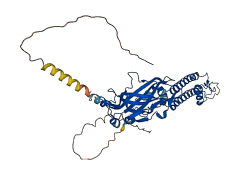
Descriptions
The autoinhibited protein was predicted that may have potential autoinhibitory elements via cis-regPred.
Autoinhibitory domains (AIDs)
Target domain |
|
Relief mechanism |
|
Assay |
cis-regPred |
Accessory elements
No accessory elements
Autoinhibited structure

Activated structure
1 structures for P52187
| Entry ID | Method | Resolution | Chain | Position | Source |
|---|---|---|---|---|---|
| AF-P52187-F1 | Predicted | AlphaFoldDB |
29 variants for P52187
| Variant ID(s) | Position | Change | Description | Diseaes Association | Provenance |
|---|---|---|---|---|---|
| rs3389171289 | 40 | R>C | No | EVA | |
| rs3389171289 | 40 | R>G | No | EVA | |
| rs3389102640 | 41 | R>L | No | EVA | |
| rs3389177117 | 54 | N>T | No | EVA | |
| rs3389161339 | 69 | A>T | No | EVA | |
| rs3389173489 | 75 | C>R | No | EVA | |
| rs1132102269 | 79 | R>H | No | EVA | |
| rs3389157728 | 104 | V>I | No | EVA | |
| rs3389102659 | 111 | D>N | No | EVA | |
| rs3401940577 | 166 | S>P | No | EVA | |
| rs3402295586 | 167 | I>T | No | EVA | |
| rs3402581560 | 168 | V>M | No | EVA | |
| rs3402194577 | 169 | G>D | No | EVA | |
| rs3402380473 | 171 | I>T | No | EVA | |
| rs3402194594 | 171 | I>V | No | EVA | |
| rs3389134720 | 208 | K>M | No | EVA | |
| rs3389166091 | 220 | K>N | No | EVA | |
| rs3389151902 | 220 | K>R | No | EVA | |
| rs3389161299 | 263 | F>L | No | EVA | |
| rs3389162802 | 269 | T>I | No | EVA | |
| rs3389166061 | 280 | L>M | No | EVA | |
| rs3389138760 | 287 | D>N | No | EVA | |
| rs3402380498 | 295 | I>S | No | EVA | |
| rs3389134688 | 316 | Y>* | No | EVA | |
| rs3389164961 | 318 | A>S | No | EVA | |
| rs3389151908 | 331 | L>F | No | EVA | |
| rs3389138725 | 356 | R>H | No | EVA | |
| rs3389161515 | 376 | C>S | No | EVA | |
| rs3389173438 | 399 | R>S | No | EVA |
No associated diseases with P52187
6 GO annotations of cellular component
| Name | Definition |
|---|---|
| dendrite | A neuron projection that has a short, tapering, morphology. Dendrites receive and integrate signals from other neurons or from sensory stimuli, and conduct nerve impulses towards the axon or the cell body. In most neurons, the impulse is conveyed from dendrites to axon via the cell body, but in some types of unipolar neuron, the impulse does not travel via the cell body. |
| integral component of membrane | The component of a membrane consisting of the gene products and protein complexes having at least some part of their peptide sequence embedded in the hydrophobic region of the membrane. |
| intrinsic component of membrane | The component of a membrane consisting of the gene products having some covalently attached portion, for example part of a peptide sequence or some other covalently attached group such as a GPI anchor, which spans or is embedded in one or both leaflets of the membrane. |
| neuronal cell body | The portion of a neuron that includes the nucleus, but excludes cell projections such as axons and dendrites. |
| plasma membrane | The membrane surrounding a cell that separates the cell from its external environment. It consists of a phospholipid bilayer and associated proteins. |
| T-tubule | Invagination of the plasma membrane of a muscle cell that extends inward from the cell surface around each myofibril. The ends of T-tubules make contact with the sarcoplasmic reticulum membrane. |
2 GO annotations of molecular function
| Name | Definition |
|---|---|
| inward rectifier potassium channel activity | Enables the transmembrane transfer of a potassium ion by an inwardly-rectifying voltage-gated channel. An inwardly rectifying current-voltage relation is one where at any given driving force the inward flow of K+ ions exceeds the outward flow for the opposite driving force. The inward-rectification is due to a voltage-dependent block of the channel pore by a specific ligand or ligands, and as a result the macroscopic conductance depends on the difference between membrane voltage and the K+ equilibrium potential rather than on membrane voltage itself. |
| PDZ domain binding | Binding to a PDZ domain of a protein, a domain found in diverse signaling proteins. |
4 GO annotations of biological process
| Name | Definition |
|---|---|
| potassium ion import across plasma membrane | The directed movement of potassium ions from outside of a cell, across the plasma membrane and into the cytosol. |
| potassium ion transport | The directed movement of potassium ions (K+) into, out of or within a cell, or between cells, by means of some agent such as a transporter or pore. |
| protein homotetramerization | The formation of a protein homotetramer, a macromolecular structure consisting of four noncovalently associated identical subunits. |
| regulation of ion transmembrane transport | Any process that modulates the frequency, rate or extent of the directed movement of ions from one side of a membrane to the other. |
15 homologous proteins in AiPD
| UniProt AC | Gene Name | Protein Name | Species | Evidence Code |
|---|---|---|---|---|
| Q4TZY1 | KCNJ12 | ATP-sensitive inward rectifier potassium channel 12 | Bos taurus (Bovine) | PR |
| F1NHE9 | KCNJ12 | ATP-sensitive inward rectifier potassium channel 12 | Gallus gallus (Chicken) | PR |
| Q15842 | KCNJ8 | ATP-sensitive inward rectifier potassium channel 8 | Homo sapiens (Human) | PR |
| P48549 | KCNJ3 | G protein-activated inward rectifier potassium channel 1 | Homo sapiens (Human) | PR |
| Q14654 | KCNJ11 | ATP-sensitive inward rectifier potassium channel 11 | Homo sapiens (Human) | PR |
| B7U540 | KCNJ18 | Inward rectifier potassium channel 18 | Homo sapiens (Human) | PR |
| Q14500 | KCNJ12 | ATP-sensitive inward rectifier potassium channel 12 | Homo sapiens (Human) | PR |
| P97794 | Kcnj8 | ATP-sensitive inward rectifier potassium channel 8 | Mus musculus (Mouse) | PR |
| Q61743 | Kcnj11 | ATP-sensitive inward rectifier potassium channel 11 | Mus musculus (Mouse) | PR |
| Q8JZN3 | Kcnj14 | ATP-sensitive inward rectifier potassium channel 14 | Mus musculus (Mouse) | PR |
| Q9Z307 | Kcnj16 | Inward rectifier potassium channel 16 | Mus musculus (Mouse) | PR |
| P52189 | Kcnj4 | Inward rectifier potassium channel 4 | Mus musculus (Mouse) | PR |
| Q63664 | Kcnj8 | ATP-sensitive inward rectifier potassium channel 8 | Rattus norvegicus (Rat) | PR |
| P70673 | Kcnj11 | ATP-sensitive inward rectifier potassium channel 11 | Rattus norvegicus (Rat) | PR |
| P52188 | Kcnj12 | ATP-sensitive inward rectifier potassium channel 12 | Rattus norvegicus (Rat) | PR |
| 10 | 20 | 30 | 40 | 50 | 60 |
| MTAASRANPY | SIVSSEEDGL | HLVTMSGANG | FGNGKVHTRR | RCRNRFVKKN | GQCNIEFANM |
| 70 | 80 | 90 | 100 | 110 | 120 |
| DEKSQRYLAD | MFTTCVDIRW | RYMLLIFSLA | FLASWLLFGI | IFWVIAVAHG | DLEPAEGRGR |
| 130 | 140 | 150 | 160 | 170 | 180 |
| TPCVLQVHGF | MAAFLFSIET | QTTIGYGLRC | VTEECPVAVF | MVVAQSIVGC | IIDSFMIGAI |
| 190 | 200 | 210 | 220 | 230 | 240 |
| MAKMARPKKR | AQTLLFSHNA | VVALRDGKLC | LMWRVGNLRK | SHIVEAHVRA | QLIKPRVTEE |
| 250 | 260 | 270 | 280 | 290 | 300 |
| GEYIPLDQID | IDVGFDKGLD | RIFLVSPITI | LHEIDEASPL | FGISRQDLET | DDFEIVVILE |
| 310 | 320 | 330 | 340 | 350 | 360 |
| GMVEATAMTT | QARSSYLANE | ILWGHRFEPV | LFEEKNQYKI | DYSHFHKTYE | VPSTPRCSAK |
| 370 | 380 | 390 | 400 | 410 | 420 |
| DLVENKFLLP | SANSFCYENE | LAFLSRDEED | EVATDRDGRS | PQPEHDFDRL | QASSAALERP |
| YRRESEI |