F1NHE9
Gene name |
KCNJ12 |
Protein name |
ATP-sensitive inward rectifier potassium channel 12 |
Names |
Inward rectifier K(+) channel Kir2.2, Potassium channel, inwardly rectifying subfamily J member 12 |
Species |
Gallus gallus (Chicken) |
KEGG Pathway |
gga:427662 |
EC number |
|
Protein Class |
|
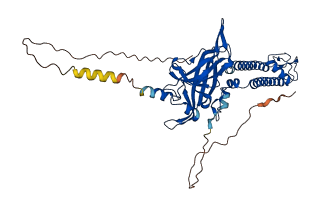
Descriptions
The autoinhibited protein was predicted that may have potential autoinhibitory elements via cis-regPred.
Autoinhibitory domains (AIDs)
Target domain |
|
Relief mechanism |
|
Assay |
cis-regPred |
Accessory elements
No accessory elements
Autoinhibited structure

Activated structure
12 structures for F1NHE9
| Entry ID | Method | Resolution | Chain | Position | Source |
|---|---|---|---|---|---|
| 3JYC | X-ray | 311 A | A | 38-369 | PDB |
| 3SPC | X-ray | 245 A | A | 38-369 | PDB |
| 3SPG | X-ray | 261 A | A | 38-369 | PDB |
| 3SPH | X-ray | 300 A | A | 38-369 | PDB |
| 3SPI | X-ray | 331 A | A | 38-369 | PDB |
| 3SPJ | X-ray | 331 A | A | 38-369 | PDB |
| 5KUK | X-ray | 200 A | A | 38-369 | PDB |
| 5KUM | X-ray | 280 A | A | 38-369 | PDB |
| 6M84 | X-ray | 281 A | A | 38-369 | PDB |
| 6M85 | X-ray | 271 A | A | 38-369 | PDB |
| 6M86 | X-ray | 360 A | A | 38-366 | PDB |
| AF-F1NHE9-F1 | Predicted | AlphaFoldDB |
9 variants for F1NHE9
| Variant ID(s) | Position | Change | Description | Diseaes Association | Provenance |
|---|---|---|---|---|---|
| rs737488322 | 6 | V>G | No | Ensembl | |
| rs316688574 | 59 | M>R | No | Ensembl | |
| rs733444636 | 143 | T>A | No | Ensembl | |
| rs736299855 | 163 | V>G | No | Ensembl | |
| rs739659852 | 170 | C>G | No | Ensembl | |
| rs737830406 | 314 | S>R | No | Ensembl | |
| rs317311659 | 343 | S>P | No | Ensembl | |
| rs731806400 | 361 | D>A | No | Ensembl | |
| rs317536120 | 409 | F>C | No | Ensembl |
No associated diseases with F1NHE9
3 regional properties for F1NHE9
3 GO annotations of cellular component
| Name | Definition |
|---|---|
| integral component of membrane | The component of a membrane consisting of the gene products and protein complexes having at least some part of their peptide sequence embedded in the hydrophobic region of the membrane. |
| intrinsic component of membrane | The component of a membrane consisting of the gene products having some covalently attached portion, for example part of a peptide sequence or some other covalently attached group such as a GPI anchor, which spans or is embedded in one or both leaflets of the membrane. |
| plasma membrane | The membrane surrounding a cell that separates the cell from its external environment. It consists of a phospholipid bilayer and associated proteins. |
2 GO annotations of molecular function
| Name | Definition |
|---|---|
| identical protein binding | Binding to an identical protein or proteins. |
| inward rectifier potassium channel activity | Enables the transmembrane transfer of a potassium ion by an inwardly-rectifying voltage-gated channel. An inwardly rectifying current-voltage relation is one where at any given driving force the inward flow of K+ ions exceeds the outward flow for the opposite driving force. The inward-rectification is due to a voltage-dependent block of the channel pore by a specific ligand or ligands, and as a result the macroscopic conductance depends on the difference between membrane voltage and the K+ equilibrium potential rather than on membrane voltage itself. |
4 GO annotations of biological process
| Name | Definition |
|---|---|
| potassium ion import across plasma membrane | The directed movement of potassium ions from outside of a cell, across the plasma membrane and into the cytosol. |
| potassium ion transport | The directed movement of potassium ions (K+) into, out of or within a cell, or between cells, by means of some agent such as a transporter or pore. |
| protein homotetramerization | The formation of a protein homotetramer, a macromolecular structure consisting of four noncovalently associated identical subunits. |
| regulation of ion transmembrane transport | Any process that modulates the frequency, rate or extent of the directed movement of ions from one side of a membrane to the other. |
15 homologous proteins in AiPD
| UniProt AC | Gene Name | Protein Name | Species | Evidence Code |
|---|---|---|---|---|
| Q4TZY1 | KCNJ12 | ATP-sensitive inward rectifier potassium channel 12 | Bos taurus (Bovine) | PR |
| Q15842 | KCNJ8 | ATP-sensitive inward rectifier potassium channel 8 | Homo sapiens (Human) | PR |
| P48549 | KCNJ3 | G protein-activated inward rectifier potassium channel 1 | Homo sapiens (Human) | PR |
| Q14654 | KCNJ11 | ATP-sensitive inward rectifier potassium channel 11 | Homo sapiens (Human) | PR |
| B7U540 | KCNJ18 | Inward rectifier potassium channel 18 | Homo sapiens (Human) | PR |
| Q14500 | KCNJ12 | ATP-sensitive inward rectifier potassium channel 12 | Homo sapiens (Human) | PR |
| P97794 | Kcnj8 | ATP-sensitive inward rectifier potassium channel 8 | Mus musculus (Mouse) | PR |
| Q8JZN3 | Kcnj14 | ATP-sensitive inward rectifier potassium channel 14 | Mus musculus (Mouse) | PR |
| P52189 | Kcnj4 | Inward rectifier potassium channel 4 | Mus musculus (Mouse) | PR |
| Q9Z307 | Kcnj16 | Inward rectifier potassium channel 16 | Mus musculus (Mouse) | PR |
| Q61743 | Kcnj11 | ATP-sensitive inward rectifier potassium channel 11 | Mus musculus (Mouse) | PR |
| P52187 | Kcnj12 | ATP-sensitive inward rectifier potassium channel 12 | Mus musculus (Mouse) | PR |
| Q63664 | Kcnj8 | ATP-sensitive inward rectifier potassium channel 8 | Rattus norvegicus (Rat) | PR |
| P70673 | Kcnj11 | ATP-sensitive inward rectifier potassium channel 11 | Rattus norvegicus (Rat) | PR |
| P52188 | Kcnj12 | ATP-sensitive inward rectifier potassium channel 12 | Rattus norvegicus (Rat) | PR |
| 10 | 20 | 30 | 40 | 50 | 60 |
| MTAGRVNPYS | IVSSEEDGLR | LTTMPGINGF | GNGKIHTRRK | CRNRFVKKNG | QCNVEFTNMD |
| 70 | 80 | 90 | 100 | 110 | 120 |
| DKPQRYIADM | FTTCVDIRWR | YMLLLFSLAF | LVSWLLFGLI | FWLIALIHGD | LENPGGDDTF |
| 130 | 140 | 150 | 160 | 170 | 180 |
| KPCVLQVNGF | VAAFLFSIET | QTTIGYGFRC | VTEECPLAVF | MVVVQSIVGC | IIDSFMIGAI |
| 190 | 200 | 210 | 220 | 230 | 240 |
| MAKMARPKKR | AQTLLFSHNA | VVAMRDGKLC | LMWRVGNLRK | SHIVEAHVRA | QLIKPRITEE |
| 250 | 260 | 270 | 280 | 290 | 300 |
| GEYIPLDQID | IDVGFDKGLD | RIFLVSPITI | LHEINEDSPL | FGISRQDLET | DDFEIVVILE |
| 310 | 320 | 330 | 340 | 350 | 360 |
| GMVEATAMTT | QARSSYLASE | ILWGHRFEPV | LFEEKNQYKV | DYSHFHKTYE | VPSTPRCSAK |
| 370 | 380 | 390 | 400 | 410 | 420 |
| DLVENKFLLP | STNSFCYENE | LAFMSRDEDE | EDDDSRGLDD | LSPDNRHEFD | RLQATIALDQ |
| RSYRRESEI |