Q61743
Gene name |
Kcnj11 |
Protein name |
ATP-sensitive inward rectifier potassium channel 11 |
Names |
Integrin-associated protein, IAP, CD49 antigen-like family member F, VLA-6, Inward rectifier K(+) channel Kir6.2, Potassium channel, inwardly rectifying subfamily J member 11 |
Species |
Mus musculus (Mouse) |
KEGG Pathway |
mmu:16514 |
EC number |
|
Protein Class |
|
Descriptions
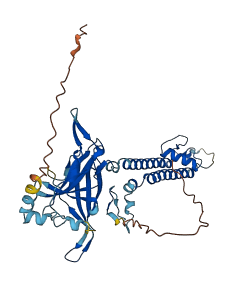
The autoinhibited protein was predicted that may have potential autoinhibitory elements via cis-regPred.
Autoinhibitory domains (AIDs)
Target domain |
|
Relief mechanism |
|
Assay |
cis-regPred |
Accessory elements
No accessory elements
Autoinhibited structure

Activated structure
13 structures for Q61743
| Entry ID | Method | Resolution | Chain | Position | Source |
|---|---|---|---|---|---|
| 5WUA | EM | 560 A | A/B/C/D | 1-390 | PDB |
| 5YKE | EM | 411 A | A/C/E/G | 1-390 | PDB |
| 5YKF | EM | 433 A | A/C/E/G | 1-390 | PDB |
| 5YKG | EM | 457 A | A/C/E/G | 1-390 | PDB |
| 5YW8 | EM | 440 A | A/C/E/G | 1-390 | PDB |
| 5YW9 | EM | 500 A | A/C/E/G | 1-390 | PDB |
| 5YWA | EM | 610 A | A/C/E/G | 1-390 | PDB |
| 5YWB | EM | 520 A | A/C/E/G | 1-390 | PDB |
| 5YWC | EM | 430 A | A/C/E/G | 1-390 | PDB |
| 6JB1 | EM | 330 A | A/C/E/G | 1-390 | PDB |
| 7W4O | EM | 296 A | A/C/E/G | 1-390 | PDB |
| 7W4P | EM | 319 A | A/C/E/G | 1-390 | PDB |
| AF-Q61743-F1 | Predicted | AlphaFoldDB |
19 variants for Q61743
| Variant ID(s) | Position | Change | Description | Diseaes Association | Provenance |
|---|---|---|---|---|---|
| rs3388893674 | 33 | A>V | No | EVA | |
| rs3388904983 | 44 | V>I | No | EVA | |
| rs3388871045 | 71 | T>S | No | EVA | |
| rs3388911359 | 104 | E>* | No | EVA | |
| rs3388911089 | 125 | I>F | No | EVA | |
| rs3388911390 | 158 | M>K | No | EVA | |
| rs3388908141 | 200 | L>M | No | EVA | |
| rs3388905019 | 213 | A>T | No | EVA | |
| rs8251187 | 248 | G>S | No | EVA | |
| rs3388898252 | 252 | V>M | No | EVA | |
| rs3388871008 | 272 | P>S | No | EVA | |
| rs3388908129 | 275 | L>M | No | EVA | |
| rs3388871015 | 279 | Q>* | No | EVA | |
| rs3388871046 | 292 | E>G | No | EVA | |
| rs3388898299 | 310 | L>I | No | EVA | |
| rs3388905046 | 316 | V>A | No | EVA | |
| rs3388914572 | 335 | N>S | No | EVA | |
| rs3388893645 | 367 | P>T | No | EVA | |
| rs3388898301 | 369 | R>P | No | EVA |
No associated diseases with Q61743
16 GO annotations of cellular component
| Name | Definition |
|---|---|
| acrosomal vesicle | A structure in the head of a spermatozoon that contains acid hydrolases, and is concerned with the breakdown of the outer membrane of the ovum during fertilization. It lies just beneath the plasma membrane and is derived from the lysosome. |
| axolemma | The portion of the plasma membrane surrounding an axon; it is a specialized trilaminar random mosaic of protein molecules floating within a fluid matrix of highly mobile phospholipid molecules, 7-8 nm in thickness. |
| cell body fiber | A neuron projection that is found in unipolar neurons and corresponds to the region between the cell body and the point at which the single projection branches. |
| cytosol | The part of the cytoplasm that does not contain organelles but which does contain other particulate matter, such as protein complexes. |
| endoplasmic reticulum | The irregular network of unit membranes, visible only by electron microscopy, that occurs in the cytoplasm of many eukaryotic cells. The membranes form a complex meshwork of tubular channels, which are often expanded into slitlike cavities called cisternae. The ER takes two forms, rough (or granular), with ribosomes adhering to the outer surface, and smooth (with no ribosomes attached). |
| endosome | A vacuole to which materials ingested by endocytosis are delivered. |
| intercalated disc | A complex cell-cell junction at which myofibrils terminate in cardiomyocytes; mediates mechanical and electrochemical integration between individual cardiomyocytes. The intercalated disc contains regions of tight mechanical attachment (fasciae adherentes and desmosomes) and electrical coupling (gap junctions) between adjacent cells. |
| intracellular membrane-bounded organelle | Organized structure of distinctive morphology and function, bounded by a single or double lipid bilayer membrane and occurring within the cell. Includes the nucleus, mitochondria, plastids, vacuoles, and vesicles. Excludes the plasma membrane. |
| inward rectifying potassium channel | A protein complex that comprises four pore-forming (Kir6.x) and four regulatory sulphonylurea receptor (SURx) subunits and forms a transmembrane channel through which ions may pass. The opening and closing of the channel is regulated by ATP: binding of ATP to the Kir6.x subunit inhibits channel activity, whereas binding of Mg2+-complexed ATP or ADP to the SURx subunit stimulates channel activity. |
| mitochondrion | A semiautonomous, self replicating organelle that occurs in varying numbers, shapes, and sizes in the cytoplasm of virtually all eukaryotic cells. It is notably the site of tissue respiration. |
| myelin sheath | An electrically insulating fatty layer that surrounds the axons of many neurons. It is an outgrowth of glial cells: Schwann cells supply the myelin for peripheral neurons while oligodendrocytes supply it to those of the central nervous system. |
| neuronal cell body | The portion of a neuron that includes the nucleus, but excludes cell projections such as axons and dendrites. |
| nuclear envelope | The double lipid bilayer enclosing the nucleus and separating its contents from the rest of the cytoplasm; includes the intermembrane space, a gap of width 20-40 nm (also called the perinuclear space). |
| plasma membrane | The membrane surrounding a cell that separates the cell from its external environment. It consists of a phospholipid bilayer and associated proteins. |
| sarcolemma | The outer membrane of a muscle cell, consisting of the plasma membrane, a covering basement membrane (about 100 nm thick and sometimes common to more than one fiber), and the associated loose network of collagen fibers. |
| T-tubule | Invagination of the plasma membrane of a muscle cell that extends inward from the cell surface around each myofibril. The ends of T-tubules make contact with the sarcoplasmic reticulum membrane. |
10 GO annotations of molecular function
| Name | Definition |
|---|---|
| ankyrin binding | Binding to ankyrin, a 200 kDa cytoskeletal protein that attaches other cytoskeletal proteins to integral membrane proteins. |
| ATP binding | Binding to ATP, adenosine 5'-triphosphate, a universally important coenzyme and enzyme regulator. |
| ATP-activated inward rectifier potassium channel activity | Enables the transmembrane transfer of a potassium ion by an inwardly-rectifying voltage-gated channel, where the inward rectification is due to a voltage-dependent block of the channel pore by ATP. An inwardly rectifying current-voltage relation is one where at any given driving force the inward flow of K+ ions exceeds the outward flow for the opposite driving force. |
| ATPase-coupled cation transmembrane transporter activity | Enables the transfer of a solute or solutes from one side of a membrane to the other according to the reaction: ATP + H2O + cation(out) = ADP + phosphate + cation(in). |
| heat shock protein binding | Binding to a heat shock protein, a protein synthesized or activated in response to heat shock. |
| inward rectifier potassium channel activity | Enables the transmembrane transfer of a potassium ion by an inwardly-rectifying voltage-gated channel. An inwardly rectifying current-voltage relation is one where at any given driving force the inward flow of K+ ions exceeds the outward flow for the opposite driving force. The inward-rectification is due to a voltage-dependent block of the channel pore by a specific ligand or ligands, and as a result the macroscopic conductance depends on the difference between membrane voltage and the K+ equilibrium potential rather than on membrane voltage itself. |
| potassium ion binding | Binding to a potassium ion (K+). |
| protein C-terminus binding | Binding to a protein C-terminus, the end of a peptide chain at which the 1-carboxyl function of a constituent amino acid is not attached in peptide linkage to another amino-acid residue. |
| transmembrane transporter binding | Binding to a transmembrane transporter, a protein or protein complex that enables the transfer of a substance, usually a specific substance or a group of related substances, from one side of a membrane to the other. |
| voltage-gated potassium channel activity | Enables the transmembrane transfer of a potassium ion by a voltage-gated channel. A voltage-gated channel is a channel whose open state is dependent on the voltage across the membrane in which it is embedded. |
20 GO annotations of biological process
| Name | Definition |
|---|---|
| cellular response to glucose stimulus | Any process that results in a change in state or activity of a cell (in terms of movement, secretion, enzyme production, gene expression, etc.) as a result of a glucose stimulus. |
| cellular response to nicotine | Any process that results in a change in state or activity of a cell (in terms of movement, secretion, enzyme production, gene expression, etc.) as a result of a nicotine stimulus. |
| cellular response to tumor necrosis factor | Any process that results in a change in state or activity of a cell (in terms of movement, secretion, enzyme production, gene expression, etc.) as a result of a tumor necrosis factor stimulus. |
| glucose metabolic process | The chemical reactions and pathways involving glucose, the aldohexose gluco-hexose. D-glucose is dextrorotatory and is sometimes known as dextrose; it is an important source of energy for living organisms and is found free as well as combined in homo- and hetero-oligosaccharides and polysaccharides. |
| inorganic cation transmembrane transport | A process in which an inorganic cation is transported from one side of a membrane to the other by means of some agent such as a transporter or pore. |
| negative regulation of insulin secretion | Any process that stops, prevents, or reduces the frequency, rate or extent of the regulated release of insulin. |
| nervous system process | A organ system process carried out by any of the organs or tissues of neurological system. |
| positive regulation of cation channel activity | Any process that activates or increases the frequency, rate or extent of cation channel activity. |
| positive regulation of protein localization to plasma membrane | Any process that activates or increases the frequency, rate or extent of protein localization to plasma membrane. |
| potassium ion import across plasma membrane | The directed movement of potassium ions from outside of a cell, across the plasma membrane and into the cytosol. |
| potassium ion transmembrane transport | A process in which a potassium ion is transported from one side of a membrane to the other. |
| potassium ion transport | The directed movement of potassium ions (K+) into, out of or within a cell, or between cells, by means of some agent such as a transporter or pore. |
| regulation of insulin secretion | Any process that modulates the frequency, rate or extent of the regulated release of insulin. |
| regulation of ion transmembrane transport | Any process that modulates the frequency, rate or extent of the directed movement of ions from one side of a membrane to the other. |
| regulation of membrane potential | Any process that modulates the establishment or extent of a membrane potential, the electric potential existing across any membrane arising from charges in the membrane itself and from the charges present in the media on either side of the membrane. |
| response to ATP | Any process that results in a change in state or activity of a cell or an organism (in terms of movement, secretion, enzyme production, gene expression, etc.) as a result of an ATP (adenosine 5'-triphosphate) stimulus. |
| response to estradiol | Any process that results in a change in state or activity of a cell or an organism (in terms of movement, secretion, enzyme production, gene expression, etc.) as a result of stimulus by estradiol, a C18 steroid hormone hydroxylated at C3 and C17 that acts as a potent estrogen. |
| response to ischemia | Any process that results in a change in state or activity of an organism (in terms of movement, secretion, enzyme production, gene expression, etc.) as a result of a inadequate blood supply. |
| response to testosterone | Any process that results in a change in state or activity of a cell or an organism (in terms of movement, secretion, enzyme production, gene expression, etc.) as a result of a testosterone stimulus. |
| response to xenobiotic stimulus | Any process that results in a change in state or activity of a cell or an organism (in terms of movement, secretion, enzyme production, gene expression, etc.) as a result of a stimulus from a xenobiotic, a compound foreign to the organim exposed to it. It may be synthesized by another organism (like ampicilin) or it can be a synthetic chemical. |
15 homologous proteins in AiPD
| UniProt AC | Gene Name | Protein Name | Species | Evidence Code |
|---|---|---|---|---|
| Q4TZY1 | KCNJ12 | ATP-sensitive inward rectifier potassium channel 12 | Bos taurus (Bovine) | PR |
| F1NHE9 | KCNJ12 | ATP-sensitive inward rectifier potassium channel 12 | Gallus gallus (Chicken) | PR |
| Q15842 | KCNJ8 | ATP-sensitive inward rectifier potassium channel 8 | Homo sapiens (Human) | PR |
| P48549 | KCNJ3 | G protein-activated inward rectifier potassium channel 1 | Homo sapiens (Human) | PR |
| B7U540 | KCNJ18 | Inward rectifier potassium channel 18 | Homo sapiens (Human) | PR |
| Q14500 | KCNJ12 | ATP-sensitive inward rectifier potassium channel 12 | Homo sapiens (Human) | PR |
| Q14654 | KCNJ11 | ATP-sensitive inward rectifier potassium channel 11 | Homo sapiens (Human) | PR |
| P52187 | Kcnj12 | ATP-sensitive inward rectifier potassium channel 12 | Mus musculus (Mouse) | PR |
| P97794 | Kcnj8 | ATP-sensitive inward rectifier potassium channel 8 | Mus musculus (Mouse) | PR |
| Q8JZN3 | Kcnj14 | ATP-sensitive inward rectifier potassium channel 14 | Mus musculus (Mouse) | PR |
| Q9Z307 | Kcnj16 | Inward rectifier potassium channel 16 | Mus musculus (Mouse) | PR |
| P52189 | Kcnj4 | Inward rectifier potassium channel 4 | Mus musculus (Mouse) | PR |
| Q63664 | Kcnj8 | ATP-sensitive inward rectifier potassium channel 8 | Rattus norvegicus (Rat) | PR |
| P52188 | Kcnj12 | ATP-sensitive inward rectifier potassium channel 12 | Rattus norvegicus (Rat) | PR |
| P70673 | Kcnj11 | ATP-sensitive inward rectifier potassium channel 11 | Rattus norvegicus (Rat) | PR |
| 10 | 20 | 30 | 40 | 50 | 60 |
| MLSRKGIIPE | EYVLTRLAED | PAEPRYRTRE | RRARFVSKKG | NCNVAHKNIR | EQGRFLQDVF |
| 70 | 80 | 90 | 100 | 110 | 120 |
| TTLVDLKWPH | TLLIFTMSFL | CSWLLFAMVW | WLIAFAHGDL | APGEGTNVPC | VTSIHSFSSA |
| 130 | 140 | 150 | 160 | 170 | 180 |
| FLFSIEVQVT | IGFGGRMVTE | ECPLAILILI | VQNIVGLMIN | AIMLGCIFMK | TAQAHRRAET |
| 190 | 200 | 210 | 220 | 230 | 240 |
| LIFSKHAVIT | LRHGRLCFML | RVGDLRKSMI | ISATIHMQVV | RKTTSPEGEV | VPLHQVDIPM |
| 250 | 260 | 270 | 280 | 290 | 300 |
| ENGVGGNGIF | LVAPLIIYHV | IDSNSPLYDL | APSDLHHHQD | LEIIVILEGV | VETTGITTQA |
| 310 | 320 | 330 | 340 | 350 | 360 |
| RTSYLADEIL | WGQRFVPIVA | EEDGRYSVDY | SKFGNTIKVP | TPLCTARQLD | EDRSLLDALT |
| 370 | 380 | ||||
| LASSRGPLRK | RSVAVAKAKP | KFSISPDSLS |