Q06559
Gene name |
RpS3 (M(3)95A, CG6779) |
Protein name |
40S ribosomal protein S3 |
Names |
|
Species |
Drosophila melanogaster (Fruit fly) |
KEGG Pathway |
dme:Dmel_CG6779 |
EC number |
|
Protein Class |
|
Descriptions
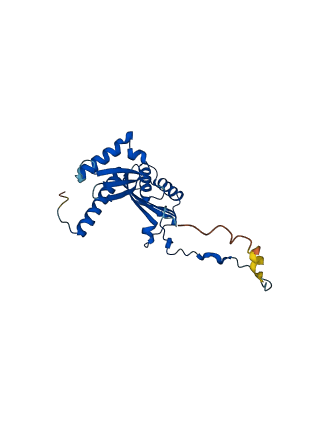
The autoinhibited protein was predicted that may have potential autoinhibitory elements via cis-regPred.
Autoinhibitory domains (AIDs)
Target domain |
|
Relief mechanism |
|
Assay |
cis-regPred |
Accessory elements
No accessory elements
Autoinhibited structure

Activated structure
5 structures for Q06559
| Entry ID | Method | Resolution | Chain | Position | Source |
|---|---|---|---|---|---|
| 4V6W | EM | 600 A | AD | 1-246 | PDB |
| 6XU6 | EM | 350 A | AD | 3-229 | PDB |
| 6XU7 | EM | 490 A | AD | 3-229 | PDB |
| 6XU8 | EM | 300 A | AD | 3-229 | PDB |
| AF-Q06559-F1 | Predicted | AlphaFoldDB |
No variants for Q06559
| Variant ID(s) | Position | Change | Description | Diseaes Association | Provenance |
|---|---|---|---|---|---|
| No variants for Q06559 | |||||
No associated diseases with Q06559
4 GO annotations of cellular component
| Name | Definition |
|---|---|
| cytosolic ribosome | A ribosome located in the cytosol. |
| cytosolic small ribosomal subunit | The small subunit of a ribosome located in the cytosol. |
| nuclear matrix | The dense fibrillar network lying on the inner side of the nuclear membrane. |
| nucleus | A membrane-bounded organelle of eukaryotic cells in which chromosomes are housed and replicated. In most cells, the nucleus contains all of the cell's chromosomes except the organellar chromosomes, and is the site of RNA synthesis and processing. In some species, or in specialized cell types, RNA metabolism or DNA replication may be absent. |
7 GO annotations of molecular function
| Name | Definition |
|---|---|
| class I DNA-(apurinic or apyrimidinic site) endonuclease activity | Catalysis of the cleavage of an AP site 3' of the baseless site by a beta-lyase mechanism, leaving an unsaturated aldehyde, termed a 3'-(4-hydroxy-5-phospho-2-pentenal) residue, and a 5'-phosphate. |
| damaged DNA binding | Binding to damaged DNA. |
| endonuclease activity | Catalysis of the hydrolysis of ester linkages within nucleic acids by creating internal breaks. |
| oxidized purine DNA binding | Binding to a DNA region containing an oxidized purine residue. |
| oxidized purine nucleobase lesion DNA N-glycosylase activity | Catalysis of the removal of oxidized purine bases by cleaving the N-C1' glycosidic bond between the oxidized purine and the deoxyribose sugar. The reaction involves the formation of a covalent enzyme-substrate intermediate. Release of the enzyme and free base by a beta-elimination or a beta, gamma-elimination mechanism results in the cleavage of the DNA backbone 3' of the apurinic (AP) site. |
| RNA binding | Binding to an RNA molecule or a portion thereof. |
| structural constituent of ribosome | The action of a molecule that contributes to the structural integrity of the ribosome. |
5 GO annotations of biological process
| Name | Definition |
|---|---|
| cytoplasmic translation | The chemical reactions and pathways resulting in the formation of a protein in the cytoplasm. This is a ribosome-mediated process in which the information in messenger RNA (mRNA) is used to specify the sequence of amino acids in the protein. |
| DNA repair | The process of restoring DNA after damage. Genomes are subject to damage by chemical and physical agents in the environment (e.g. UV and ionizing radiations, chemical mutagens, fungal and bacterial toxins, etc.) and by free radicals or alkylating agents endogenously generated in metabolism. DNA is also damaged because of errors during its replication. A variety of different DNA repair pathways have been reported that include direct reversal, base excision repair, nucleotide excision repair, photoreactivation, bypass, double-strand break repair pathway, and mismatch repair pathway. |
| mitotic cell cycle | Progression through the phases of the mitotic cell cycle, the most common eukaryotic cell cycle, which canonically comprises four successive phases called G1, S, G2, and M and includes replication of the genome and the subsequent segregation of chromosomes into daughter cells. In some variant cell cycles nuclear replication or nuclear division may not be followed by cell division, or G1 and G2 phases may be absent. |
| negative regulation of neuron apoptotic process | Any process that stops, prevents, or reduces the frequency, rate or extent of cell death by apoptotic process in neurons. |
| positive regulation of apoptotic signaling pathway | Any process that activates or increases the frequency, rate or extent of apoptotic signaling pathway. |
7 homologous proteins in AiPD
| UniProt AC | Gene Name | Protein Name | Species | Evidence Code |
|---|---|---|---|---|
| P05750 | RPS3 | 40S ribosomal protein S3 | Saccharomyces cerevisiae (strain ATCC 204508 / S288c) (Baker's yeast) | PR |
| P23396 | RPS3 | 40S ribosomal protein S3 | Homo sapiens (Human) | PR |
| P62908 | Rps3 | 40S ribosomal protein S3 | Mus musculus (Mouse) | PR |
| P48152 | rps-3 | 40S ribosomal protein S3 | Caenorhabditis elegans | PR |
| Q9FJA6 | RPS3C | 40S ribosomal protein S3-3 | Arabidopsis thaliana (Mouse-ear cress) | PR |
| Q9M339 | RPS3B | 40S ribosomal protein S3-2 | Arabidopsis thaliana (Mouse-ear cress) | PR |
| Q9SIP7 | RPS3A | 40S ribosomal protein S3-1 | Arabidopsis thaliana (Mouse-ear cress) | PR |
| 10 | 20 | 30 | 40 | 50 | 60 |
| MNANLPISKK | RKFVSDGIFK | AELNEFLTRE | LAEDGYSGVE | VRVTPSRTEI | IIMATKTQQV |
| 70 | 80 | 90 | 100 | 110 | 120 |
| LGEKGRRIRE | LTAMVQKRFN | FETGRIELYA | EKVAARGLCA | IAQAESLRYK | LTGGLAVRRA |
| 130 | 140 | 150 | 160 | 170 | 180 |
| CYGVLRYIME | SGAKGCEVVV | SGKLRGQRAK | SMKFVDGLMI | HSGDPCNDYV | ETATRHVLLR |
| 190 | 200 | 210 | 220 | 230 | 240 |
| QGVLGIKVKV | MLPYDPKNKI | GPKKPLPDNV | SVVEPKEEKI | YETPETEYKI | PPPSKPLDDL |
| SEAKVL |