P23396
Gene name |
RPS3 |
Protein name |
40S ribosomal protein S3 |
Names |
Small ribosomal subunit protein uS3 |
Species |
Homo sapiens (Human) |
KEGG Pathway |
hsa:6188 |
EC number |
4.2.99.18: Other carbon-oxygen lyases |
Protein Class |
|
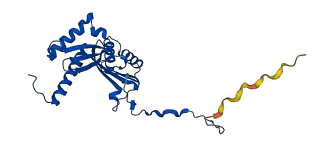
Descriptions
The autoinhibited protein was predicted that may have potential autoinhibitory elements via cis-regPred.
Autoinhibitory domains (AIDs)
Target domain |
|
Relief mechanism |
|
Assay |
cis-regPred |
Accessory elements
No accessory elements
Autoinhibited structure

Activated structure
83 structures for P23396
| Entry ID | Method | Resolution | Chain | Position | Source |
|---|---|---|---|---|---|
| 1WH9 | NMR | - | A | 17-95 | PDB |
| 4UG0 | EM | - | SD | 1-243 | PDB |
| 4V6X | EM | 500 A | AD | 1-243 | PDB |
| 5A2Q | EM | 390 A | D | 1-243 | PDB |
| 5AJ0 | EM | 350 A | BD | 1-243 | PDB |
| 5FLX | EM | 390 A | D | 1-243 | PDB |
| 5LKS | EM | 360 A | SD | 1-243 | PDB |
| 5OA3 | EM | 430 A | D | 1-243 | PDB |
| 5T2C | EM | 360 A | Aq | 1-243 | PDB |
| 5VYC | X-ray | 600 A | D1/D2/D3/D4/D5/D6 | 1-243 | PDB |
| 6FEC | EM | 630 A | g | 1-227 | PDB |
| 6G51 | EM | 410 A | D | 1-243 | PDB |
| 6G53 | EM | 450 A | D | 1-243 | PDB |
| 6G5H | EM | 360 A | D | 1-243 | PDB |
| 6G5I | EM | 350 A | D | 1-243 | PDB |
| 6IP5 | EM | 390 A | 2p | 1-243 | PDB |
| 6IP6 | EM | 450 A | 2p | 1-243 | PDB |
| 6IP8 | EM | 390 A | 2p | 1-243 | PDB |
| 6OLE | EM | 310 A | SD | 2-227 | PDB |
| 6OLF | EM | 390 A | SD | 2-227 | PDB |
| 6OLG | EM | 340 A | BD | 2-221 | PDB |
| 6OLI | EM | 350 A | SD | 2-227 | PDB |
| 6OLZ | EM | 390 A | BD | 2-221 | PDB |
| 6OM0 | EM | 310 A | SD | 2-227 | PDB |
| 6OM7 | EM | 370 A | SD | 2-227 | PDB |
| 6QZP | EM | 290 A | SD | 1-227 | PDB |
| 6XA1 | EM | 280 A | SD | 4-227 | PDB |
| 6Y0G | EM | 320 A | SD | 1-243 | PDB |
| 6Y2L | EM | 300 A | SD | 1-243 | PDB |
| 6Y57 | EM | 350 A | SD | 1-243 | PDB |
| 6YBS | EM | 310 A | Z | 1-243 | PDB |
| 6Z6L | EM | 300 A | SD | 1-243 | PDB |
| 6Z6M | EM | 310 A | SD | 1-243 | PDB |
| 6Z6N | EM | 290 A | SD | 1-243 | PDB |
| 6ZLW | EM | 260 A | F | 1-243 | PDB |
| 6ZM7 | EM | 270 A | SD | 1-243 | PDB |
| 6ZME | EM | 300 A | SD | 1-243 | PDB |
| 6ZMI | EM | 260 A | SD | 1-243 | PDB |
| 6ZMO | EM | 310 A | SD | 1-243 | PDB |
| 6ZMT | EM | 300 A | F | 1-243 | PDB |
| 6ZMW | EM | 370 A | Z | 1-243 | PDB |
| 6ZN5 | EM | 320 A | F | 3-227 | PDB |
| 6ZOJ | EM | 280 A | D | 1-243 | PDB |
| 6ZOL | EM | 280 A | D | 1-243 | PDB |
| 6ZON | EM | 300 A | b | 1-243 | PDB |
| 6ZP4 | EM | 290 A | b | 1-243 | PDB |
| 6ZUO | EM | 310 A | D | 1-243 | PDB |
| 6ZV6 | EM | 290 A | D | 1-243 | PDB |
| 6ZVH | EM | 290 A | D | 1-227 | PDB |
| 6ZVJ | EM | 380 A | b | 4-227 | PDB |
| 6ZXD | EM | 320 A | D | 1-243 | PDB |
| 6ZXE | EM | 300 A | D | 1-243 | PDB |
| 6ZXF | EM | 370 A | D | 1-243 | PDB |
| 6ZXG | EM | 260 A | D | 1-243 | PDB |
| 6ZXH | EM | 270 A | D | 1-243 | PDB |
| 7A09 | EM | 350 A | b | 1-243 | PDB |
| 7K5I | EM | 290 A | D | 1-243 | PDB |
| 7QP6 | EM | 470 A | Z | 1-243 | PDB |
| 7QP7 | EM | 370 A | Z | 1-243 | PDB |
| 7QVP | EM | 300 A | RD/SD | 1-243 | PDB |
| 7R4X | EM | 215 A | D | 1-243 | PDB |
| 7TQL | EM | 340 A | F | 3-227 | PDB |
| 7XNX | EM | 270 A | SD | 1-243 | PDB |
| 7XNY | EM | 250 A | SD | 1-243 | PDB |
| 8G5Y | EM | 229 A | SD | 1-243 | PDB |
| 8G5Z | EM | 264 A | SD | 1-226 | PDB |
| 8G60 | EM | 254 A | SD | 1-243 | PDB |
| 8G61 | EM | 294 A | SD | 1-243 | PDB |
| 8G6J | EM | 280 A | SD | 1-243 | PDB |
| 8GLP | EM | 167 A | SD | 1-243 | PDB |
| 8IFD | EM | 259 A | 2p | 1-243 | PDB |
| 8IFE | EM | 257 A | 2p | 1-243 | PDB |
| 8JDJ | EM | 250 A | 0 | 1-243 | PDB |
| 8JDK | EM | 226 A | 0 | 1-243 | PDB |
| 8JDL | EM | 242 A | 0 | 1-243 | PDB |
| 8JDM | EM | 267 A | 0 | 1-243 | PDB |
| 8OZ0 | EM | 350 A | h | 1-243 | PDB |
| 8PPK | EM | 298 A | D | 1-243 | PDB |
| 8PPL | EM | 265 A | AD | 1-243 | PDB |
| 8T4S | EM | 260 A | D | 1-243 | PDB |
| 8Y0W | EM | 340 A | SD | 1-243 | PDB |
| 8Y0X | EM | 330 A | SD | 1-243 | PDB |
| AF-P23396-F1 | Predicted | AlphaFoldDB |
113 variants for P23396
| Variant ID(s) | Position | Change | Description | Diseaes Association | Provenance |
|---|---|---|---|---|---|
|
rs939710830 CA224657313 |
2 | A>T | No |
ClinGen TOPMed |
|
|
rs1046077337 CA224657315 |
2 | A>V | No |
ClinGen gnomAD |
|
|
CA381877033 rs1381673730 |
3 | V>A | No |
ClinGen gnomAD |
|
|
CA224657325 rs1001912436 |
3 | V>L | No |
ClinGen TOPMed gnomAD |
|
| TCGA novel | 4 | Q>* | Variant assessed as Somatic; impact. [NCI-TCGA] | No | NCI-TCGA |
|
rs772964979 CA6189272 |
4 | Q>R | Variant assessed as Somatic; 0.0 impact. [NCI-TCGA] | No |
ClinGen ExAC NCI-TCGA TOPMed gnomAD |
|
rs1033354284 CA224657350 |
5 | I>M | No |
ClinGen gnomAD |
|
|
CA381877064 rs1415968412 |
5 | I>V | No |
ClinGen gnomAD |
|
|
CA381877087 rs1399258948 |
6 | S>C | No |
ClinGen TOPMed gnomAD |
|
|
CA381877083 rs1327928698 |
6 | S>P | No |
ClinGen TOPMed |
|
|
rs1327928698 CA381877081 |
6 | S>T | No |
ClinGen TOPMed |
|
|
CA381877131 rs1565162329 |
9 | R>K | No |
ClinGen Ensembl |
|
|
CA381877158 rs1463071170 |
10 | K>N | No |
ClinGen TOPMed |
|
|
rs748523553 CA6189358 |
11 | F>I | No |
ClinGen ExAC gnomAD |
|
|
CA6189360 rs773847813 |
14 | D>E | No |
ClinGen ExAC gnomAD |
|
| TCGA novel | 15 | G>D | Variant assessed as Somatic; impact. [NCI-TCGA] | No | NCI-TCGA |
|
CA224658577 rs1002914063 |
17 | F>V | No |
ClinGen Ensembl |
|
|
CA381878196 rs1282731545 |
20 | E>* | No |
ClinGen TOPMed |
|
|
CA6189363 rs776774578 |
23 | E>A | No |
ClinGen ExAC gnomAD |
|
| TCGA novel | 25 | L>F | Variant assessed as Somatic; impact. [NCI-TCGA] | No | NCI-TCGA |
| TCGA novel | 28 | E>K | Variant assessed as Somatic; impact. [NCI-TCGA] | No | NCI-TCGA |
|
CA6189365 rs765478023 |
34 | Y>H | No |
ClinGen ExAC gnomAD |
|
|
CA6189367 rs762736053 |
36 | G>R | No |
ClinGen ExAC gnomAD |
|
|
rs766895283 CA6189371 |
44 | T>N | No |
ClinGen ExAC gnomAD |
|
|
CA381878534 rs1345824468 |
48 | I>V | No |
ClinGen gnomAD |
|
|
rs755628828 CA6189373 |
49 | I>V | No |
ClinGen ExAC TOPMed gnomAD |
|
|
CA224658719 rs3206671 |
51 | L>* | No |
ClinGen Ensembl |
|
|
rs1276122131 CA381878578 |
52 | A>T | No |
ClinGen gnomAD |
|
|
CA224658725 rs11546210 |
52 | A>V | No |
ClinGen TOPMed |
|
|
CA6189399 rs778241086 |
56 | Q>E | No |
ClinGen ExAC gnomAD |
|
|
CA6189401 rs757739842 |
64 | R>Q | No |
ClinGen ExAC gnomAD |
|
|
rs1366756752 CA381878836 |
65 | R>Q | No |
ClinGen gnomAD |
|
|
CA381878861 rs1400923703 |
67 | R>W | No |
ClinGen gnomAD |
|
|
rs781721862 CA381878923 |
72 | V>I | No |
ClinGen ExAC gnomAD |
|
|
CA6189402 rs781721862 |
72 | V>L | No |
ClinGen ExAC gnomAD |
|
|
rs1403609388 CA381878938 |
73 | V>I | No |
ClinGen gnomAD |
|
|
rs11546235 CA224659562 |
74 | Q>R | No |
ClinGen gnomAD |
|
|
rs11546227 CA224659564 |
76 | R>G | No |
ClinGen Ensembl |
|
|
rs1229279903 CA381878998 |
77 | F>I | No |
ClinGen TOPMed |
|
|
CA224659570 rs11546209 |
78 | G>R | No |
ClinGen Ensembl |
|
|
CA381879042 rs1376284272 |
79 | F>V | No |
ClinGen gnomAD |
|
|
rs377566662 CA224659597 |
80 | P>L | No |
ClinGen ESP TOPMed |
|
|
CA224659584 rs11546212 |
80 | P>S | No |
ClinGen TOPMed |
|
|
CA381879078 rs1281497092 |
81 | E>Q | No |
ClinGen gnomAD |
|
|
rs959967422 CA224659608 |
83 | S>N | No |
ClinGen Ensembl |
|
|
CA381880109 rs11546215 |
86 | L>H | No |
ClinGen gnomAD |
|
|
CA224660321 rs11546215 |
86 | L>P | No |
ClinGen gnomAD |
|
|
CA381880106 rs1460438636 |
86 | L>V | No |
ClinGen gnomAD |
|
|
CA381880129 rs1565163571 |
88 | A>P | No |
ClinGen Ensembl |
|
|
rs11546234 CA224660328 |
91 | V>L | No |
ClinGen Ensembl |
|
|
rs1301527696 CA381880213 |
95 | G>D | No |
ClinGen gnomAD |
|
|
CA381880245 rs1278023527 |
97 | C>S | No |
ClinGen gnomAD |
|
|
CA381880272 rs1230305698 |
99 | I>F | No |
ClinGen gnomAD |
|
|
rs528039603 COSM467420 CA6189431 |
106 | R>C | kidney Variant assessed as Somatic; 0.0 impact. [Cosmic, NCI-TCGA] | No |
ClinGen cosmic curated 1000Genomes ExAC NCI-TCGA gnomAD |
|
COSM1356991 CA224660361 rs1802703 |
110 | L>I | large_intestine Variant assessed as Somatic; impact. [Cosmic, NCI-TCGA] | No |
ClinGen cosmic curated Ensembl NCI-TCGA |
| TCGA novel | 112 | G>missing | Variant assessed as Somatic; impact. [NCI-TCGA] | No | NCI-TCGA |
|
CA6189433 rs776751854 |
114 | A>P | No |
ClinGen ExAC gnomAD |
|
|
CA224661918 rs1019933958 |
127 | M>L | No |
ClinGen Ensembl |
|
| TCGA novel | 131 | A>V | Variant assessed as Somatic; impact. [NCI-TCGA] | No | NCI-TCGA |
|
rs11546221 CA224661924 |
132 | K>Q | No |
ClinGen Ensembl |
|
|
rs11546219 CA224661956 |
140 | G>R | No |
ClinGen Ensembl |
|
|
CA224661962 rs1802701 |
142 | L>I | No |
ClinGen Ensembl |
|
|
rs1424228633 CA381881220 |
147 | A>T | No |
ClinGen gnomAD |
|
|
CA6189459 rs760942337 |
153 | V>A | No |
ClinGen ExAC gnomAD |
|
|
rs1261132427 CA381881294 |
157 | M>K | No |
ClinGen gnomAD |
|
| TCGA novel | 162 | D>Y | Variant assessed as Somatic; impact. [NCI-TCGA] | No | NCI-TCGA |
|
CA381881383 rs1244837718 |
164 | V>I | No |
ClinGen gnomAD |
|
|
CA6189463 rs765258151 |
165 | N>I | No |
ClinGen ExAC gnomAD |
|
|
rs752738974 CA6189464 |
165 | N>K | No |
ClinGen ExAC TOPMed gnomAD |
|
|
CA381881436 rs1232968412 |
167 | Y>F | No |
ClinGen TOPMed |
|
|
rs747317928 CA6189467 COSM931985 |
173 | R>C | Variant assessed as Somatic; 0.0 impact. endometrium [NCI-TCGA, Cosmic] | No |
ClinGen cosmic curated ExAC NCI-TCGA TOPMed gnomAD |
|
rs201666763 CA224662041 |
173 | R>H | No |
ClinGen TOPMed |
|
|
CA381881530 rs1360641558 |
174 | H>R | No |
ClinGen gnomAD |
|
| TCGA novel | 177 | L>F | Variant assessed as Somatic; impact. [NCI-TCGA] | No | NCI-TCGA |
|
rs1802702 CA224662740 |
181 | V>M | No |
ClinGen Ensembl |
|
|
rs1236091952 CA381881757 |
185 | K>M | No |
ClinGen TOPMed |
|
|
rs780760239 CA6189537 |
185 | K>N | No |
ClinGen ExAC gnomAD |
|
|
CA381881806 rs1592024620 |
189 | M>L | No |
ClinGen Ensembl |
|
|
CA381881913 rs1592024642 |
196 | G>D | No |
ClinGen Ensembl |
|
|
rs774988250 CA381881941 |
198 | I>S | No |
ClinGen ExAC TOPMed gnomAD |
|
|
rs774988250 CA6189540 |
198 | I>T | No |
ClinGen ExAC TOPMed gnomAD |
|
|
rs748676206 CA6189541 |
201 | K>N | No |
ClinGen ExAC gnomAD |
|
|
CA381882057 rs1326337008 |
207 | H>Y | No |
ClinGen gnomAD |
|
|
rs1242865269 CA381882067 |
208 | V>M | No |
ClinGen Ensembl |
|
| TCGA novel | 210 | I>T | Variant assessed as Somatic; impact. [NCI-TCGA] | No | NCI-TCGA |
|
CA224662809 rs11546223 |
219 | P>A | No |
ClinGen Ensembl |
|
|
rs11266773 CA224662861 |
220 | T>A | No |
ClinGen Ensembl |
|
|
CA381882237 rs1464846112 |
220 | T>I | No |
ClinGen TOPMed |
|
|
CA224662818 rs11266773 |
220 | T>P | No |
ClinGen Ensembl |
|
|
rs1592024733 CA381882240 |
221 | T>P | No |
ClinGen Ensembl |
|
|
rs1481403035 CA381882269 |
223 | I>M | No |
ClinGen gnomAD |
|
|
rs759369058 CA6189547 |
223 | I>T | No |
ClinGen ExAC gnomAD |
|
|
CA6189546 rs776757218 |
223 | I>V | No |
ClinGen ExAC gnomAD |
|
|
rs878935892 CA224662894 |
225 | E>Q | No |
ClinGen Ensembl |
|
| TCGA novel | 227 | K>N | Variant assessed as Somatic; impact. [NCI-TCGA] | No | NCI-TCGA |
|
rs1174164337 CA381882303 |
227 | K>Q | No |
ClinGen TOPMed |
|
|
rs11546195 CA224662896 |
228 | G>V | No |
ClinGen Ensembl |
|
|
rs1395895163 CA381882326 |
230 | K>R | No |
ClinGen gnomAD |
|
|
CA381882330 rs1193061325 |
231 | P>S | No |
ClinGen TOPMed |
|
|
rs73006114 CA6189550 |
233 | P>L | No |
ClinGen 1000Genomes ESP ExAC TOPMed gnomAD |
|
|
CA6189549 rs73006114 |
233 | P>Q | No |
ClinGen 1000Genomes ESP ExAC TOPMed gnomAD |
|
|
rs73006114 CA224662929 |
233 | P>R | No |
ClinGen 1000Genomes ESP ExAC TOPMed gnomAD |
|
|
rs1404540682 CA381882365 |
236 | M>I | No |
ClinGen gnomAD |
|
|
rs780895530 CA6189554 |
236 | M>V | No |
ClinGen ExAC gnomAD |
|
|
CA6189555 rs374046719 |
237 | P>S | No |
ClinGen ESP ExAC TOPMed gnomAD |
|
|
rs11546224 CA6189556 |
239 | P>Q | No |
ClinGen 1000Genomes ESP ExAC TOPMed gnomAD |
|
|
rs11546224 CA224662979 |
239 | P>R | No |
ClinGen 1000Genomes ESP ExAC TOPMed gnomAD |
|
|
rs936723303 CA224662967 |
239 | P>S | No |
ClinGen Ensembl |
|
| TCGA novel | 240 | V>I | Variant assessed as Somatic; impact. [NCI-TCGA] | No | NCI-TCGA |
|
CA381882384 rs1343457825 |
240 | V>L | No |
ClinGen TOPMed |
|
|
CA381882400 rs1303382753 |
242 | T>I | No |
ClinGen TOPMed |
|
|
CA6189557 rs779421649 |
243 | A>T | No |
ClinGen ExAC gnomAD |
|
|
rs748621426 CA6189558 |
243 | A>V | No |
ClinGen ExAC gnomAD |
No associated diseases with P23396
Functions
| Description | ||
|---|---|---|
| EC Number | 4.2.99.18 | Other carbon-oxygen lyases |
| Subcellular Localization |
|
|
| PANTHER Family | ||
| PANTHER Subfamily | ||
| PANTHER Protein Class | ||
| PANTHER Pathway Category | No pathway information available | |
21 GO annotations of cellular component
| Name | Definition |
|---|---|
| cytoplasm | The contents of a cell excluding the plasma membrane and nucleus, but including other subcellular structures. |
| cytosol | The part of the cytoplasm that does not contain organelles but which does contain other particulate matter, such as protein complexes. |
| cytosolic ribosome | A ribosome located in the cytosol. |
| cytosolic small ribosomal subunit | The small subunit of a ribosome located in the cytosol. |
| endoplasmic reticulum | The irregular network of unit membranes, visible only by electron microscopy, that occurs in the cytoplasm of many eukaryotic cells. The membranes form a complex meshwork of tubular channels, which are often expanded into slitlike cavities called cisternae. The ER takes two forms, rough (or granular), with ribosomes adhering to the outer surface, and smooth (with no ribosomes attached). |
| extracellular exosome | A vesicle that is released into the extracellular region by fusion of the limiting endosomal membrane of a multivesicular body with the plasma membrane. Extracellular exosomes, also simply called exosomes, have a diameter of about 40-100 nm. |
| focal adhesion | A cell-substrate junction that anchors the cell to the extracellular matrix and that forms a point of termination of actin filaments. In insects focal adhesion has also been referred to as hemi-adherens junction (HAJ). |
| membrane | A lipid bilayer along with all the proteins and protein complexes embedded in it an attached to it. |
| mitochondrial inner membrane | The inner, i.e. lumen-facing, lipid bilayer of the mitochondrial envelope. It is highly folded to form cristae. |
| mitochondrial matrix | The gel-like material, with considerable fine structure, that lies in the matrix space, or lumen, of a mitochondrion. It contains the enzymes of the tricarboxylic acid cycle and, in some organisms, the enzymes concerned with fatty acid oxidation. |
| mitotic spindle | A spindle that forms as part of mitosis. Mitotic and meiotic spindles contain distinctive complements of proteins associated with microtubules. |
| NF-kappaB complex | A protein complex that consists of a homo- or heterodimer of members of a family of structurally related proteins that contain a conserved N-terminal region called the Rel homology domain (RHD). In the nucleus, NF-kappaB complexes act as transcription factors. In unstimulated cells, NF-kappaB dimers are sequestered in the cytoplasm by IkappaB monomers; signals that induce NF-kappaB activity cause degradation of IkappaB, allowing NF-kappaB dimers to translocate to the nucleus and induce gene expression. |
| nucleolus | A small, dense body one or more of which are present in the nucleus of eukaryotic cells. It is rich in RNA and protein, is not bounded by a limiting membrane, and is not seen during mitosis. Its prime function is the transcription of the nucleolar DNA into 45S ribosomal-precursor RNA, the processing of this RNA into 5.8S, 18S, and 28S components of ribosomal RNA, and the association of these components with 5S RNA and proteins synthesized outside the nucleolus. This association results in the formation of ribonucleoprotein precursors; these pass into the cytoplasm and mature into the 40S and 60S subunits of the ribosome. |
| nucleoplasm | That part of the nuclear content other than the chromosomes or the nucleolus. |
| nucleus | A membrane-bounded organelle of eukaryotic cells in which chromosomes are housed and replicated. In most cells, the nucleus contains all of the cell's chromosomes except the organellar chromosomes, and is the site of RNA synthesis and processing. In some species, or in specialized cell types, RNA metabolism or DNA replication may be absent. |
| plasma membrane | The membrane surrounding a cell that separates the cell from its external environment. It consists of a phospholipid bilayer and associated proteins. |
| polysome | A multiribosomal structure representing a linear array of ribosomes held together by messenger RNA. They represent the active complexes in cellular protein synthesis and are able to incorporate amino acids into polypeptides both in vivo and in vitro. |
| postsynaptic density | An electron dense network of proteins within and adjacent to the postsynaptic membrane of an asymmetric, neuron-neuron synapse. Its major components include neurotransmitter receptors and the proteins that spatially and functionally organize them such as anchoring and scaffolding molecules, signaling enzymes and cytoskeletal components. |
| ribonucleoprotein complex | A macromolecular complex that contains both RNA and protein molecules. |
| ribosome | An intracellular organelle, about 200 A in diameter, consisting of RNA and protein. It is the site of protein biosynthesis resulting from translation of messenger RNA (mRNA). It consists of two subunits, one large and one small, each containing only protein and RNA. Both the ribosome and its subunits are characterized by their sedimentation coefficients, expressed in Svedberg units (symbol: S). Hence, the prokaryotic ribosome (70S) comprises a large (50S) subunit and a small (30S) subunit, while the eukaryotic ribosome (80S) comprises a large (60S) subunit and a small (40S) subunit. Two sites on the ribosomal large subunit are involved in translation, namely the aminoacyl site (A site) and peptidyl site (P site). Ribosomes from prokaryotes, eukaryotes, mitochondria, and chloroplasts have characteristically distinct ribosomal proteins. |
| ruffle membrane | The portion of the plasma membrane surrounding a ruffle. |
24 GO annotations of molecular function
| Name | Definition |
|---|---|
| class I DNA-(apurinic or apyrimidinic site) endonuclease activity | Catalysis of the cleavage of an AP site 3' of the baseless site by a beta-lyase mechanism, leaving an unsaturated aldehyde, termed a 3'-(4-hydroxy-5-phospho-2-pentenal) residue, and a 5'-phosphate. |
| damaged DNA binding | Binding to damaged DNA. |
| DNA binding | Any molecular function by which a gene product interacts selectively and non-covalently with DNA (deoxyribonucleic acid). |
| DNA-(apurinic or apyrimidinic site) endonuclease activity | Catalysis of the cleavage of the C-O-P bond in the AP site created when DNA glycosylase removes a damaged base, involved in the DNA base excision repair pathway (BER). |
| DNA-binding transcription factor binding | Binding to a DNA-binding transcription factor, a protein that interacts with a specific DNA sequence (sometimes referred to as a motif) within the regulatory region of a gene to modulate transcription. |
| endodeoxyribonuclease activity | Catalysis of the hydrolysis of ester linkages within deoxyribonucleic acid by creating internal breaks. |
| enzyme binding | Binding to an enzyme, a protein with catalytic activity. |
| Hsp70 protein binding | Binding to a Hsp70 protein, heat shock proteins around 70kDa in size. |
| Hsp90 protein binding | Binding to Hsp90 proteins, any of a group of heat shock proteins around 90kDa in size. |
| iron-sulfur cluster binding | Binding to an iron-sulfur cluster, a combination of iron and sulfur atoms. |
| kinase binding | Binding to a kinase, any enzyme that catalyzes the transfer of a phosphate group. |
| microtubule binding | Binding to a microtubule, a filament composed of tubulin monomers. |
| mRNA binding | Binding to messenger RNA (mRNA), an intermediate molecule between DNA and protein. mRNA includes UTR and coding sequences, but does not contain introns. |
| oxidized purine DNA binding | Binding to a DNA region containing an oxidized purine residue. |
| oxidized pyrimidine DNA binding | Binding to a DNA region containing an oxidized pyrimidine residue. |
| protein kinase A binding | Binding to a protein kinase A. |
| protein kinase binding | Binding to a protein kinase, any enzyme that catalyzes the transfer of a phosphate group, usually from ATP, to a protein substrate. |
| protein-containing complex binding | Binding to a macromolecular complex. |
| RNA binding | Binding to an RNA molecule or a portion thereof. |
| small ribosomal subunit rRNA binding | Binding to small ribosomal subunit RNA (SSU rRNA), a constituent of the small ribosomal subunit. In S. cerevisiae, this is the 18S rRNA. |
| structural constituent of ribosome | The action of a molecule that contributes to the structural integrity of the ribosome. |
| supercoiled DNA binding | Binding to supercoiled DNA. For example, during replication and transcription, template DNA is negatively supercoiled in the receding downstream DNA and positively supercoiled in the approaching downstream DNA. |
| tubulin binding | Binding to monomeric or multimeric forms of tubulin, including microtubules. |
| ubiquitin-like protein conjugating enzyme binding | Binding to a ubiquitin-like protein conjugating enzyme such as ubiquitin conjugating enzyme. |
33 GO annotations of biological process
| Name | Definition |
|---|---|
| apoptotic process | A programmed cell death process which begins when a cell receives an internal (e.g. DNA damage) or external signal (e.g. an extracellular death ligand), and proceeds through a series of biochemical events (signaling pathway phase) which trigger an execution phase. The execution phase is the last step of an apoptotic process, and is typically characterized by rounding-up of the cell, retraction of pseudopodes, reduction of cellular volume (pyknosis), chromatin condensation, nuclear fragmentation (karyorrhexis), plasma membrane blebbing and fragmentation of the cell into apoptotic bodies. When the execution phase is completed, the cell has died. |
| cell division | The process resulting in division and partitioning of components of a cell to form more cells; may or may not be accompanied by the physical separation of a cell into distinct, individually membrane-bounded daughter cells. |
| cellular response to DNA damage stimulus | Any process that results in a change in state or activity of a cell (in terms of movement, secretion, enzyme production, gene expression, etc.) as a result of a stimulus indicating damage to its DNA from environmental insults or errors during metabolism. |
| cellular response to hydrogen peroxide | Any process that results in a change in state or activity of a cell (in terms of movement, secretion, enzyme production, gene expression, etc.) as a result of a hydrogen peroxide (H2O2) stimulus. |
| cellular response to reactive oxygen species | Any process that results in a change in state or activity of a cell (in terms of movement, secretion, enzyme production, gene expression, etc.) as a result of a reactive oxygen species stimulus. Reactive oxygen species include singlet oxygen, superoxide, and oxygen free radicals. |
| cellular response to tumor necrosis factor | Any process that results in a change in state or activity of a cell (in terms of movement, secretion, enzyme production, gene expression, etc.) as a result of a tumor necrosis factor stimulus. |
| chromosome segregation | The process in which genetic material, in the form of chromosomes, is organized into specific structures and then physically separated and apportioned to two or more sets. In eukaryotes, chromosome segregation begins with the condensation of chromosomes, includes chromosome separation, and ends when chromosomes have completed movement to the spindle poles. |
| cytoplasmic translation | The chemical reactions and pathways resulting in the formation of a protein in the cytoplasm. This is a ribosome-mediated process in which the information in messenger RNA (mRNA) is used to specify the sequence of amino acids in the protein. |
| DNA repair | The process of restoring DNA after damage. Genomes are subject to damage by chemical and physical agents in the environment (e.g. UV and ionizing radiations, chemical mutagens, fungal and bacterial toxins, etc.) and by free radicals or alkylating agents endogenously generated in metabolism. DNA is also damaged because of errors during its replication. A variety of different DNA repair pathways have been reported that include direct reversal, base excision repair, nucleotide excision repair, photoreactivation, bypass, double-strand break repair pathway, and mismatch repair pathway. |
| negative regulation of DNA repair | Any process that stops, prevents, or reduces the frequency, rate or extent of DNA repair. |
| negative regulation of protein ubiquitination | Any process that stops, prevents, or reduces the frequency, rate or extent of the addition of ubiquitin groups to a protein. |
| negative regulation of translation | Any process that stops, prevents, or reduces the frequency, rate or extent of the chemical reactions and pathways resulting in the formation of proteins by the translation of mRNA or circRNA. |
| positive regulation of activated T cell proliferation | Any process that activates or increases the rate or extent of activated T cell proliferation. |
| positive regulation of apoptotic signaling pathway | Any process that activates or increases the frequency, rate or extent of apoptotic signaling pathway. |
| positive regulation of base-excision repair | Any process that activates or increases the frequency, rate or extent of base-excision repair. |
| positive regulation of cysteine-type endopeptidase activity involved in execution phase of apoptosis | Any process that activates or increases the frequency, rate or extent of cysteine-type endopeptidase activity involved in execution phase of apoptosis. |
| positive regulation of DNA N-glycosylase activity | Any process that activates or increases the frequency, rate or extent of DNA N-glycosylase activity. |
| positive regulation of DNA repair | Any process that activates or increases the frequency, rate or extent of DNA repair. |
| positive regulation of endodeoxyribonuclease activity | Any process that activates or increases the frequency, rate or extent of endodeoxyribonuclease activity, the hydrolysis of ester linkages within deoxyribonucleic acid by creating internal breaks. |
| positive regulation of gene expression | Any process that increases the frequency, rate or extent of gene expression. Gene expression is the process in which a gene's coding sequence is converted into a mature gene product (protein or RNA). |
| positive regulation of interleukin-2 production | Any process that activates or increases the frequency, rate, or extent of interleukin-2 production. |
| positive regulation of intrinsic apoptotic signaling pathway in response to DNA damage | Any process that activates or increases the frequency, rate or extent of intrinsic apoptotic signaling pathway in response to DNA damage. |
| positive regulation of JUN kinase activity | Any process that activates or increases the frequency, rate or extent of JUN kinase activity. |
| positive regulation of microtubule polymerization | Any process that activates or increases the frequency, rate or extent of microtubule polymerization. |
| positive regulation of NF-kappaB transcription factor activity | Any process that activates or increases the frequency, rate or extent of activity of the transcription factor NF-kappaB. |
| positive regulation of NIK/NF-kappaB signaling | Any process that activates or increases the frequency, rate or extent of NIK/NF-kappaB signaling. |
| positive regulation of protein-containing complex assembly | Any process that activates or increases the frequency, rate or extent of protein complex assembly. |
| positive regulation of T cell receptor signaling pathway | Any process that activates or increases the frequency, rate or extent of signaling pathways initiated by the cross-linking of an antigen receptor on a T cell. |
| regulation of apoptotic process | Any process that modulates the occurrence or rate of cell death by apoptotic process. |
| response to TNF agonist | Any process that results in a change in state or activity of a cell or an organism (in terms of movement, secretion, enzyme production, gene expression, etc.) as a result of a TNF agonist stimulus. |
| spindle assembly | The aggregation, arrangement and bonding together of a set of components to form the spindle, the array of microtubules and associated molecules that serves to move duplicated chromosomes apart. |
| translation | The cellular metabolic process in which a protein is formed, using the sequence of a mature mRNA or circRNA molecule to specify the sequence of amino acids in a polypeptide chain. Translation is mediated by the ribosome, and begins with the formation of a ternary complex between aminoacylated initiator methionine tRNA, GTP, and initiation factor 2, which subsequently associates with the small subunit of the ribosome and an mRNA or circRNA. Translation ends with the release of a polypeptide chain from the ribosome. |
| translational initiation | The process preceding formation of the peptide bond between the first two amino acids of a protein. This includes the formation of a complex of the ribosome, mRNA or circRNA, and an initiation complex that contains the first aminoacyl-tRNA. |
7 homologous proteins in AiPD
| UniProt AC | Gene Name | Protein Name | Species | Evidence Code |
|---|---|---|---|---|
| P05750 | RPS3 | 40S ribosomal protein S3 | Saccharomyces cerevisiae (strain ATCC 204508 / S288c) (Baker's yeast) | PR |
| Q06559 | RpS3 | 40S ribosomal protein S3 | Drosophila melanogaster (Fruit fly) | PR |
| P62908 | Rps3 | 40S ribosomal protein S3 | Mus musculus (Mouse) | PR |
| P48152 | rps-3 | 40S ribosomal protein S3 | Caenorhabditis elegans | PR |
| Q9FJA6 | RPS3C | 40S ribosomal protein S3-3 | Arabidopsis thaliana (Mouse-ear cress) | PR |
| Q9SIP7 | RPS3A | 40S ribosomal protein S3-1 | Arabidopsis thaliana (Mouse-ear cress) | PR |
| Q9M339 | RPS3B | 40S ribosomal protein S3-2 | Arabidopsis thaliana (Mouse-ear cress) | PR |
| 10 | 20 | 30 | 40 | 50 | 60 |
| MAVQISKKRK | FVADGIFKAE | LNEFLTRELA | EDGYSGVEVR | VTPTRTEIII | LATRTQNVLG |
| 70 | 80 | 90 | 100 | 110 | 120 |
| EKGRRIRELT | AVVQKRFGFP | EGSVELYAEK | VATRGLCAIA | QAESLRYKLL | GGLAVRRACY |
| 130 | 140 | 150 | 160 | 170 | 180 |
| GVLRFIMESG | AKGCEVVVSG | KLRGQRAKSM | KFVDGLMIHS | GDPVNYYVDT | AVRHVLLRQG |
| 190 | 200 | 210 | 220 | 230 | 240 |
| VLGIKVKIML | PWDPTGKIGP | KKPLPDHVSI | VEPKDEILPT | TPISEQKGGK | PEPPAMPQPV |
| PTA |