P70428
Gene name |
Ext2 |
Protein name |
Exostosin-2 |
Names |
Glucuronosyl-N-acetylglucosaminyl-proteoglycan/N-acetylglucosaminyl-proteoglycan 4-alpha-N-acetylglucosaminyltransferase, Multiple exostoses protein 2 homolog |
Species |
Mus musculus (Mouse) |
KEGG Pathway |
mmu:14043 |
EC number |
2.4.1.224: Hexosyltransferases |
Protein Class |
|
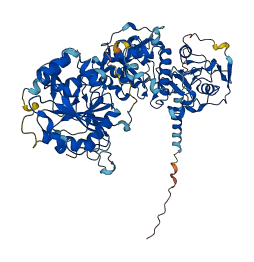
Descriptions
The autoinhibited protein was predicted that may have potential autoinhibitory elements via cis-regPred.
Autoinhibitory domains (AIDs)
Target domain |
|
Relief mechanism |
|
Assay |
cis-regPred |
Accessory elements
No accessory elements
Autoinhibited structure

Activated structure
1 structures for P70428
| Entry ID | Method | Resolution | Chain | Position | Source |
|---|---|---|---|---|---|
| AF-P70428-F1 | Predicted | AlphaFoldDB |
32 variants for P70428
| Variant ID(s) | Position | Change | Description | Diseaes Association | Provenance |
|---|---|---|---|---|---|
| rs3388569245 | 28 | T>P | No | EVA | |
| rs256111826 | 73 | T>A | No | EVA | |
| rs3388569575 | 96 | C>* | No | EVA | |
| rs3388571617 | 101 | K>N | No | EVA | |
| rs3388567422 | 110 | P>S | No | EVA | |
| rs3388569594 | 113 | K>R | No | EVA | |
| rs3412659356 | 121 | P>L | No | EVA | |
| rs3388573802 | 139 | D>G | No | EVA | |
| rs3388567446 | 146 | D>V | No | EVA | |
| rs3388573618 | 168 | K>N | No | EVA | |
| rs3388572805 | 189 | F>L | No | EVA | |
| rs3388571362 | 199 | Y>* | No | EVA | |
| rs3388571651 | 226 | Y>F | No | EVA | |
| rs3388573827 | 238 | A>T | No | EVA | |
| rs3388571351 | 299 | R>H | No | EVA | |
| rs27397950 | 313 | Q>R | No | EVA | |
| rs3388574847 | 320 | V>I | No | EVA | |
| rs3388572790 | 334 | V>D | No | EVA | |
| rs3413075937 | 386 | E>D | No | EVA | |
| rs3388567420 | 398 | A>G | No | EVA | |
| rs3388566137 | 434 | A>D | No | EVA | |
| rs3388567479 | 511 | V>A | No | EVA | |
| rs3388571564 | 528 | E>K | No | EVA | |
| rs3388569593 | 529 | I>F | No | EVA | |
| rs13476641 | 622 | T>A | No | EVA | |
| rs3388567219 | 628 | D>H | No | EVA | |
| rs3391760597 | 636 | A>T | No | EVA | |
| rs3388566138 | 648 | P>T | No | EVA | |
| rs3388569590 | 651 | K>N | No | EVA | |
| rs3388566109 | 670 | M>I | No | EVA | |
| rs3388569581 | 691 | V>L | No | EVA | |
| rs3388571480 | 691 | V>SDG* | No | EVA |
No associated diseases with P70428
11 regional properties for P70428
| Type | Name | Position | InterPro Accession |
|---|---|---|---|
| repeat | Tetratricopeptide repeat 1 | 246 - 279 | IPR001440-1 |
| repeat | Tetratricopeptide repeat 1 | 642 - 672 | IPR001440-2 |
| repeat | Tetratricopeptide repeat | 213 - 246 | IPR019734-1 |
| repeat | Tetratricopeptide repeat | 246 - 279 | IPR019734-2 |
| repeat | Tetratricopeptide repeat | 280 - 313 | IPR019734-3 |
| repeat | Tetratricopeptide repeat | 430 - 463 | IPR019734-4 |
| repeat | Tetratricopeptide repeat | 472 - 505 | IPR019734-5 |
| repeat | Tetratricopeptide repeat | 506 - 539 | IPR019734-6 |
| repeat | Tetratricopeptide repeat | 606 - 639 | IPR019734-7 |
| repeat | Tetratricopeptide repeat | 640 - 673 | IPR019734-8 |
| domain | RNA-polymerase II-associated protein 3-like, C-terminal domain | 777 - 869 | IPR025986 |
Functions
| Description | ||
|---|---|---|
| EC Number | 2.4.1.224 | Hexosyltransferases |
| Subcellular Localization |
|
|
| PANTHER Family | ||
| PANTHER Subfamily | ||
| PANTHER Protein Class | ||
| PANTHER Pathway Category | No pathway information available | |
6 GO annotations of cellular component
| Name | Definition |
|---|---|
| endoplasmic reticulum | The irregular network of unit membranes, visible only by electron microscopy, that occurs in the cytoplasm of many eukaryotic cells. The membranes form a complex meshwork of tubular channels, which are often expanded into slitlike cavities called cisternae. The ER takes two forms, rough (or granular), with ribosomes adhering to the outer surface, and smooth (with no ribosomes attached). |
| endoplasmic reticulum membrane | The lipid bilayer surrounding the endoplasmic reticulum. |
| Golgi apparatus | A membrane-bound cytoplasmic organelle of the endomembrane system that further processes the core oligosaccharides (e.g. N-glycans) added to proteins in the endoplasmic reticulum and packages them into membrane-bound vesicles. The Golgi apparatus operates at the intersection of the secretory, lysosomal, and endocytic pathways. |
| Golgi membrane | The lipid bilayer surrounding any of the compartments of the Golgi apparatus. |
| integral component of membrane | The component of a membrane consisting of the gene products and protein complexes having at least some part of their peptide sequence embedded in the hydrophobic region of the membrane. |
| UDP-N-acetylglucosamine transferase complex | A multienzyme, heterooligomeric complex involved in dolichyl-linked oligosaccharide synthesis. In yeast the complex is composed of Alg7p, which catalyzes the first step (GlcNAc1-PP-Dol from dolichol-phosphate and UDP-GlcNAc), and Alg13p plus Alg14p, the catalytic and anchoring subunits respectively, which together catalyze the second step (GlcNAc2-PP-dolichol from GlcNAc1-PP-Dol and UDP-GlcNAc) of dolichyl-linked oligosaccharide synthesis. |
9 GO annotations of molecular function
| Name | Definition |
|---|---|
| acetylglucosaminyltransferase activity | Catalysis of the transfer of an N-acetylglucosaminyl residue from UDP-N-acetyl-glucosamine to a sugar. |
| glucuronosyl-N-acetylglucosaminyl-proteoglycan 4-alpha-N-acetylglucosaminyltransferase activity | Catalysis of the reaction: beta-D-glucuronosyl-(1,4)-N-acetyl-alpha-D-glucosaminyl-proteoglycan + UDP-N-acetyl-D-glucosamine = N-acetyl-alpha-D-glucosaminyl-(1,4)-beta-D-glucuronosyl-(1,4)-N-acetyl-alpha-D-glucosaminyl-proteoglycan + UDP. |
| glucuronosyltransferase activity | Catalysis of the reaction: UDP-glucuronate + acceptor = UDP + acceptor beta-D-glucuronoside. |
| glycosyltransferase activity | Catalysis of the transfer of a glycosyl group from one compound (donor) to another (acceptor). |
| heparan sulfate N-acetylglucosaminyltransferase activity | Catalysis of the reaction: UDP-N-acetyl-D-glucosamine + heparan sulfate = UDP + (N-acetyl-D-glucosaminyl)-heparan sulfate. |
| metal ion binding | Binding to a metal ion. |
| N-acetylglucosaminyl-proteoglycan 4-beta-glucuronosyltransferase activity | Catalysis of the reaction: N-acetyl-alpha-D-glucosaminyl-(1,4)-beta-D-glucuronosyl-proteoglycan + UDP-alpha-D-glucuronate = beta-D-glucuronosyl-(1,4)-N-acetyl-alpha-D-glucosaminyl-(1,4)-beta-D-glucuronosyl-proteoglycan + UDP. |
| protein heterodimerization activity | Binding to a nonidentical protein to form a heterodimer. |
| protein homodimerization activity | Binding to an identical protein to form a homodimer. |
19 GO annotations of biological process
| Name | Definition |
|---|---|
| cellular polysaccharide biosynthetic process | The chemical reactions and pathways resulting in the formation of polysaccharides, polymers of many (typically more than 10) monosaccharide residues linked glycosidically, occurring at the level of an individual cell. |
| cellular response to fibroblast growth factor stimulus | Any process that results in a change in state or activity of a cell (in terms of movement, secretion, enzyme production, gene expression, etc.) as a result of an fibroblast growth factor stimulus. |
| chondrocyte differentiation | The process in which a chondroblast acquires specialized structural and/or functional features of a chondrocyte. A chondrocyte is a polymorphic cell that forms cartilage. |
| endochondral bone morphogenesis | The process in which bones are generated and organized as a result of the conversion of initial cartilaginous anlage into bone. |
| fluid transport | The directed movement of substances that are in liquid form in normal living conditions into, out of or within a cell, or between cells, by means of some agent such as a transporter or pore. |
| gene expression | The process in which a gene's sequence is converted into a mature gene product (protein or RNA). This includes the production of an RNA transcript and its processing, translation and maturation for protein-coding genes. |
| glycosaminoglycan biosynthetic process | The chemical reactions and pathways resulting in the formation of glycosaminoglycans, any of a group of polysaccharides that contain amino sugars. |
| heart contraction | The multicellular organismal process in which the heart decreases in volume in a characteristic way to propel blood through the body. |
| heparan sulfate proteoglycan biosynthetic process | The chemical reactions and pathways resulting in the formation of the heparan sulfate proteoglycan, a glycosaminoglycan with repeat unit consisting of alternating alpha-(1->4)-linked hexuronic acid and glucosamine residues; the former are a mixture of sulfated and nonsulfated D-glucuronic acid and L-iduronic acid; the L-iduronic acid is either sulfated or acetylated on its amino group as well as being sulfated on one of its hydroxyl groups; heparan sulfate chains are covalently linked to peptidyl-serine by a glycosidic attachment through the trisaccharide galactosyl-galactosyl-xylosyl to serine residues. |
| heparan sulfate proteoglycan biosynthetic process, polysaccharide chain biosynthetic process | The chemical reactions and pathways resulting in the formation of polysaccharide chain component of heparan sulfate proteoglycan. |
| heparin biosynthetic process | The chemical reactions and pathways resulting in the formation of heparin, any member of a group of glycosaminoglycans of average Mr (6000-20000), consisting predominantly of alternating alpha-(1->4)-linked D-galactose and N-acetyl-D-glucosamine-6-sulfate residues. |
| mesoderm formation | The process that gives rise to the mesoderm. This process pertains to the initial formation of the structure from unspecified parts. |
| multicellular organismal water homeostasis | Any process involved in the maintenance of an internal steady state of water within a tissue, organ, or a multicellular organism. |
| ossification | The formation of bone or of a bony substance, or the conversion of fibrous tissue or of cartilage into bone or a bony substance. |
| protein N-linked glycosylation | A protein glycosylation process in which a carbohydrate or carbohydrate derivative unit is added to a protein via the N4 atom of peptidyl-asparagine, the omega-N of arginine, or the N1' atom peptidyl-tryptophan. |
| regulation of blood pressure | Any process that modulates the force with which blood travels through the circulatory system. The process is controlled by a balance of processes that increase pressure and decrease pressure. |
| sodium ion homeostasis | Any process involved in the maintenance of an internal steady state of sodium ions within an organism or cell. |
| sulfation | The addition of a sulfate group to a molecule. |
| vasodilation | An increase in the internal diameter of blood vessels, especially arterioles or capillaries, due to relaxation of smooth muscle cells that line the vessels, and usually resulting in a decrease in blood pressure. |
8 homologous proteins in AiPD
| UniProt AC | Gene Name | Protein Name | Species | Evidence Code |
|---|---|---|---|---|
| O77783 | EXT2 | Exostosin-2 | Bos taurus (Bovine) | PR |
| Q9Y169 | sotv | Exostosin-2 | Drosophila melanogaster (Fruit fly) | PR |
| Q9ES89 | Extl2 | Exostosin-like 2 | Mus musculus (Mouse) | PR |
| P97464 | Ext1 | Exostosin-1 | Mus musculus (Mouse) | PR |
| Q9WVL6 | Extl3 | Exostosin-like 3 | Mus musculus (Mouse) | PR |
| Q94AA9 | XGD1 | Xylogalacturonan beta-1,3-xylosyltransferase | Arabidopsis thaliana (Mouse-ear cress) | PR |
| Q9LFP3 | At5g11130/At5g11120 | Probable glycosyltransferase At5g11130 | Arabidopsis thaliana (Mouse-ear cress) | PR |
| Q3EAR7 | At3g42180 | Probable glycosyltransferase At3g42180 | Arabidopsis thaliana (Mouse-ear cress) | PR |
| 10 | 20 | 30 | 40 | 50 | 60 |
| MCASVKSNIR | GPALIPRMKT | KHRIYYVTLF | SIVLLGLIAT | GMFQFWPHSI | ESSSDGGVEK |
| 70 | 80 | 90 | 100 | 110 | 120 |
| RSIREVPVVR | LPTDSPIPER | GDLSCRMHTC | FDVYRCGFNP | KNKIKVYIYP | LKKYVDDAGV |
| 130 | 140 | 150 | 160 | 170 | 180 |
| PVSSAISREY | NELLTAISDS | DYYTDDINRA | CLFVPSIDVL | NQNPLRIKET | AQALAQLSRW |
| 190 | 200 | 210 | 220 | 230 | 240 |
| DRGTNHLLFN | MLPGAPPDYN | TALDVPRDRA | LLAGGGFSTW | TYRQGYDVSI | PVFSPLSAEM |
| 250 | 260 | 270 | 280 | 290 | 300 |
| ALPEKAPGPR | RYFLLSSQMA | IHPEYREELE | ALQAKHQESV | LVLDKCTNLS | EGVLSVRKRC |
| 310 | 320 | 330 | 340 | 350 | 360 |
| HQHQVFDYPQ | VLQEATFCTV | LRGARLGQAV | LSDVLQAGCV | PVVIADSYIL | PFSEVLDWKR |
| 370 | 380 | 390 | 400 | 410 | 420 |
| ASVVVPEEKM | SDVYSILQNI | PQRQIEEMQR | QARWFWEAYF | QSIKAIALAT | LQIINDRIYP |
| 430 | 440 | 450 | 460 | 470 | 480 |
| YAAISYEEWN | DPPAVKWASV | SNPLFLPLIP | PQSQGFTAIV | LTYDRVESLF | RVITEVSKVP |
| 490 | 500 | 510 | 520 | 530 | 540 |
| SLSKLLVVWN | NQNKNPPEES | LWPKIRVPLK | VVRTAENKLS | NRFFPYDEIE | TEAVLAIDDD |
| 550 | 560 | 570 | 580 | 590 | 600 |
| IIMLTSDELQ | FGYEVWREFP | DRLVGYPGRL | HLWDHEMNKW | KYESEWTNEV | SMVLTGAAFY |
| 610 | 620 | 630 | 640 | 650 | 660 |
| HKYFNYLYTY | KMPGDIKNWV | DTHMNCEDIA | MNFLVANVTG | KAVIKVTPRK | KFKCPECTAI |
| 670 | 680 | 690 | 700 | 710 | |
| DGLSLDQTHM | VERSECINKF | ASVFGTMPLK | VVEHRADPVL | YKDDFPEKLK | SFPNIGSL |