P62140
Gene name |
PPP1CB |
Protein name |
Serine/threonine-protein phosphatase PP1-beta catalytic subunit |
Names |
PP-1B, PPP1CD |
Species |
Homo sapiens (Human) |
KEGG Pathway |
hsa:5500 |
EC number |
3.1.3.16: Phosphoric monoester hydrolases |
Protein Class |
|
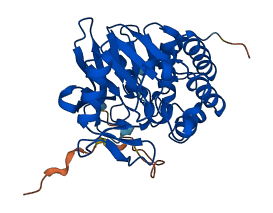
Descriptions
The autoinhibited protein was predicted that may have potential autoinhibitory elements via cis-regPred.
Autoinhibitory domains (AIDs)
Target domain |
|
Relief mechanism |
|
Assay |
cis-regPred |
Accessory elements
No accessory elements
Autoinhibited structure

Activated structure
1 structures for P62140
| Entry ID | Method | Resolution | Chain | Position | Source |
|---|---|---|---|---|---|
| AF-P62140-F1 | Predicted | AlphaFoldDB |
72 variants for P62140
| Variant ID(s) | Position | Change | Description | Diseaes Association | Provenance |
|---|---|---|---|---|---|
|
RCV001257999 RCV002274002 RCV000490622 rs886037952 RCV000257986 RCV001251211 CA10586682 RCV001265940 VAR_076839 |
49 | P>R | Noonan syndrome-like disorder with loose anagen hair 2 Dandy-Walker syndrome Noonan syndrome Inborn genetic diseases NSLH2 [ClinVar, UniProt] | Yes |
ClinGen ClinVar UniProt Ensembl dbSNP |
|
rs1114167429 CA346581171 VAR_076840 RCV000490624 |
56 | A>P | Noonan syndrome-like disorder with loose anagen hair 2 NSLH2 [ClinVar, UniProt] | Yes |
ClinGen ClinVar UniProt Ensembl dbSNP |
|
VAR_079189 RCV000490621 CA10586683 RCV001731461 RCV001266742 rs886037954 |
183 | E>A | Noonan syndrome-like disorder with loose anagen hair 2 Inborn genetic diseases NSLH2 [ClinVar, UniProt] | Yes |
ClinGen ClinVar UniProt Ensembl dbSNP |
|
RCV000257978 CA10586684 RCV000490623 VAR_079190 rs886037954 |
183 | E>V | Noonan syndrome-like disorder with loose anagen hair 2 NSLH2 [ClinVar, UniProt] | Yes |
ClinGen ClinVar UniProt Ensembl dbSNP |
|
RCV000523298 CA346583250 RCV002470896 rs1553311527 |
220 | R>C | Noonan syndrome-like disorder with loose anagen hair 2 [ClinVar] | Yes |
ClinGen ClinVar Ensembl dbSNP |
|
RCV000257996 VAR_079191 rs886037953 CA10586685 |
252 | D>Y | NSLH2 [UniProt] | Yes |
ClinGen ClinVar UniProt Ensembl dbSNP |
|
VAR_079192 rs886037955 RCV000490625 CA10586686 |
274 | E>K | Noonan syndrome-like disorder with loose anagen hair 2 Variant assessed as Somatic; impact. NSLH2; unknown pathological significance [ClinVar, NCI-TCGA, UniProt] | Yes |
ClinGen ClinVar UniProt Ensembl NCI-TCGA dbSNP |
|
RCV001267174 rs1667442382 |
276 | D>Y | Inborn genetic diseases [ClinVar] | Yes |
ClinVar dbSNP |
|
rs1305465866 CA346584296 |
2 | A>V | No |
ClinGen TOPMed |
|
|
rs367543173 RCV000084655 CA225573 |
4 | G>R | No |
ClinGen ClinVar Ensembl dbSNP |
|
| TCGA novel | 5 | E>* | Variant assessed as Somatic; impact. [NCI-TCGA] | No | NCI-TCGA |
|
rs1158082133 CA346584339 |
5 | E>Q | No |
ClinGen gnomAD |
|
|
CA44845359 rs139538860 |
10 | S>C | No |
ClinGen ESP gnomAD |
|
|
rs141124389 CA44845360 |
10 | S>I | No |
ClinGen ESP gnomAD |
|
|
rs960710587 CA44845361 |
11 | L>F | No |
ClinGen Ensembl |
|
|
rs1347016886 CA346584422 |
12 | I>N | No |
ClinGen gnomAD |
|
|
rs1223651476 CA346584419 |
12 | I>V | No |
ClinGen TOPMed gnomAD |
|
|
CA346580628 rs1247252530 |
19 | R>Q | No |
ClinGen gnomAD |
|
|
CA346580648 rs1205316044 |
22 | R>H | No |
ClinGen gnomAD |
|
|
CA346580694 rs1291974875 |
26 | I>M | No |
ClinGen TOPMed |
|
|
RCV001048325 rs1667055747 |
27 | V>M | No |
ClinVar dbSNP |
|
|
CA346580756 rs1230033680 |
30 | T>P | No |
ClinGen TOPMed |
|
|
CA346580759 rs1238656649 |
30 | T>S | No |
ClinGen gnomAD |
|
|
CA1589164 rs760562458 |
32 | A>T | Variant assessed as Somatic; 0.0 impact. [NCI-TCGA] | No |
ClinGen ExAC NCI-TCGA TOPMed gnomAD |
|
CA1589166 rs372864249 |
41 | S>F | No |
ClinGen ESP ExAC gnomAD |
|
|
rs1317594310 CA346581001 |
44 | I>T | No |
ClinGen TOPMed gnomAD |
|
| TCGA novel | 49 | P>S | Variant assessed as Somatic; impact. [NCI-TCGA] | No | NCI-TCGA |
|
CA1589167 rs138103928 |
50 | I>V | No |
ClinGen 1000Genomes ExAC gnomAD |
|
|
rs1403080346 CA346581204 |
59 | K>R | No |
ClinGen TOPMed |
|
|
CA346581351 rs1553310737 RCV000520931 |
66 | G>A | No |
ClinGen ClinVar Ensembl dbSNP |
|
|
rs1128416 CA44869954 |
67 | Q>H | No |
ClinGen 1000Genomes ESP ExAC TOPMed gnomAD |
|
| TCGA novel | 70 | D>N | Variant assessed as Somatic; impact. [NCI-TCGA] | No | NCI-TCGA |
| TCGA novel | 70 | D>Y | Variant assessed as Somatic; impact. [NCI-TCGA] | No | NCI-TCGA |
| TCGA novel | 76 | E>* | Variant assessed as Somatic; impact. [NCI-TCGA] | No | NCI-TCGA |
|
rs1366060246 CA346581432 |
78 | G>R | No |
ClinGen gnomAD |
|
|
CA44870012 rs951846731 |
79 | G>S | No |
ClinGen TOPMed |
|
|
rs1553310744 CA346581483 RCV000658863 |
85 | N>K | No |
ClinGen ClinVar Ensembl dbSNP |
|
|
rs1558305309 CA346581489 RCV000681353 |
86 | Y>C | No |
ClinGen ClinVar Ensembl dbSNP |
|
|
CA346581686 rs1294390542 |
114 | P>A | No |
ClinGen gnomAD |
|
|
rs75466421 CA44870108 |
124 | H>P | No |
ClinGen Ensembl |
|
| TCGA novel | 124 | H>Y | Variant assessed as Somatic; impact. [NCI-TCGA] | No | NCI-TCGA |
| TCGA novel | 127 | A>G | Variant assessed as Somatic; impact. [NCI-TCGA] | No | NCI-TCGA |
|
rs773877489 CA1589226 |
140 | K>T | No |
ClinGen ExAC gnomAD |
|
|
rs1457861725 CA346581897 |
141 | R>G | No |
ClinGen gnomAD |
|
|
CA346581964 rs1572460818 |
150 | T>P | No |
ClinGen Ensembl |
|
| TCGA novel | 161 | A>T | Variant assessed as Somatic; impact. [NCI-TCGA] | No | NCI-TCGA |
|
CA346582055 rs1241904157 |
163 | I>V | No |
ClinGen gnomAD |
|
| TCGA novel | 165 | D>Y | Variant assessed as Somatic; impact. [NCI-TCGA] | No | NCI-TCGA |
|
CA1589270 rs768286092 |
182 | M>V | No |
ClinGen ExAC gnomAD |
|
|
CA346582469 rs1250549046 |
189 | M>V | No |
ClinGen TOPMed gnomAD |
|
| TCGA novel | 190 | R>D | Variant assessed as Somatic; impact. [NCI-TCGA] | No | NCI-TCGA |
| TCGA novel | 191 | P>L | Variant assessed as Somatic; impact. [NCI-TCGA] | No | NCI-TCGA |
|
rs1572466593 CA346583102 |
200 | L>F | No |
ClinGen Ensembl |
|
|
rs867598418 CA44879355 |
204 | L>I | No |
ClinGen Ensembl |
|
| TCGA novel | 206 | S>C | Variant assessed as Somatic; impact. [NCI-TCGA] | No | NCI-TCGA |
|
CA346583184 rs1357383751 |
211 | D>E | No |
ClinGen TOPMed gnomAD |
|
|
rs111555795 CA44879381 |
222 | V>I | No |
ClinGen Ensembl |
|
|
CA346583329 rs1438779667 |
232 | S>N | No |
ClinGen TOPMed gnomAD |
|
|
CA346583412 rs1238818326 |
243 | I>T | No |
ClinGen gnomAD |
|
| TCGA novel | 281 | M>I | Variant assessed as Somatic; impact. [NCI-TCGA] | No | NCI-TCGA |
| TCGA novel | 285 | D>G | Variant assessed as Somatic; impact. [NCI-TCGA] | No | NCI-TCGA |
|
rs1430962228 CA346583978 |
290 | C>S | No |
ClinGen gnomAD |
|
|
CA531653821 rs1201558282 |
291 | S>* | No |
ClinGen gnomAD |
|
|
rs1343054862 CA346584106 |
302 | A>V | No |
ClinGen TOPMed |
|
| TCGA novel | 305 | Q>R | Variant assessed as Somatic; impact. [NCI-TCGA] | No | NCI-TCGA |
|
CA44890299 rs199975807 |
307 | G>S | No |
ClinGen TOPMed gnomAD |
|
|
CA1589346 rs781756970 |
312 | G>E | No |
ClinGen ExAC gnomAD |
|
|
rs1378749083 CA346584176 |
313 | R>C | No |
ClinGen gnomAD |
|
|
CA1589347 rs748608614 |
315 | V>I | No |
ClinGen ExAC TOPMed gnomAD |
|
|
rs202171795 CA1589349 |
323 | P>L | No |
ClinGen 1000Genomes ESP ExAC TOPMed gnomAD |
|
|
rs1265471325 CA346584277 |
324 | P>L | No |
ClinGen gnomAD |
|
|
CA44890349 rs267599330 |
327 | R>K | No |
ClinGen Ensembl |
1 associated diseases with P62140
[MIM: 617506]: Noonan syndrome-like disorder with loose anagen hair 2 (NSLH2)
A syndrome characterized by Noonan dysmorphic features such as macrocephaly, high forehead, hypertelorism, palpebral ptosis, low-set and posteriorly rotated ears, short and webbed neck, pectus anomalies, in association with pluckable, sparse, thin and slow-growing hair. {ECO:0000269|PubMed:27264673, ECO:0000269|PubMed:27681385, ECO:0000269|PubMed:27868344, ECO:0000269|PubMed:28211982, ECO:0000269|PubMed:30368668}. Note=The disease is caused by variants affecting the gene represented in this entry.
Without disease ID
- A syndrome characterized by Noonan dysmorphic features such as macrocephaly, high forehead, hypertelorism, palpebral ptosis, low-set and posteriorly rotated ears, short and webbed neck, pectus anomalies, in association with pluckable, sparse, thin and slow-growing hair. {ECO:0000269|PubMed:27264673, ECO:0000269|PubMed:27681385, ECO:0000269|PubMed:27868344, ECO:0000269|PubMed:28211982, ECO:0000269|PubMed:30368668}. Note=The disease is caused by variants affecting the gene represented in this entry.
3 regional properties for P62140
Functions
| Description | ||
|---|---|---|
| EC Number | 3.1.3.16 | Phosphoric monoester hydrolases |
| Subcellular Localization |
|
|
| PANTHER Family | ||
| PANTHER Subfamily | ||
| PANTHER Protein Class | ||
| PANTHER Pathway Category | No pathway information available | |
9 GO annotations of cellular component
| Name | Definition |
|---|---|
| cytoplasm | The contents of a cell excluding the plasma membrane and nucleus, but including other subcellular structures. |
| cytosol | The part of the cytoplasm that does not contain organelles but which does contain other particulate matter, such as protein complexes. |
| extracellular exosome | A vesicle that is released into the extracellular region by fusion of the limiting endosomal membrane of a multivesicular body with the plasma membrane. Extracellular exosomes, also simply called exosomes, have a diameter of about 40-100 nm. |
| focal adhesion | A cell-substrate junction that anchors the cell to the extracellular matrix and that forms a point of termination of actin filaments. In insects focal adhesion has also been referred to as hemi-adherens junction (HAJ). |
| nucleolus | A small, dense body one or more of which are present in the nucleus of eukaryotic cells. It is rich in RNA and protein, is not bounded by a limiting membrane, and is not seen during mitosis. Its prime function is the transcription of the nucleolar DNA into 45S ribosomal-precursor RNA, the processing of this RNA into 5.8S, 18S, and 28S components of ribosomal RNA, and the association of these components with 5S RNA and proteins synthesized outside the nucleolus. This association results in the formation of ribonucleoprotein precursors; these pass into the cytoplasm and mature into the 40S and 60S subunits of the ribosome. |
| nucleoplasm | That part of the nuclear content other than the chromosomes or the nucleolus. |
| nucleus | A membrane-bounded organelle of eukaryotic cells in which chromosomes are housed and replicated. In most cells, the nucleus contains all of the cell's chromosomes except the organellar chromosomes, and is the site of RNA synthesis and processing. In some species, or in specialized cell types, RNA metabolism or DNA replication may be absent. |
| plasma membrane | The membrane surrounding a cell that separates the cell from its external environment. It consists of a phospholipid bilayer and associated proteins. |
| PTW/PP1 phosphatase complex | A protein serine/threonine phosphatase complex that contains a catalytic subunit (PPP1CA, PPP1CB or PPP1CC) and the regulatory subunits PPP1R10 (PNUTS), TOX4 and WDR82, and plays a role in the control of chromatin structure and cell cycle progression during the transition from mitosis into interphase. |
6 GO annotations of molecular function
| Name | Definition |
|---|---|
| metal ion binding | Binding to a metal ion. |
| myosin phosphatase activity | Catalysis of the reaction: phosphomyosin + H2O = myosin + phosphate. |
| myosin-light-chain-phosphatase activity | Catalysis of the reaction: myosin light-chain phosphate + H2O = myosin light chain + phosphate. |
| phosphatase activity | Catalysis of the hydrolysis of phosphoric monoesters, releasing inorganic phosphate. |
| protein kinase binding | Binding to a protein kinase, any enzyme that catalyzes the transfer of a phosphate group, usually from ATP, to a protein substrate. |
| protein serine/threonine phosphatase activity | Catalysis of the reaction: protein serine phosphate + H2O = protein serine + phosphate, and protein threonine phosphate + H2O = protein threonine + phosphate. |
9 GO annotations of biological process
| Name | Definition |
|---|---|
| cell cycle | The progression of biochemical and morphological phases and events that occur in a cell during successive cell replication or nuclear replication events. Canonically, the cell cycle comprises the replication and segregation of genetic material followed by the division of the cell, but in endocycles or syncytial cells nuclear replication or nuclear division may not be followed by cell division. |
| cell division | The process resulting in division and partitioning of components of a cell to form more cells; may or may not be accompanied by the physical separation of a cell into distinct, individually membrane-bounded daughter cells. |
| circadian regulation of gene expression | Any process that modulates the frequency, rate or extent of gene expression such that an expression pattern recurs with a regularity of approximately 24 hours. |
| entrainment of circadian clock by photoperiod | The synchronization of a circadian rhythm to photoperiod, the intermittent cycle of light (day) and dark (night). |
| glycogen metabolic process | The chemical reactions and pathways involving glycogen, a polydisperse, highly branched glucan composed of chains of D-glucose residues in alpha-(1->4) glycosidic linkage, joined together by alpha-(1->6) glycosidic linkages. |
| MAPK cascade | An intracellular protein kinase cascade containing at least a MAPK, a MAPKK and a MAP3K. The cascade can also contain an additional tiers: the upstream MAP4K. The kinases in each tier phosphorylate and activate the kinase in the downstream tier to transmit a signal within a cell. |
| protein dephosphorylation | The process of removing one or more phosphoric residues from a protein. |
| regulation of cell adhesion | Any process that modulates the frequency, rate or extent of attachment of a cell to another cell or to the extracellular matrix. |
| regulation of circadian rhythm | Any process that modulates the frequency, rate or extent of a circadian rhythm. A circadian rhythm is a biological process in an organism that recurs with a regularity of approximately 24 hours. |
7 homologous proteins in AiPD
| UniProt AC | Gene Name | Protein Name | Species | Evidence Code |
|---|---|---|---|---|
| P62136 | PPP1CA | Serine/threonine-protein phosphatase PP1-alpha catalytic subunit | Homo sapiens (Human) | PR |
| P62137 | Ppp1ca | Serine/threonine-protein phosphatase PP1-alpha catalytic subunit | Mus musculus (Mouse) | PR |
| P62141 | Ppp1cb | Serine/threonine-protein phosphatase PP1-beta catalytic subunit | Mus musculus (Mouse) | PR |
| P62142 | Ppp1cb | Serine/threonine-protein phosphatase PP1-beta catalytic subunit | Rattus norvegicus (Rat) | PR |
| P48459 | C23G10.1 | Serine/threonine-protein phosphatase C23G10.1 | Caenorhabditis elegans | PR |
| P34430 | F44B9.9 | Uncharacterized protein F44B9.9 | Caenorhabditis elegans | PR |
| O82733 | TOPP7 | Serine/threonine-protein phosphatase PP1 isozyme 7 | Arabidopsis thaliana (Mouse-ear cress) | PR |
| 10 | 20 | 30 | 40 | 50 | 60 |
| MADGELNVDS | LITRLLEVRG | CRPGKIVQMT | EAEVRGLCIK | SREIFLSQPI | LLELEAPLKI |
| 70 | 80 | 90 | 100 | 110 | 120 |
| CGDIHGQYTD | LLRLFEYGGF | PPEANYLFLG | DYVDRGKQSL | ETICLLLAYK | IKYPENFFLL |
| 130 | 140 | 150 | 160 | 170 | 180 |
| RGNHECASIN | RIYGFYDECK | RRFNIKLWKT | FTDCFNCLPI | AAIVDEKIFC | CHGGLSPDLQ |
| 190 | 200 | 210 | 220 | 230 | 240 |
| SMEQIRRIMR | PTDVPDTGLL | CDLLWSDPDK | DVQGWGENDR | GVSFTFGADV | VSKFLNRHDL |
| 250 | 260 | 270 | 280 | 290 | 300 |
| DLICRAHQVV | EDGYEFFAKR | QLVTLFSAPN | YCGEFDNAGG | MMSVDETLMC | SFQILKPSEK |
| 310 | 320 | ||||
| KAKYQYGGLN | SGRPVTPPRT | ANPPKKR |