P62137
Gene name |
Ppp1ca (Ppp1a) |
Protein name |
Serine/threonine-protein phosphatase PP1-alpha catalytic subunit |
Names |
PP-1A |
Species |
Mus musculus (Mouse) |
KEGG Pathway |
mmu:19045 |
EC number |
3.1.3.16: Phosphoric monoester hydrolases |
Protein Class |
|
Descriptions
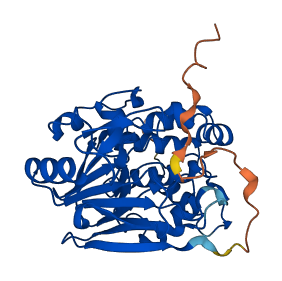
The autoinhibited protein was predicted that may have potential autoinhibitory elements via cis-regPred.
Autoinhibitory domains (AIDs)
Target domain |
|
Relief mechanism |
|
Assay |
cis-regPred |
Accessory elements
No accessory elements
Autoinhibited structure

Activated structure
3 structures for P62137
| Entry ID | Method | Resolution | Chain | Position | Source |
|---|---|---|---|---|---|
| 5ZQV | X-ray | 295 A | A/B/C/D | 1-330 | PDB |
| 5ZT0 | X-ray | 332 A | A/B/C/D/E/F | 7-300 | PDB |
| AF-P62137-F1 | Predicted | AlphaFoldDB |
12 variants for P62137
| Variant ID(s) | Position | Change | Description | Diseaes Association | Provenance |
|---|---|---|---|---|---|
| rs3408798712 | 57 | A>G | No | EVA | |
| rs3408838468 | 58 | P>R | No | EVA | |
| rs3408887697 | 61 | I>L | No | EVA | |
| rs3389495358 | 159 | L>Q | No | EVA | |
| rs3389530516 | 191 | R>W | No | EVA | |
| rs3389519603 | 222 | G>D | No | EVA | |
| rs3410466272 | 275 | E>V | No | EVA | |
| rs3389424879 | 290 | M>I | No | EVA | |
| rs3389495398 | 294 | Q>H | No | EVA | |
| rs3389509647 | 297 | K>* | No | EVA | |
| rs3389519579 | 312 | L>P | No | EVA | |
| rs3389481234 | 319 | I>F | No | EVA |
No associated diseases with P62137
No regional properties for P62137
| Type | Name | Position | InterPro Accession |
|---|---|---|---|
| No domain, repeats, and functional sites for P62137 | |||
Functions
| Description | ||
|---|---|---|
| EC Number | 3.1.3.16 | Phosphoric monoester hydrolases |
| Subcellular Localization |
|
|
| PANTHER Family | ||
| PANTHER Subfamily | ||
| PANTHER Protein Class | ||
| PANTHER Pathway Category | No pathway information available | |
18 GO annotations of cellular component
| Name | Definition |
|---|---|
| adherens junction | A cell-cell junction composed of the epithelial cadherin-catenin complex. The epithelial cadherins, or E-cadherins, of each interacting cell extend through the plasma membrane into the extracellular space and bind to each other. The E-cadherins bind to catenins on the cytoplasmic side of the membrane, where the E-cadherin-catenin complex binds to cytoskeletal components and regulatory and signaling molecules. |
| chromosome, telomeric region | The end of a linear chromosome, required for the integrity and maintenance of the end. A chromosome telomere usually includes a region of telomerase-encoded repeats the length of which rarely exceeds 20 bp each and that permits the formation of a telomeric loop (T-loop). The telomeric repeat region is usually preceded by a sub-telomeric region that is gene-poor but rich in repetitive elements. Some telomeres only consist of the latter part (for eg. D. melanogaster telomeres). |
| cytoplasm | The contents of a cell excluding the plasma membrane and nucleus, but including other subcellular structures. |
| cytosol | The part of the cytoplasm that does not contain organelles but which does contain other particulate matter, such as protein complexes. |
| dendritic spine | A small, membranous protrusion from a dendrite that forms a postsynaptic compartment, typically receiving input from a single presynapse. They function as partially isolated biochemical and an electrical compartments. Spine morphology is variable:they can be thin, stubby, mushroom, or branched, with a continuum of intermediate morphologies. They typically terminate in a bulb shape, linked to the dendritic shaft by a restriction. Spine remodeling is though to be involved in synaptic plasticity. |
| glutamatergic synapse | A synapse that uses glutamate as a neurotransmitter. |
| glycogen granule | Cytoplasmic bead-like structures of animal cells, visible by electron microscope. Each granule is a functional unit with the biosynthesis and catabolism of glycogen being catalyzed by enzymes bound to the granule surface. |
| neuron projection | A prolongation or process extending from a nerve cell, e.g. an axon or dendrite. |
| neuronal cell body | The portion of a neuron that includes the nucleus, but excludes cell projections such as axons and dendrites. |
| nucleolus | A small, dense body one or more of which are present in the nucleus of eukaryotic cells. It is rich in RNA and protein, is not bounded by a limiting membrane, and is not seen during mitosis. Its prime function is the transcription of the nucleolar DNA into 45S ribosomal-precursor RNA, the processing of this RNA into 5.8S, 18S, and 28S components of ribosomal RNA, and the association of these components with 5S RNA and proteins synthesized outside the nucleolus. This association results in the formation of ribonucleoprotein precursors; these pass into the cytoplasm and mature into the 40S and 60S subunits of the ribosome. |
| nucleoplasm | That part of the nuclear content other than the chromosomes or the nucleolus. |
| nucleus | A membrane-bounded organelle of eukaryotic cells in which chromosomes are housed and replicated. In most cells, the nucleus contains all of the cell's chromosomes except the organellar chromosomes, and is the site of RNA synthesis and processing. In some species, or in specialized cell types, RNA metabolism or DNA replication may be absent. |
| perikaryon | The portion of the cell soma (neuronal cell body) that excludes the nucleus. |
| plasma membrane | The membrane surrounding a cell that separates the cell from its external environment. It consists of a phospholipid bilayer and associated proteins. |
| postsynapse | The part of a synapse that is part of the post-synaptic cell. |
| presynapse | The part of a synapse that is part of the presynaptic cell. |
| protein phosphatase type 1 complex | A protein complex that possesses magnesium-dependent protein serine/threonine phosphatase (AMD phosphatase) activity, and consists of a catalytic subunit and one or more regulatory subunits that dictates the phosphatase's substrate specificity, function, and activity. |
| PTW/PP1 phosphatase complex | A protein serine/threonine phosphatase complex that contains a catalytic subunit (PPP1CA, PPP1CB or PPP1CC) and the regulatory subunits PPP1R10 (PNUTS), TOX4 and WDR82, and plays a role in the control of chromatin structure and cell cycle progression during the transition from mitosis into interphase. |
9 GO annotations of molecular function
| Name | Definition |
|---|---|
| cadherin binding involved in cell-cell adhesion | Any cadherin binding that occurs as part of the process of cell-cell adhesion. |
| metal ion binding | Binding to a metal ion. |
| myosin phosphatase activity | Catalysis of the reaction: phosphomyosin + H2O = myosin + phosphate. |
| phosphatase activity | Catalysis of the hydrolysis of phosphoric monoesters, releasing inorganic phosphate. |
| phosphoprotein phosphatase activity | Catalysis of the reaction: a phosphoprotein + H2O = a protein + phosphate. Together with protein kinases, these enzymes control the state of phosphorylation of cellular proteins and thereby provide an important mechanism for regulating cellular activity. |
| protein phosphatase 1 binding | Binding to a protein phosphatase 1. |
| protein serine/threonine phosphatase activity | Catalysis of the reaction: protein serine phosphate + H2O = protein serine + phosphate, and protein threonine phosphate + H2O = protein threonine + phosphate. |
| protein-containing complex binding | Binding to a macromolecular complex. |
| ribonucleoprotein complex binding | Binding to a complex of RNA and protein. |
15 GO annotations of biological process
| Name | Definition |
|---|---|
| branching morphogenesis of an epithelial tube | The process in which the anatomical structures of branches in an epithelial tube are generated and organized. A tube is a long hollow cylinder. |
| cell cycle | The progression of biochemical and morphological phases and events that occur in a cell during successive cell replication or nuclear replication events. Canonically, the cell cycle comprises the replication and segregation of genetic material followed by the division of the cell, but in endocycles or syncytial cells nuclear replication or nuclear division may not be followed by cell division. |
| cell division | The process resulting in division and partitioning of components of a cell to form more cells; may or may not be accompanied by the physical separation of a cell into distinct, individually membrane-bounded daughter cells. |
| circadian regulation of gene expression | Any process that modulates the frequency, rate or extent of gene expression such that an expression pattern recurs with a regularity of approximately 24 hours. |
| dephosphorylation | The process of removing one or more phosphoric (ester or anhydride) residues from a molecule. |
| entrainment of circadian clock by photoperiod | The synchronization of a circadian rhythm to photoperiod, the intermittent cycle of light (day) and dark (night). |
| glycogen metabolic process | The chemical reactions and pathways involving glycogen, a polydisperse, highly branched glucan composed of chains of D-glucose residues in alpha-(1->4) glycosidic linkage, joined together by alpha-(1->6) glycosidic linkages. |
| lung development | The process whose specific outcome is the progression of the lung over time, from its formation to the mature structure. In all air-breathing vertebrates the lungs are developed from the ventral wall of the oesophagus as a pouch which divides into two sacs. In amphibians and many reptiles the lungs retain very nearly this primitive sac-like character, but in the higher forms the connection with the esophagus becomes elongated into the windpipe and the inner walls of the sacs become more and more divided, until, in the mammals, the air spaces become minutely divided into tubes ending in small air cells, in the walls of which the blood circulates in a fine network of capillaries. In mammals the lungs are more or less divided into lobes, and each lung occupies a separate cavity in the thorax. |
| positive regulation of extrinsic apoptotic signaling pathway in absence of ligand | Any process that activates or increases the frequency, rate or extent of extrinsic apoptotic signaling pathway in absence of ligand. |
| protein dephosphorylation | The process of removing one or more phosphoric residues from a protein. |
| regulation of circadian rhythm | Any process that modulates the frequency, rate or extent of a circadian rhythm. A circadian rhythm is a biological process in an organism that recurs with a regularity of approximately 24 hours. |
| regulation of glycogen biosynthetic process | Any process that modulates the frequency, rate or extent of the chemical reactions and pathways resulting in the formation of glycogen. |
| regulation of glycogen catabolic process | Any process that modulates the frequency, rate or extent of the chemical reactions and pathways resulting in the breakdown of glycogen. |
| regulation of translation | Any process that modulates the frequency, rate or extent of the chemical reactions and pathways resulting in the formation of proteins by the translation of mRNA or circRNA. |
| response to lead ion | Any process that results in a change in state or activity of a cell or an organism (in terms of movement, secretion, enzyme production, gene expression, etc.) as a result of a lead ion stimulus. |
7 homologous proteins in AiPD
| UniProt AC | Gene Name | Protein Name | Species | Evidence Code |
|---|---|---|---|---|
| P62140 | PPP1CB | Serine/threonine-protein phosphatase PP1-beta catalytic subunit | Homo sapiens (Human) | PR |
| P62136 | PPP1CA | Serine/threonine-protein phosphatase PP1-alpha catalytic subunit | Homo sapiens (Human) | PR |
| P62141 | Ppp1cb | Serine/threonine-protein phosphatase PP1-beta catalytic subunit | Mus musculus (Mouse) | PR |
| P62142 | Ppp1cb | Serine/threonine-protein phosphatase PP1-beta catalytic subunit | Rattus norvegicus (Rat) | PR |
| P34430 | F44B9.9 | Uncharacterized protein F44B9.9 | Caenorhabditis elegans | PR |
| P48459 | C23G10.1 | Serine/threonine-protein phosphatase C23G10.1 | Caenorhabditis elegans | PR |
| O82733 | TOPP7 | Serine/threonine-protein phosphatase PP1 isozyme 7 | Arabidopsis thaliana (Mouse-ear cress) | PR |
| 10 | 20 | 30 | 40 | 50 | 60 |
| MSDSEKLNLD | SIIGRLLEVQ | GSRPGKNVQL | TENEIRGLCL | KSREIFLSQP | ILLELEAPLK |
| 70 | 80 | 90 | 100 | 110 | 120 |
| ICGDIHGQYY | DLLRLFEYGG | FPPESNYLFL | GDYVDRGKQS | LETICLLLAY | KIRYPENFFL |
| 130 | 140 | 150 | 160 | 170 | 180 |
| LRGNHECASI | NRIYGFYDEC | KRRYNIKLWK | TFTDCFNCLP | IAAIVDEKIF | CCHGGLSPDL |
| 190 | 200 | 210 | 220 | 230 | 240 |
| QSMEQIRRIM | RPTDVPDQGL | LCDLLWSDPD | KDVQGWGEND | RGVSFTFGAE | VVAKFLHKHD |
| 250 | 260 | 270 | 280 | 290 | 300 |
| LDLICRAHQV | VEDGYEFFAK | RQLVTLFSAP | NYCGEFDNAG | AMMSVDETLM | CSFQILKPAD |
| 310 | 320 | ||||
| KNKGKYGQFS | GLNPGGRPIT | PPRNSAKAKK |