P51149
Gene name |
RAB7A |
Protein name |
Ras-related protein Rab-7a |
Names |
|
Species |
Homo sapiens (Human) |
KEGG Pathway |
hsa:7879 |
EC number |
3.6.5.2: Acting on GTP; involved in cellular and subcellular movement |
Protein Class |
|
Descriptions
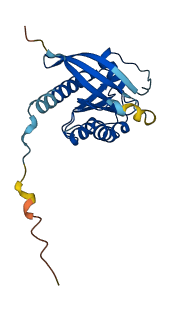
The autoinhibited protein was predicted that may have potential autoinhibitory elements via cis-regPred.
Autoinhibitory domains (AIDs)
Target domain |
|
Relief mechanism |
|
Assay |
cis-regPred |
Accessory elements
No accessory elements
Autoinhibited structure

Activated structure
98 variants for P51149
| Variant ID(s) | Position | Change | Description | Diseaes Association | Provenance |
|---|---|---|---|---|---|
|
rs1933610846 RCV001035500 |
50 | V>M | Charcot-Marie-Tooth disease type 2B [ClinVar] | Yes |
ClinVar dbSNP |
|
RCV000698626 CA2600787 RCV002401921 rs775104487 RCV000235278 |
56 | L>P | Charcot-Marie-Tooth disease type 2B Inborn genetic diseases [ClinVar] | Yes |
ClinGen ClinVar ExAC TOPMed dbSNP gnomAD |
|
RCV000346174 CA2600802 rs11549756 |
93 | P>S | Charcot-Marie-Tooth disease type 2B [ClinVar] | Yes |
ClinGen ClinVar ExAC dbSNP gnomAD |
|
rs1576303712 RCV000857130 |
111 | S>missing | Charcot-Marie-Tooth disease [ClinVar] | Yes |
ClinVar dbSNP |
|
rs1933806198 RCV001173965 |
111 | S>G | Charcot-Marie-Tooth disease [ClinVar] | Yes |
ClinVar dbSNP |
|
rs1933806941 RCV001202133 |
126 | K>R | Charcot-Marie-Tooth disease type 2B [ClinVar] | Yes |
ClinVar dbSNP |
|
rs121909078 VAR_018722 RCV000059221 RCV000789555 CA219656 RCV000007770 |
129 | L>F | Charcot-Marie-Tooth disease Charcot-Marie-Tooth disease type 2B CMT2B; increases GTP hydrolysis; decreases affinity for GTP and GDP; does not affect interaction with NTRK1; results in higher levels of NTRK1 and MAPK1/MAPK3 phosphorylation after NGF stimulation consistent with enhanced MAPK signaling; increases interaction with PRPH [ClinVar, UniProt] | Yes |
ClinGen ClinVar UniProt Ensembl dbSNP |
|
RCV001343529 rs368804888 CA2600841 |
135 | A>T | Charcot-Marie-Tooth disease type 2B [ClinVar] | Yes |
ClinGen ClinVar ESP ExAC dbSNP gnomAD |
|
RCV001237164 rs1320514833 |
150 | P>T | Charcot-Marie-Tooth disease type 2B [ClinVar] | Yes |
ClinVar dbSNP |
|
rs1933833236 RCV001146704 |
152 | F>L | Charcot-Marie-Tooth disease type 2B [ClinVar] | Yes |
ClinVar dbSNP |
|
RCV001858754 CA354709450 RCV000992739 rs1576304176 |
156 | A>T | Charcot-Marie-Tooth disease type 2B [ClinVar] | Yes |
ClinGen ClinVar Ensembl dbSNP |
|
VAR_037887 rs121909081 RCV000059222 RCV000007773 RCV000789553 CA219658 RCV001049977 |
157 | K>N | Charcot-Marie-Tooth disease Charcot-Marie-Tooth disease type 2B CMT2B; does not affect interaction with NTRK1; results in higher levels of NTRK1 and MAPK1/MAPK3 phosphorylation after NGF stimulation consistent with enhanced MAPK signaling; increases interaction with PRPH [ClinVar, UniProt] | Yes |
ClinVar UniProt dbSNP ClinGen Ensembl |
|
rs963894786 RCV001345681 CA82632196 |
161 | N>D | Charcot-Marie-Tooth disease type 2B [ClinVar] | Yes |
ClinGen ClinVar dbSNP gnomAD |
|
rs121909080 RCV000789556 CA354709486 RCV001386686 |
161 | N>I | Charcot-Marie-Tooth disease Charcot-Marie-Tooth disease type 2B [ClinVar] | Yes |
ClinGen ClinVar TOPMed dbSNP gnomAD |
|
RCV001050283 rs121909080 CA354709485 |
161 | N>S | Charcot-Marie-Tooth disease type 2B [ClinVar] | Yes |
ClinGen ClinVar TOPMed dbSNP gnomAD |
|
VAR_037888 RCV000789552 RCV000059223 rs121909080 CA219660 RCV000007772 |
161 | N>T | Charcot-Marie-Tooth disease Charcot-Marie-Tooth disease type 2B CMT2B; does not affect interaction with NTRK1; results in higher levels of NTRK1 and MAPK1/MAPK3 phosphorylation after NGF stimulation consistent with enhanced MAPK signaling; increases interaction with PRPH [ClinVar, UniProt] | Yes |
ClinGen ClinVar UniProt TOPMed dbSNP gnomAD |
|
RCV000007771 CA219662 rs121909079 RCV000059224 VAR_018723 RCV000789554 |
162 | V>M | Charcot-Marie-Tooth disease Charcot-Marie-Tooth disease type 2B Variant assessed as Somatic; impact. CMT2B; increases GTP hydrolysis; decreases affinity for GTP and GDP; does not affect interaction with NTRK1; results in higher levels of NTRK1 and MAPK1/MAPK3 phosphorylation after NGF stimulation consistent with enhanced MAPK signaling; increases interaction with PRPH [ClinVar, NCI-TCGA, UniProt] | Yes |
ClinGen ClinVar UniProt Ensembl NCI-TCGA dbSNP |
|
RCV001351229 CA2600852 rs141978327 |
168 | T>M | Charcot-Marie-Tooth disease type 2B [ClinVar] | Yes |
ClinGen ClinVar ESP ExAC TOPMed dbSNP gnomAD |
|
CA2600854 RCV000521666 rs375630134 RCV002528236 |
169 | I>T | Charcot-Marie-Tooth disease type 2B [ClinVar] | Yes |
ClinGen ClinVar ESP ExAC TOPMed dbSNP gnomAD |
|
RCV001314132 CA2600875 rs142747565 |
178 | T>M | Charcot-Marie-Tooth disease type 2B [ClinVar] | Yes |
ClinGen ClinVar 1000Genomes ESP ExAC TOPMed dbSNP gnomAD |
|
rs752824265 RCV000639624 CA2600880 RCV002473082 |
184 | N>S | Charcot-Marie-Tooth disease type 2B [ClinVar] | Yes |
ClinGen ClinVar ExAC TOPMed dbSNP gnomAD |
|
rs147480945 RCV002343491 RCV000695902 CA2600883 |
190 | I>V | Charcot-Marie-Tooth disease type 2B Inborn genetic diseases [ClinVar] | Yes |
ClinGen ClinVar ESP ExAC TOPMed dbSNP gnomAD |
|
rs756968558 CA2600884 RCV000542314 |
193 | D>N | Charcot-Marie-Tooth disease type 2B [ClinVar] | Yes |
ClinGen ClinVar ExAC TOPMed dbSNP gnomAD |
|
CA2600888 RCV001043273 rs779472408 |
197 | R>Q | Charcot-Marie-Tooth disease type 2B [ClinVar] | Yes |
ClinGen ClinVar ExAC TOPMed dbSNP gnomAD |
|
RCV001208352 rs745507763 CA2600886 RCV002356894 |
197 | R>W | Charcot-Marie-Tooth disease type 2B Inborn genetic diseases [ClinVar] | Yes |
ClinGen ClinVar ExAC TOPMed dbSNP gnomAD |
|
CA354706719 rs1399453701 |
2 | T>A | No |
ClinGen TOPMed |
|
| TCGA novel | 6 | K>T | Variant assessed as Somatic; impact. [NCI-TCGA] | No | NCI-TCGA |
|
rs150089960 CA82626495 |
11 | V>L | No |
ClinGen ESP |
|
|
rs780732950 CA2600756 |
12 | I>V | No |
ClinGen ExAC gnomAD |
|
| TCGA novel | 22 | T>I | Variant assessed as Somatic; impact. [NCI-TCGA] | No | NCI-TCGA |
|
rs1576299943 RCV000857129 |
27 | Q>missing | No |
ClinVar dbSNP |
|
|
rs1286235403 CA354707523 |
27 | Q>R | No |
ClinGen gnomAD |
|
|
CA82627298 rs201407628 |
30 | N>S | No |
ClinGen TOPMed |
|
|
CA82627300 VAR_037886 rs11549759 |
32 | K>E | No |
ClinGen UniProt Ensembl dbSNP |
|
|
CA354707639 rs1553722327 |
34 | S>N | No |
ClinGen Ensembl |
|
|
CA2600782 rs747270770 |
35 | N>S | No |
ClinGen ExAC gnomAD |
|
|
rs776746396 CA2600784 |
39 | A>T | No |
ClinGen ExAC gnomAD |
|
| TCGA novel | 40 | T>P | Variant assessed as Somatic; impact. [NCI-TCGA] | No | NCI-TCGA |
|
rs769771992 CA2600786 |
51 | M>T | No |
ClinGen ExAC TOPMed |
|
|
rs1228959786 CA354707893 |
51 | M>V | No |
ClinGen TOPMed |
|
|
CA354708023 rs1559795312 |
59 | M>I | No |
ClinGen Ensembl |
|
|
rs749968204 CA2600795 |
61 | I>V | No |
ClinGen ExAC |
|
|
rs747759228 CA82631169 |
64 | T>A | No |
ClinGen Ensembl |
|
| TCGA novel | 73 | L>R | Variant assessed as Somatic; impact. [NCI-TCGA] | No | NCI-TCGA |
| TCGA novel | 74 | G>V | Variant assessed as Somatic; impact. [NCI-TCGA] | No | NCI-TCGA |
|
CA354708670 COSM1222955 rs1313908916 |
76 | A>V | large_intestine [Cosmic] | No |
ClinGen cosmic curated gnomAD |
| TCGA novel | 80 | G>S | Variant assessed as Somatic; impact. [NCI-TCGA] | No | NCI-TCGA |
|
CA2600800 rs747215257 |
85 | V>I | No |
ClinGen ExAC TOPMed gnomAD |
|
|
rs1412658156 CA354708741 |
87 | V>L | No |
ClinGen TOPMed |
|
|
rs925560872 CA354708778 |
92 | A>G | No |
ClinGen TOPMed gnomAD |
|
|
rs925560872 CA82631225 |
92 | A>V | No |
ClinGen TOPMed gnomAD |
|
|
CA82631230 rs11549756 |
93 | P>A | No |
ClinGen ExAC gnomAD |
|
|
rs745988626 CA2600803 |
96 | F>L | No |
ClinGen ExAC gnomAD |
|
|
rs1359173081 CA354708820 |
98 | T>S | No |
ClinGen gnomAD |
|
|
rs1235879402 CA354708837 |
101 | S>N | No |
ClinGen TOPMed |
|
|
CA354708855 rs1415488185 |
103 | R>I | No |
ClinGen TOPMed gnomAD |
|
| TCGA novel | 107 | L>I | Variant assessed as Somatic; impact. [NCI-TCGA] | No | NCI-TCGA |
|
rs1398153172 CA354708922 |
112 | P>H | No |
ClinGen gnomAD |
|
|
CA82631261 rs142136407 |
113 | R>Q | No |
ClinGen ESP gnomAD |
|
| TCGA novel | 119 | P>S | Variant assessed as Somatic; impact. [NCI-TCGA] | No | NCI-TCGA |
| TCGA novel | 120 | F>L | Variant assessed as Somatic; impact. [NCI-TCGA] | No | NCI-TCGA |
|
COSM1670550 CA354709060 rs1446351110 |
130 | E>K | large_intestine Variant assessed as Somatic; impact. [Cosmic, NCI-TCGA] | No |
ClinGen cosmic curated NCI-TCGA gnomAD |
|
rs1933807332 RCV001289163 |
131 | N>D | No |
ClinVar dbSNP |
|
|
CA354709323 rs1339801191 |
139 | A>T | No |
ClinGen gnomAD |
|
|
CA2600845 rs201399896 |
141 | A>S | No |
ClinGen 1000Genomes ExAC gnomAD |
|
|
rs201399896 CA2600844 |
141 | A>T | No |
ClinGen 1000Genomes ExAC gnomAD |
|
| TCGA novel | 142 | W>* | Variant assessed as Somatic; impact. [NCI-TCGA] | No | NCI-TCGA |
|
CA354709362 rs1217563584 |
144 | Y>C | No |
ClinGen gnomAD |
|
|
CA354709406 rs1320514833 |
150 | P>A | No |
ClinGen gnomAD |
|
|
CA354709415 rs1196736493 |
151 | Y>C | No |
ClinGen gnomAD |
|
|
rs770494797 CA354709439 |
154 | T>I | No |
ClinGen ExAC gnomAD |
|
|
CA2600849 rs770494797 |
154 | T>S | No |
ClinGen ExAC gnomAD |
|
|
CA82632249 rs200290674 |
163 | E>D | No |
ClinGen 1000Genomes |
|
|
CA2600850 rs776165312 |
165 | A>V | No |
ClinGen ExAC gnomAD |
|
|
rs1455710715 CA354709531 |
168 | T>A | No |
ClinGen TOPMed |
|
|
CA2600853 rs774810842 |
169 | I>V | No |
ClinGen ExAC gnomAD |
|
|
CA2600856 rs750766845 |
170 | A>T | No |
ClinGen ExAC TOPMed gnomAD |
|
|
CA354709544 rs1355476911 |
170 | A>V | No |
ClinGen gnomAD |
|
|
CA354709545 rs1802891 |
171 | R>W | No |
ClinGen gnomAD |
|
|
CA354709552 rs1322655419 |
172 | N>D | No |
ClinGen gnomAD |
|
|
CA2600857 rs760888311 |
172 | N>K | No |
ClinGen ExAC gnomAD |
|
|
rs1304894378 CA354423462 |
180 | V>G | No |
ClinGen gnomAD |
|
|
rs186247059 CA2600877 |
180 | V>M | No |
ClinGen 1000Genomes ExAC gnomAD |
|
|
RCV000857131 rs1576306723 |
181 | E>missing | No |
ClinVar dbSNP |
|
|
rs140685176 CA2600878 |
182 | L>M | No |
ClinGen ESP ExAC gnomAD |
|
|
CA2600882 rs143140848 |
184 | N>K | No |
ClinGen ESP ExAC TOPMed gnomAD |
|
|
rs1032559719 COSM1037996 CA82513244 |
185 | E>K | Variant assessed as Somatic; impact. endometrium [NCI-TCGA, Cosmic] | No |
ClinGen cosmic curated Ensembl NCI-TCGA |
|
rs1431291361 CA354423611 |
193 | D>G | No |
ClinGen gnomAD |
|
|
rs1395663847 CA354423632 |
194 | K>N | No |
ClinGen gnomAD |
|
|
CA354423629 rs781110052 |
194 | K>R | No |
ClinGen ExAC gnomAD |
|
|
CA2600885 rs781110052 |
194 | K>T | No |
ClinGen ExAC gnomAD |
|
|
rs745507763 CA2600887 |
197 | R>G | No |
ClinGen ExAC TOPMed gnomAD |
|
|
CA2600889 rs748832566 |
198 | A>T | No |
ClinGen ExAC TOPMed gnomAD |
|
|
CA354423683 rs1415425287 |
199 | K>R | No |
ClinGen TOPMed |
|
|
CA354423687 rs1415425287 |
199 | K>T | No |
ClinGen TOPMed |
|
|
CA354423695 rs1186668103 |
200 | A>S | No |
ClinGen TOPMed |
|
|
rs866854462 CA82513270 |
201 | S>L | No |
ClinGen TOPMed gnomAD |
|
| TCGA novel | 203 | E>K | Variant assessed as Somatic; impact. [NCI-TCGA] | No | NCI-TCGA |
1 associated diseases with P51149
[MIM: 600882]: Charcot-Marie-Tooth disease 2B (CMT2B)
A dominant axonal form of Charcot-Marie-Tooth disease, a disorder of the peripheral nervous system, characterized by progressive weakness and atrophy, initially of the peroneal muscles and later of the distal muscles of the arms. Charcot-Marie-Tooth disease is classified in two main groups on the basis of electrophysiologic properties and histopathology
Without disease ID
- A dominant axonal form of Charcot-Marie-Tooth disease, a disorder of the peripheral nervous system, characterized by progressive weakness and atrophy, initially of the peroneal muscles and later of the distal muscles of the arms. Charcot-Marie-Tooth disease is classified in two main groups on the basis of electrophysiologic properties and histopathology
1 regional properties for P51149
| Type | Name | Position | InterPro Accession |
|---|---|---|---|
| domain | Small GTP-binding protein domain | 10 - 169 | IPR005225 |
Functions
| Description | ||
|---|---|---|
| EC Number | 3.6.5.2 | Acting on GTP; involved in cellular and subcellular movement |
| Subcellular Localization |
|
|
| PANTHER Family | ||
| PANTHER Subfamily | ||
| PANTHER Protein Class | ||
| PANTHER Pathway Category | No pathway information available | |
21 GO annotations of cellular component
| Name | Definition |
|---|---|
| alveolar lamellar body | A specialized secretory organelle found in type II pneumocytes and involved in the synthesis, secretion, and reutilization of pulmonary surfactant. |
| anchored component of synaptic vesicle membrane | The component of the synaptic vesicle membrane consisting of the gene products that are tethered to the membrane only by a covalently attached anchor, such as a lipid group that is embedded in the membrane. Gene products with peptide sequences that are embedded in the membrane are excluded from this grouping. |
| autophagosome membrane | The lipid bilayer surrounding an autophagosome, a double-membrane-bounded vesicle in which endogenous cellular material is sequestered. |
| cytosol | The part of the cytoplasm that does not contain organelles but which does contain other particulate matter, such as protein complexes. |
| endosome membrane | The lipid bilayer surrounding an endosome. |
| extracellular exosome | A vesicle that is released into the extracellular region by fusion of the limiting endosomal membrane of a multivesicular body with the plasma membrane. Extracellular exosomes, also simply called exosomes, have a diameter of about 40-100 nm. |
| extrinsic component of lysosome membrane | The component of an lysosome membrane consisting of gene products and protein complexes that are loosely bound to one of its surfaces, but not integrated into the hydrophobic region. |
| Golgi apparatus | A membrane-bound cytoplasmic organelle of the endomembrane system that further processes the core oligosaccharides (e.g. N-glycans) added to proteins in the endoplasmic reticulum and packages them into membrane-bound vesicles. The Golgi apparatus operates at the intersection of the secretory, lysosomal, and endocytic pathways. |
| late endosome | A prelysosomal endocytic organelle differentiated from early endosomes by lower lumenal pH and different protein composition. Late endosomes are more spherical than early endosomes and are mostly juxtanuclear, being concentrated near the microtubule organizing center. |
| late endosome membrane | The lipid bilayer surrounding a late endosome. |
| lipid droplet | An intracellular non-membrane-bounded organelle comprising a matrix of coalesced lipids surrounded by a phospholipid monolayer. May include associated proteins. |
| lysosomal membrane | The lipid bilayer surrounding the lysosome and separating its contents from the cell cytoplasm. |
| lysosome | A small lytic vacuole that has cell cycle-independent morphology found in most animal cells and that contains a variety of hydrolases, most of which have their maximal activities in the pH range 5-6. The contained enzymes display latency if properly isolated. About 40 different lysosomal hydrolases are known and lysosomes have a great variety of morphologies and functions. |
| melanosome membrane | The lipid bilayer surrounding a melanosome. |
| mitochondrial membrane | Either of the lipid bilayers that surround the mitochondrion and form the mitochondrial envelope. |
| mitochondrion | A semiautonomous, self replicating organelle that occurs in varying numbers, shapes, and sizes in the cytoplasm of virtually all eukaryotic cells. It is notably the site of tissue respiration. |
| phagocytic vesicle | A membrane-bounded intracellular vesicle that arises from the ingestion of particulate material by phagocytosis. |
| phagocytic vesicle membrane | The lipid bilayer surrounding a phagocytic vesicle. |
| phagophore assembly site membrane | A cellular membrane associated with the phagophore assembly site. |
| plasma membrane | The membrane surrounding a cell that separates the cell from its external environment. It consists of a phospholipid bilayer and associated proteins. |
| secretory granule membrane | The lipid bilayer surrounding a secretory granule. |
6 GO annotations of molecular function
| Name | Definition |
|---|---|
| G protein activity | A molecular function regulator that cycles between active GTP-bound and inactive GDP-bound states. In its active state, binds to a variety of effector proteins to regulate cellular processes. Intrinsic GTPase activity returns the G protein to its GDP-bound state. The return to the GDP-bound state can be accelerated by the action of a GTPase-activating protein (GAP). |
| GDP binding | Binding to GDP, guanosine 5'-diphosphate. |
| GTP binding | Binding to GTP, guanosine triphosphate. |
| GTPase activity | Catalysis of the reaction: GTP + H2O = GDP + H+ + phosphate. |
| retromer complex binding | Binding to a retromer complex. |
| small GTPase binding | Binding to a small monomeric GTPase. |
25 GO annotations of biological process
| Name | Definition |
|---|---|
| autophagosome assembly | The formation of a double membrane-bounded structure, the autophagosome, that occurs when a specialized membrane sac, called the isolation membrane, starts to enclose a portion of the cytoplasm. |
| bone resorption | The process in which specialized cells known as osteoclasts degrade the organic and inorganic portions of bone, and endocytose and transport the degradation products. |
| early endosome to late endosome transport | The directed movement of substances, in membrane-bounded vesicles, from the early sorting endosomes to the late sorting endosomes; transport occurs along microtubules and can be experimentally blocked with microtubule-depolymerizing drugs. |
| endocytosis | A vesicle-mediated transport process in which cells take up external materials or membrane constituents by the invagination of a small region of the plasma membrane to form a new membrane-bounded vesicle. |
| endosome to lysosome transport | The directed movement of substances from endosomes to lysosomes. |
| endosome to plasma membrane protein transport | The directed movement of proteins from the endosome to the plasma membrane in transport vesicles. |
| epidermal growth factor catabolic process | The chemical reactions and pathways resulting in the breakdown of epidermal growth factor (EGF), following internalization of the receptor-bound ligand into the signal-receiving cell. Full breakdown of epidermal growth factor results in a ligand that is unable to bind and activate its receptor. |
| establishment of vesicle localization | The directed movement of a vesicle to a specific location. |
| intracellular transport | The directed movement of substances within a cell. |
| lipid catabolic process | The chemical reactions and pathways resulting in the breakdown of lipids, compounds soluble in an organic solvent but not, or sparingly, in an aqueous solvent. |
| lipophagy | The selective autophagy process in which lipid droplets are delivered to the vacuole and degraded in response to changing cellular conditions. |
| negative regulation of exosomal secretion | Any process that stops, prevents or reduces the frequency, rate or extent of exosomal secretion. |
| negative regulation of intralumenal vesicle formation | Any process that stops, prevents or reduces the frequency, rate or extent of intralumenal vesicle formation. |
| phagosome acidification | Any process that reduces the pH of the phagosome, measured by the concentration of the hydrogen ion. |
| phagosome maturation | A process that is carried out at the cellular level which results in the arrangement of constituent parts of a phagosome within a cell. Phagosome maturation begins with endocytosis and formation of the early phagosome and ends with the formation of the hybrid organelle, the phagolysosome. |
| phagosome-lysosome fusion | The creation of a phagolysosome from a phagosome and a lysosome. |
| positive regulation of exosomal secretion | Any process that activates or increases the frequency, rate or extent of exosomal secretion. |
| positive regulation of protein catabolic process | Any process that activates or increases the frequency, rate or extent of the chemical reactions and pathways resulting in the breakdown of a protein by the destruction of the native, active configuration, with or without the hydrolysis of peptide bonds. |
| positive regulation of viral process | Any process that activates or increases the frequency, rate or extent of a multi-organism process in which a virus is a participant. |
| protein targeting to lysosome | The process of directing proteins towards the lysosome using signals contained within the protein. |
| protein to membrane docking | The initial attachment of a protein to a target membrane, mediated by a proteins protruding from the target membrane. Docking requires only that the proteins come close enough to interact and adhere. |
| protein transport | The directed movement of proteins into, out of or within a cell, or between cells, by means of some agent such as a transporter or pore. |
| response to bacterium | Any process that results in a change in state or activity of a cell or an organism (in terms of movement, secretion, enzyme production, gene expression, etc.) as a result of a stimulus from a bacterium. |
| retrograde transport, endosome to Golgi | The directed movement of membrane-bounded vesicles from endosomes back to the trans-Golgi network where they are recycled for further rounds of transport. |
| viral release from host cell | The dissemination of mature viral particles from the host cell, e.g. by cell lysis or the budding of virus particles from the cell membrane. |
8 homologous proteins in AiPD
| UniProt AC | Gene Name | Protein Name | Species | Evidence Code |
|---|---|---|---|---|
| P18067 | RAB7A | Ras-related protein Rab-7a | Canis lupus familiaris (Dog) (Canis familiaris) | PR |
| Q9NP90 | RAB9B | Ras-related protein Rab-9B | Homo sapiens (Human) | PR |
| Q9R0M6 | Rab9a | Ras-related protein Rab-9A | Mus musculus (Mouse) | PR |
| P51150 | Rab7a | Ras-related protein Rab-7a | Mus musculus (Mouse) | PR |
| Q99P75 | Rab9a | Ras-related protein Rab-9A | Rattus norvegicus (Rat) | PR |
| P09527 | Rab7a | Ras-related protein Rab-7a | Rattus norvegicus (Rat) | PR |
| Q9C820 | RABG3D | Ras-related protein RABG3d | Arabidopsis thaliana (Mouse-ear cress) | PR |
| Q9LW76 | RABG3C | Ras-related protein RABG3c | Arabidopsis thaliana (Mouse-ear cress) | PR |
| 10 | 20 | 30 | 40 | 50 | 60 |
| MTSRKKVLLK | VIILGDSGVG | KTSLMNQYVN | KKFSNQYKAT | IGADFLTKEV | MVDDRLVTMQ |
| 70 | 80 | 90 | 100 | 110 | 120 |
| IWDTAGQERF | QSLGVAFYRG | ADCCVLVFDV | TAPNTFKTLD | SWRDEFLIQA | SPRDPENFPF |
| 130 | 140 | 150 | 160 | 170 | 180 |
| VVLGNKIDLE | NRQVATKRAQ | AWCYSKNNIP | YFETSAKEAI | NVEQAFQTIA | RNALKQETEV |
| 190 | 200 | ||||
| ELYNEFPEPI | KLDKNDRAKA | SAESCSC |