Q9R0M6
Gene name |
Rab9a (Rab9, Sid99) |
Protein name |
Ras-related protein Rab-9A |
Names |
Sid 99 |
Species |
Mus musculus (Mouse) |
KEGG Pathway |
mmu:56382 |
EC number |
|
Protein Class |
|
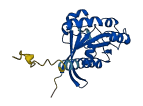
Descriptions
The autoinhibited protein was predicted that may have potential autoinhibitory elements via cis-regPred.
Autoinhibitory domains (AIDs)
Target domain |
|
Relief mechanism |
|
Assay |
cis-regPred |
Accessory elements
No accessory elements
Autoinhibited structure

Activated structure
3 structures for Q9R0M6
| Entry ID | Method | Resolution | Chain | Position | Source |
|---|---|---|---|---|---|
| 1YZL | X-ray | 185 A | A | 2-175 | PDB |
| 4QXA | X-ray | 230 A | A | 1-199 | PDB |
| AF-Q9R0M6-F1 | Predicted | AlphaFoldDB |
11 variants for Q9R0M6
| Variant ID(s) | Position | Change | Description | Diseaes Association | Provenance |
|---|---|---|---|---|---|
| rs3389582692 | 21 | S>N | No | EVA | |
| rs3412512591 | 37 | F>I* | No | EVA | |
| rs3409930145 | 39 | T>I | No | EVA | |
| rs3411823449 | 40 | I>L | No | EVA | |
| rs3412513623 | 49 | L>HGNKMSVHLQIFI* | No | EVA | |
| rs3389540485 | 72 | L>M | No | EVA | |
| rs3389550930 | 78 | R>W | No | EVA | |
| rs3389491381 | 114 | P>H | No | EVA | |
| rs3389582633 | 122 | L>W | No | EVA | |
| rs3389491313 | 180 | E>D | No | EVA | |
| rs3389578734 | 187 | T>A | No | EVA |
No associated diseases with Q9R0M6
1 regional properties for Q9R0M6
| Type | Name | Position | InterPro Accession |
|---|---|---|---|
| domain | Small GTP-binding protein domain | 8 - 167 | IPR005225 |
Functions
10 GO annotations of cellular component
| Name | Definition |
|---|---|
| cytoplasmic vesicle membrane | The lipid bilayer surrounding a cytoplasmic vesicle. |
| cytosol | The part of the cytoplasm that does not contain organelles but which does contain other particulate matter, such as protein complexes. |
| endoplasmic reticulum membrane | The lipid bilayer surrounding the endoplasmic reticulum. |
| Golgi membrane | The lipid bilayer surrounding any of the compartments of the Golgi apparatus. |
| late endosome | A prelysosomal endocytic organelle differentiated from early endosomes by lower lumenal pH and different protein composition. Late endosomes are more spherical than early endosomes and are mostly juxtanuclear, being concentrated near the microtubule organizing center. |
| lysosome | A small lytic vacuole that has cell cycle-independent morphology found in most animal cells and that contains a variety of hydrolases, most of which have their maximal activities in the pH range 5-6. The contained enzymes display latency if properly isolated. About 40 different lysosomal hydrolases are known and lysosomes have a great variety of morphologies and functions. |
| melanosome | A tissue-specific, membrane-bounded cytoplasmic organelle within which melanin pigments are synthesized and stored. Melanosomes are synthesized in melanocyte cells. |
| phagocytic vesicle | A membrane-bounded intracellular vesicle that arises from the ingestion of particulate material by phagocytosis. |
| phagocytic vesicle membrane | The lipid bilayer surrounding a phagocytic vesicle. |
| plasma membrane | The membrane surrounding a cell that separates the cell from its external environment. It consists of a phospholipid bilayer and associated proteins. |
4 GO annotations of molecular function
| Name | Definition |
|---|---|
| GDP binding | Binding to GDP, guanosine 5'-diphosphate. |
| GTP binding | Binding to GTP, guanosine triphosphate. |
| GTPase activity | Catalysis of the reaction: GTP + H2O = GDP + H+ + phosphate. |
| identical protein binding | Binding to an identical protein or proteins. |
6 GO annotations of biological process
| Name | Definition |
|---|---|
| negative regulation by host of symbiont catalytic activity | Any process in which an organism stops, prevents, or reduces the frequency, rate or extent of symbiont enzyme activity. The symbiont is defined as the smaller of the organisms involved in a symbiotic interaction. |
| positive regulation of exocytosis | Any process that activates or increases the frequency, rate or extent of exocytosis. |
| protein transport | The directed movement of proteins into, out of or within a cell, or between cells, by means of some agent such as a transporter or pore. |
| Rab protein signal transduction | The series of molecular signals within the cell that are mediated by a member of the Rab family of proteins switching to a GTP-bound active state. |
| regulation of protein localization | Any process that modulates the frequency, rate or extent of any process in which a protein is transported to, or maintained in, a specific location. |
| retrograde transport, endosome to Golgi | The directed movement of membrane-bounded vesicles from endosomes back to the trans-Golgi network where they are recycled for further rounds of transport. |
7 homologous proteins in AiPD
| UniProt AC | Gene Name | Protein Name | Species | Evidence Code |
|---|---|---|---|---|
| P51149 | RAB7A | Ras-related protein Rab-7a | Homo sapiens (Human) | PR |
| Q9NP90 | RAB9B | Ras-related protein Rab-9B | Homo sapiens (Human) | PR |
| P51150 | Rab7a | Ras-related protein Rab-7a | Mus musculus (Mouse) | PR |
| P09527 | Rab7a | Ras-related protein Rab-7a | Rattus norvegicus (Rat) | PR |
| Q99P75 | Rab9a | Ras-related protein Rab-9A | Rattus norvegicus (Rat) | PR |
| Q9C820 | RABG3D | Ras-related protein RABG3d | Arabidopsis thaliana (Mouse-ear cress) | PR |
| Q9LW76 | RABG3C | Ras-related protein RABG3c | Arabidopsis thaliana (Mouse-ear cress) | PR |
| 10 | 20 | 30 | 40 | 50 | 60 |
| MAGKSSLFKI | ILLGDGGVGK | SSLMNRYVTN | KFDSQLFHTI | GVEFLNKDLE | VDGHFVTMQI |
| 70 | 80 | 90 | 100 | 110 | 120 |
| WDTAGQERFR | SLRTPFYRGS | DCCLLTFSVD | DSQSFQNLSN | WKKEFIYYAD | VKEPESFPFV |
| 130 | 140 | 150 | 160 | 170 | 180 |
| ILGNKTDIKE | RQVSTEEAQA | WCKDNGDYPY | FETSAKDSTN | VAAAFEEAVR | RILATEDRSE |
| 190 | 200 | ||||
| HLIQTDTVNL | HRKPKPNSSC | C |