P09527
Gene name |
Rab7a (Rab7) |
Protein name |
Ras-related protein Rab-7a |
Names |
Ras-related protein BRL-RAS, Ras-related protein p23 |
Species |
Rattus norvegicus (Rat) |
KEGG Pathway |
rno:29448 |
EC number |
3.6.5.2: Acting on GTP; involved in cellular and subcellular movement |
Protein Class |
|
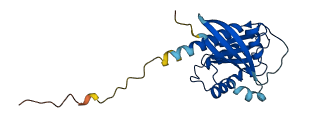
Descriptions
The autoinhibited protein was predicted that may have potential autoinhibitory elements via cis-regPred.
Autoinhibitory domains (AIDs)
Target domain |
|
Relief mechanism |
|
Assay |
cis-regPred |
Accessory elements
No accessory elements
Autoinhibited structure

Activated structure
5 structures for P09527
| Entry ID | Method | Resolution | Chain | Position | Source |
|---|---|---|---|---|---|
| 1VG0 | X-ray | 220 A | B | 1-207 | PDB |
| 1VG1 | X-ray | 190 A | A | 1-185 | PDB |
| 1VG8 | X-ray | 170 A | A/B/C/D | 1-207 | PDB |
| 1VG9 | X-ray | 250 A | B/D/F/H | 1-185 | PDB |
| AF-P09527-F1 | Predicted | AlphaFoldDB |
No variants for P09527
| Variant ID(s) | Position | Change | Description | Diseaes Association | Provenance |
|---|---|---|---|---|---|
| No variants for P09527 | |||||
No associated diseases with P09527
1 regional properties for P09527
| Type | Name | Position | InterPro Accession |
|---|---|---|---|
| domain | Small GTP-binding protein domain | 10 - 169 | IPR005225 |
Functions
| Description | ||
|---|---|---|
| EC Number | 3.6.5.2 | Acting on GTP; involved in cellular and subcellular movement |
| Subcellular Localization |
|
|
| PANTHER Family | ||
| PANTHER Subfamily | ||
| PANTHER Protein Class | ||
| PANTHER Pathway Category | No pathway information available | |
22 GO annotations of cellular component
| Name | Definition |
|---|---|
| alveolar lamellar body | A specialized secretory organelle found in type II pneumocytes and involved in the synthesis, secretion, and reutilization of pulmonary surfactant. |
| anchored component of synaptic vesicle membrane | The component of the synaptic vesicle membrane consisting of the gene products that are tethered to the membrane only by a covalently attached anchor, such as a lipid group that is embedded in the membrane. Gene products with peptide sequences that are embedded in the membrane are excluded from this grouping. |
| autophagosome membrane | The lipid bilayer surrounding an autophagosome, a double-membrane-bounded vesicle in which endogenous cellular material is sequestered. |
| cytoplasm | The contents of a cell excluding the plasma membrane and nucleus, but including other subcellular structures. |
| cytoplasmic vesicle | A vesicle found in the cytoplasm of a cell. |
| cytosol | The part of the cytoplasm that does not contain organelles but which does contain other particulate matter, such as protein complexes. |
| endosome | A vacuole to which materials ingested by endocytosis are delivered. |
| endosome membrane | The lipid bilayer surrounding an endosome. |
| extrinsic component of lysosome membrane | The component of an lysosome membrane consisting of gene products and protein complexes that are loosely bound to one of its surfaces, but not integrated into the hydrophobic region. |
| Golgi apparatus | A membrane-bound cytoplasmic organelle of the endomembrane system that further processes the core oligosaccharides (e.g. N-glycans) added to proteins in the endoplasmic reticulum and packages them into membrane-bound vesicles. The Golgi apparatus operates at the intersection of the secretory, lysosomal, and endocytic pathways. |
| late endosome | A prelysosomal endocytic organelle differentiated from early endosomes by lower lumenal pH and different protein composition. Late endosomes are more spherical than early endosomes and are mostly juxtanuclear, being concentrated near the microtubule organizing center. |
| late endosome membrane | The lipid bilayer surrounding a late endosome. |
| lipid droplet | An intracellular non-membrane-bounded organelle comprising a matrix of coalesced lipids surrounded by a phospholipid monolayer. May include associated proteins. |
| lysosome | A small lytic vacuole that has cell cycle-independent morphology found in most animal cells and that contains a variety of hydrolases, most of which have their maximal activities in the pH range 5-6. The contained enzymes display latency if properly isolated. About 40 different lysosomal hydrolases are known and lysosomes have a great variety of morphologies and functions. |
| melanosome membrane | The lipid bilayer surrounding a melanosome. |
| mitochondrial membrane | Either of the lipid bilayers that surround the mitochondrion and form the mitochondrial envelope. |
| mitochondrion | A semiautonomous, self replicating organelle that occurs in varying numbers, shapes, and sizes in the cytoplasm of virtually all eukaryotic cells. It is notably the site of tissue respiration. |
| phagocytic vesicle | A membrane-bounded intracellular vesicle that arises from the ingestion of particulate material by phagocytosis. |
| phagocytic vesicle membrane | The lipid bilayer surrounding a phagocytic vesicle. |
| phagophore assembly site membrane | A cellular membrane associated with the phagophore assembly site. |
| retromer complex | A conserved hetero-pentameric membrane-associated complex involved in retrograde transport from endosomes to the Golgi apparatus. The budding yeast retromer comprises Vps35p, Vps29p, Vps26p, Vps5p, and Vps17p. The mammalian complex shows slight variation in composition compared to yeast, and comprises SNX1 or SNX2, SNX5 or SNX6, VPS26A or VPS26B, VPS29, and VPS35. |
| terminal bouton | Terminal inflated portion of the axon, containing the specialized apparatus necessary to release neurotransmitters. The axon terminus is considered to be the whole region of thickening and the terminal bouton is a specialized region of it. |
6 GO annotations of molecular function
| Name | Definition |
|---|---|
| G protein activity | A molecular function regulator that cycles between active GTP-bound and inactive GDP-bound states. In its active state, binds to a variety of effector proteins to regulate cellular processes. Intrinsic GTPase activity returns the G protein to its GDP-bound state. The return to the GDP-bound state can be accelerated by the action of a GTPase-activating protein (GAP). |
| GDP binding | Binding to GDP, guanosine 5'-diphosphate. |
| GTP binding | Binding to GTP, guanosine triphosphate. |
| GTPase activity | Catalysis of the reaction: GTP + H2O = GDP + H+ + phosphate. |
| retromer complex binding | Binding to a retromer complex. |
| small GTPase binding | Binding to a small monomeric GTPase. |
21 GO annotations of biological process
| Name | Definition |
|---|---|
| autophagosome assembly | The formation of a double membrane-bounded structure, the autophagosome, that occurs when a specialized membrane sac, called the isolation membrane, starts to enclose a portion of the cytoplasm. |
| bone resorption | The process in which specialized cells known as osteoclasts degrade the organic and inorganic portions of bone, and endocytose and transport the degradation products. |
| early endosome to late endosome transport | The directed movement of substances, in membrane-bounded vesicles, from the early sorting endosomes to the late sorting endosomes; transport occurs along microtubules and can be experimentally blocked with microtubule-depolymerizing drugs. |
| endosome to lysosome transport | The directed movement of substances from endosomes to lysosomes. |
| endosome to plasma membrane protein transport | The directed movement of proteins from the endosome to the plasma membrane in transport vesicles. |
| epidermal growth factor catabolic process | The chemical reactions and pathways resulting in the breakdown of epidermal growth factor (EGF), following internalization of the receptor-bound ligand into the signal-receiving cell. Full breakdown of epidermal growth factor results in a ligand that is unable to bind and activate its receptor. |
| establishment of vesicle localization | The directed movement of a vesicle to a specific location. |
| intracellular transport | The directed movement of substances within a cell. |
| lipid catabolic process | The chemical reactions and pathways resulting in the breakdown of lipids, compounds soluble in an organic solvent but not, or sparingly, in an aqueous solvent. |
| lipophagy | The selective autophagy process in which lipid droplets are delivered to the vacuole and degraded in response to changing cellular conditions. |
| negative regulation of exosomal secretion | Any process that stops, prevents or reduces the frequency, rate or extent of exosomal secretion. |
| phagosome acidification | Any process that reduces the pH of the phagosome, measured by the concentration of the hydrogen ion. |
| phagosome-lysosome fusion | The creation of a phagolysosome from a phagosome and a lysosome. |
| positive regulation of exosomal secretion | Any process that activates or increases the frequency, rate or extent of exosomal secretion. |
| positive regulation of protein catabolic process | Any process that activates or increases the frequency, rate or extent of the chemical reactions and pathways resulting in the breakdown of a protein by the destruction of the native, active configuration, with or without the hydrolysis of peptide bonds. |
| positive regulation of viral process | Any process that activates or increases the frequency, rate or extent of a multi-organism process in which a virus is a participant. |
| protein targeting to lysosome | The process of directing proteins towards the lysosome using signals contained within the protein. |
| protein to membrane docking | The initial attachment of a protein to a target membrane, mediated by a proteins protruding from the target membrane. Docking requires only that the proteins come close enough to interact and adhere. |
| response to bacterium | Any process that results in a change in state or activity of a cell or an organism (in terms of movement, secretion, enzyme production, gene expression, etc.) as a result of a stimulus from a bacterium. |
| retrograde transport, endosome to Golgi | The directed movement of membrane-bounded vesicles from endosomes back to the trans-Golgi network where they are recycled for further rounds of transport. |
| viral release from host cell | The dissemination of mature viral particles from the host cell, e.g. by cell lysis or the budding of virus particles from the cell membrane. |
8 homologous proteins in AiPD
| UniProt AC | Gene Name | Protein Name | Species | Evidence Code |
|---|---|---|---|---|
| P18067 | RAB7A | Ras-related protein Rab-7a | Canis lupus familiaris (Dog) (Canis familiaris) | PR |
| Q9NP90 | RAB9B | Ras-related protein Rab-9B | Homo sapiens (Human) | PR |
| P51149 | RAB7A | Ras-related protein Rab-7a | Homo sapiens (Human) | PR |
| Q9R0M6 | Rab9a | Ras-related protein Rab-9A | Mus musculus (Mouse) | PR |
| P51150 | Rab7a | Ras-related protein Rab-7a | Mus musculus (Mouse) | PR |
| Q99P75 | Rab9a | Ras-related protein Rab-9A | Rattus norvegicus (Rat) | PR |
| Q9C820 | RABG3D | Ras-related protein RABG3d | Arabidopsis thaliana (Mouse-ear cress) | PR |
| Q9LW76 | RABG3C | Ras-related protein RABG3c | Arabidopsis thaliana (Mouse-ear cress) | PR |
| 10 | 20 | 30 | 40 | 50 | 60 |
| MTSRKKVLLK | VIILGDSGVG | KTSLMNQYVN | KKFSNQYKAT | IGADFLTKEV | MVDDRLVTMQ |
| 70 | 80 | 90 | 100 | 110 | 120 |
| IWDTAGQERF | QSLGVAFYRG | ADCCVLVFDV | TAPNTFKTLD | SWRDEFLIQA | SPRDPENFPF |
| 130 | 140 | 150 | 160 | 170 | 180 |
| VVLGNKIDLE | NRQVATKRAQ | AWCYSKNNIP | YFETSAKEAI | NVEQAFQTIA | RNALKQETEV |
| 190 | 200 | ||||
| ELYNEFPEPI | KLDKNERAKA | SAESCSC |