P48193
Gene name |
Epb41 |
Protein name |
Protein 4.1 |
Names |
P4.1, 4.1R, Band 4.1, Erythrocyte membrane protein band 4.1 |
Species |
Mus musculus (Mouse) |
KEGG Pathway |
mmu:269587 |
EC number |
|
Protein Class |
|
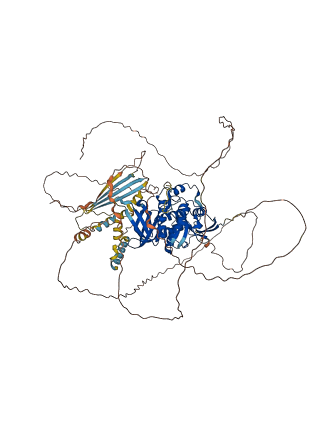
Descriptions
The autoinhibited protein was predicted that may have potential autoinhibitory elements via cis-regPred.
Autoinhibitory domains (AIDs)
Target domain |
|
Relief mechanism |
|
Assay |
cis-regPred |
Accessory elements
No accessory elements
Autoinhibited structure

Activated structure
1 structures for P48193
| Entry ID | Method | Resolution | Chain | Position | Source |
|---|---|---|---|---|---|
| AF-P48193-F1 | Predicted | AlphaFoldDB |
20 variants for P48193
| Variant ID(s) | Position | Change | Description | Diseaes Association | Provenance |
|---|---|---|---|---|---|
| rs218834639 | 8 | A>V | No | EVA | |
| rs232609547 | 42 | A>V | No | EVA | |
| rs214983641 | 57 | A>V | No | EVA | |
| rs3388716290 | 165 | R>I | No | EVA | |
| rs214551137 | 205 | V>I | No | EVA | |
| rs3388717349 | 208 | H>R | No | EVA | |
| rs3388721134 | 234 | Q>K | No | EVA | |
| rs3394998298 | 285 | F>L | No | EVA | |
| rs257980300 | 348 | M>V | No | EVA | |
| rs3394927921 | 396 | M>I | No | EVA | |
| rs3394935582 | 397 | Y>H | No | EVA | |
| rs3388713743 | 404 | A>V | No | EVA | |
| rs3388721099 | 537 | S>C | No | EVA | |
| rs387877146 | 574 | P>L | No | EVA | |
| rs27555399 | 596 | P>L | No | EVA | |
| rs3388718450 | 613 | T>I | No | EVA | |
| rs3388716259 | 683 | K>R | No | EVA | |
| rs3388717352 | 726 | V>I | No | EVA | |
| rs3388694342 | 727 | K>M | No | EVA | |
| rs3388716985 | 759 | I>S | No | EVA |
No associated diseases with P48193
11 regional properties for P48193
| Type | Name | Position | InterPro Accession |
|---|---|---|---|
| domain | FERM domain | 211 - 492 | IPR000299 |
| domain | SAB domain | 661 - 709 | IPR007477 |
| domain | Band 4.1, C-terminal | 747 - 854 | IPR008379 |
| domain | FERM adjacent | 499 - 545 | IPR014847 |
| domain | FERM, N-terminal | 215 - 277 | IPR018979 |
| domain | FERM, C-terminal PH-like domain | 406 - 496 | IPR018980 |
| conserved_site | FERM conserved site | 265 - 293 | IPR019747-1 |
| conserved_site | FERM conserved site | 372 - 401 | IPR019747-2 |
| domain | FERM central domain | 295 - 402 | IPR019748 |
| domain | Band 4.1 domain | 207 - 402 | IPR019749 |
| domain | Band 4.1 protein, FERM domain, F1 sub-domain | 211 - 293 | IPR021187 |
16 GO annotations of cellular component
| Name | Definition |
|---|---|
| actin cytoskeleton | The part of the cytoskeleton (the internal framework of a cell) composed of actin and associated proteins. Includes actin cytoskeleton-associated complexes. |
| basolateral plasma membrane | The region of the plasma membrane that includes the basal end and sides of the cell. Often used in reference to animal polarized epithelial membranes, where the basal membrane is the part attached to the extracellular matrix, or in plant cells, where the basal membrane is defined with respect to the zygotic axis. |
| cell cortex | The region of a cell that lies just beneath the plasma membrane and often, but not always, contains a network of actin filaments and associated proteins. |
| cell junction | A cellular component that forms a specialized region of connection between two or more cells, or between a cell and the extracellular matrix, or between two membrane-bound components of a cell, such as flagella. |
| cortical cytoskeleton | The portion of the cytoskeleton that lies just beneath the plasma membrane. |
| cytoplasm | The contents of a cell excluding the plasma membrane and nucleus, but including other subcellular structures. |
| cytoplasmic side of plasma membrane | The leaflet the plasma membrane that faces the cytoplasm and any proteins embedded or anchored in it or attached to its surface. |
| cytoskeleton | A cellular structure that forms the internal framework of eukaryotic and prokaryotic cells. The cytoskeleton includes intermediate filaments, microfilaments, microtubules, the microtrabecular lattice, and other structures characterized by a polymeric filamentous nature and long-range order within the cell. The various elements of the cytoskeleton not only serve in the maintenance of cellular shape but also have roles in other cellular functions, including cellular movement, cell division, endocytosis, and movement of organelles. |
| cytosol | The part of the cytoplasm that does not contain organelles but which does contain other particulate matter, such as protein complexes. |
| intercellular bridge | A direct connection between the cytoplasm of two cells that is formed following the completion of cleavage furrow ingression during cell division. They are usually present only briefly prior to completion of cytokinesis. However, in some cases, such as the bridges between germ cells during their development, they become stabilised. |
| membrane | A lipid bilayer along with all the proteins and protein complexes embedded in it an attached to it. |
| mitotic spindle | A spindle that forms as part of mitosis. Mitotic and meiotic spindles contain distinctive complements of proteins associated with microtubules. |
| nuclear body | Extra-nucleolar nuclear domains usually visualized by confocal microscopy and fluorescent antibodies to specific proteins. |
| plasma membrane | The membrane surrounding a cell that separates the cell from its external environment. It consists of a phospholipid bilayer and associated proteins. |
| postsynaptic density | An electron dense network of proteins within and adjacent to the postsynaptic membrane of an asymmetric, neuron-neuron synapse. Its major components include neurotransmitter receptors and the proteins that spatially and functionally organize them such as anchoring and scaffolding molecules, signaling enzymes and cytoskeletal components. |
| protein-containing complex | A stable assembly of two or more macromolecules, i.e. proteins, nucleic acids, carbohydrates or lipids, in which at least one component is a protein and the constituent parts function together. |
8 GO annotations of molecular function
| Name | Definition |
|---|---|
| 1-phosphatidylinositol binding | Binding to a phosphatidylinositol, a glycophospholipid with its sn-glycerol 3-phosphate residue is esterified to the 1-hydroxyl group of 1D-myo-inositol. |
| actin binding | Binding to monomeric or multimeric forms of actin, including actin filaments. |
| calmodulin binding | Binding to calmodulin, a calcium-binding protein with many roles, both in the calcium-bound and calcium-free states. |
| phosphoprotein binding | Binding to a phosphorylated protein. |
| protein C-terminus binding | Binding to a protein C-terminus, the end of a peptide chain at which the 1-carboxyl function of a constituent amino acid is not attached in peptide linkage to another amino-acid residue. |
| protein N-terminus binding | Binding to a protein N-terminus, the end of any peptide chain at which the 2-amino (or 2-imino) function of a constituent amino acid is not attached in peptide linkage to another amino-acid residue. |
| spectrin binding | Binding to spectrin, a protein that is the major constituent of the erythrocyte cytoskeletal network. It associates with band 4.1 (see band protein) and actin to form the cytoskeletal superstructure of the erythrocyte plasma membrane. It is composed of nonhomologous chains, alpha and beta, which aggregate side-to-side in an antiparallel fashion to form dimers, tetramers, and higher polymers. |
| structural molecule activity | The action of a molecule that contributes to the structural integrity of a complex or its assembly within or outside a cell. |
11 GO annotations of biological process
| Name | Definition |
|---|---|
| actin cytoskeleton organization | A process that is carried out at the cellular level which results in the assembly, arrangement of constituent parts, or disassembly of cytoskeletal structures comprising actin filaments and their associated proteins. |
| actomyosin structure organization | A process that is carried out at the cellular level which results in the assembly, arrangement of constituent parts, or disassembly of cytoskeletal structures containing both actin and myosin or paramyosin. The myosin may be organized into filaments. |
| cell cycle | The progression of biochemical and morphological phases and events that occur in a cell during successive cell replication or nuclear replication events. Canonically, the cell cycle comprises the replication and segregation of genetic material followed by the division of the cell, but in endocycles or syncytial cells nuclear replication or nuclear division may not be followed by cell division. |
| cell division | The process resulting in division and partitioning of components of a cell to form more cells; may or may not be accompanied by the physical separation of a cell into distinct, individually membrane-bounded daughter cells. |
| cortical actin cytoskeleton organization | A process that is carried out at the cellular level which results in the assembly, arrangement of constituent parts, or disassembly of actin-based cytoskeletal structures in the cell cortex, i.e. just beneath the plasma membrane. |
| positive regulation of protein binding | Any process that activates or increases the frequency, rate or extent of protein binding. |
| positive regulation of protein localization to cell cortex | Any process that activates or increases the frequency, rate or extent of protein localization to cell cortex. |
| protein-containing complex assembly | The aggregation, arrangement and bonding together of a set of macromolecules to form a protein-containing complex. |
| regulation of calcium ion transport | Any process that modulates the frequency, rate or extent of the directed movement of calcium ions into, out of or within a cell, or between cells, by means of some agent such as a transporter or pore. |
| regulation of cell shape | Any process that modulates the surface configuration of a cell. |
| regulation of intestinal absorption | Any process that modulates the frequency, rate or extent of intestinal absorption. |
13 homologous proteins in AiPD
| UniProt AC | Gene Name | Protein Name | Species | Evidence Code |
|---|---|---|---|---|
| Q9N179 | EPB41 | Protein 4.1 | Bos taurus (Bovine) | PR |
| Q9H4G0 | EPB41L1 | Band 4.1-like protein 1 | Homo sapiens (Human) | PR |
| O43491 | EPB41L2 | Band 4.1-like protein 2 | Homo sapiens (Human) | PR |
| Q9Y2J2 | EPB41L3 | Band 4.1-like protein 3 | Homo sapiens (Human) | PR |
| P11171 | EPB41 | Protein 4.1 | Homo sapiens (Human) | PR |
| Q8BGS1 | Epb41l5 | Band 4.1-like protein 5 | Mus musculus (Mouse) | PR |
| P52963 | Epb41l4a | Band 4.1-like protein 4A | Mus musculus (Mouse) | PR |
| Q6P5H6 | Frmd5 | FERM domain-containing protein 5 | Mus musculus (Mouse) | PR |
| Q8BHD4 | Frmd3 | FERM domain-containing protein 3 | Mus musculus (Mouse) | PR |
| O70318 | Epb41l2 | Band 4.1-like protein 2 | Mus musculus (Mouse) | PR |
| Q9Z2H5 | Epb41l1 | Band 4.1-like protein 1 | Mus musculus (Mouse) | PR |
| Q9WV92 | Epb41l3 | Band 4.1-like protein 3 | Mus musculus (Mouse) | PR |
| Q9WTP0 | Epb41l1 | Band 4.1-like protein 1 | Rattus norvegicus (Rat) | PR |
| 10 | 20 | 30 | 40 | 50 | 60 |
| MTTEKSLAAE | AENSQHQQQK | EEGEGATNSG | QQETQLEEAS | QAAAAEGSDQ | GEQKLKASNG |
| 70 | 80 | 90 | 100 | 110 | 120 |
| DTPTHEDLTK | NKERTSESRG | LSRLLSSFLK | RPKSQVSEEE | GREVESEKEK | GEGGQKEIEL |
| 130 | 140 | 150 | 160 | 170 | 180 |
| GNSLDEDIIL | KAPIAAPEPE | LKTDPSLDLH | SLSSIETQPA | QEEHREDPDS | ETKEGEGIEE |
| 190 | 200 | 210 | 220 | 230 | 240 |
| CSGTEVKEDP | ESRAEREPEA | SQKPVRRHRN | MHCKVSLLDD | TVYECVVEKH | AKGQDLLKRV |
| 250 | 260 | 270 | 280 | 290 | 300 |
| CEHLNLLEED | YFGLALWDSA | TSKTWLDSAK | EIKKQVRGVP | WNFTFNVKFY | PPDPAQLTED |
| 310 | 320 | 330 | 340 | 350 | 360 |
| ITRYYLCLQL | RQDIVAGRLP | CSFATLALLG | SYTIQSELGD | YDPELHGMDY | VSDFKLAPNQ |
| 370 | 380 | 390 | 400 | 410 | 420 |
| TKELEEKVME | LHKSYRSMTP | AQADLEFLEN | AKKLSMYGVD | LHKAKDLEGV | DIILGVCSSG |
| 430 | 440 | 450 | 460 | 470 | 480 |
| LLVYKDKLRI | NRFPWPKVLK | ISYKRSSFFI | KIRPGEQEHY | ESTIGFKLPS | YRAAKKLWKV |
| 490 | 500 | 510 | 520 | 530 | 540 |
| CVEHHTFFRL | TSTDTIPKSK | FLALGSKFRY | SGRTQAQTRQ | ASALIDRPAP | HFERTASKRA |
| 550 | 560 | 570 | 580 | 590 | 600 |
| SRSLDGAAAA | ESTDRSPRPT | SAPAIAQSQV | TEGPGAPIKK | TPKEAVKVEE | KRGEEPAEPA |
| 610 | 620 | 630 | 640 | 650 | 660 |
| EPEPTEAWKV | EKTHTEVTVP | TSNGDQTQKL | AGKGEDLIRM | RKKKRERLDG | ENIYIRHSNL |
| 670 | 680 | 690 | 700 | 710 | 720 |
| MLEDLDKSQE | EIKKHHASIS | ELKKNFMESV | PEPRPSEWDK | RLSTHSPFRT | LNINGQVPTG |
| 730 | 740 | 750 | 760 | 770 | 780 |
| DGPPLVKTQT | VTISDTANAV | KSEIPTKDVP | IVHTETKTIT | YEAAQTEDSN | GDLDPGVLLT |
| 790 | 800 | 810 | 820 | 830 | 840 |
| AQTITSETTS | STTTTQITKT | VKGGISETRI | EKRIVITGDA | DIDHDQVLVQ | AIKEAKEQHP |
| 850 | |||||
| DMSVTKVVVH | QETEISEE |