P46421
Gene name |
GSTU5 (GSTU1, At2g29450, F16P2.17) |
Protein name |
Glutathione S-transferase U5 |
Names |
AtGSTU5, AtGSTU1, GST class-tau member 5, Glutathione S-transferase 103-1A |
Species |
Arabidopsis thaliana (Mouse-ear cress) |
KEGG Pathway |
ath:AT2G29450 |
EC number |
2.5.1.18: Transferring alkyl or aryl groups, other than methyl groups |
Protein Class |
|
Descriptions
The autoinhibited protein was predicted that may have potential autoinhibitory elements via cis-regPred.
Autoinhibitory domains (AIDs)
Target domain |
|
Relief mechanism |
|
Assay |
cis-regPred |
Accessory elements
No accessory elements
Autoinhibited structure

Activated structure
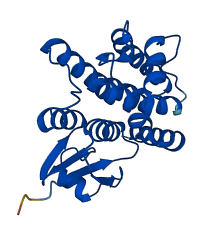
1 structures for P46421
| Entry ID | Method | Resolution | Chain | Position | Source |
|---|---|---|---|---|---|
| AF-P46421-F1 | Predicted | AlphaFoldDB |
19 variants for P46421
| Variant ID(s) | Position | Change | Description | Diseaes Association | Provenance |
|---|---|---|---|---|---|
| tmp_2_12625563_C_A | 2 | A>S | No | 1000Genomes | |
| tmp_2_12625529_C_G | 13 | W>S | No | 1000Genomes | |
| ENSVATH05624226 | 44 | P>H | No | 1000Genomes | |
| ENSVATH05624225 | 82 | Q>H | No | 1000Genomes | |
| tmp_2_12625322_T_C | 82 | Q>R | No | 1000Genomes | |
| ENSVATH01923772 | 91 | Y>H | No | 1000Genomes | |
| ENSVATH01923771 | 96 | A>T | No | 1000Genomes | |
| tmp_2_12625112_T_G | 113 | I>L | No | 1000Genomes | |
| ENSVATH01923764 | 123 | R>K | No | 1000Genomes | |
| ENSVATH00253674 | 130 | V>A | No | 1000Genomes | |
| ENSVATH00253674 | 130 | V>E | No | 1000Genomes | |
| ENSVATH05624215 | 142 | V>I | No | 1000Genomes | |
| tmp_2_12624974_C_T | 159 | A>T | No | 1000Genomes | |
| tmp_2_12624933_T_G | 172 | E>D | No | 1000Genomes | |
| ENSVATH05624212 | 177 | E>D | No | 1000Genomes | |
| ENSVATH05624208 | 192 | R>K | No | 1000Genomes | |
| ENSVATH13467865 | 201 | K>N | No | 1000Genomes | |
| ENSVATH14569254 | 206 | P>Q | No | 1000Genomes | |
| tmp_2_12624790_C_G | 220 | R>T | No | 1000Genomes |
No associated diseases with P46421
4 regional properties for P46421
| Type | Name | Position | InterPro Accession |
|---|---|---|---|
| domain | Glutathione S-transferase, N-terminal | 5 - 84 | IPR004045 |
| domain | Glutathione S-transferase, C-terminal | 107 - 194 | IPR004046 |
| domain | Glutathione S-transferase, C-terminal-like | 89 - 217 | IPR010987 |
| domain | Glutathione S-transferases Tau, C-terminal alpha helical domain, plant | 90 - 217 | IPR045074 |
Functions
| Description | ||
|---|---|---|
| EC Number | 2.5.1.18 | Transferring alkyl or aryl groups, other than methyl groups |
| Subcellular Localization |
|
|
| PANTHER Family | ||
| PANTHER Subfamily | ||
| PANTHER Protein Class | ||
| PANTHER Pathway Category | No pathway information available | |
5 GO annotations of cellular component
| Name | Definition |
|---|---|
| cytoplasm | The contents of a cell excluding the plasma membrane and nucleus, but including other subcellular structures. |
| cytosol | The part of the cytoplasm that does not contain organelles but which does contain other particulate matter, such as protein complexes. |
| peroxisome | A small organelle enclosed by a single membrane, and found in most eukaryotic cells. Contains peroxidases and other enzymes involved in a variety of metabolic processes including free radical detoxification, lipid catabolism and biosynthesis, and hydrogen peroxide metabolism. |
| plasma membrane | The membrane surrounding a cell that separates the cell from its external environment. It consists of a phospholipid bilayer and associated proteins. |
| plasmodesma | A fine cytoplasmic channel, found in all higher plants, that connects the cytoplasm of one cell to that of an adjacent cell. |
2 GO annotations of molecular function
| Name | Definition |
|---|---|
| glutathione binding | Binding to glutathione; a tripeptide composed of the three amino acids cysteine, glutamic acid and glycine. |
| glutathione transferase activity | Catalysis of the reaction: R-X + glutathione = H-X + R-S-glutathione. R may be an aliphatic, aromatic or heterocyclic group; X may be a sulfate, nitrile or halide group. |
3 GO annotations of biological process
| Name | Definition |
|---|---|
| glutathione metabolic process | The chemical reactions and pathways involving glutathione, the tripeptide glutamylcysteinylglycine, which acts as a coenzyme for some enzymes and as an antioxidant in the protection of sulfhydryl groups in enzymes and other proteins; it has a specific role in the reduction of hydrogen peroxide (H2O2) and oxidized ascorbate, and it participates in the gamma-glutamyl cycle. |
| response to oxidative stress | Any process that results in a change in state or activity of a cell or an organism (in terms of movement, secretion, enzyme production, gene expression, etc.) as a result of oxidative stress, a state often resulting from exposure to high levels of reactive oxygen species, e.g. superoxide anions, hydrogen peroxide (H2O2), and hydroxyl radicals. |
| toxin catabolic process | The chemical reactions and pathways resulting in the breakdown of toxin, a poisonous compound (typically a protein) that is produced by cells or organisms and that can cause disease when introduced into the body or tissues of an organism. |
7 homologous proteins in AiPD
| UniProt AC | Gene Name | Protein Name | Species | Evidence Code |
|---|---|---|---|---|
| P78417 | GSTO1 | Glutathione S-transferase omega-1 | Homo sapiens (Human) | PR |
| O09131 | Gsto1 | Glutathione S-transferase omega-1 | Mus musculus (Mouse) | PR |
| Q9WVL0 | Gstz1 | Maleylacetoacetate isomerase | Mus musculus (Mouse) | PR |
| Q9N1F5 | GSTO1 | Glutathione S-transferase omega-1 | Sus scrofa (Pig) | PR |
| Q9Z339 | Gsto1 | Glutathione S-transferase omega-1 | Rattus norvegicus (Rat) | PR |
| Q9FUS9 | GSTU18 | Glutathione S-transferase U18 | Arabidopsis thaliana (Mouse-ear cress) | PR |
| Q9ZW30 | GSTU1 | Glutathione S-transferase U1 | Arabidopsis thaliana (Mouse-ear cress) | PR |
| 10 | 20 | 30 | 40 | 50 | 60 |
| MAEKEEVKLL | GIWASPFSRR | VEMALKLKGI | PYEYVEEILE | NKSPLLLALN | PIHKKVPVLV |
| 70 | 80 | 90 | 100 | 110 | 120 |
| HNGKTILESH | VILEYIDETW | PQNPILPQDP | YERSKARFFA | KLVDEQIMNV | GFISMARADE |
| 130 | 140 | 150 | 160 | 170 | 180 |
| KGREVLAEQV | RELIMYLEKE | LVGKDYFGGK | TVGFLDFVAG | SLIPFCLERG | WEGIGLEVIT |
| 190 | 200 | 210 | 220 | ||
| EEKFPEFKRW | VRNLEKVEIV | KDCVPPREEH | VEHMNYMAER | VRSS |