O09131
Gene name |
Gsto1 (Gstx, Gtsttl) |
Protein name |
Glutathione S-transferase omega-1 |
Names |
GSTO-1, Glutathione S-transferase omega 1-1, GSTO 1-1, Glutathione-dependent dehydroascorbate reductase, Monomethylarsonic acid reductase, MMA(V) reductase, S-(Phenacyl)glutathione reductase, SPG-R, p28 |
Species |
Mus musculus (Mouse) |
KEGG Pathway |
mmu:14873 |
EC number |
1.8.5.1: With a quinone or similar compound as acceptor |
Protein Class |
|
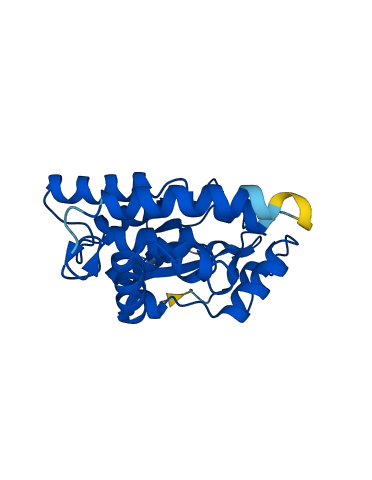
Descriptions
The autoinhibited protein was predicted that may have potential autoinhibitory elements via cis-regPred.
Autoinhibitory domains (AIDs)
Target domain |
|
Relief mechanism |
|
Assay |
cis-regPred |
Accessory elements
No accessory elements
Autoinhibited structure

Activated structure
1 structures for O09131
| Entry ID | Method | Resolution | Chain | Position | Source |
|---|---|---|---|---|---|
| AF-O09131-F1 | Predicted | AlphaFoldDB |
18 variants for O09131
| Variant ID(s) | Position | Change | Description | Diseaes Association | Provenance |
|---|---|---|---|---|---|
| rs3389547733 | 27 | Y>N | No | EVA | |
| rs3389549428 | 49 | H>Q | No | EVA | |
| rs3389557271 | 78 | S>R | No | EVA | |
| rs3389541174 | 90 | C>Y | No | EVA | |
| rs3389539301 | 101 | K>N | No | EVA | |
| rs3389549395 | 118 | E>G | No | EVA | |
| rs3389555928 | 136 | K>N | No | EVA | |
| rs8257574 | 140 | P>L | No | EVA | |
| rs37539749 | 141 | N>D | No | EVA | |
| rs8257575 | 143 | R>K | No | EVA | |
| rs252932606 | 148 | N>K | No | EVA | |
| rs221779206 | 150 | F>L | No | EVA | |
| rs8257609 | 204 | A>T | No | EVA | |
| rs3389512396 | 216 | I>F | No | EVA | |
| rs8257610 | 224 | Y>F | No | EVA | |
| rs3389512411 | 230 | Q>H | No | EVA | |
| rs259585888 | 238 | Y>C | No | EVA | |
| rs3389544808 | 240 | L>F | No | EVA |
No associated diseases with O09131
Functions
| Description | ||
|---|---|---|
| EC Number | 1.8.5.1 | With a quinone or similar compound as acceptor |
| Subcellular Localization |
|
|
| PANTHER Family | ||
| PANTHER Subfamily | ||
| PANTHER Protein Class | ||
| PANTHER Pathway Category | No pathway information available | |
7 GO annotations of cellular component
| Name | Definition |
|---|---|
| axon | The long process of a neuron that conducts nerve impulses, usually away from the cell body to the terminals and varicosities, which are sites of storage and release of neurotransmitter. |
| basement membrane | A collagen-containing extracellular matrix consisting of a thin layer of dense material found in various animal tissues interposed between the cells and the adjacent connective tissue. It consists of the basal lamina plus an associated layer of reticulin fibers. |
| cell body | The portion of a cell bearing surface projections such as axons, dendrites, cilia, or flagella that includes the nucleus, but excludes all cell projections. |
| cytoplasm | The contents of a cell excluding the plasma membrane and nucleus, but including other subcellular structures. |
| cytosol | The part of the cytoplasm that does not contain organelles but which does contain other particulate matter, such as protein complexes. |
| myelin sheath | An electrically insulating fatty layer that surrounds the axons of many neurons. It is an outgrowth of glial cells: Schwann cells supply the myelin for peripheral neurons while oligodendrocytes supply it to those of the central nervous system. |
| nuclear membrane | Either of the lipid bilayers that surround the nucleus and form the nuclear envelope; excludes the intermembrane space. |
4 GO annotations of molecular function
| Name | Definition |
|---|---|
| glutathione dehydrogenase (ascorbate) activity | Catalysis of the reaction: dehydroascorbate + 2 glutathione = L-ascorbate + glutathione disulfide. |
| glutathione transferase activity | Catalysis of the reaction: R-X + glutathione = H-X + R-S-glutathione. R may be an aliphatic, aromatic or heterocyclic group; X may be a sulfate, nitrile or halide group. |
| methylarsonate reductase activity | Catalysis of the reaction: 2 glutathione + H(+) + methylarsonate = glutathione disulfide + H(2)O + methylarsonous acid. |
| oxidoreductase activity | Catalysis of an oxidation-reduction (redox) reaction, a reversible chemical reaction in which the oxidation state of an atom or atoms within a molecule is altered. One substrate acts as a hydrogen or electron donor and becomes oxidized, while the other acts as hydrogen or electron acceptor and becomes reduced. |
8 GO annotations of biological process
| Name | Definition |
|---|---|
| cellular response to arsenic-containing substance | Any process that results in a change in state or activity of a cell (in terms of movement, secretion, enzyme production, gene expression, etc.) as a result of an arsenic stimulus from compounds containing arsenic, including arsenates, arsenites, and arsenides. |
| glutathione metabolic process | The chemical reactions and pathways involving glutathione, the tripeptide glutamylcysteinylglycine, which acts as a coenzyme for some enzymes and as an antioxidant in the protection of sulfhydryl groups in enzymes and other proteins; it has a specific role in the reduction of hydrogen peroxide (H2O2) and oxidized ascorbate, and it participates in the gamma-glutamyl cycle. |
| L-ascorbic acid biosynthetic process | The chemical reactions and pathways resulting in the formation of L-ascorbic acid; L-ascorbic acid ionizes to give L-ascorbate, (2R)-2-[(1S)-1,2-dihydroxyethyl]-4-hydroxy-5-oxo-2,5-dihydrofuran-3-olate, which is required as a cofactor in the oxidation of prolyl residues to hydroxyprolyl, and other reactions. |
| L-ascorbic acid metabolic process | The chemical reactions and pathways involving L-ascorbic acid, (2R)-2-[(1S)-1,2-dihydroxyethyl]-4-hydroxy-5-oxo-2,5-dihydrofuran-3-olate; L-ascorbic acid is vitamin C and has co-factor and anti-oxidant activities in many species. |
| negative regulation of ryanodine-sensitive calcium-release channel activity | Any process that decreases the activity of a ryanodine-sensitive calcium-release channel. The ryanodine-sensitive calcium-release channel catalyzes the transmembrane transfer of a calcium ion by a channel that opens when a ryanodine class ligand has been bound by the channel complex or one of its constituent parts. |
| positive regulation of ryanodine-sensitive calcium-release channel activity | Any process that increases the activity of a ryanodine-sensitive calcium-release channel. The ryanodine-sensitive calcium-release channel catalyzes the transmembrane transfer of a calcium ion by a channel that opens when a ryanodine class ligand has been bound by the channel complex or one of its constituent parts. |
| regulation of release of sequestered calcium ion into cytosol by sarcoplasmic reticulum | Any process that modulates the rate, frequency or extent of release of sequestered calcium ion into cytosol by the sarcoplasmic reticulum, the process in which the release of sequestered calcium ion by sarcoplasmic reticulum into cytosol occurs via calcium release channels. |
| xenobiotic catabolic process | The chemical reactions and pathways resulting in the breakdown of a xenobiotic compound, a compound foreign to the organim exposed to it. It may be synthesized by another organism (like ampicilin) or it can be a synthetic chemical. |
6 homologous proteins in AiPD
| UniProt AC | Gene Name | Protein Name | Species | Evidence Code |
|---|---|---|---|---|
| P78417 | GSTO1 | Glutathione S-transferase omega-1 | Homo sapiens (Human) | PR |
| Q9N1F5 | GSTO1 | Glutathione S-transferase omega-1 | Sus scrofa (Pig) | PR |
| Q9Z339 | Gsto1 | Glutathione S-transferase omega-1 | Rattus norvegicus (Rat) | PR |
| P46421 | GSTU5 | Glutathione S-transferase U5 | Arabidopsis thaliana (Mouse-ear cress) | PR |
| Q9FUS9 | GSTU18 | Glutathione S-transferase U18 | Arabidopsis thaliana (Mouse-ear cress) | PR |
| Q9ZW30 | GSTU1 | Glutathione S-transferase U1 | Arabidopsis thaliana (Mouse-ear cress) | PR |
| 10 | 20 | 30 | 40 | 50 | 60 |
| MSGESSRSLG | KGSAPPGPVP | EGQIRVYSMR | FCPFAQRTLM | VLKAKGIRHE | VININLKNKP |
| 70 | 80 | 90 | 100 | 110 | 120 |
| EWFFEKNPLG | LVPVLENSQG | HLVTESVITC | EYLDEAYPEK | KLFPDDPYKK | ARQKMTLESF |
| 130 | 140 | 150 | 160 | 170 | 180 |
| SKVPPLIASF | VRSKRKEDSP | NLREALENEF | KKLEEGMDNY | KSFLGGDSPS | MVDYLTWPWF |
| 190 | 200 | 210 | 220 | 230 | |
| QRLEALELKE | CLAHTPKLKL | WMAAMQQDPV | ASSHKIDAKT | YREYLNLYLQ | DSPEACDYGL |