Q9N1F5
Gene name |
GSTO1 |
Protein name |
Glutathione S-transferase omega-1 |
Names |
GSTO-1, Glutathione S-transferase omega 1-1, GSTO 1-1, Glutathione-dependent dehydroascorbate reductase, Monomethylarsonic acid reductase, MMA(V) reductase, S-(Phenacyl)glutathione reductase, SPG-R |
Species |
Sus scrofa (Pig) |
KEGG Pathway |
ssc:397117 |
EC number |
1.8.5.1: With a quinone or similar compound as acceptor |
Protein Class |
|
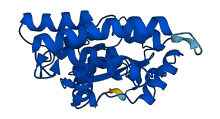
Descriptions
The autoinhibited protein was predicted that may have potential autoinhibitory elements via cis-regPred.
Autoinhibitory domains (AIDs)
Target domain |
|
Relief mechanism |
|
Assay |
cis-regPred |
Accessory elements
No accessory elements
Autoinhibited structure

Activated structure
1 structures for Q9N1F5
| Entry ID | Method | Resolution | Chain | Position | Source |
|---|---|---|---|---|---|
| AF-Q9N1F5-F1 | Predicted | AlphaFoldDB |
6 variants for Q9N1F5
| Variant ID(s) | Position | Change | Description | Diseaes Association | Provenance |
|---|---|---|---|---|---|
| rs702606246 | 4 | G>E | No | EVA | |
| rs337312060 | 120 | S>F | No | EVA | |
| rs331662197 | 141 | G>S | No | EVA | |
| rs80944846 | 165 | F>L | No | EVA | |
| rs710127605 | 228 | L>I | No | EVA | |
| rs694197151 | 233 | S>I | No | EVA |
No associated diseases with Q9N1F5
Functions
| Description | ||
|---|---|---|
| EC Number | 1.8.5.1 | With a quinone or similar compound as acceptor |
| Subcellular Localization |
|
|
| PANTHER Family | ||
| PANTHER Subfamily | ||
| PANTHER Protein Class | ||
| PANTHER Pathway Category | No pathway information available | |
2 GO annotations of cellular component
4 GO annotations of molecular function
| Name | Definition |
|---|---|
| glutathione dehydrogenase (ascorbate) activity | Catalysis of the reaction: dehydroascorbate + 2 glutathione = L-ascorbate + glutathione disulfide. |
| glutathione transferase activity | Catalysis of the reaction: R-X + glutathione = H-X + R-S-glutathione. R may be an aliphatic, aromatic or heterocyclic group; X may be a sulfate, nitrile or halide group. |
| methylarsonate reductase activity | Catalysis of the reaction: 2 glutathione + H(+) + methylarsonate = glutathione disulfide + H(2)O + methylarsonous acid. |
| oxidoreductase activity | Catalysis of an oxidation-reduction (redox) reaction, a reversible chemical reaction in which the oxidation state of an atom or atoms within a molecule is altered. One substrate acts as a hydrogen or electron donor and becomes oxidized, while the other acts as hydrogen or electron acceptor and becomes reduced. |
4 GO annotations of biological process
| Name | Definition |
|---|---|
| cellular response to arsenic-containing substance | Any process that results in a change in state or activity of a cell (in terms of movement, secretion, enzyme production, gene expression, etc.) as a result of an arsenic stimulus from compounds containing arsenic, including arsenates, arsenites, and arsenides. |
| glutathione metabolic process | The chemical reactions and pathways involving glutathione, the tripeptide glutamylcysteinylglycine, which acts as a coenzyme for some enzymes and as an antioxidant in the protection of sulfhydryl groups in enzymes and other proteins; it has a specific role in the reduction of hydrogen peroxide (H2O2) and oxidized ascorbate, and it participates in the gamma-glutamyl cycle. |
| L-ascorbic acid metabolic process | The chemical reactions and pathways involving L-ascorbic acid, (2R)-2-[(1S)-1,2-dihydroxyethyl]-4-hydroxy-5-oxo-2,5-dihydrofuran-3-olate; L-ascorbic acid is vitamin C and has co-factor and anti-oxidant activities in many species. |
| xenobiotic catabolic process | The chemical reactions and pathways resulting in the breakdown of a xenobiotic compound, a compound foreign to the organim exposed to it. It may be synthesized by another organism (like ampicilin) or it can be a synthetic chemical. |
6 homologous proteins in AiPD
| UniProt AC | Gene Name | Protein Name | Species | Evidence Code |
|---|---|---|---|---|
| P78417 | GSTO1 | Glutathione S-transferase omega-1 | Homo sapiens (Human) | PR |
| O09131 | Gsto1 | Glutathione S-transferase omega-1 | Mus musculus (Mouse) | PR |
| Q9Z339 | Gsto1 | Glutathione S-transferase omega-1 | Rattus norvegicus (Rat) | PR |
| Q9FUS9 | GSTU18 | Glutathione S-transferase U18 | Arabidopsis thaliana (Mouse-ear cress) | PR |
| P46421 | GSTU5 | Glutathione S-transferase U5 | Arabidopsis thaliana (Mouse-ear cress) | PR |
| Q9ZW30 | GSTU1 | Glutathione S-transferase U1 | Arabidopsis thaliana (Mouse-ear cress) | PR |
| 10 | 20 | 30 | 40 | 50 | 60 |
| MSGGSARSLG | KGSAPPGPVP | EGLIRVYSMR | FCPFAQRTLL | VLNAKGIRHQ | VININLKNKP |
| 70 | 80 | 90 | 100 | 110 | 120 |
| EWFFQKNPSG | LVPVLENSQG | QLIYESAITC | EYLDEAYPGK | KLLPDDPYEK | ACQKMVFELS |
| 130 | 140 | 150 | 160 | 170 | 180 |
| SKVPPLLIRF | IRRENEADCS | GLKEELRKEF | SKLEEVLTKK | KTTYFGGSSL | SMIDYLIWPW |
| 190 | 200 | 210 | 220 | 230 | 240 |
| FERLEALELN | ECIDHTPKLK | LWMAAMMKDP | AVSALHIEPR | DLRAFNDLYL | QNSPEACDYG |
| L |