P43144
Gene name |
Chrna9 (Acra9) |
Protein name |
Neuronal acetylcholine receptor subunit alpha-9 |
Names |
Nicotinic acetylcholine receptor subunit alpha-9, NACHR alpha-9 |
Species |
Rattus norvegicus (Rat) |
KEGG Pathway |
rno:65024 |
EC number |
|
Protein Class |
|
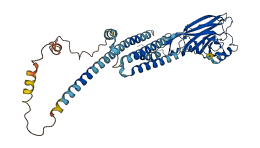
Descriptions
The autoinhibited protein was predicted that may have potential autoinhibitory elements via cis-regPred.
Autoinhibitory domains (AIDs)
Target domain |
|
Relief mechanism |
|
Assay |
cis-regPred |
Accessory elements
No accessory elements
Autoinhibited structure

Activated structure
1 structures for P43144
| Entry ID | Method | Resolution | Chain | Position | Source |
|---|---|---|---|---|---|
| AF-P43144-F1 | Predicted | AlphaFoldDB |
No variants for P43144
| Variant ID(s) | Position | Change | Description | Diseaes Association | Provenance |
|---|---|---|---|---|---|
| No variants for P43144 | |||||
No associated diseases with P43144
3 regional properties for P43144
8 GO annotations of cellular component
| Name | Definition |
|---|---|
| acetylcholine-gated channel complex | A homo- or hetero-pentameric protein complex that forms a transmembrane channel through which ions may pass in response to acetylcholine binding. |
| anchoring junction | A cell junction that mechanically attaches a cell (and its cytoskeleton) to neighboring cells or to the extracellular matrix. |
| cholinergic synapse | A synapse that uses acetylcholine as a neurotransmitter. |
| integral component of plasma membrane | The component of the plasma membrane consisting of the gene products and protein complexes having at least some part of their peptide sequence embedded in the hydrophobic region of the membrane. |
| integral component of postsynaptic specialization membrane | The component of the postsynaptic specialization membrane consisting of the gene products and protein complexes having at least some part of their peptide sequence embedded in the hydrophobic region of the membrane. |
| neuron projection | A prolongation or process extending from a nerve cell, e.g. an axon or dendrite. |
| plasma membrane | The membrane surrounding a cell that separates the cell from its external environment. It consists of a phospholipid bilayer and associated proteins. |
| synapse | The junction between an axon of one neuron and a dendrite of another neuron, a muscle fiber or a glial cell. As the axon approaches the synapse it enlarges into a specialized structure, the presynaptic terminal bouton, which contains mitochondria and synaptic vesicles. At the tip of the terminal bouton is the presynaptic membrane; facing it, and separated from it by a minute cleft (the synaptic cleft) is a specialized area of membrane on the receiving cell, known as the postsynaptic membrane. In response to the arrival of nerve impulses, the presynaptic terminal bouton secretes molecules of neurotransmitters into the synaptic cleft. These diffuse across the cleft and transmit the signal to the postsynaptic membrane. |
6 GO annotations of molecular function
| Name | Definition |
|---|---|
| acetylcholine-gated cation-selective channel activity | Selectively enables the transmembrane transfer of a cation by a channel that opens upon binding acetylcholine. |
| calcium channel activity | Enables the facilitated diffusion of a calcium ion (by an energy-independent process) involving passage through a transmembrane aqueous pore or channel without evidence for a carrier-mediated mechanism. |
| excitatory extracellular ligand-gated ion channel activity | Enables the transmembrane transfer of an ion by a channel that opens when a specific extracellular ligand has been bound by the channel complex or one of its constituent parts, where channel opening contributes to an increase in membrane potential. |
| neurotransmitter receptor activity | Combining with a neurotransmitter and transmitting the signal to initiate a change in cell activity. |
| transmembrane signaling receptor activity | Combining with an extracellular or intracellular signal and transmitting the signal from one side of the membrane to the other to initiate a change in cell activity or state as part of signal transduction. |
| transmitter-gated ion channel activity involved in regulation of postsynaptic membrane potential | Any transmitter-gated ion channel activity that is involved in regulation of postsynaptic membrane potential. |
15 GO annotations of biological process
| Name | Definition |
|---|---|
| cation transmembrane transport | The process in which a cation is transported across a membrane. |
| cation transport | The directed movement of cations, atoms or small molecules with a net positive charge, into, out of or within a cell, or between cells, by means of some agent such as a transporter or pore. |
| chemical synaptic transmission | The vesicular release of classical neurotransmitter molecules from a presynapse, across a chemical synapse, the subsequent activation of neurotransmitter receptors at the postsynapse of a target cell (neuron, muscle, or secretory cell) and the effects of this activation on the postsynaptic membrane potential and ionic composition of the postsynaptic cytosol. This process encompasses both spontaneous and evoked release of neurotransmitter and all parts of synaptic vesicle exocytosis. Evoked transmission starts with the arrival of an action potential at the presynapse. |
| detection of mechanical stimulus involved in sensory perception of sound | The series of events involved in the perception of sound vibration in which the vibration is received and converted into a molecular signal. |
| excitatory postsynaptic potential | A process that leads to a temporary increase in postsynaptic potential due to the flow of positively charged ions into the postsynaptic cell. The flow of ions that causes an EPSP is an excitatory postsynaptic current (EPSC) and makes it easier for the neuron to fire an action potential. |
| inner ear morphogenesis | The process in which the anatomical structures of the inner ear are generated and organized. The inner ear is the structure in vertebrates that contains the organs of balance and hearing. It consists of soft hollow sensory structures (the membranous labyrinth) containing fluid (endolymph) surrounded by fluid (perilymph) and encased in a bony cavity (the bony labyrinth). It consists of two chambers, the sacculus and utriculus, from which arise the cochlea and semicircular canals respectively. |
| ion transmembrane transport | A process in which an ion is transported across a membrane. |
| membrane depolarization | The process in which membrane potential decreases with respect to its steady-state potential, usually from negative potential to a more positive potential. For example, the initial depolarization during the rising phase of an action potential is in the direction from the negative steady-state resting potential towards the positive membrane potential that will be the peak of the action potential. |
| negative regulation of ERK1 and ERK2 cascade | Any process that stops, prevents, or reduces the frequency, rate or extent of signal transduction mediated by the ERK1 and ERK2 cascade. |
| nervous system process | A organ system process carried out by any of the organs or tissues of neurological system. |
| positive regulation of cytosolic calcium ion concentration | Any process that increases the concentration of calcium ions in the cytosol. |
| regulation of membrane potential | Any process that modulates the establishment or extent of a membrane potential, the electric potential existing across any membrane arising from charges in the membrane itself and from the charges present in the media on either side of the membrane. |
| response to auditory stimulus | Any process that results in a change in state or activity of a cell or an organism (in terms of movement, secretion, enzyme production, gene expression, etc.) as a result of an auditory stimulus. |
| sensory perception of sound | The series of events required for an organism to receive an auditory stimulus, convert it to a molecular signal, and recognize and characterize the signal. Sonic stimuli are detected in the form of vibrations and are processed to form a sound. |
| signal transduction | The cellular process in which a signal is conveyed to trigger a change in the activity or state of a cell. Signal transduction begins with reception of a signal (e.g. a ligand binding to a receptor or receptor activation by a stimulus such as light), or for signal transduction in the absence of ligand, signal-withdrawal or the activity of a constitutively active receptor. Signal transduction ends with regulation of a downstream cellular process, e.g. regulation of transcription or regulation of a metabolic process. Signal transduction covers signaling from receptors located on the surface of the cell and signaling via molecules located within the cell. For signaling between cells, signal transduction is restricted to events at and within the receiving cell. |
35 homologous proteins in AiPD
| UniProt AC | Gene Name | Protein Name | Species | Evidence Code |
|---|---|---|---|---|
| Q07263 | CHRNA3 | Neuronal acetylcholine receptor subunit alpha-3 | Bos taurus (Bovine) | PR |
| P04758 | CHRNB1 | Acetylcholine receptor subunit beta | Bos taurus (Bovine) | PR |
| Q8SPU7 | CHRNA5 | Neuronal acetylcholine receptor subunit alpha-5 | Bos taurus (Bovine) | PR |
| P09481 | CHRNA3 | Neuronal acetylcholine receptor subunit alpha-3 | Gallus gallus (Chicken) | PR |
| P26152 | CHRNA5 | Neuronal acetylcholine receptor subunit alpha-5 | Gallus gallus (Chicken) | PR |
| Q9I8C7 | CHRNA10 | Neuronal acetylcholine receptor subunit alpha-10 | Gallus gallus (Chicken) | PR |
| P43679 | CHRNB3 | Neuronal acetylcholine receptor subunit beta-3 | Gallus gallus (Chicken) | PR |
| Q5IS76 | CHRNA6 | Neuronal acetylcholine receptor subunit alpha-6 | Pan troglodytes (Chimpanzee) | PR |
| Q5IS75 | CHRNB3 | Neuronal acetylcholine receptor subunit beta-3 | Pan troglodytes (Chimpanzee) | PR |
| P25162 | nAChRbeta2 | Acetylcholine receptor subunit beta-like 2 | Drosophila melanogaster (Fruit fly) | PR |
| Q15825 | CHRNA6 | Neuronal acetylcholine receptor subunit alpha-6 | Homo sapiens (Human) | PR |
| Q05901 | CHRNB3 | Neuronal acetylcholine receptor subunit beta-3 | Homo sapiens (Human) | PR |
| P30532 | CHRNA5 | Neuronal acetylcholine receptor subunit alpha-5 | Homo sapiens (Human) | PR |
| P11230 | CHRNB1 | Acetylcholine receptor subunit beta | Homo sapiens (Human) | PR |
| P32297 | CHRNA3 | Neuronal acetylcholine receptor subunit alpha-3 | Homo sapiens (Human) | PR |
| P23979 | Htr3a | 5-hydroxytryptamine receptor 3A | Mus musculus (Mouse) | PR |
| P04756 | Chrna1 | Acetylcholine receptor subunit alpha | Mus musculus (Mouse) | PR |
| Q9R0W9 | Chrna6 | Neuronal acetylcholine receptor subunit alpha-6 | Mus musculus (Mouse) | PR |
| P09690 | Chrnb1 | Acetylcholine receptor subunit beta | Mus musculus (Mouse) | PR |
| Q8BMN3 | Chrnb3 | Neuronal acetylcholine receptor subunit beta-3 | Mus musculus (Mouse) | PR |
| Q2MKA5 | Chrna5 | Neuronal acetylcholine receptor subunit alpha-5 | Mus musculus (Mouse) | PR |
| P12391 | Chrnb3 | Neuronal acetylcholine receptor subunit beta-3 | Rattus norvegicus (Rat) | PR |
| P25108 | Chrna1 | Acetylcholine receptor subunit alpha | Rattus norvegicus (Rat) | PR |
| P25109 | Chrnb1 | Acetylcholine receptor subunit beta | Rattus norvegicus (Rat) | PR |
| P35563 | Htr3a | 5-hydroxytryptamine receptor 3A | Rattus norvegicus (Rat) | PR |
| P62813 | Gabra1 | Gamma-aminobutyric acid receptor subunit alpha-1 | Rattus norvegicus (Rat) | PR |
| P43143 | Chrna6 | Neuronal acetylcholine receptor subunit alpha-6 | Rattus norvegicus (Rat) | PR |
| P20781 | Glrb | Glycine receptor subunit beta | Rattus norvegicus (Rat) | PR |
| P07727 | Glra1 | Glycine receptor subunit alpha-1 | Rattus norvegicus (Rat) | PR |
| P04757 | Chrna3 | Neuronal acetylcholine receptor subunit alpha-3 | Rattus norvegicus (Rat) | PR |
| P20420 | Chrna5 | Neuronal acetylcholine receptor subunit alpha-5 | Rattus norvegicus (Rat) | PR |
| P24524 | Glra3 | Glycine receptor subunit alpha-3 | Rattus norvegicus (Rat) | PR |
| Q93149 | acr-3 | Acetylcholine receptor subunit beta-type acr-3 | Caenorhabditis elegans | PR |
| P54244 | deg-3 | Acetylcholine receptor subunit alpha-type deg-3 | Caenorhabditis elegans | PR |
| P54246 | acr-5 | Acetylcholine receptor subunit alpha-type acr-5 | Caenorhabditis elegans | PR |
| 10 | 20 | 30 | 40 | 50 | 60 |
| MNRPHSCLSF | CWMYFAASGI | RAVETANGKY | AQKLFSDLFE | DYSSALRPVE | DTDAVLNVTL |
| 70 | 80 | 90 | 100 | 110 | 120 |
| QVTLSQIKDM | DERNQILTAY | LWIRQTWHDA | YLTWDRDQYD | RLDSIRIPSD | LVWRPDIVLY |
| 130 | 140 | 150 | 160 | 170 | 180 |
| NKADDESSEP | VNTNVVLRYD | GLITWDSPAI | TKSSCVVDVT | YFPFDSQQCN | LTFGSWTYNG |
| 190 | 200 | 210 | 220 | 230 | 240 |
| NQVDIFNALD | SGDLSDFIED | VEWEVHGMPA | VKNVISYGCC | SEPYPDVTFT | LLLKRRSSFY |
| 250 | 260 | 270 | 280 | 290 | 300 |
| IVNLLIPCVL | ISFLAPLSFY | LPAASGEKVS | LGVTILLAMT | VFQLMVAEIM | PASENVPLIG |
| 310 | 320 | 330 | 340 | 350 | 360 |
| KYYIATMALI | TASTALTIMV | MNIHFCGAEA | RPVPHWAKVV | ILKYMSRILF | VYDVGESCLS |
| 370 | 380 | 390 | 400 | 410 | 420 |
| PRHSQEPEQV | TKVYSKLPES | NLKTSRNKDL | SRKKEVRKLL | KNDLGYQGGI | PQNTDSYCAR |
| 430 | 440 | 450 | 460 | 470 | |
| YEALTKNIEY | IAKCLKDHKA | TNSKGSEWKK | VAKVIDRFFM | WIFFAMVFVM | TVLIIARAD |