P35563
Gene name |
Htr3a (5ht3, Htr3) |
Protein name |
5-hydroxytryptamine receptor 3A |
Names |
5-HT3-A, 5-HT3A, 5-hydroxytryptamine receptor 3, 5-HT-3, 5-HT3R, Serotonin receptor 3A, Serotonin-gated ion channel receptor |
Species |
Rattus norvegicus (Rat) |
KEGG Pathway |
rno:79246 |
EC number |
|
Protein Class |
|
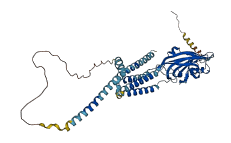
Descriptions
The autoinhibited protein was predicted that may have potential autoinhibitory elements via cis-regPred.
Autoinhibitory domains (AIDs)
Target domain |
|
Relief mechanism |
|
Assay |
cis-regPred |
Accessory elements
No accessory elements
Autoinhibited structure

Activated structure
1 structures for P35563
| Entry ID | Method | Resolution | Chain | Position | Source |
|---|---|---|---|---|---|
| AF-P35563-F1 | Predicted | AlphaFoldDB |
No variants for P35563
| Variant ID(s) | Position | Change | Description | Diseaes Association | Provenance |
|---|---|---|---|---|---|
| No variants for P35563 | |||||
No associated diseases with P35563
3 regional properties for P35563
13 GO annotations of cellular component
| Name | Definition |
|---|---|
| anchoring junction | A cell junction that mechanically attaches a cell (and its cytoskeleton) to neighboring cells or to the extracellular matrix. |
| axon | The long process of a neuron that conducts nerve impulses, usually away from the cell body to the terminals and varicosities, which are sites of storage and release of neurotransmitter. |
| cleavage furrow | The cleavage furrow is a plasma membrane invagination at the cell division site. The cleavage furrow begins as a shallow groove and eventually deepens to divide the cytoplasm. |
| cytoplasm | The contents of a cell excluding the plasma membrane and nucleus, but including other subcellular structures. |
| glutamatergic synapse | A synapse that uses glutamate as a neurotransmitter. |
| integral component of plasma membrane | The component of the plasma membrane consisting of the gene products and protein complexes having at least some part of their peptide sequence embedded in the hydrophobic region of the membrane. |
| integral component of postsynaptic membrane | The component of the postsynaptic membrane consisting of the gene products and protein complexes having at least some part of their peptide sequence embedded in the hydrophobic region of the membrane. |
| integral component of presynaptic membrane | The component of the presynaptic membrane consisting of the gene products and protein complexes having at least some part of their peptide sequence embedded in the hydrophobic region of the membrane. |
| neuron projection | A prolongation or process extending from a nerve cell, e.g. an axon or dendrite. |
| neuronal cell body | The portion of a neuron that includes the nucleus, but excludes cell projections such as axons and dendrites. |
| plasma membrane | The membrane surrounding a cell that separates the cell from its external environment. It consists of a phospholipid bilayer and associated proteins. |
| serotonin-activated cation-selective channel complex | A protein complex which is capable of serotonin-activated cation-selective channel activity. Mainly found in pre- and postsynaptic membranes of the brain and gastrointestinal tract. Depending on its location it transports Ca2+, Mg2+, Na+ or K+. It is always a pentamer, containing at least the 5HT3A subunit forming 5HT3A homopentamers or 5HT3A/B heteropentamers. In human, 5HT3A/C, A/D and A/E heteropentamers also exist. |
| synapse | The junction between an axon of one neuron and a dendrite of another neuron, a muscle fiber or a glial cell. As the axon approaches the synapse it enlarges into a specialized structure, the presynaptic terminal bouton, which contains mitochondria and synaptic vesicles. At the tip of the terminal bouton is the presynaptic membrane; facing it, and separated from it by a minute cleft (the synaptic cleft) is a specialized area of membrane on the receiving cell, known as the postsynaptic membrane. In response to the arrival of nerve impulses, the presynaptic terminal bouton secretes molecules of neurotransmitters into the synaptic cleft. These diffuse across the cleft and transmit the signal to the postsynaptic membrane. |
7 GO annotations of molecular function
| Name | Definition |
|---|---|
| excitatory extracellular ligand-gated ion channel activity | Enables the transmembrane transfer of an ion by a channel that opens when a specific extracellular ligand has been bound by the channel complex or one of its constituent parts, where channel opening contributes to an increase in membrane potential. |
| identical protein binding | Binding to an identical protein or proteins. |
| neurotransmitter receptor activity | Combining with a neurotransmitter and transmitting the signal to initiate a change in cell activity. |
| serotonin binding | Binding to serotonin (5-hydroxytryptamine), a monoamine neurotransmitter occurring in the peripheral and central nervous systems, also having hormonal properties. |
| serotonin-gated cation-selective channel activity | Enables the transmembrane transfer of a cation by a channel that opens when serotonin has been bound by the channel complex or one of its constituent parts. |
| transmembrane signaling receptor activity | Combining with an extracellular or intracellular signal and transmitting the signal from one side of the membrane to the other to initiate a change in cell activity or state as part of signal transduction. |
| transmitter-gated ion channel activity involved in regulation of postsynaptic membrane potential | Any transmitter-gated ion channel activity that is involved in regulation of postsynaptic membrane potential. |
11 GO annotations of biological process
| Name | Definition |
|---|---|
| cellular response to growth factor stimulus | Any process that results in a change in state or activity of a cell (in terms of movement, secretion, enzyme production, gene expression, etc.) as a result of a growth factor stimulus. |
| chemical synaptic transmission | The vesicular release of classical neurotransmitter molecules from a presynapse, across a chemical synapse, the subsequent activation of neurotransmitter receptors at the postsynapse of a target cell (neuron, muscle, or secretory cell) and the effects of this activation on the postsynaptic membrane potential and ionic composition of the postsynaptic cytosol. This process encompasses both spontaneous and evoked release of neurotransmitter and all parts of synaptic vesicle exocytosis. Evoked transmission starts with the arrival of an action potential at the presynapse. |
| inorganic cation transmembrane transport | A process in which an inorganic cation is transported from one side of a membrane to the other by means of some agent such as a transporter or pore. |
| ion transmembrane transport | A process in which an ion is transported across a membrane. |
| nervous system process | A organ system process carried out by any of the organs or tissues of neurological system. |
| positive regulation of ion transmembrane transporter activity | Any process that activates or increases the activity of an ion transporter. |
| regulation of membrane potential | Any process that modulates the establishment or extent of a membrane potential, the electric potential existing across any membrane arising from charges in the membrane itself and from the charges present in the media on either side of the membrane. |
| response to cocaine | Any process that results in a change in state or activity of a cell or an organism (in terms of movement, secretion, enzyme production, gene expression, etc.) as a result of a cocaine stimulus. Cocaine is a crystalline alkaloid obtained from the leaves of the coca plant. |
| response to ethanol | Any process that results in a change in state or activity of a cell or an organism (in terms of movement, secretion, enzyme production, gene expression, etc.) as a result of an ethanol stimulus. |
| serotonin receptor signaling pathway | The series of molecular signals generated as a consequence of a serotonin receptor binding to one of its physiological ligands. |
| signal transduction | The cellular process in which a signal is conveyed to trigger a change in the activity or state of a cell. Signal transduction begins with reception of a signal (e.g. a ligand binding to a receptor or receptor activation by a stimulus such as light), or for signal transduction in the absence of ligand, signal-withdrawal or the activity of a constitutively active receptor. Signal transduction ends with regulation of a downstream cellular process, e.g. regulation of transcription or regulation of a metabolic process. Signal transduction covers signaling from receptors located on the surface of the cell and signaling via molecules located within the cell. For signaling between cells, signal transduction is restricted to events at and within the receiving cell. |
35 homologous proteins in AiPD
| UniProt AC | Gene Name | Protein Name | Species | Evidence Code |
|---|---|---|---|---|
| Q07263 | CHRNA3 | Neuronal acetylcholine receptor subunit alpha-3 | Bos taurus (Bovine) | PR |
| P04758 | CHRNB1 | Acetylcholine receptor subunit beta | Bos taurus (Bovine) | PR |
| Q8SPU7 | CHRNA5 | Neuronal acetylcholine receptor subunit alpha-5 | Bos taurus (Bovine) | PR |
| P09481 | CHRNA3 | Neuronal acetylcholine receptor subunit alpha-3 | Gallus gallus (Chicken) | PR |
| P26152 | CHRNA5 | Neuronal acetylcholine receptor subunit alpha-5 | Gallus gallus (Chicken) | PR |
| Q9I8C7 | CHRNA10 | Neuronal acetylcholine receptor subunit alpha-10 | Gallus gallus (Chicken) | PR |
| P43679 | CHRNB3 | Neuronal acetylcholine receptor subunit beta-3 | Gallus gallus (Chicken) | PR |
| Q5IS76 | CHRNA6 | Neuronal acetylcholine receptor subunit alpha-6 | Pan troglodytes (Chimpanzee) | PR |
| Q5IS75 | CHRNB3 | Neuronal acetylcholine receptor subunit beta-3 | Pan troglodytes (Chimpanzee) | PR |
| P25162 | nAChRbeta2 | Acetylcholine receptor subunit beta-like 2 | Drosophila melanogaster (Fruit fly) | PR |
| Q15825 | CHRNA6 | Neuronal acetylcholine receptor subunit alpha-6 | Homo sapiens (Human) | PR |
| Q05901 | CHRNB3 | Neuronal acetylcholine receptor subunit beta-3 | Homo sapiens (Human) | PR |
| P30532 | CHRNA5 | Neuronal acetylcholine receptor subunit alpha-5 | Homo sapiens (Human) | PR |
| P11230 | CHRNB1 | Acetylcholine receptor subunit beta | Homo sapiens (Human) | PR |
| P32297 | CHRNA3 | Neuronal acetylcholine receptor subunit alpha-3 | Homo sapiens (Human) | PR |
| P04756 | Chrna1 | Acetylcholine receptor subunit alpha | Mus musculus (Mouse) | PR |
| Q9R0W9 | Chrna6 | Neuronal acetylcholine receptor subunit alpha-6 | Mus musculus (Mouse) | PR |
| P09690 | Chrnb1 | Acetylcholine receptor subunit beta | Mus musculus (Mouse) | PR |
| Q8BMN3 | Chrnb3 | Neuronal acetylcholine receptor subunit beta-3 | Mus musculus (Mouse) | PR |
| Q2MKA5 | Chrna5 | Neuronal acetylcholine receptor subunit alpha-5 | Mus musculus (Mouse) | PR |
| P23979 | Htr3a | 5-hydroxytryptamine receptor 3A | Mus musculus (Mouse) | PR |
| P12391 | Chrnb3 | Neuronal acetylcholine receptor subunit beta-3 | Rattus norvegicus (Rat) | PR |
| P25108 | Chrna1 | Acetylcholine receptor subunit alpha | Rattus norvegicus (Rat) | PR |
| P25109 | Chrnb1 | Acetylcholine receptor subunit beta | Rattus norvegicus (Rat) | PR |
| P43144 | Chrna9 | Neuronal acetylcholine receptor subunit alpha-9 | Rattus norvegicus (Rat) | PR |
| P62813 | Gabra1 | Gamma-aminobutyric acid receptor subunit alpha-1 | Rattus norvegicus (Rat) | PR |
| P43143 | Chrna6 | Neuronal acetylcholine receptor subunit alpha-6 | Rattus norvegicus (Rat) | PR |
| P20781 | Glrb | Glycine receptor subunit beta | Rattus norvegicus (Rat) | PR |
| P07727 | Glra1 | Glycine receptor subunit alpha-1 | Rattus norvegicus (Rat) | PR |
| P04757 | Chrna3 | Neuronal acetylcholine receptor subunit alpha-3 | Rattus norvegicus (Rat) | PR |
| P20420 | Chrna5 | Neuronal acetylcholine receptor subunit alpha-5 | Rattus norvegicus (Rat) | PR |
| P24524 | Glra3 | Glycine receptor subunit alpha-3 | Rattus norvegicus (Rat) | PR |
| Q93149 | acr-3 | Acetylcholine receptor subunit beta-type acr-3 | Caenorhabditis elegans | PR |
| P54244 | deg-3 | Acetylcholine receptor subunit alpha-type deg-3 | Caenorhabditis elegans | PR |
| P54246 | acr-5 | Acetylcholine receptor subunit alpha-type acr-5 | Caenorhabditis elegans | PR |
| 10 | 20 | 30 | 40 | 50 | 60 |
| MPLCIPQVLL | ALFLSVLIAQ | GEGSRRRATQ | AHSTTQPALL | RLSDHLLANY | KKGVRPVRDW |
| 70 | 80 | 90 | 100 | 110 | 120 |
| RKPTLVSIDV | IMYAILNVDE | KNQVLTTYIW | YRQFWTDEFL | QWTPEDFDNV | TKLSIPTDSI |
| 130 | 140 | 150 | 160 | 170 | 180 |
| WVPDILINEF | VDVGKSPSIP | YVYVHHQGEV | QNYKPLQLVT | ACSLDIYNFP | FDVQNCSLTF |
| 190 | 200 | 210 | 220 | 230 | 240 |
| TSWLHTIQDI | NISLWRTPEE | VRSDKSIFIN | QGEWELLGVF | TKFQEFSIET | SNSYAEMKFY |
| 250 | 260 | 270 | 280 | 290 | 300 |
| VVIRRRPLFY | AVSLLLPSIF | LMVVDIVGFC | LPPDSGERVS | FKITLLLGYS | VFLIIVSDTL |
| 310 | 320 | 330 | 340 | 350 | 360 |
| PATAIGTPLI | GVYFVVCMAL | LVISLAETIF | IVQLVHKQDL | QRPVPDWLRH | LVLDRIAWLL |
| 370 | 380 | 390 | 400 | 410 | 420 |
| CLGEQPMAHR | PPATFQANKT | DDCSAMGNHC | SHVGSPQDLE | KTSRSRDSPL | PPPREASLAV |
| 430 | 440 | 450 | 460 | 470 | 480 |
| RGLLQELSSI | RHSLEKRDEM | REVARDWLRV | GYVLDRLLFR | IYLLAVLAYS | ITLVTLWSIW |
| HYS |