P35030
Gene name |
PRSS3 (PRSS4, TRY3, TRY4) |
Protein name |
Trypsin-3 |
Names |
Brain trypsinogen, Mesotrypsin, Mesotrypsinogen, Serine protease 3, Serine protease 4, Trypsin III, Trypsin IV |
Species |
Homo sapiens (Human) |
KEGG Pathway |
hsa:5646 |
EC number |
3.4.21.4: Serine endopeptidases |
Protein Class |
|
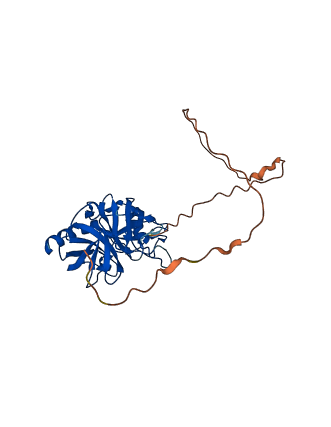
Descriptions
The autoinhibited protein was predicted that may have potential autoinhibitory elements via cis-regPred.
Autoinhibitory domains (AIDs)
Target domain |
|
Relief mechanism |
|
Assay |
cis-regPred |
Accessory elements
No accessory elements
Autoinhibited structure

Activated structure
15 structures for P35030
| Entry ID | Method | Resolution | Chain | Position | Source |
|---|---|---|---|---|---|
| 1H4W | X-ray | 170 A | A | 81-304 | PDB |
| 2R9P | X-ray | 140 A | A/B/C/D | 81-304 | PDB |
| 3L33 | X-ray | 248 A | A/B/C/D | 81-304 | PDB |
| 3L3T | X-ray | 238 A | A/B/C/D | 81-304 | PDB |
| 3P92 | X-ray | 160 A | A | 81-304 | PDB |
| 3P95 | X-ray | 130 A | A | 81-304 | PDB |
| 4DG4 | X-ray | 140 A | A/B/D/G | 81-304 | PDB |
| 4U30 | X-ray | 250 A | A/B/C/D | 81-304 | PDB |
| 4U32 | X-ray | 165 A | A | 81-304 | PDB |
| 5C67 | X-ray | 183 A | A/B | 81-304 | PDB |
| 5JBT | X-ray | 140 A | A | 81-304 | PDB |
| 5TP0 | X-ray | 125 A | A | 81-304 | PDB |
| 6BX8 | X-ray | 198 A | A/C/E/G | 81-304 | PDB |
| 6GFI | X-ray | 230 A | A/B | 81-304 | PDB |
| AF-P35030-F1 | Predicted | AlphaFoldDB |
4 variants for P35030
| Variant ID(s) | Position | Change | Description | Diseaes Association | Provenance |
|---|---|---|---|---|---|
|
rs11547028 VAR_067459 |
174 | A>V | No |
UniProt dbSNP |
|
|
VAR_046794 rs855581 |
188 | T>A | No |
UniProt dbSNP |
|
|
VAR_059788 rs1063273 |
224 | T>S | No |
UniProt dbSNP |
|
|
rs1048379 VAR_046795 |
232 | Y>C | No |
UniProt dbSNP |
No associated diseases with P35030
Functions
| Description | ||
|---|---|---|
| EC Number | 3.4.21.4 | Serine endopeptidases |
| Subcellular Localization |
|
|
| PANTHER Family | ||
| PANTHER Subfamily | ||
| PANTHER Protein Class | ||
| PANTHER Pathway Category | No pathway information available | |
3 GO annotations of cellular component
| Name | Definition |
|---|---|
| extracellular region | The space external to the outermost structure of a cell. For cells without external protective or external encapsulating structures this refers to space outside of the plasma membrane. This term covers the host cell environment outside an intracellular parasite. |
| extracellular space | That part of a multicellular organism outside the cells proper, usually taken to be outside the plasma membranes, and occupied by fluid. |
| tertiary granule lumen | Any membrane-enclosed lumen that is part of a tertiary granule. |
3 GO annotations of molecular function
| Name | Definition |
|---|---|
| calcium ion binding | Binding to a calcium ion (Ca2+). |
| serine-type endopeptidase activity | Catalysis of the hydrolysis of internal, alpha-peptide bonds in a polypeptide chain by a catalytic mechanism that involves a catalytic triad consisting of a serine nucleophile that is activated by a proton relay involving an acidic residue (e.g. aspartate or glutamate) and a basic residue (usually histidine). |
| serine-type peptidase activity | Catalysis of the hydrolysis of peptide bonds in a polypeptide chain by a catalytic mechanism that involves a catalytic triad consisting of a serine nucleophile that is activated by a proton relay involving an acidic residue (e.g. aspartate or glutamate) and a basic residue (usually histidine). |
5 GO annotations of biological process
| Name | Definition |
|---|---|
| antimicrobial humoral response | An immune response against microbes mediated through a body fluid. Examples of this process are seen in the antimicrobial humoral response of Drosophila melanogaster and Mus musculus. |
| digestion | The whole of the physical, chemical, and biochemical processes carried out by multicellular organisms to break down ingested nutrients into components that may be easily absorbed and directed into metabolism. |
| endothelial cell migration | The orderly movement of an endothelial cell into the extracellular matrix to form an endothelium. |
| proteolysis | The hydrolysis of proteins into smaller polypeptides and/or amino acids by cleavage of their peptide bonds. |
| zymogen activation | The proteolytic processing of an inactive enzyme to an active form. |
11 homologous proteins in AiPD
| UniProt AC | Gene Name | Protein Name | Species | Evidence Code |
|---|---|---|---|---|
| P05049 | snk | Serine protease snake | Drosophila melanogaster (Fruit fly) | PR |
| Q6UWB4 | PRSS55 | Serine protease 55 | Homo sapiens (Human) | PR |
| Q9UI38 | PRSS50 | Probable threonine protease PRSS50 | Homo sapiens (Human) | PR |
| E5RG02 | PRSS46P | Putative serine protease 46 | Homo sapiens (Human) | PR |
| P0CW18 | PRSS56 | Serine protease 56 | Homo sapiens (Human) | PR |
| P15119 | Mcpt2 | Mast cell protease 2 | Mus musculus (Mouse) | PR |
| Q9DBI0 | Tmprss6 | Transmembrane protease serine 6 | Mus musculus (Mouse) | PR |
| P98064 | Masp1 | Mannan-binding lectin serine protease 1 | Mus musculus (Mouse) | PR |
| Q402U7 | Prss44 | Serine protease 44 | Mus musculus (Mouse) | PR |
| Q8CHN8 | Masp1 | Mannan-binding lectin serine protease 1 | Rattus norvegicus (Rat) | PR |
| Q6IE63 | Prss46 | Serine protease 46 | Rattus norvegicus (Rat) | PR |
| 10 | 20 | 30 | 40 | 50 | 60 |
| MCGPDDRCPA | RWPGPGRAVK | CGKGLAAARP | GRVERGGAQR | GGAGLELHPL | LGGRTWRAAR |
| 70 | 80 | 90 | 100 | 110 | 120 |
| DADGCEALGT | VAVPFDDDDK | IVGGYTCEEN | SLPYQVSLNS | GSHFCGGSLI | SEQWVVSAAH |
| 130 | 140 | 150 | 160 | 170 | 180 |
| CYKTRIQVRL | GEHNIKVLEG | NEQFINAAKI | IRHPKYNRDT | LDNDIMLIKL | SSPAVINARV |
| 190 | 200 | 210 | 220 | 230 | 240 |
| STISLPTTPP | AAGTECLISG | WGNTLSFGAD | YPDELKCLDA | PVLTQAECKA | SYPGKITNSM |
| 250 | 260 | 270 | 280 | 290 | 300 |
| FCVGFLEGGK | DSCQRDSGGP | VVCNGQLQGV | VSWGHGCAWK | NRPGVYTKVY | NYVDWIKDTI |
| AANS |