O88477
Gene name |
Igf2bp1 (Vickz1) |
Protein name |
Insulin-like growth factor 2 mRNA-binding protein 1 |
Names |
B-cell maturation protein, IGF2 mRNA-binding protein 1, IMP-1, Coding region determinant-binding protein, CRD-BP, IGF-II mRNA-binding protein 1, VICKZ family member 1, Zipcode-binding protein 1, ZBP-1 |
Species |
Mus musculus (Mouse) |
KEGG Pathway |
mmu:140486 |
EC number |
|
Protein Class |
|
Descriptions
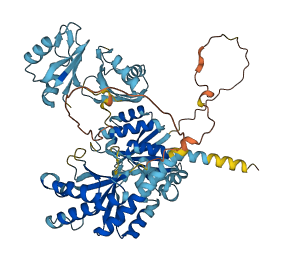
The autoinhibited protein was predicted that may have potential autoinhibitory elements via cis-regPred.
Autoinhibitory domains (AIDs)
Target domain |
|
Relief mechanism |
|
Assay |
cis-regPred |
Accessory elements
No accessory elements
Autoinhibited structure

Activated structure
2 structures for O88477
| Entry ID | Method | Resolution | Chain | Position | Source |
|---|---|---|---|---|---|
| 7WW3 | X-ray | 190 A | A | 400-577 | PDB |
| AF-O88477-F1 | Predicted | AlphaFoldDB |
33 variants for O88477
| Variant ID(s) | Position | Change | Description | Diseaes Association | Provenance |
|---|---|---|---|---|---|
| rs3389171367 | 15 | P>L | No | EVA | |
| rs3401992345 | 78 | Q>K | No | EVA | |
| rs3389171417 | 82 | K>E | No | EVA | |
| rs3389209826 | 84 | Q>H | No | EVA | |
| rs3389193812 | 106 | T>R | No | EVA | |
| rs3389158433 | 168 | R>H | No | EVA | |
| rs3389203819 | 188 | P>L | No | EVA | |
| rs3389182473 | 201 | L>Q | No | EVA | |
| rs3402954719 | 202 | V>M | No | EVA | |
| rs3402819201 | 206 | Y>D | No | EVA | |
| rs3411897568 | 213 | K>E | No | EVA | |
| rs3402533790 | 236 | N>K | No | EVA | |
| rs3389203797 | 243 | A>V | No | EVA | |
| rs3389130943 | 258 | K>R | No | EVA | |
| rs3389194901 | 292 | I>M | No | EVA | |
| rs3389205179 | 297 | R>W | No | EVA | |
| rs3389209848 | 304 | Q>H | No | EVA | |
| rs3389205138 | 334 | E>V | No | EVA | |
| rs3389209868 | 335 | N>K | No | EVA | |
| rs3389130997 | 335 | N>S | No | EVA | |
| rs3389171441 | 337 | C>* | No | EVA | |
| rs3389191976 | 337 | C>G | No | EVA | |
| rs3389193741 | 338 | R>G | No | EVA | |
| rs3389205130 | 340 | E>G | No | EVA | |
| rs3389164945 | 356 | A>T | No | EVA | |
| rs3389191977 | 375 | L>P | No | EVA | |
| rs3389193748 | 416 | A>D | No | EVA | |
| rs3401419762 | 443 | P>S | No | EVA | |
| rs3389182456 | 453 | M>I | No | EVA | |
| rs3412481360 | 470 | I>V | No | EVA | |
| rs3402717289 | 497 | S>A | No | EVA | |
| rs3402404240 | 498 | A>E | No | EVA | |
| rs3389198483 | 517 | T>S | No | EVA |
No associated diseases with O88477
Functions
17 GO annotations of cellular component
| Name | Definition |
|---|---|
| anchoring junction | A cell junction that mechanically attaches a cell (and its cytoskeleton) to neighboring cells or to the extracellular matrix. |
| axon | The long process of a neuron that conducts nerve impulses, usually away from the cell body to the terminals and varicosities, which are sites of storage and release of neurotransmitter. |
| CRD-mediated mRNA stability complex | A protein complex that binds to, and promotes stabilization of, mRNA molecules containing the coding region instability determinant (CRD). In human, it may consist of IGF2BP1, HNRNPU, SYNCRIP/HNRNPQ, YBX1, and DHX9. |
| cytoplasm | The contents of a cell excluding the plasma membrane and nucleus, but including other subcellular structures. |
| cytoplasmic stress granule | A dense aggregation in the cytosol composed of proteins and RNAs that appear when the cell is under stress. |
| cytosol | The part of the cytoplasm that does not contain organelles but which does contain other particulate matter, such as protein complexes. |
| dendrite | A neuron projection that has a short, tapering, morphology. Dendrites receive and integrate signals from other neurons or from sensory stimuli, and conduct nerve impulses towards the axon or the cell body. In most neurons, the impulse is conveyed from dendrites to axon via the cell body, but in some types of unipolar neuron, the impulse does not travel via the cell body. |
| dendritic spine | A small, membranous protrusion from a dendrite that forms a postsynaptic compartment, typically receiving input from a single presynapse. They function as partially isolated biochemical and an electrical compartments. Spine morphology is variable:they can be thin, stubby, mushroom, or branched, with a continuum of intermediate morphologies. They typically terminate in a bulb shape, linked to the dendritic shaft by a restriction. Spine remodeling is though to be involved in synaptic plasticity. |
| filopodium | Thin, stiff, actin-based protrusion extended by the leading edge of a motile cell such as a crawling fibroblast or amoeba, or an axonal or dendritic growth cone, or a dendritic shaft. |
| growth cone | The migrating motile tip of a growing neuron projection, where actin accumulates, and the actin cytoskeleton is the most dynamic. |
| lamellipodium | A thin sheetlike process extended by the leading edge of a migrating cell or extending cell process; contains a dense meshwork of actin filaments. |
| neuronal cell body | The portion of a neuron that includes the nucleus, but excludes cell projections such as axons and dendrites. |
| nucleoplasm | That part of the nuclear content other than the chromosomes or the nucleolus. |
| nucleus | A membrane-bounded organelle of eukaryotic cells in which chromosomes are housed and replicated. In most cells, the nucleus contains all of the cell's chromosomes except the organellar chromosomes, and is the site of RNA synthesis and processing. In some species, or in specialized cell types, RNA metabolism or DNA replication may be absent. |
| P-body | A focus in the cytoplasm where mRNAs may become inactivated by decapping or some other mechanism. Protein and RNA localized to these foci are involved in mRNA degradation, nonsense-mediated mRNA decay (NMD), translational repression, and RNA-mediated gene silencing. |
| perinuclear region of cytoplasm | Cytoplasm situated near, or occurring around, the nucleus. |
| ribonucleoprotein complex | A macromolecular complex that contains both RNA and protein molecules. |
5 GO annotations of molecular function
| Name | Definition |
|---|---|
| mRNA 3'-UTR binding | Binding to a 3' untranslated region of an mRNA molecule. |
| mRNA 5'-UTR binding | Binding to an mRNA molecule at its 5' untranslated region. |
| mRNA binding | Binding to messenger RNA (mRNA), an intermediate molecule between DNA and protein. mRNA includes UTR and coding sequences, but does not contain introns. |
| N6-methyladenosine-containing RNA binding | Binding to an RNA molecule modified by N6-methyladenosine (m6A), a modification present at internal sites of mRNAs and some non-coding RNAs. |
| translation regulator activity | Any molecular function involved in the initiation, activation, perpetuation, repression or termination of polypeptide synthesis at the ribosome. |
13 GO annotations of biological process
| Name | Definition |
|---|---|
| CRD-mediated mRNA stabilization | An mRNA stabilization process in which one or more RNA-binding proteins associate with a sequence in the open reading frame called the coding region instability determinant (CRD). |
| dendrite arborization | The process in which the anatomical structures of a dendritic tree are generated and organized into dendritic branches. |
| mRNA transport | The directed movement of mRNA, messenger ribonucleic acid, into, out of or within a cell, or between cells, by means of some agent such as a transporter or pore. |
| negative regulation of nuclear-transcribed mRNA catabolic process, deadenylation-dependent decay | Any process that stops, prevents or reduces the frequency, rate or extent of nuclear-transcribed mRNA catabolic process, deadenylation-dependent decay. |
| negative regulation of translation | Any process that stops, prevents, or reduces the frequency, rate or extent of the chemical reactions and pathways resulting in the formation of proteins by the translation of mRNA or circRNA. |
| nervous system development | The process whose specific outcome is the progression of nervous tissue over time, from its formation to its mature state. |
| neuronal stem cell population maintenance | Any process in by an organism or tissue maintains a population of neuronal stem cells. |
| pallium cell proliferation in forebrain | The multiplication or reproduction of pallium cells in the forebrain, resulting in the expansion of the cell population. |
| positive regulation of cytoplasmic translation | Any process that activates or increases the frequency, rate or extent of cytoplasmic translation. |
| regulation of gene expression | Any process that modulates the frequency, rate or extent of gene expression. Gene expression is the process in which a gene's coding sequence is converted into a mature gene product (protein or RNA). |
| regulation of mRNA stability involved in response to stress | Any process that modulates the propensity of mRNA molecules to degradation that is part of a change in state or activity of a cell as a result of an exogenous disturbance. |
| regulation of RNA metabolic process | Any process that modulates the frequency, rate or extent of the chemical reactions and pathways involving RNA. |
| RNA localization | A process in which RNA is transported to, or maintained in, a specific location. |
10 homologous proteins in AiPD
| UniProt AC | Gene Name | Protein Name | Species | Evidence Code |
|---|---|---|---|---|
| Q5ZLP8 | IGF2BP3 | Insulin-like growth factor 2 mRNA-binding protein 3 | Gallus gallus (Chicken) | PR |
| O42254 | IGF2BP1 | Insulin-like growth factor 2 mRNA-binding protein 1 | Gallus gallus (Chicken) | PR |
| O00425 | IGF2BP3 | Insulin-like growth factor 2 mRNA-binding protein 3 | Homo sapiens (Human) | PR |
| Q9Y6M1 | IGF2BP2 | Insulin-like growth factor 2 mRNA-binding protein 2 | Homo sapiens (Human) | PR |
| Q9NZI8 | IGF2BP1 | Insulin-like growth factor 2 mRNA-binding protein 1 | Homo sapiens (Human) | PR |
| Q9CPN8 | Igf2bp3 | Insulin-like growth factor 2 mRNA-binding protein 3 | Mus musculus (Mouse) | PR |
| Q5SF07 | Igf2bp2 | Insulin-like growth factor 2 mRNA-binding protein 2 | Mus musculus (Mouse) | PR |
| P60335 | Pcbp1 | Poly(rC)-binding protein 1 | Mus musculus (Mouse) | PR |
| Q8CGX0 | Igf2bp1 | Insulin-like growth factor 2 mRNA-binding protein 1 | Rattus norvegicus (Rat) | PR |
| Q08CK7 | igf2bp1 | Insulin-like growth factor 2 mRNA-binding protein 1 | Danio rerio (Zebrafish) (Brachydanio rerio) | PR |
| 10 | 20 | 30 | 40 | 50 | 60 |
| MNKLYIGNLN | ESVTPADLEK | VFAEHKISYS | GQFLVKSGYA | FVDCPDEHWA | MKAIETFSGK |
| 70 | 80 | 90 | 100 | 110 | 120 |
| VELQGKRLEI | EHSVPKKQRS | RKIQIRNIPP | QLRWEVLDSL | LAQYGTVENC | EQVNTESETA |
| 130 | 140 | 150 | 160 | 170 | 180 |
| VVNVTYSNRE | QTRQAIMKLN | GHQLENHALK | VSYIPDEQIT | QGPENGRRGG | FGSRGQPRQG |
| 190 | 200 | 210 | 220 | 230 | 240 |
| SPVAAGAPAK | QQPVDIPLRL | LVPTQYVGAI | IGKEGATIRN | ITKQTQSKID | VHRKENAGAA |
| 250 | 260 | 270 | 280 | 290 | 300 |
| EKAISVHSTP | EGCSSACKMI | LEIMHKEAKD | TKTADEVPLK | ILAHNNFVGR | LIGKEGRNLK |
| 310 | 320 | 330 | 340 | 350 | 360 |
| KVEQDTETKI | TISSLQDLTL | YNPERTITVK | GAIENCCRAE | QEIMKKVREA | YENDVAAMSL |
| 370 | 380 | 390 | 400 | 410 | 420 |
| QSHLIPGLNL | AAVGLFPASS | SAVPPPPSSV | TGAAPYSSFM | QAPEQEMVQV | FIPAQAVGAI |
| 430 | 440 | 450 | 460 | 470 | 480 |
| IGKKGQHIKQ | LSRFASASIK | IAPPETPDSK | VRMVVITGPP | EAQFKAQGRI | YGKLKEENFF |
| 490 | 500 | 510 | 520 | 530 | 540 |
| GPKEEVKLET | HIRVPASAAG | RVIGKGGKTV | NELQNLTAAE | VVVPRDQTPD | ENDQVIVKII |
| 550 | 560 | 570 | |||
| GHFYASQMAQ | RKIRDILAQV | KQQHQKGQSN | LAQARRK |