Q9WUM3
Gene name |
Coro1b |
Protein name |
Coronin-1B |
Names |
Coronin-2 |
Species |
Mus musculus (Mouse) |
KEGG Pathway |
mmu:23789 |
EC number |
|
Protein Class |
|
Descriptions
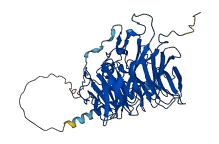
The autoinhibited protein was predicted that may have potential autoinhibitory elements via cis-regPred.
Autoinhibitory domains (AIDs)
Target domain |
|
Relief mechanism |
|
Assay |
cis-regPred |
Accessory elements
No accessory elements
Autoinhibited structure

Activated structure
1 structures for Q9WUM3
| Entry ID | Method | Resolution | Chain | Position | Source |
|---|---|---|---|---|---|
| AF-Q9WUM3-F1 | Predicted | AlphaFoldDB |
22 variants for Q9WUM3
| Variant ID(s) | Position | Change | Description | Diseaes Association | Provenance |
|---|---|---|---|---|---|
| rs3407811164 | 80 | G>V | No | EVA | |
| rs3389530490 | 85 | V>I | No | EVA | |
| rs3408717896 | 111 | Q>E | No | EVA | |
| rs3389510833 | 138 | I>N | No | EVA | |
| rs3389516689 | 140 | W>* | No | EVA | |
| rs3389509666 | 147 | V>M | No | EVA | |
| rs3389516666 | 177 | D>E | No | EVA | |
| rs3389472085 | 204 | D>N | No | EVA | |
| rs3408954412 | 228 | F>PAAVHSCG* | No | EVA | |
| rs3389481280 | 258 | P>S | No | EVA | |
| rs3409275139 | 316 | Q>H | No | EVA | |
| rs3408798619 | 316 | Q>L | No | EVA | |
| rs3406958398 | 317 | R>W | No | EVA | |
| rs3407888980 | 319 | M>L | No | EVA | |
| rs3389510826 | 343 | R>H | No | EVA | |
| rs3389530522 | 344 | K>E | No | EVA | |
| rs3389530552 | 381 | S>N | No | EVA | |
| rs3389514846 | 425 | A>S | No | EVA | |
| rs3413147429 | 458 | L>F | No | EVA | |
| rs3389510852 | 459 | R>W | No | EVA | |
| rs3389516708 | 462 | V>I | No | EVA | |
| rs3389472045 | 474 | E>D | No | EVA |
No associated diseases with Q9WUM3
No regional properties for Q9WUM3
| Type | Name | Position | InterPro Accession |
|---|---|---|---|
| No domain, repeats, and functional sites for Q9WUM3 | |||
Functions
9 GO annotations of cellular component
| Name | Definition |
|---|---|
| actin filament | A filamentous structure formed of a two-stranded helical polymer of the protein actin and associated proteins. Actin filaments are a major component of the contractile apparatus of skeletal muscle and the microfilaments of the cytoskeleton of eukaryotic cells. The filaments, comprising polymerized globular actin molecules, appear as flexible structures with a diameter of 5-9 nm. They are organized into a variety of linear bundles, two-dimensional networks, and three dimensional gels. In the cytoskeleton they are most highly concentrated in the cortex of the cell just beneath the plasma membrane. |
| cell leading edge | The area of a motile cell closest to the direction of movement. |
| cell periphery | The part of a cell encompassing the cell cortex, the plasma membrane, and any external encapsulating structures. |
| cytoplasm | The contents of a cell excluding the plasma membrane and nucleus, but including other subcellular structures. |
| cytosol | The part of the cytoplasm that does not contain organelles but which does contain other particulate matter, such as protein complexes. |
| lamellipodium | A thin sheetlike process extended by the leading edge of a migrating cell or extending cell process; contains a dense meshwork of actin filaments. |
| perinuclear region of cytoplasm | Cytoplasm situated near, or occurring around, the nucleus. |
| plasma membrane | The membrane surrounding a cell that separates the cell from its external environment. It consists of a phospholipid bilayer and associated proteins. |
| stress fiber | A contractile actin filament bundle that consists of short actin filaments with alternating polarity, cross-linked by alpha-actinin and possibly other actin bundling proteins, and with myosin present in a periodic distribution along the fiber. |
5 GO annotations of molecular function
| Name | Definition |
|---|---|
| actin filament binding | Binding to an actin filament, also known as F-actin, a helical filamentous polymer of globular G-actin subunits. |
| Arp2/3 complex binding | Binding to an Arp2/3 complex, a protein complex that contains two actin-related proteins, Arp2 and Arp3, and five novel proteins (ARPC1-5). |
| cytoskeletal protein binding | Binding to a protein component of a cytoskeleton (actin, microtubule, or intermediate filament cytoskeleton). |
| identical protein binding | Binding to an identical protein or proteins. |
| protein-containing complex binding | Binding to a macromolecular complex. |
15 GO annotations of biological process
| Name | Definition |
|---|---|
| actin cytoskeleton organization | A process that is carried out at the cellular level which results in the assembly, arrangement of constituent parts, or disassembly of cytoskeletal structures comprising actin filaments and their associated proteins. |
| actin filament branching | The formation of daughter actin filament branches at an angle on the sides of preexisting mother filaments. |
| actin filament bundle assembly | The assembly of actin filament bundles; actin filaments are on the same axis but may be oriented with the same or opposite polarities and may be packed with different levels of tightness. |
| actin filament organization | A process that is carried out at the cellular level which results in the assembly, arrangement of constituent parts, or disassembly of cytoskeletal structures comprising actin filaments. Includes processes that control the spatial distribution of actin filaments, such as organizing filaments into meshworks, bundles, or other structures, as by cross-linking. |
| cell migration | The controlled self-propelled movement of a cell from one site to a destination guided by molecular cues. Cell migration is a central process in the development and maintenance of multicellular organisms. |
| cellular response to platelet-derived growth factor stimulus | Any process that results in a change in state or activity of a cell (in terms of movement, secretion, enzyme production, gene expression, etc.) as a result of a platelet-derived growth factor stimulus. |
| endothelial cell chemotaxis | The directed movement of an endothelial cell guided by a specific chemical concentration gradient. Movement may be towards a higher concentration (positive chemotaxis) or towards a lower concentration (negative chemotaxis). |
| negative regulation of Arp2/3 complex-mediated actin nucleation | Any process that stops, prevents, or reduces the frequency, rate or extent of actin nucleation mediated by the Arp2/3 complex and interacting proteins. |
| negative regulation of lamellipodium morphogenesis | Any process that stops, prevents or reduces the frequency, rate or extent of lamellipodium morphogenesis. |
| negative regulation of smooth muscle cell chemotaxis | Any process that stops, prevents, or reduces the frequency, rate, or extent of smooth muscle cell chemotaxis. |
| positive regulation of lamellipodium morphogenesis | Any process that activates or increases the frequency, rate or extent of lamellipodium morphogenesis. |
| protein kinase C signaling | A series of reactions, mediated by the intracellular serine/threonine kinase protein kinase C, which occurs as a result of a single trigger reaction or compound. |
| protein localization to cell leading edge | A process in which a protein is transported to, or maintained in, a location within a cell leading edge. |
| ruffle organization | A process that is carried out at the cellular level which results in the assembly, arrangement of constituent parts, or disassembly of a ruffle, a projection at the leading edge of a crawling cell. |
| wound healing | The series of events that restore integrity to a damaged tissue, following an injury. |
7 homologous proteins in AiPD
| UniProt AC | Gene Name | Protein Name | Species | Evidence Code |
|---|---|---|---|---|
| Q06440 | CRN1 | Coronin-like protein | Saccharomyces cerevisiae (strain ATCC 204508 / S288c) (Baker's yeast) | PR |
| Q6QEF8 | CORO6 | Coronin-6 | Homo sapiens (Human) | PR |
| Q9ULV4 | CORO1C | Coronin-1C | Homo sapiens (Human) | PR |
| Q9UQ03 | CORO2B | Coronin-2B | Homo sapiens (Human) | PR |
| Q9WUM4 | Coro1c | Coronin-1C | Mus musculus (Mouse) | PR |
| Q9D2V7 | Coro7 | Coronin-7 | Mus musculus (Mouse) | PR |
| Q920M5 | Coro6 | Coronin-6 | Mus musculus (Mouse) | PR |
| 10 | 20 | 30 | 40 | 50 | 60 |
| MSFRKVVRQS | KFRHVFGQPV | KNDQCYEDIR | VSRVTWDSTF | CAVNPKFLAV | IVEASGGGAF |
| 70 | 80 | 90 | 100 | 110 | 120 |
| MVLPLNKTGR | IDKAYPTVCG | HTGPVLDIDW | CPHNDEVIAS | GSEDCTVMVW | QIPENGLTSP |
| 130 | 140 | 150 | 160 | 170 | 180 |
| LTEPVVVLEG | HTKRVGIITW | HPTARNVLLS | AGCDNVVLIW | NVGTAEELYR | LDSLHPDLIY |
| 190 | 200 | 210 | 220 | 230 | 240 |
| NVSWNHNGSL | FCSACKDKSV | RIIDPRRGTL | VAEREKAHEG | ARPMRAIFLA | DGKVFTTGFS |
| 250 | 260 | 270 | 280 | 290 | 300 |
| RMSERQLALW | DPENLEEPMA | LQELDSSNGA | LLPFYDPDTS | VVYVCGKGDS | SIRYFEITDE |
| 310 | 320 | 330 | 340 | 350 | 360 |
| PPYIHFLNTF | TSKEPQRGMG | SMPKRGLEVS | KCEIARFYKL | HERKCEPIVM | TVPRKSDLFQ |
| 370 | 380 | 390 | 400 | 410 | 420 |
| DDLYPDTAGP | EAALEAEDWV | SGQDANPILI | SLREAYVPSK | QRDLKVSRRN | VLSDSRPASY |
| 430 | 440 | 450 | 460 | 470 | 480 |
| SRSGASTATA | VTDVPSGNLA | GAGEAGKLEE | VMQELRALRM | LVKEQGERIS | RLEEQLGRME |
| NGDT |